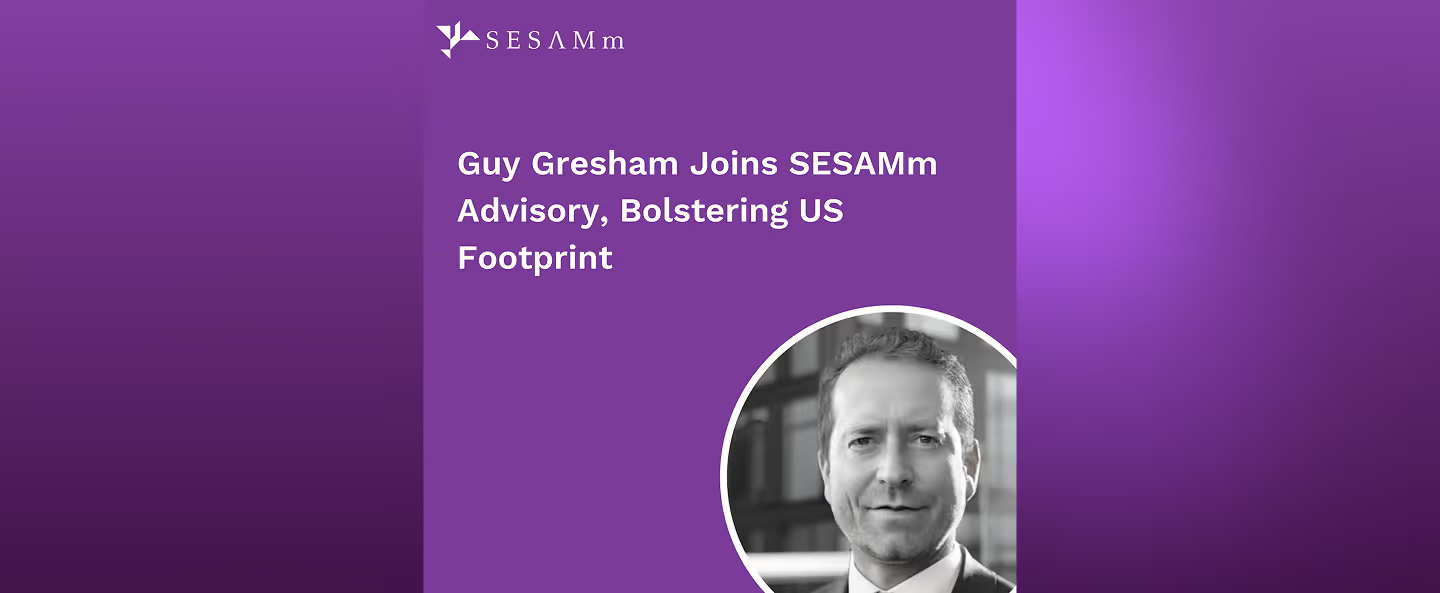
Guy Gresham Joins SESAMm Advisory, Bolstering US Footprint
December 11, 2025
•
5 mins read
SESAMm is pleased to welcome Guy Gresham to its Advisory Board. A globally recognized capital-markets strategist and former Group Head of Global Investor Relations Advisory at BNY, Guy brings more than two decades of experience in global financial services, specializing in equity capital markets, investor relations, and sustainability. Originally from New Zealand and now based in New York, he has deep expertise in regulatory compliance, ESG governance, and aligning global standards with business operations. His presence in North America will further strengthen SESAMm’s footprint in the U.S. market at a time of rapidly evolving expectations around sustainability and reputational risk.
"Guy’s experience advising companies across more than 50 countries, combined with his understanding of the North American market, brings a tremendous amount of insight and credibility,” said Sylvain Forté, CEO of SESAMm. “He has a remarkable ability to bridge sustainability, regulation, and capital-markets strategy, and we’re delighted to welcome him to our advisory board.”
During his time leading BNY’s Global Investor Relations Advisory group, Guy oversaw a global team supporting issuers across multiple markets and guided companies through major shifts in regulation, geopolitics, and capital markets expectations. As co-chair of BNY’s enterprise ESG Advisory Council and the Sustainable Client Solutions Working Group, he advised executive management on governance and regulatory requirements, embedding sustainability into core decision-making and risk management.
Today, Guy sits on the advisory committee of Sedex, a leading global supply-chain sustainability data platform, and serves as a non-executive director at Strategy&Ops, an international consultancy focused on sustainability and digital transformation. He holds an MBA from Cornell University, a BA (Hons) in International Relations from Victoria University of Wellington, and is a 2026 Digital Statecraft Fellow at Cambridge University.
“The growing convergence of sustainability, regulation, and technology is reshaping how companies engage with investors and manage risk,” said Guy Gresham. “SESAMm is at the forefront of this transition, using advanced AI to surface insights that were previously inaccessible. I’m delighted to support the team as they scale these capabilities globally.”
We’re thrilled to welcome Guy to SESAMm’s Advisory Board and look forward to working together as we continue advancing AI-powered ESG and reputational risk analysis worldwide, including expanding our partnerships and presence across North America.
SESAMm’s AI Technology Reveals ESG Insights
Discover unparalleled insights into ESG controversies, risks, and opportunities across industries. Learn more about how SESAMm can help you analyze millions of private and public companies using AI-powered text analysis tools.
November 11, 2022, FTX, a $32 billion cryptocurrency exchange company that many believed would “change the world,” filed for bankruptcy. This news shook the crypto and financial communities, compelling many to debate the future of the crypto market and its platforms.
How did FTX collapse?
You could say that FTX’s collapse began before the news broke, but here’s a summary of events as The New York Times and ABC News details:
Breaking news
In early November, CoinDesk, a crypto publication, broke the news on a leaked document from FTX. The balance sheet showed that the hedge fund run by Sam Bankman-Fried (SBF), Alameda Research, held a substantial amount of FTT tokens. In short, SBF had set up Alameda (his trading firm) and FTX (his exchange firm) in such a way that if one unit experienced trouble, such as dropping cryptocurrency prices, the other experienced it, too.
First domino falls
By the way, FTT is used for various functions, including traders’ payment of operation fees. Also, by the way, Changpeng Zhao, Binance’s Chief Executive, sold his stake in FTX to SBF in 2021, partially with FTT. So, “due to recent revelations,” Binance (Zhao) announced on November 6, 2022, that it would sell its FTT tokens.
Other dominos follow
Traders responded; they hurried to pull funds out of FTX out of fear, and FTT’s price fell. Meanwhile, FTX processed withdrawal requests over three days, amounting to an estimated $6 billion. The liquidity crunch was upon it.
Then, on November 8, Binance said it would bail out FTX. But on November 9, Binance backtracked and announced in a Tweet that it would not “as a result of corporate due diligence,” while also citing regulatory investigations and reports of mishandled funds.
Things get worse
The next day, November 10, the Securities Commission of the Bahamas froze FTX’s assets, citing the public statement about potentially “mishandled” and “mismanaged” customer funds. On November 11, FTX filed for Chapter 11 bankruptcy protections, and SBF resigned as CEO. John J. Ray III—famously known as the CEO who headed the infamously known energy company, Enron, through its collapse in the 2000s—replaced SBF on November 17.
Fallout
Today, FTX faces federal investigation for securities laws violations based on a report by The Wall Street Journal regarding FTX lending customer deposits to Alameda Research for liabilities, of which the company’s top executives were aware. Investors have suffered loss, traders have suffered loss, and the greater crypto community and regulators are asking questions.
FTX and SBF web data analysis
News about FTX’s collapse generated tons of web data for us to scour. With this data, here’s what we aimed to find out:
How did the public web react to FTX’s collapse?
Could we have seen red flags before the news broke?
What was FTX’s collapse’s effect on the cryptocurrency market’s sentiment?
Is it possible to evaluate cryptocurrency exchange companies’ ESG risks and opportunities?
Was FTX’s collapse unprecedented? If not, what does web data tell us about that?
FTX and Sam Bankman-Fried mentions analysis
Web public sentiment for FTX and SBF was consistently positive until Q1 of 2022. As mentions volume increased, their sentiment polarity decreased (Figure 1). The mentions spike for both in November when CoinDesk broke the news. Likewise, polarity dips into the negative range for both.
Definition: Polarity represents the aggregate of positive and negative sentiments (opinions or reviews) on a company. A 0 score means there is as much positive as negative sentiment expressed. The dotted and dashed lines represent sentiment in the following charts.
Figure 1: FTX and SBF mentions and sentiment over time.
Looking closer at Q1 (Figure 2), we find that mentions affecting sentiment increased for FTX and SBF during this period. What are the mentions about, and why did they affect polarity negatively?
Figure 2: FTX and SBF pre-bankruptcy mentions and sentiment.
It turns out that SBF is linked to other keywords—we call these co-mentions—and between January 2022 and November 2022, SBF/withdrawal co-mentions (Figure 3) spiked in July when SBF defended Terra Luna’s founder, who was accused of peddling a Ponzi scheme.
Figure 3: FTX and SBF withdrawal co-mentions.
If withdrawal co-mentions brought up possible reasons why SBF and FTX experienced dips in sentiment, what other co-mentions could give us more insight? How about donations, SEC, and U.S. elections?
Figure 4: Donations, SEC, and U.S. elections co-mentions with SBF.
Corporate governance stands out when evaluating SBF’s ESG risks, but his social risks are nothing to ignore either.
Figure 5: SBF governance risks over time.
Two areas of governance risks to note are money laundering and board of directors (Figure 5). Money laundering as a co-mention has been an issue as early as February 2022, but it became a bigger issue in October. These risks may be popping up due to allegations of manipulating the price of the APT token and a securities violations probe.
If you’ve read this far, you by now get an impression of FTX and SBF, from mention volume to sentiment analysis and ESG risk. But how did FTX’s collapse affect the overall cryptocurrency market? Let’s find out.
In comparing the sentiment polarities for FTX and the crypto market from January 2021 through November 2022 (Figure 6), the sentiment for crypto remains relatively steady despite FTX’s sentiment taking a hit.
Figure 6: Effect of FTX collapse on the crypto market.
When comparing other cryptocurrency exchanges to FTX (Figure 7), sentiment polarity for them is hardly affected, except Binance, because of its connection with FTX. Oddly enough, eToro experienced a boost in sentiment, possibly because of its core values around openness and transparency, the fact that they’ve been around since 2007, its early compliance with regulations (i.e., AMF, FCA, ASIC, BaFin, and ACPR), and that it also proposes investing in stocks and ETFs, a contrast to most other crypto market exchanges. Bitfinex has its own issues, so its dip in sentiment might not be correlated.
Figure 7: FTX sentiment comparison across competitors.
At this time, FTX’s ESG risks based on the mention volume are only surpassed by Bitfinex (Figure 8), which its risks are based on many other reasons we won’t get into in this article.
Figure 8: FTX and competitors ESG risks by mention volume.
Centralized vs. decentralized crypto exchange platforms
FTX’s collapse also affected sentiment around the centralized vs. decentralized debate. Since October 2022, sentiment for centralized exchange platforms, such as FTX and its competitors, has fallen (Figure 9).
Figure 9: Centralized vs. decentralized mentions and sentiment over time.
Likewise, the mention volume for self-custody has more than doubled in the last couple of months (Figure 10). Although centralized platforms offer quicker and easier access to crypto trading, traders are considering complex but more secure options such as crypto wallets and keys because, like banks, centralized exchanges can do what they will with cryptocurrency while it’s in their possession. With self-custody, owners are in control.
Believe it or not, FTX was not the first crypto exchange to collapse. In 2014, Mt. Gox—the biggest crypto exchange at the time—lost half a billion dollars worth of Bitcoin due to a hack. How did Mt. Gox’s collapse affect sentiment for the crypto market then? The short answer is: It didn’t.
Figure 11 shows that while Mt. Gox’s sentiment polarity fluctuated, even reaching negative territories, the sentiment for the crypto market remained relatively stable and positive.
Figure 11: Mt. Gox and crypto sentiment comparison.
Is FTX’s collapse a warning for investors?
Our analysis is that investors should treat cryptocurrency exchanges like any investment opportunity. Do your due diligence and monitor your portfolio with tools like SESAMm’s TextReveal®.
As for the cryptocurrency market, data shows that sentiment for it remains level and positive. We speculate that cryptocurrency and centralized exchanges are here to stay. However, based on historical data and current news, we suspect conversations about crypto regulations to increase.
Reach out to SESAMm
For a deeper analysis of FTX’s collapse and access to all charts and supportive-article links, reach out to a representative today.
Held from June 21–29, London Climate Action Week (LCAW) 2025 brought together over 45,000 participants across 700+ events, emphasizing London’s role as a global hub for climate finance and leadership. As geopolitical uncertainty clouds climate ambitions, this year’s event signaled a broader market pivot: investors are now prioritizing regions with regulatory clarity and policy momentum, namely Europe and Asia.
He also outlined plans for new corporate sustainability reporting standards, a move intended to improve transparency, build investor confidence, and ensure alignment with the UK's net-zero targets. These commitments were part of the UK’s post-Brexit green industrial strategy, distinguishing it from recent ESG policy slowdowns in Brussels and Washington.
Climate Finance and Market Confidence
One of the most prominent themes throughout the week was capital mobilization. At the “Finance Live” forum, asset managers, banks, and insurers debated how to align their portfolios with net-zero goals while navigating geopolitical instability and rising greenwashing scrutiny. Key discussions included scaling blended finance vehicles, investing in transition technologies, and strengthening ESG data governance.
Meanwhile, sessions like the Nature Hub spotlighted biodiversity and natural capital, moving beyond carbon to more holistic definitions of environmental value. This reflects a growing consensus that an effective climate strategy must include nature-based solutions and ecosystem restoration.
The Broader Message: A Shift in Global Climate Leadership
While the U.S. backtracks on core climate regulations, London and Europe are entering a leadership void. For global investors, that means that developing a climate strategy now includes not only where to invest but also where to trust. In that context, LCAW 2025 offered both policy and finance updates and a credibility reset.
The takeaway is clear: in an age of fragmented regulation and climate politicization, market trust flows towards stability. London Climate Action Week didn’t just reflect that shift; it helped define it.
U.S. banks have dramatically increased fossil fuel financing in a notable contradiction with the narrative established after COP26. According to the 2025 Banking on Climate Chaos report, compiled by the Rainforest Action Network and its partners, global banks significantly scaled up their support for the fossil fuel industry in 2024, with a staggering $162 billion increase, pushing total financing to $869 billion.
U.S. institutions are at the forefront of this backslide. JPMorgan Chase, Bank of America, Citigroup, and Wells Fargo accounted for one-third of global fossil fuel financing, approximately $289 billion. JPMorgan alone provided $53.5 billion, a 35% rise in funding that placed it at the top of the global list. Bank of America and Citi each contributed over $44 billion, while Barclays led among European banks, increasing its lending by 55% ($35.4 billion).
Why the Sudden Surge?
This resurgence coincides with the political shift in the U.S. following the Trump administration’s departure from the Paris Agreement and weakened climate policies. In parallel, several major banks have exited the Net-Zero Banking Alliance, prompting environmental groups to accuse them of “walking away from climate commitments.”
What This Means for Climate Risk
The spike in fossil fuel financing carries profound implications. First, it increases banks’ exposure to climate liability risk. A Financial Times analysis cites growing concerns that banks may face litigation due to their financing practices in relation to climate change. Second, funneling money back into carbon-intensive sectors undermines global efforts to limit warming to 1.5 °C; long-term goals rest on systemic transitions away from fossil fuels.
Public Relations vs. Funding Reality
Banks have defended their actions by emphasizing fossil fuels and clean energy investments. JPMorgan, for instance, claims it invested $1.29 in green energy for every dollar in fossil fuel financing. Nevertheless, critics argue that green financing claims ring hollow when fossil fuel funding is simultaneously ramping up.
Rebuilding Credibility in Sustainable Finance
The disconnect between words and actions is a challenge for the financial sector. With growing scrutiny on climate claims, stakeholders demand greater transparency and accountability. Greenwashing has evolved from a reputational issue to a regulatory one, impacting trust and market access. Banks that emphasize climate commitments while increasing fossil fuel investments risk losing credibility. To maintain stakeholder confidence, a genuine transition to clean energy financing is crucial. Trust now hinges on consistent actions rather than just marketing promises, allowing us to build a sustainable future together.
SESAMm’s AI Technology Reveals ESG Insights
Discover unparalleled insights into ESG controversies, risks, and opportunities across industries. Learn more about how SESAMm can help you analyze millions of private and public companies using AI-powered text analysis tools.
Stay ahead with the latest in ESG and AI intelligence
Join our mailing list to receive new reports, event invites, and updates from SESAMm directly to your inbox.