Some infrastructure sectors carry far more ESG risk than others. We analyzed over 250,000 projects worldwide to map exactly where that risk concentrates, what drives it, and how real-world controversies like the Turów and Cerrejón coal mines play out once they start.
Infrastructure sits at the center of the energy transition, and it's also one of the sectors most exposed to ESG controversy, from community displacement and water pollution to safety failures and corruption. As LPs, lenders, and regulators sharpen their scrutiny, knowing where that risk concentrates and how it evolves has become essential to due diligence and portfolio monitoring alike.
This whitepaper draws on SESAMm's analysis of over 250,000 infrastructure projects worldwide between 2021 and 2026, built on our natural language processing engine's coverage of millions of news, NGO, and regulatory sources.
It covers which project types carry the highest ESG risk, which pillar (Environmental, Social, or Governance) dominates the narrative, what drives spikes in governance controversy, and how two contrasting case studies, the Turów and Cerrejón coal mines, show just how differently a controversy can play out over time.
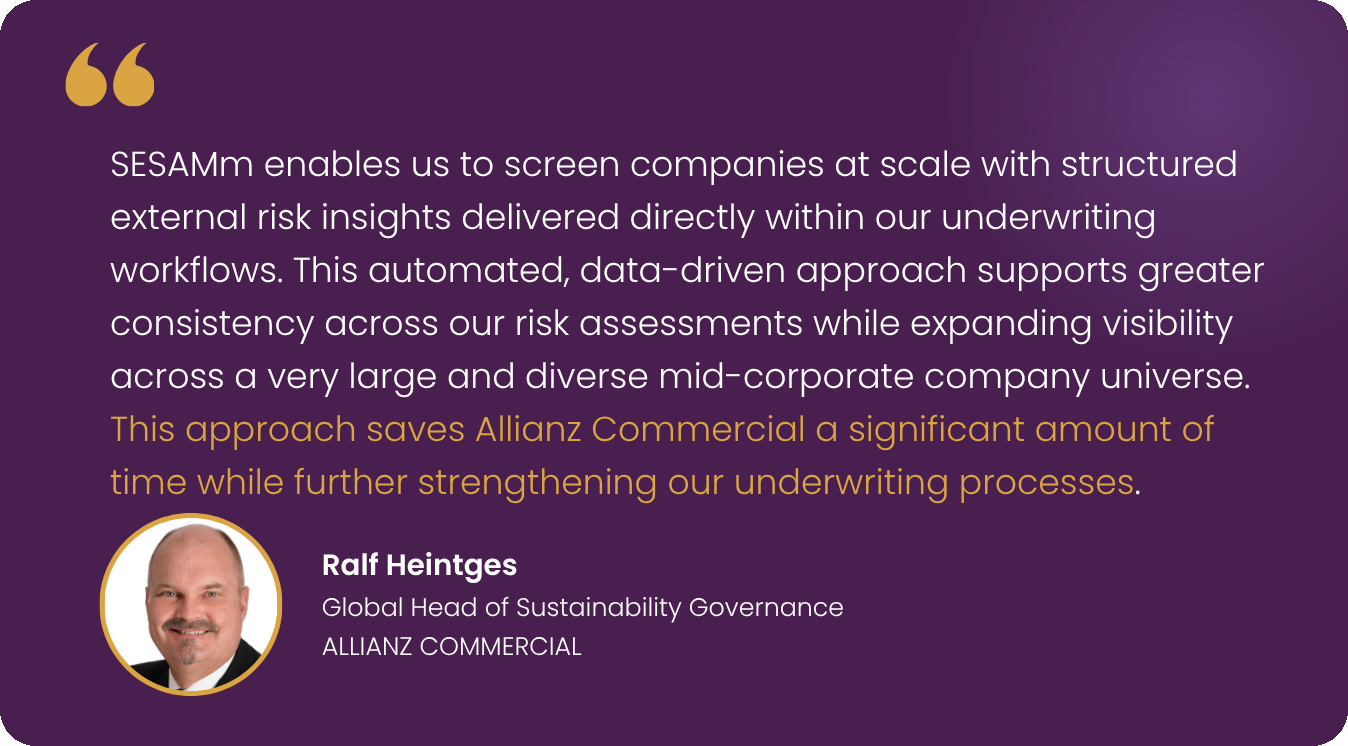
Allianz Commercial oversees underwriting for a highly diversified global client base, including a vast ecosystem of large and medium-sized enterprises and infrastructure projects.
To enhance visibility into underwriting risks at scale, Allianz Commercial partnered with SESAMm to implement an automated sustainability and reputational risk due diligence capability directly integrated into underwriting workflows. SESAMm now automates the assessment of hundreds of thousands of companies each year, delivering structured insights on sustainability and reputational risk in seconds via a real-time API-driven workflow.
This deployment functions as a fully integrated component of daily underwriting activities across global teams, supporting high-volume decision-making processes without adding operational burden.
Key Benefits at a Glance
Efficiency: Transformed a manual, multi-step process into a fully automated, real-time underwriting check delivered in seconds.
Going Beyond Data: Automatically completes the sustainability and reputational due diligence questionnaire rather than simply delivering raw risk event data, saving time and enabling faster referral decisions.
Dedicated Corporate and Infrastructure Projects Coverage: Comprehensive global coverage across corporate coverage and infrastructure projects.
Tailored Approach: Risk logic configured to Allianz Commercial’s underwriting policies and decision frameworks, delivering assessments tailored to its specific requirements rather than requiring adaptation to an off-the-shelf product.
The Objective: Consistent Risk Visibility at Scale
Underwriting teams had sustainability and reputational risk data for large listed companies from an existing data provider, but required broader coverage across SMEs and privately held companies. To fill this gap, underwriting teams relied on a combination of internal processes and external research to identify potential risks. As volumes increased, ensuring consistent and timely access to sustainability impacts became a key challenge, particularly during onboarding and renewal cycles.
As part of this process, SESAMm delivered significant additional value by providing direct answers to each sustainability and reputation due diligence questionnaire question in a systematic way, enabling Allianz Commercial to fully automate the process, which was not feasible with other solutions.
Allianz Commercial aimed to:
Provide underwriters with immediate access to structured risk data.
Align with internal sustainability and reputational risk guidelines.
Support efficient onboarding and renewal workflows at high volumes.
Allianz Commercial needed a solution that could deliver real-time, standardized, and scalable risk insights directly within underwriters’ workflows.
The Solution: SESAMm’s Enterprise Underwriting Automation
SESAMm partnered with Allianz Commercial to deploy a fully integrated risk intelligence layer embedded within its proprietary underwriting environment. Underwriters now access SESAMm insights directly within their existing interface.
When underwriters enter a company identifier, the system uses Dun & Bradstreet’s D‑U‑N‑S® Number to anchor the search in a globally recognized, trusted, and data‑rich company record. With that foundation, the SESAMm API can instantly retrieve and deliver a structured sustainability and reputational risk assessment, supporting both precise entity matching and scalable discovery across millions of companies.
The SESAMm API evaluates external data over a multi-year period and automatically answers predefined due diligence questions across sustainability and reputational risk categories. Each response includes:
Clear yes/no determinations
Supporting justification and context
Supporting evidence, compliant with Allianz Commercial audit track requirements
The output is aligned with internal reputational risk and sustainability guidelines and supports transparent, auditable underwriting decisions without adding operational complexity.
Results & Impact
Since deployment, SESAMm has enabled Allianz Commercial to evaluate corporate coverage and infrastructure projects underwriting with consistent, real-time external risk intelligence. A process that previously required multiple research and validation steps can now be completed in under a minute through automated API-driven checks embedded directly within underwriting workflows.
The solution supports the assessment of hundreds of thousands of companies annually for Allianz Commercial and provides underwriters with documented sustainability and reputational risk insights at the point of decision. With expanded visibility across privately held and smaller companies globally, Allianz Commercial benefits from a far more consistent risk coverage while maintaining the speed and reliability required for high-volume onboarding and renewal processes across global operations.
The secondaries market has tripled in size since 2019, now representing roughly $240 billion in annual volume. LP expectations around diligence - on exclusions, sanctions, mandate compliance, and reputational risk - have risen in lockstep. The window to screen a 300-company portfolio has not. For deal teams operating in an auction environment, the question is no longer how much to screen, but how to do it without becoming the reason a deal slips.
It covers how screening requirements differ by transaction type, what investors are actually screening for, why private market data makes this hard, and what a workflow looks like that can realistically fit inside a 48-hour timeline.
Secondaries investors evaluate large, diversified portfolios under compressed timelines, with the level of detail and underlying company visibility differing by transaction type.
In this context, screening is embedded in the underwriting workflow, not a one-off exercise: it helps apply investment guidelines, support LP opt-outs, prioritize follow-up diligence, and enable ongoing monitoring over the life of the investment.
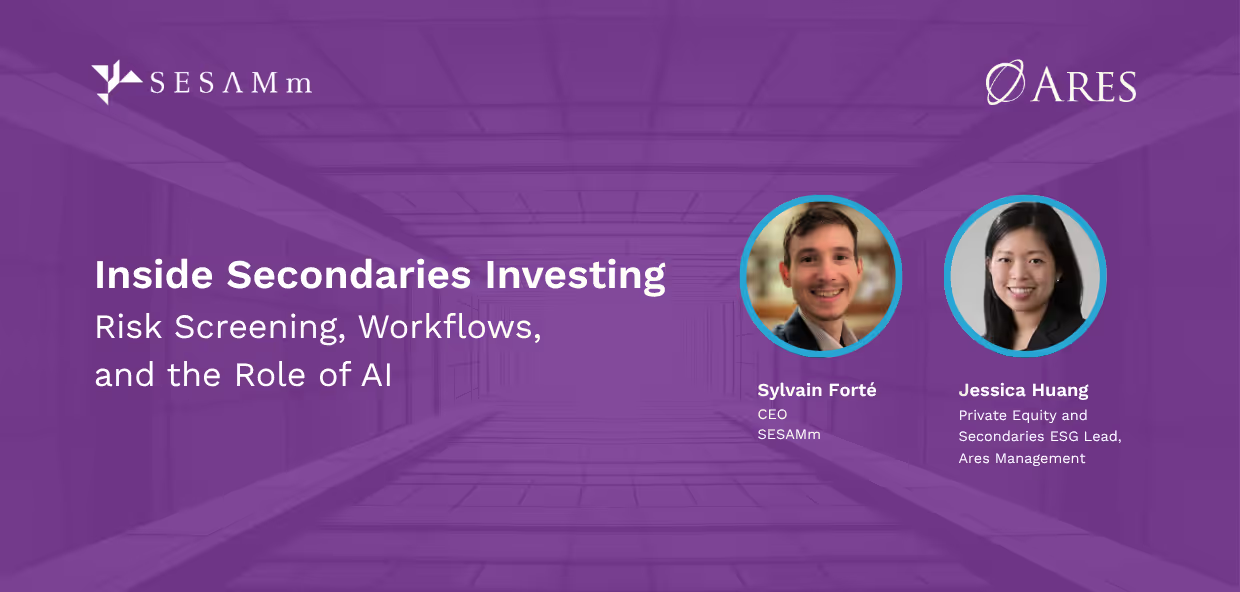
Watch this webinar replay to hear Jessica Huang, Private Equity and Secondaries ESG Lead at Ares Management, and Sylvain Forté, CEO at SESAMm, discuss:
The operational and data challenges secondaries teams face
How screening is applied in secondaries investing in practice
How AI helps teams scale screening and support ongoing monitoring workflows
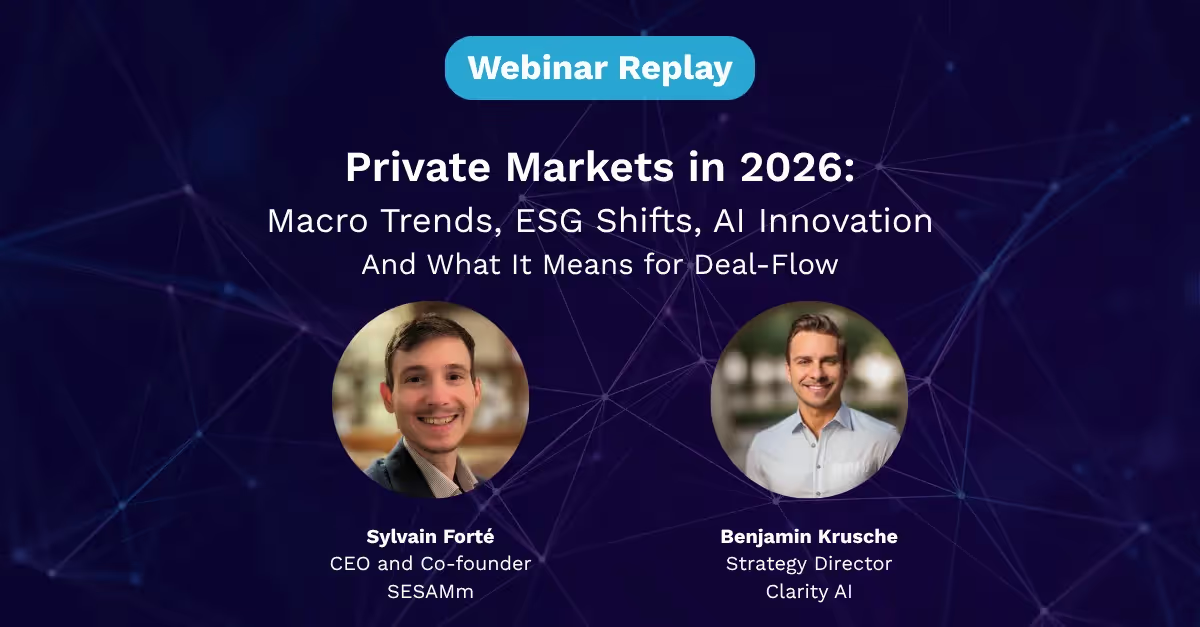
Private markets are changing fast. From new ESG regulations to advances in AI, the forces shaping investment decisions are multiplying.
Join Clarity AI and SESAMm as we explore the biggest shifts redefining private-market investing in 2026 and how data and technology are transforming due diligence, risk management, and deal flow.
Watch this replay to explore:
What shaped private markets in 2025 - and what’s ahead in 2026
How AI is transforming due diligence, risk monitoring, and value creation
What these changes mean for deal-flow, risk, and competitive advantage
Controversial business involvement is no longer a niche ESG issue. From fossil fuels and weapons to gambling, sanctions, and human rights abuses, exclusion policies are expanding and scrutiny is intensifying, especially across private markets.
As SFDR and the EU Taxonomy raise the bar, investors must prove that controversial exposures are identified, documented, and consistently screened, even when disclosures are limited.
In this ebook, SESAMm explores:
How exclusion rules are evolving under SFDR, the EU Taxonomy, and investor mandates
Why controversial involvement is harder to detect in private markets and secondaries
Real-world case studies revealing hidden exposure and compliance risk
How AI enables faster, auditable screening across public and private assets
Download the ebook to learn how investors can apply consistent, defensible exclusion screening at scale.
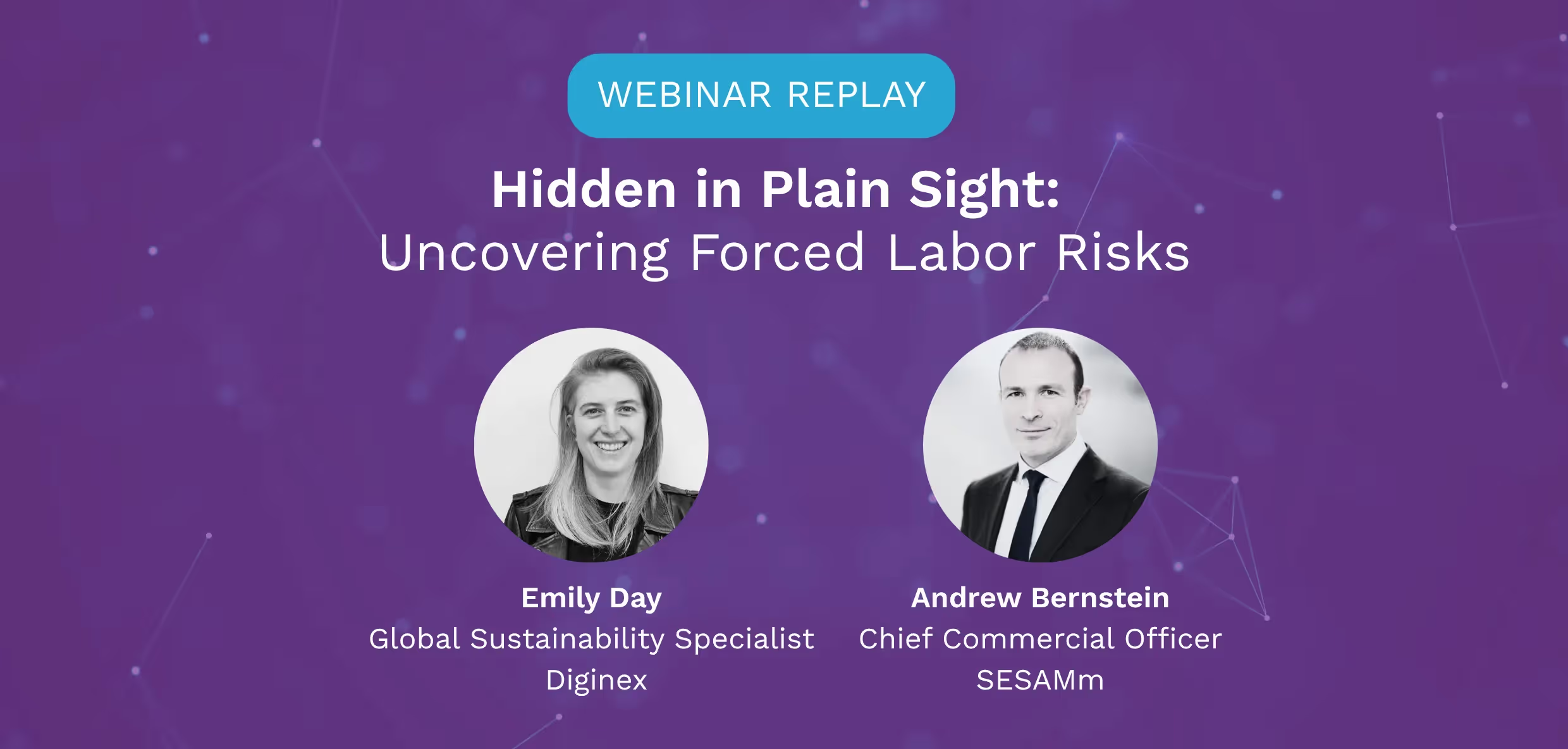
Forced labor remains a critical challenge for global businesses. Recent scandals across industrial and consumer sectors have shown how quickly hidden labor abuses can surface, sparking regulatory action, investor backlash, and lasting reputational damage.
Watch this webinar replay to hear Emily Day, Global Sustainability Specialist at Diginex, and Andrew Bernstein, Chief Commercial Officer at SESAMm, share data-driven insights and real-world lessons on how to anticipate and manage these risks effectively.
You’ll learn:
The evolving regulatory landscape and its implications for investors and corporations
Real-world case studies of forced labor controversies and their financial impact
How leading firms are strengthening risk detection and due diligence to stay ahead of compliance and reputational challenges
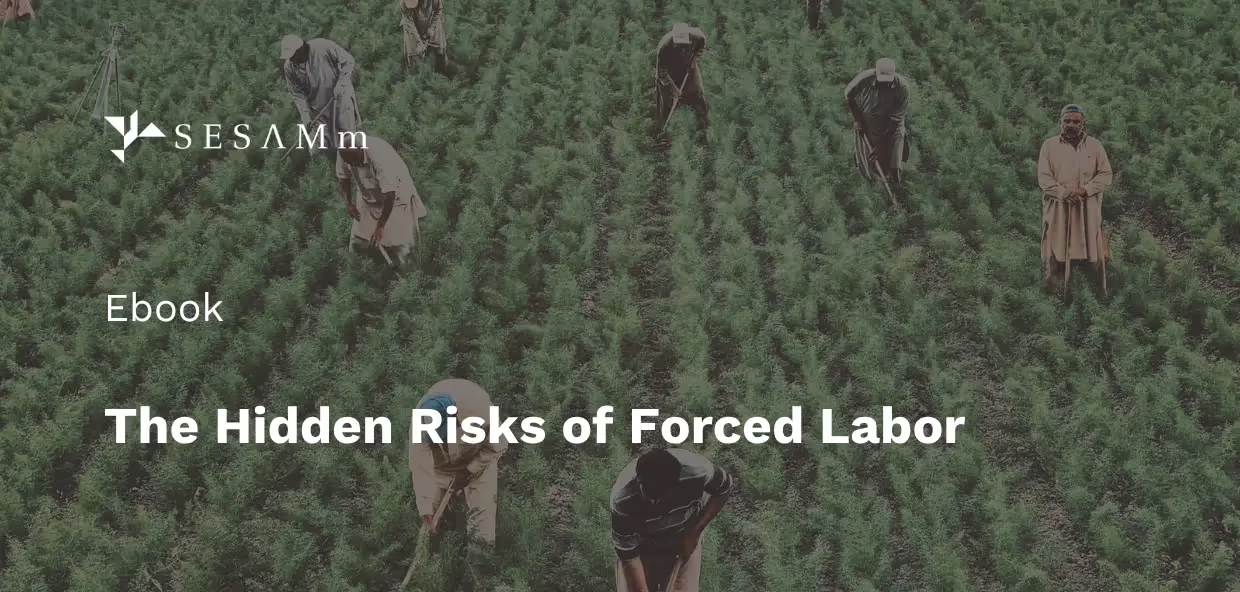
Forced labor remains among the most pressing human rights challenges for companies worldwide. Despite stronger regulations and corporate pledges, millions remain trapped in exploitative conditions, often deep within complex global supply chains.
As new laws increase scrutiny and liability, the cost of blind spots is rising. Investors, corporates, and private equity firms alike must now demonstrate active due diligence or face legal, financial, and reputational consequences.
In this whitepaper, SESAMm explores:
The tightening global regulatory landscape on forced labor
Exclusive data-driven insights from SESAMm’s AI platform on labor-related controversies
Real-world case studies revealing how risks can remain hidden despite compliance efforts
Download the report to learn how data and AI are transforming the fight against forced labor - and how organizations can move from reactive to proactive risk management.
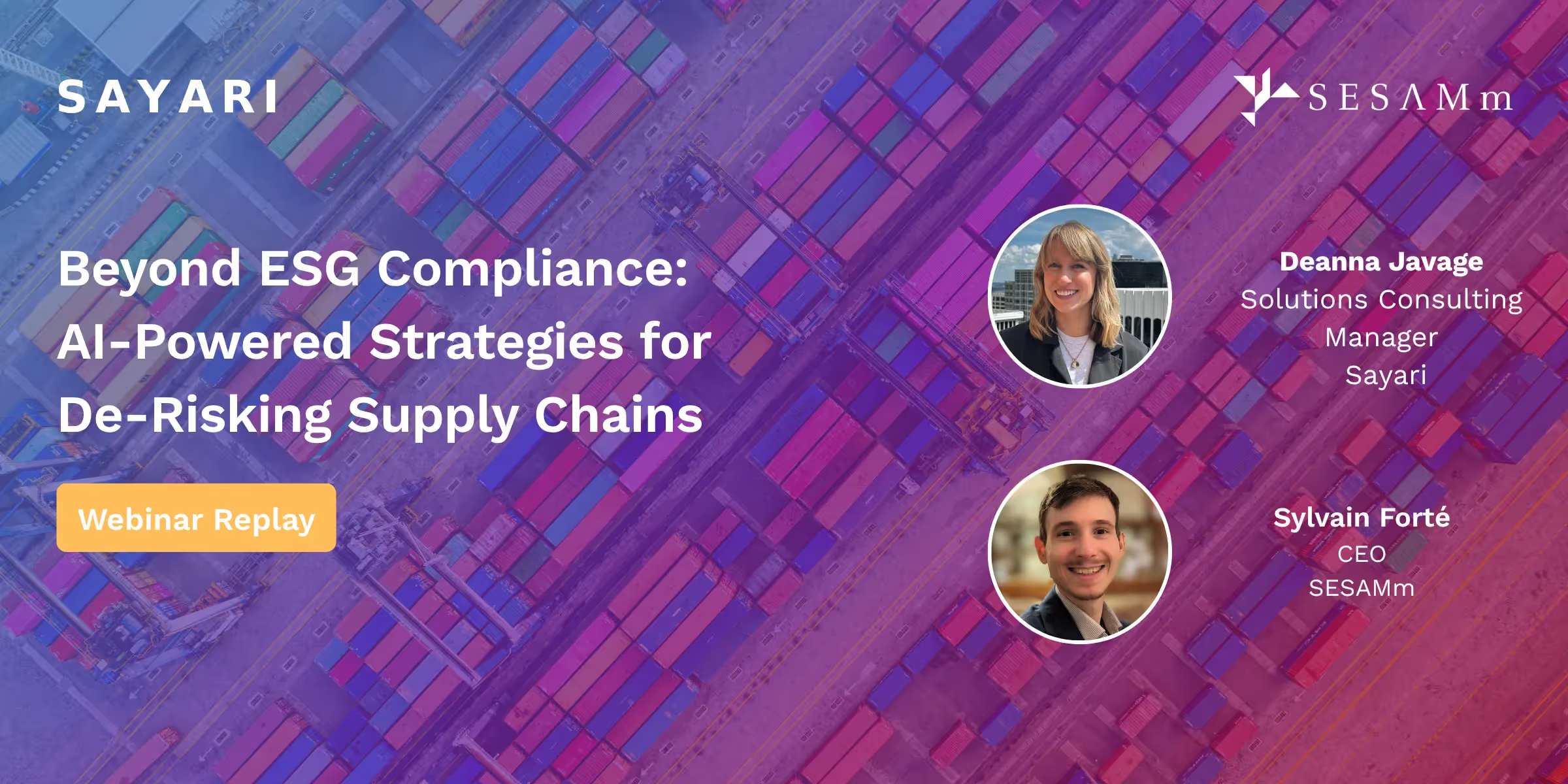
ESG frameworks are multiplying faster than organizations can comply with them. Supply chain visibility remains the weakest link, supplier self-disclosures are incomplete, ESG data is inconsistent, and regulatory requirements conflict across jurisdictions. Yet controversy events move fast. A reputational crisis, a forced labor allegation, or an environmental violation at a tier-two supplier can cascade through your entire supply chain in hours. Organizations that win today are those using AI to detect hidden ESG risk before the news breaks, turning fragmented data into actionable intelligence that protects brand, license to operate, and investor confidence.
Key Takeaways
Timely Response to ESG Controversy EventsCritical for maintaining corporate responsibility programs amid regulatory fluctuations.
AI-Powered Risk DetectionProactively detect and mitigate hidden ESG risk across supply chains.
Real-World Case StudiesUncover ESG risk that supplier questionnaires and internal data cannot expose.
As scrutiny of corporate supply chains intensifies, investors are demanding more than policy statements and third-party audits. In this webinar, SESAMm and Inrate explore two powerful lenses for evaluating risks and sustainability impacts across global supplier networks: SESAMm’s real-time controversy detection and Inrate’s impact-driven sustainability data and ratings. Together, these approaches cover both public and private companies, go beyond self-disclosures, and enable assessments across a wide range of suppliers.
Watch this instant replay to dive into:
Emerging trends shaping how investors assess ESG risks and impacts across supply chains
The expanding role of AI in identifying hidden exposures and mapping sustainability outcomes
Proven strategies for combining controversy signals, ESG ratings, and emissions data to drive more informed decisions


.jpg)

.jpg)


.png)