The secondaries market has tripled in size since 2019, now representing roughly $240 billion in annual volume. LP expectations around diligence - on exclusions, sanctions, mandate compliance, and reputational risk - have risen in lockstep. The window to screen a 300-company portfolio has not. For deal teams operating in an auction environment, the question is no longer how much to screen, but how to do it without becoming the reason a deal slips.
It covers how screening requirements differ by transaction type, what investors are actually screening for, why private market data makes this hard, and what a workflow looks like that can realistically fit inside a 48-hour timeline.
Download the full report
The complete framework for screening secondaries portfolios rapidly.
In this issue of the "what investors ought to know about…" series, we'll cover natural language processing (NLP), a tool that draws from the computer science and computational linguistics disciplines. In the last topic, we discussed knowledge graphs as the core of text analysis. And if knowledge graphs are the core of the data’s context, NLP is the transition to understanding the data.
What is natural language processing?
Natural language processing is an artificial intelligence (AI) technology that automates the data analysis of mined textual, unstructured data to include natural language understanding and natural language generation to simulate a human's ability to create language. It combines computational linguistics with machine learning and deep learning models, performing a special linguistic analysis by algorithms so a machine can "read" text.
Where is natural language processing used?
Today, various industries use NLP, from email filters to virtual assistants and search engines to chatbots. Here's a list of common ways natural language processing is used:
Chatbots: Chatbots are computer programs that use NLP. They simulate human conversation by identifying a sentence's intent, determining suitable topics, keywords, and emotions, and calculating the best response based on the data's interpretation.
Email filters: Email filters apply machine learning using many data samples to sort emails into the right inbox.
Machine translation: Translation software like Google Translate or Microsoft Translator use NLP to translate text from one language to another, such as English to French.
Natural language generation (NLG): NLG, a subfield of NLP, builds applications or computer systems that can automatically produce natural language texts of various types by using a semantic representation as input. Applications of NLG include question answering and text summarization.
Predicting and autocorrecting text: Predictive text and autocorrect use NLP to recognize and recall commonly used words and names to make text suggestions and correct common errors.
Search engines: Search engines like Google search use NLP machine learning to interpret a searcher's intent and provide relevant results. It can even suggest subjects and topics related to the query the searcher might be interested in.
Virtual and voice assistants: Virtual assistants like Apple's Siri or Amazon's Alexa use NLP technology to understand and respond to voice requests. Speech-to-text can dictate messages and notes, and speech recognition can control everything from smartphone apps and smart speakers to thermostats and home security systems.
Web sentiment analysis: Sentiment analysis automates classifying opinions in a text as positive, negative, or neutral. It's a method companies like SESAMm use to monitor sentiments like a brand's sentiment on the web and social media.
Why natural language processing is important to uncover financial-related alternative data
NLP is important because it helps resolve human language ambiguity in big datasets (big data). Languages are complex, diverse, and expressed in unlimited ways, from speaking hundreds of languages and dialects to having a unique set of grammar and syntax rules, slang, and terms for each. In text form, these variables are unstructured text. But with NLP, we can transform unstructured data into structured data and make sense of it.
Because of NLP's power, investors can research and analyze unstructured data from the web to gain insights into financial and ESG data. You can use this wealth of information to focus on systematic data processing, risk management, and alpha discovery through contexts, such as:
Major global indices sentiment
Euronext exchange sentiment
Private company sentiment
ESG risks for public and private companies worldwide
A quick overview of how natural language processing works at SESAMm
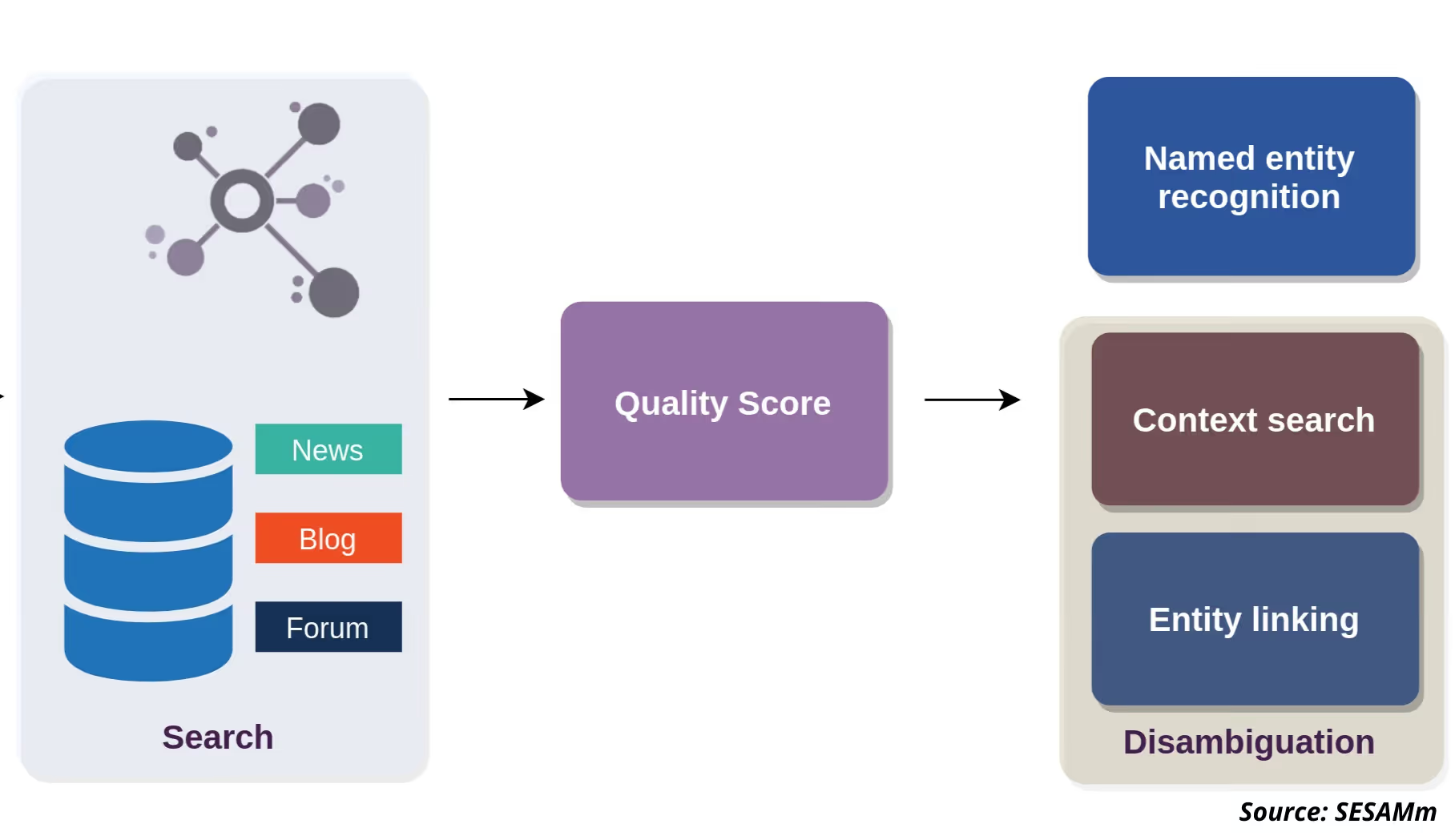
At SESAMm, we use named entity recognition (NER), which extracts the names of people, places, and other entities from text, and then named entity disambiguation (NED) to identify named entities based on their context and usage. For example, text referencing "Elon" could refer indirectly to Tesla through its CEO or a university in North Carolina. NED considers the context when classifying entities for an accurate match. Compared to simple pattern matching, which limits the number of possible matches, requires frequent manual adjustments, and can't distinguish homophones, NED is superior.
Process representation for NER and NED.
When identifying entities and creating actionable insights, SESAMm uses three other NLP tools: lemmatization and stemming, embeddings, and similarity. The lemmatization process normalizes a word into its base form (morphology) to help identify and aggregate entities. Embedding assigns the entity a numerical value to help analyze how words change meaning depending on context and understand the subtle differences between words that refer to the same concept—similarity measures whether two words, sentences, or objects are close to one another in meaning.
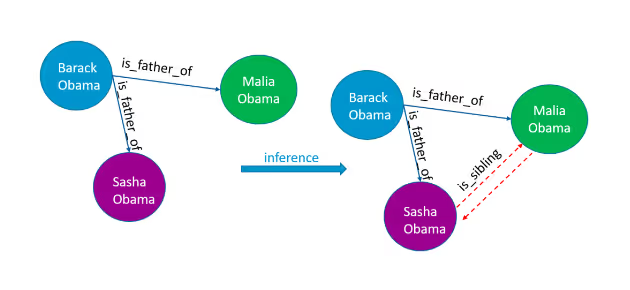
Representation of nodes in a knowledge graph.
Of course, NLP couldn't function without the core of the text analytics process: knowledge graphs. A knowledge graph is a digital representation of a network of real-world entities, the foundation of a search engine or question-answering service. This structured data model puts the schema in context through semantic metadata and linking, providing a framework for analytics, data integration, sharing, and unification. In other words, it's like a map and legend, with the legend labeling the concepts, entities, and events and the map connecting and identifying their relationships. These details are stored in a graph database and visualized as a graph representation, hence the term knowledge graph.
SESAMm's natural language processing platform for investment research and analysis
SESAMm is the leading provider of natural language processing and machine learning solutions and analytics for investment firms and corporations.
As the debate around ESG investing continues to evolve, some institutions and policymakers have grown increasingly vocal in their skepticism. Questions about greenwashing, the effectiveness of ESG strategies, and even outright regulatory rollbacks have cast a shadow over the sustainability movement. However, amidst the noise and uncertainty, there are clear signs of resilience and commitment from major financial players determined to keep sustainability front and center.
Two recent initiatives by European financial leaders—Snam and La Banque Postale—demonstrate that even as some institutions step back from ESG, others are doubling down and forging ahead with ambitious plans to integrate sustainability at the heart of their financial strategies.
This move is particularly significant when SLB issuance has generally slowed due to concerns over the credibility of targets. Snam’s SLB, however, was met with overwhelming demand, being five times oversubscribed with an order book of nearly $10 billion. Such enthusiasm from the market underscores a growing appetite for credible and ambitious sustainability-linked investments. Moreover, by setting clear milestones—like a 25% reduction in Scope 1 and 2 emissions by 2027 and a 90% reduction across Scopes 1, 2, and 3 by 2050—Snam is making a public, measurable commitment to climate action.
La Banque Postale: Transforming Savings with ESG Tiers
The bank’s strategy is built around three distinct ESG tiers. The first excludes companies that conflict with environmental and social goals, while the second prioritizes firms with the best ESG practices. The third and most ambitious tier channels savings into impact-driven solutions—investments directly contributing to environmental and social progress. By creating these accessible, transparent pathways, La Banque Postale empowers individuals to align their savings with their values and participate in the ecological and social transition.
Positive Momentum for ESG
These two examples send a powerful message: while ESG may face headwinds in some circles, forward-thinking institutions remain firmly committed to integrating sustainability into their financial practices. This momentum is important, especially as public trust and regulatory scrutiny around greenwashing intensify.
ltimately, these initiatives remind us that sustainable finance is not about pleasing every critic. It’s about taking concrete steps to create long-term value for investors, communities, and the planet.
SESAMm’s AI Technology Reveals ESG Insights
Discover unparalleled insights into ESG controversies, risks, and opportunities across industries. Learn more about how SESAMm can help you analyze millions of private and public companies using AI-powered text analysis tools.
The physical infrastructure powering the AI boom (the data centers that house it, and the hardware that runs it) has become one of the most ESG-exposed sectors in the global economy. As demand for computing accelerates, so does the scrutiny on the companies enabling it.
This scorecard examines three major players across the AI infrastructure stack: Equinix and Digital Realty, two of the world's largest data center operators, and Supermicro, a leading manufacturer of high-performance AI server hardware. Despite their different roles, all three are navigating the same storm: a convergence of governance failures, environmental friction, and national security risk that is reshaping how investors, regulators, and communities assess the sector.
Our analysis reveals three defining pressure points: governance failures spanning accounting manipulation, board instability, and fraud; environmental and social friction from community opposition, resource strain, and safety violations; and national security exposure through data breaches, export control violations, and supply chain risk.
Together, these risks represent a fundamental shift for the sector. ESG in AI infrastructure is no longer about carbon reporting - it is about fiduciary integrity, operational transparency, and the social license to keep building.
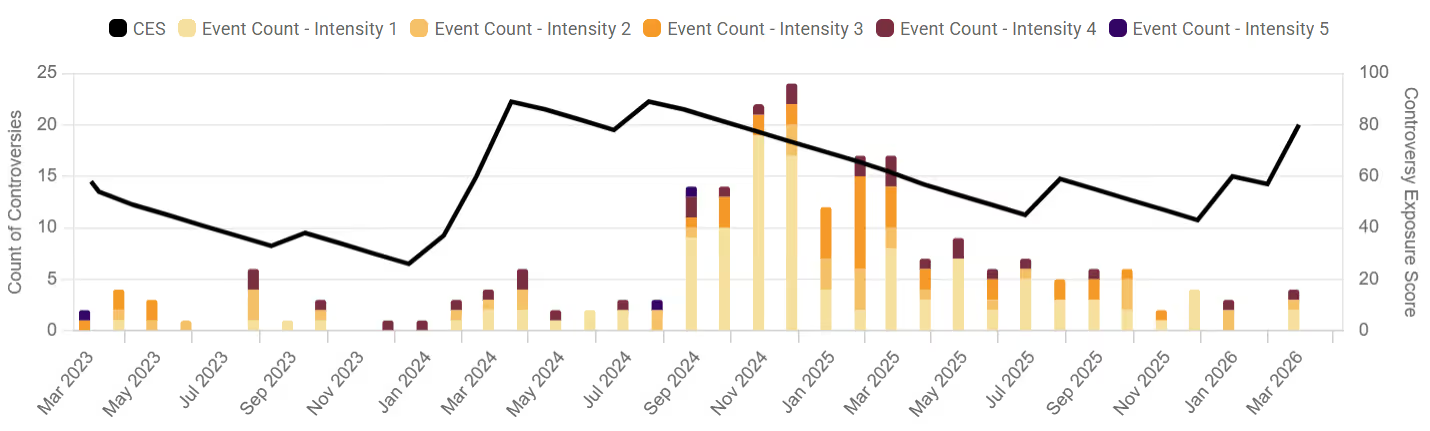
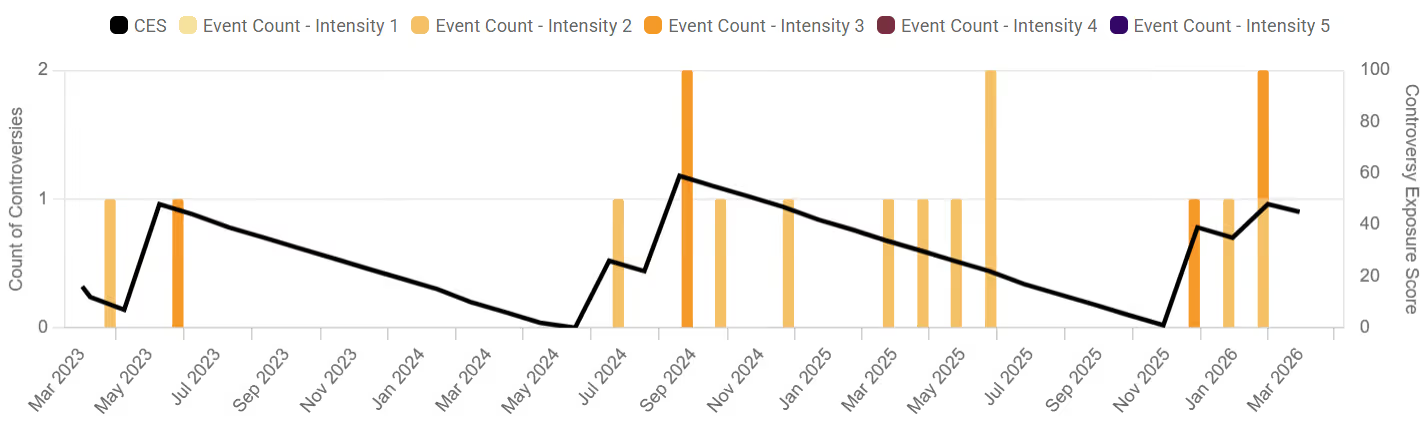
With a controversy exposure score (CES) of 80/100, Supermicro’s ESG profile is dominated by extreme governance risks centered on systemic accounting failures and geopolitical compliance breaches. The company is currently battling a U.S. Justice Department probe, Nasdaq delisting threats, and a series of securities fraud lawsuits following a 2024 accounting scandal that forced the search for a new CFO and echoed a prior $17.5 million SEC fine from 2020.
Beyond financial integrity, the firm faces severe national security scrutiny over the alleged smuggling of restricted Nvidia AI chips to China, alongside 2025 investigations into "spy chips," unremovable motherboard malware, and multiple patent infringement claims from competitors like AMD and Lenovo. Socially, the company’s risk is compounded by a 2025 whistleblower retaliation suit and labor rights violations involving Filipino workers at its semiconductor supply chain partners, as well as multiple OSHA safety penalties for workplace hazards.
Equinix: Accounting Manipulation & the AI Infrastructure Backlash
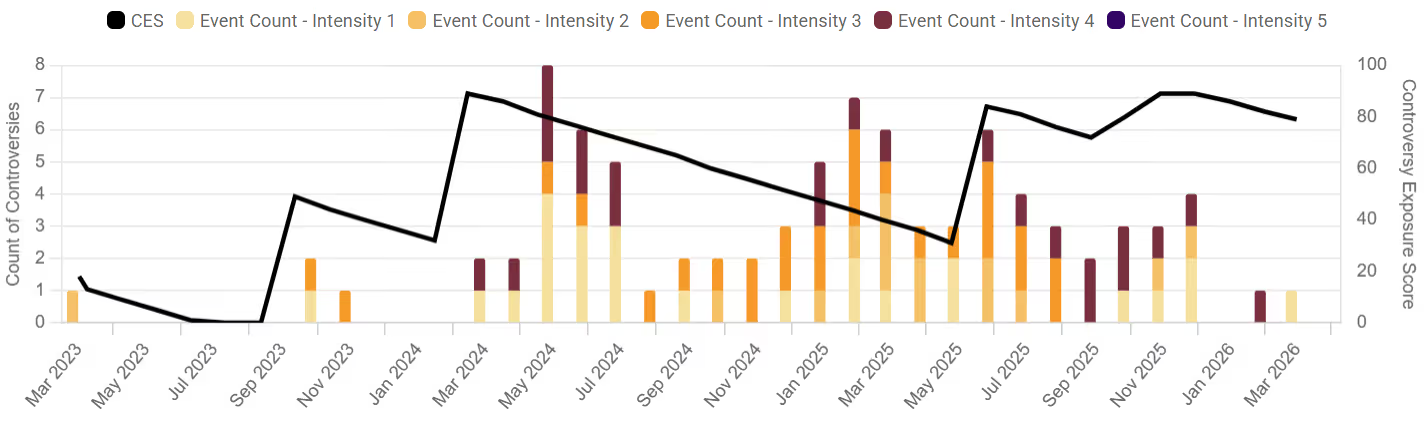
Similarly, Equinix’s CES of 79/100 is defined by a volatile combination of intensifying community opposition, environmental resource strain, and severe governance scrutiny. Socially and environmentally, the company faces a "Global AI Arms Race" backlash, where massive 340-acre proposals on local farmland in Minooka and "green belt" developments in South Mimms have sparked significant resident opposition over air pollution and traffic, while regulators in Dublin have begun blocking gas-powered facilities that violate national climate targets. These operational hurdles are compounded by a lack of transparency regarding massive water consumption and a series of high-profile safety and security failures, including data center fires in São Paulo and Madrid and a recurring "cybersecurity blind spot" in building systems. On the governance front, Equinix is navigating a severe trust deficit following a $41.5 million settlement over allegations of "major accounting manipulations" and the systematic over-selling of power capacity.
Digital Realty: Board Instability, Gas Leaks & Cybersecurity Breaches
Although it has a lower CES of 48/100, Digital Realty’s ESG profile is defined by governance instability and intensifying environmental friction in key urban hubs. The abrupt 2022 termination of its CEO and the 2023 resignation of its Chairman, who alleged bias against female directors, highlight deep-seated board-level conflicts, further exacerbated by 2026 investigations into director bias and a $3.4 million loss of tax breaks in Hillsboro.
Environmentally, the company faces formal legal notices in Marseille over fluorinated gas leaks and "imminent dangers to health," as well as noise complaints in Chicago and a 2024 fire in Singapore. Socially, the firm is navigating a Biometric Information Privacy Act (BIPA) lawsuit over scanning workers' fingerprints without consent, a major 2025 "Salt Typhoon" hacking breach, and mounting federal scrutiny over the industry's role in driving up local electricity and water costs.
The ESG challenges facing AI infrastructure operators are no longer peripheral concerns; they have become central to the sector's long-term viability. As the cases of Equinix, Supermicro, and Digital Realty illustrate, the consequences of their unchecked growth range from community backlash and environmental violations to governance failures and national security breaches. The AI infrastructure industry stands at an inflection point: continued expansion without proportional investment in transparency, accountability, and sustainability risks eroding stakeholder trust, inviting heavier regulation, and ultimately undermining the very infrastructure it seeks to build.
Stay ahead with the latest in ESG and AI intelligence
Join our mailing list to receive new reports, event invites, and updates from SESAMm directly to your inbox.






-converti-depuis-png.avif)


.png)