Introducing SESAMm’s New AI-Powered Secondaries & Credit Screening
July 22, 2025
•
5 mins read
Screen smarter. Act faster. Flag hidden risks at scale.
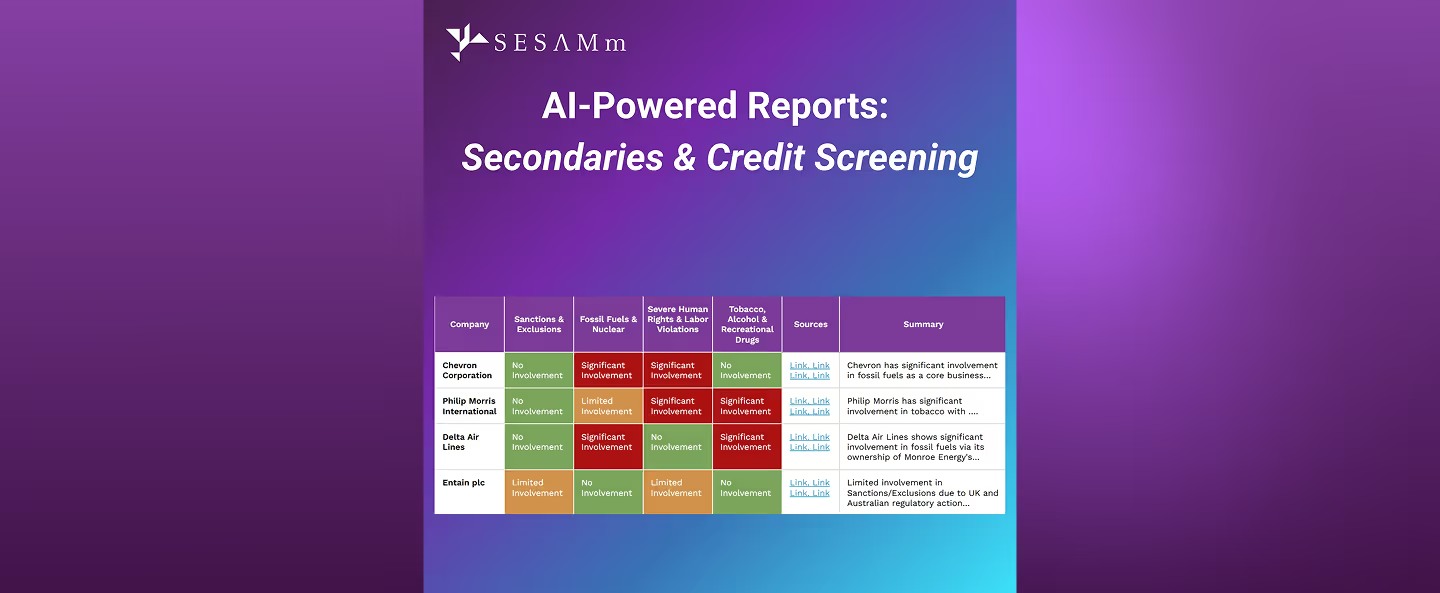
Speed and accuracy are critical in due diligence, especially when screening for reputational or compliance risks across large portfolios. That’s why we built SESAMm’s Secondaries & Credit Screening report: a faster, smarter way to assess exposure to restricted and controversial business activities.
How it works
Designed for investors, compliance teams, and financial institutions, this report uses SESAMm’s generative AI and large language models (LLMs) to analyze millions of documents and flag companies involved in sensitive sectors.
With just a list of company names, it highlights potential involvement in:
Fossil Fuels & Nuclear
Weapons & Military Equipment
Predatory Lending
Gambling & Betting
Adult & Violent Content
Severe Human Rights & Labor Violations
Tobacco, Alcohol & Recreational Drugs
Each result includes linked sources and a clear explanation, providing not just a flag but the context behind it.
Fast, Transparent, Scalable
Whether you're conducting secondary deal due diligence, reviewing a loanbook, or aligning portfolios with exclusion lists, this new report offers:
Scalable, fast batch screening: Upload a list of companies and get standardized, structured results in minutes.
Transparency: Each flag is backed by a justification and includes access to cited sources.
Faster decisions: Get standardized Excel outputs in minutes.
Deeper insight: Uncover risks that go beyond traditional industry classifications.
A New Standard for Risk Screening
Already in use by leading financial firms, the Secondaries & Credit Screening report brings clarity to complex decisions, helping teams flag risks earlier, faster, and more confidently.
Ready to Get Started?
Reach out to see a sample report or request a custom screening of your own list. With SESAMm’s Secondaries & Credit Screening, your next due diligence process just got faster and smarter.
ESG frameworks are multiplying faster than organizations can comply with them. Supply chain visibility remains the weakest link, supplier self-disclosures are incomplete, ESG data is inconsistent, and regulatory requirements conflict across jurisdictions. Yet controversy events move fast. A reputational crisis, a forced labor allegation, or an environmental violation at a tier-two supplier can cascade through your entire supply chain in hours. Organizations that win today are those using AI to detect hidden ESG risk before the news breaks, turning fragmented data into actionable intelligence that protects brand, license to operate, and investor confidence.
Key Takeaways
Timely Response to ESG Controversy EventsCritical for maintaining corporate responsibility programs amid regulatory fluctuations.
AI-Powered Risk DetectionProactively detect and mitigate hidden ESG risk across supply chains.
Real-World Case StudiesUncover ESG risk that supplier questionnaires and internal data cannot expose.
At SESAMm, we have always been at the forefront of utilizing artificial intelligence (AI) for Environmental, Social, and Governance (ESG) risk analysis. Our journey began in 2014, leveraging natural language processing (NLP) to analyze vast amounts of data to identify company risks - from public equities to expanding into private assets. Our technology stack, deeply rooted in AI-first principles, has evolved significantly over the years, incorporating deep learning and large language models since their inception.
2023 marked a significant leap in generative AI, breaking data quality and precision barriers. Our ability to attain human-level precision in ESG control detection across dozens of languages is a testament to our commitment to continual technological advancement. We plan to further integrate generative AI into our processes, enhancing data quality and expanding our coverage, especially for smaller firms and infrastructure projects that often go unnoticed in the market.
Similarly to our 2023 vision blog post, we generated this image using Open AI, using the exact same prompt: An oil painting in classical style of an artificial intelligence holding the whole world in its hand. Realistic. - Check out how the image differs from last year's here.
Enhancing User Interaction with AI: The Future of Client Engagement
A significant focus for SESAMm in 2024 is transforming how clients interact with our SaaS platform. Last year, we introduced a prototype of our generative AI chatbot, which marked the beginning of a new era in user interaction. Our goal is to utilize generative AI not just for data improvement but to enhance the overall user experience. This includes making data more accessible and addressing challenges like the lack of unique identifiers in the private space.
Accelerating Innovation and Development with AI
Our team of 60 engineers and researchers is the driving force behind our rapid development and innovation. The integration of large language models has enabled us to deliver features more quickly and efficiently. With a robust infrastructure and an agile AI team, we're pushing the boundaries of what's achievable with AI, outpacing traditional human analyst capabilities. This agility in innovation is crucial for our continued leadership in the market.
The Future of AI Technologies in SESAMm's Roadmap
We keep a close eye on the latest AI advancements, from new open-source libraries to cutting-edge commercial models. Our team is deeply engaged in fine-tuning models for specific applications, especially in tracking ESG events and uncovering insights about smaller, lesser-known companies. This approach reflects our culture – an AI-first company specializing in the financial and ESG space, always eager to incorporate more technology and innovate.
Cementing Leadership in AI-Powered ESG Analysis
Our vision extends beyond 2024, aiming to be the premier global player in ESG controversy and risk analysis. With regulations evolving globally, we anticipate a significant expansion in our market. Our focus remains on delivering unparalleled reputational insights, especially in the investment world, but also rapidly expanding into supply chain analysis and client monitoring. We're not just keeping pace with the market but setting the standard for AI-powered ESG analysis.
The Expanding Global ESG Landscape: Opportunities and Challenges
As regulations intensify worldwide, including in polarized markets like the US and Asia, we see a growing demand for ESG analysis. This global shift presents both opportunities and challenges. Our strategy includes further integrating our solutions into various ecosystems, such as ESG reporting tools, portfolio management systems, and CRMs. Through strategic partnerships, we aim to position SESAMm as an integral part of the global ESG analysis framework.
Walking the Talk: SESAMm's Commitment to Sustainability
In 2024, SESAMm is not just about leading in technology; we're deeply committed to practicing what we preach regarding sustainability. We have a robust ESG Manifesto and a series of actions aligned with environmental, social, and governance principles. Recognizing our relatively limited carbon footprint as a tech company, we focus on making impactful choices and fostering a culture of awareness and change within our team.
We've implemented programs for environmental awareness, like our Climate Risk training, conducted by certified employees. Our efforts in governance are highlighted by the appointment of our first independent board member, Stephane Beson, signifying our dedication to having diverse external perspectives guiding our company.
Regarding environmental footprint, we prioritize partnering with providers that use clean energy in their data centers. This conscious decision-making extends to selecting partners who can offset their carbon emissions, reflecting our commitment to sustainability.
Remote Work and Sustainability: A Dual Focus
Our approach to remote work has always been progressive. We see it as not just a productivity enhancer but also as a key sustainability strategy. Given our global presence, with teams in France, New York, Tunisia, and London, remote work is essential. It brings our team closer, transcends cultural barriers, and reduces our carbon footprint by significantly cutting down on travel. This strategy aligns with our dedication to work-life balance, recognizing the importance of flexibility for our employees.
Targeting the Right Market with Tailored Services
2024 is a year of strategic focus for SESAMm, especially in terms of our target market. We're seeing a growing trend among banks to aggregate ESG controversy data. Our unique capability to provide comprehensive coverage, encompassing mixed assets portfolios, positions us as a key player for these institutions.
We continue strengthening our presence in private equity and expanding our reach into the banking sector, private debt, and infrastructure funds. Our dedicated corporate business practice is another area of expansion, helping European companies monitor ESG controversies. We also focus on sustainability and ESG teams, procurement teams, and third-party risk teams, ensuring a broad yet targeted market approach.
Upholding Data Security and Privacy
Data security and privacy are paramount, especially given the increasing sophistication of cyber threats. Our co-founder and CTO brings invaluable expertise in cybersecurity. We conduct annual audits, have robust systems to monitor and preempt attacks, and continuously train our teams to be vigilant. While we don't deal with personal data, we focus on protecting critical systems for our clients, ensuring that we maintain the highest standards in data security.
Building a Team for the Future
Looking ahead, our confidence in 2024 stems from our team's exceptional capabilities. We've implemented agile processes and onboarded talented individuals across all levels. Our team's passion and dedication are key drivers in adapting to market changes and delivering high-quality services. It's not just about where SESAMm is now but how our team will continue to excel and innovate in the future.
A Vision of Innovation and Responsibility
As we move into 2024, SESAMm stands at the forefront of AI-powered ESG analysis, not just through technological innovation but also through a steadfast commitment to sustainability and security. Our focus on the right markets, combined with a forward-thinking approach to remote work and data protection, positions us to meet the evolving needs of our clients.
Join us at SESAMm as we navigate the future of ESG analysis, leveraging our expertise to foster a sustainable, secure, and innovative business environment. Explore SESAMm's cutting-edge solutions and be part of a future where technology meets responsibility.
SESAMm’s AI Technology Reveals ESG Insights
Discover unparalleled insights into ESG controversies, risks, and opportunities across industries. Learn more about how SESAMm can help you analyze millions of private and public companies using AI-powered text analysis tools.
Below is an approximation of this video’s audio content. Watch the video for a better view of graphs, charts, graphics, images, and quotes the presenter might be referring to in context.
Intro to SESAMm
Thank you very much, Greg. Thank you, everyone, for listening to this presentation. I’m Sylvain. I’m CEO and co-founder of SESAMm. SESAMm is an AI company. We extract billions of articles and messages from the web in order to identify critical insights related to financial institutions and corporates. We’re a team of close to a hundred people. And what we aim to show you today is our new product that helps financial institutions and corporates identify ESG controversies in the form of alerts on all of their investments, on all of their clients, and all of their suppliers.
So there are more than 23 million companies in the world right now. These companies are your investments, your suppliers, your clients, and no one is actually tracking them. Most of these companies are never tracked day to day. SESAMm’s solution aims at automatically identifying controversies on these companies and finding the critical information that you’re missing.
See a dashboard example
So let’s take a quick example first. Here we have dashboards where we analyze a company called Wirecard. Wirecard is a fintech company—German—that went bankrupt a few years ago due to a two billion fraud scandal. That company was heavily embedded into the financial sector, working with a lot of banks, a lot of corporates worldwide.
On our dashboards, we can immediately identify all of the key controversies and all of the key risks on the companies. And we have a score called a virality score that helps assess the severity of each ESG event so as to understand whether that company should be excluded from your list of suppliers, for example, or even discussed as a client.
SESAMm solution benefits
There are key benefits to providing this information and to the way that this product is brought to the market. First, SESAMm covers more companies than anyone else. We cover close to five million firms, whereas most ESG providers have coverage limited to 50,000 firms in total. In addition to that, we’re able to detect controversies in real time and generate daily alerts where normally a bank, for example, would have to go through that process manually and update it just a few times a year instead of receiving that live information.
In addition to that, as you can see on the demo here, we have information for more than 14 years of data. So anytime you onboard a new supplier, anytime you check for information—ESG information, on a new client, or on an investment—you’ll automatically be able to go back in history and understand whether that company was exposed to issues in the past.
Trusted by major financial institutions
SESAMm solutions are already adopted by major banks such as Raiffeisen or Nomura, for example, in this industry, major private equity firms such as Carlyle. And what’s interesting in this solution is that we’re seeing specific interests from commercial banks that are missing the solution in order to track ESG risk on their suppliers and their clients. And it makes sense. Most of these suppliers and clients are small firms, local firms that no one else is going to track. And AI is enabling us to automate the process of monitoring these firms and making sense of that data in real time.
SESAMm's solution in action
So now, let’s go to the second part of the demo. We want to take an actual life example. So let’s take a company like Twilio, for example. So you may know Twilio communications, API, messaging services, phone services, and the like. This company is a typical provider of banks or of financial institutions or any other corporates in the world.
So you see on the left, we immediately identify all of the information related to Twilio. And we can rank this based on negative sentiment so as to understand what are the key critical topics that I should care about and that I should evaluate before actually working with Twilio or in the context of already working with Twilio. We go through that process by handling more than 20 billion articles and messages from more than four million sources worldwide. So that’s an insanely large amount of information.
And on Twilio—say Twilio is one of your suppliers or one of your clients—we immediately identify a large controversy related to a data breach and cybersecurity issue, and we identified both in news but also in some of the specialized cybersecurity websites. In addition to that, we can go in even more granularity and look transparently at the content themselves, read the contents from the platform, and not just rely on a numeric rate saying that “Hey! This company is problematic.” We can actually read the underlying content and understand how the controversy emerged.
SESAMm solution benefits
So the key benefits and the real advantages of that solution is getting information immediately. You don’t have to wait for a due diligence for someone to check for someone to send a questionnaire to the company. You just type in the name, get the information in a few seconds wherever the company is, and however local that company is. It could be the most obscure company. And as you can see our system also covers many different languages, including Asian languages that are monitored automatically.
The second part is that we have access to millions of sources, including very industry-specific sources. I was mentioning cyberthreats. We also have access to NGO websites that identify these types of ESG issues in real time.
So this is really the information that is aimed at helping you monitor controversies and ESG events in just one place on any number of companies, public and private, whether they are your suppliers, your clients, or your investments. You can make sense of that data in real time using AI.
Presentation summary
I’ll finish this presentation a bit early, and we’ll actually bring the point to three calls to action. The first one is, first, please come to our booth. We’re actually on the left of the exhibit hall right when you come in. The second one is, please visit our website. It’s spelled SESAMm, sesamm.com, and you can get a free trial from the website. And finally, come talk to our amazing team with Dave and the rest of our team at our booth. And please ask us for a free POC—whether you’re a bank, an asset manager, or a fintech company—and help us help you track all of the ESG controversies on millions of companies.







.png)