From Risks to Opportunities: SESAMm's Approach to Technology in the Financial Sector
February 7, 2024
•
5 mins read
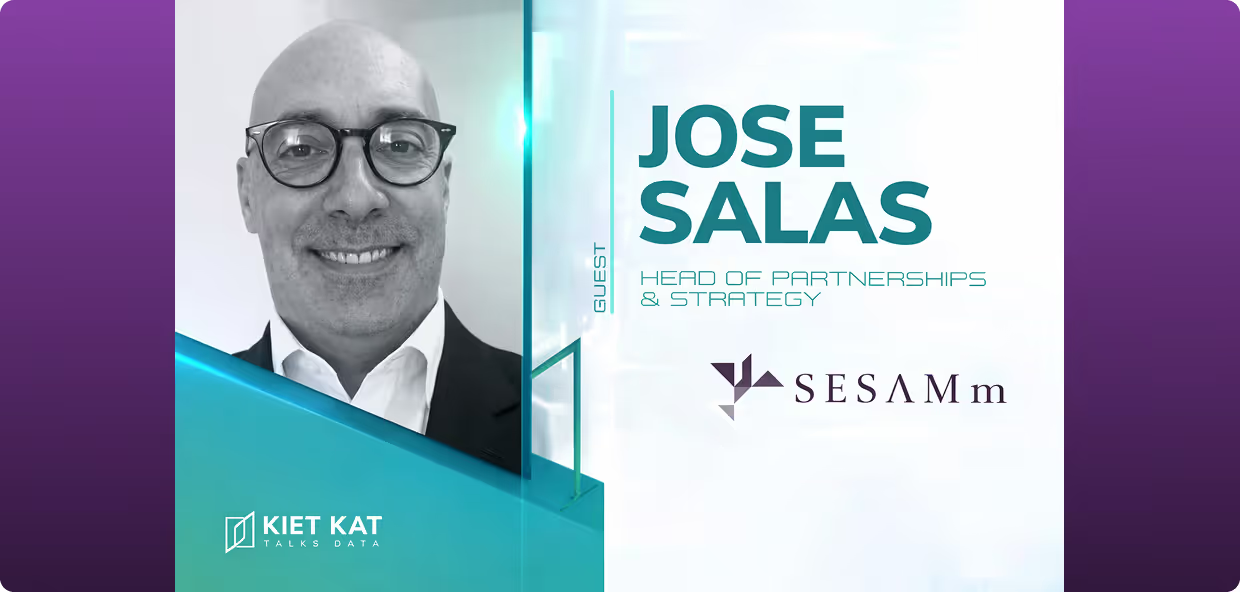
In a recent interview, Jose Salas, Head of Partnerships and Strategy at SESAMm, alongside Kiet Tran and Kat Tatochenko, shared how SESAMm is transforming the landscape of AI-powered text analysis. SESAMm excels in extracting valuable insights from diverse data sources, addressing key issues like ESG controversies and SDG impacts for clients, which include private equity firms and financial institutions.
Salas highlighted SESAMm's distinct approach to technology, emphasizing its role in identifying risks and opportunities for investors. The company's future plans involve embracing generative AI to refine our data analysis further, promising even sharper insights for our clients. SESAMm's innovative strategies demonstrate our commitment to turning complex data into actionable intelligence, paving the way for smarter investment decisions in the financial sector.
Watch the full interview here:
SESAMm’s AI Technology Reveals ESG Insights
Discover unparalleled insights into ESG controversies, risks, and opportunities across industries. Learn more about how SESAMm can help you analyze millions of private and public companies using AI-powered text analysis tools.
Today, environmental, social, and governance (ESG) criteria have become critical in shaping companies' operational and strategic directions. As organizations strive to align with the United Nation’s sustainable development goals (SDG), understanding the variances in ESG performances across different geographical regions becomes crucial. This article explores ESG discrepancies in North America, Latin America, Europe, Australia, Asia Pacific, and Emerging Countries. By dissecting the prevalent ESG risks and illustrating the distribution of SDG adverse behaviors within these regions, we aim to provide a granular analysis that not only highlights regional challenges but also paves the way for tailored strategic frameworks. This nuanced approach facilitates an informed assessment of disparities, empowering stakeholders to craft effective and regionally nuanced strategies.
ESG Overview: A Regional Perspective
Upon standardizing data across the examined regions, our analysis unveiled a predominance of social risks across the board. Yet, the regional specificities unveil the complexity of global ESG landscapes.
Fig 1: ESG Risks by region
Upon standardizing data across the examined regions, our analysis unveiled a predominance of social risks across the board. Yet, the regional specificities unveil the complexity of global ESG landscapes.
Europe emerges as a hotbed for governance-related risks, particularly emphasizing influence strategy and communication. European companies find themselves at the correlation of controversies ranging from greenwashing and emissions cheating to governance failures, spotlighting the complex governance terrain they navigate.
While grappling with governance risks, North America and Australia exhibit unique profiles. North American firms face various governance challenges, from securities fraud to greenwashing, painting a complex picture of corporate governance in the region. Australian companies are likewise embroiled in governance concerns, predominantly linked to senior management and regulatory compliance, reflecting the governance trials specific to the Australian context.
This multifaceted overview underscores the broad spectrum of ESG risks while illuminating the distinctive challenges faced by each region.
UNSDG Adverse Behaviors: Regional Breakdown
When looking at UNSDG adverse behaviors for the same regions, we find regional trends and more generalized ones. For example, Goal 1, “End Poverty,” displays one of the highest breach rates of all the goals. Whereas Goal 6 - Clean Water and Sanitation, displays interesting discrepancies, mainly exposing differences between developed and developing countries.
The table below provides a detailed comparison of SDG adverse behaviors across regions, categorizing them by specific goals to highlight regional differences in SDG challenges.
Fig 2: SDG breach/region
Goal 1, "End Poverty," is the most prevalent SDG issue across all areas. Europe is experiencing the most significant impact due to various factors, including labor rights issues, human capital concerns, governance challenges, anti-competitive practices, and tax controversies.
Similarly, Goal 16, "Peace, Justice, and Strong Institutions," underscores significant issues in North America related to human rights, labor, management integrity, anti-competitive actions, tax strategies, corruption, and shareholder matters, driven largely by flaws in the criminal justice system, including over-incarceration, racial bias, and police misconduct. These problems undermine public trust and equality, highlighting the need for governance improvements despite North America's strong institutional base.
Emerging countries face the greatest challenges with Goals 3 and 11, "Health & Well-being" and "Sustainable Cities," respectively, due to inadequate healthcare infrastructure, disease prevalence, limited healthcare access, poor sanitation, pollution, overcrowding, and substandard urban planning. Addressing these issues requires substantial healthcare, sanitation, and sustainable urban development investments to mitigate risks.
UNGC Controversies: A Regional Analysis
Our exploration extends to aligning ESG controversies with their respective regions and assessing the proportion of these risks aligning with breaches of the United Nations Global Compact (UNGC) principles.
Fig 3: UNGC breaches by region
Latin America emerges as the frontrunner in this evaluation, demonstrating a noteworthy prevalence of breaches, particularly within the environmental pillar. Notably, the focal point centers on environmental damages attributed mostly to mining and metals companies.
Australia is marked by a significant number of controversies surrounding human rights violations. These encompass various instances, ranging from privacy breaches and infringements on the right to security and dignity and diversity & inclusion. These incidents have garnered considerable attention, contributing to the heightened significance of regional human rights breaches.
In North America, despite a considerable share of human rights breaches, it distinguishes itself by exhibiting the highest prevalence of labor rights violations. In contrast to other regions, North America faces a substantial number of lawsuits related to employment, particularly concerning diversity and inclusion breaches, including harassment lawsuits and instances of racial bias.
European companies distinguish themselves through notable instances of Anti-corruption pillar breaches, including multiple failures in money laundering investigations, legal actions resulting in lawsuits and fines, as well as settlements for bribery allegations and accusations of kickbacks.
Latin America's environmental controversies, Australia's human rights challenges, North America's labor rights issues, and Europe's anti-corruption breaches each tell a part of the global ESG narrative, demonstrating the diverse facets of regional ESG controversies.
Leveraging SESAMm for Insightful ESG Analysis
SESAMm's technology identifies and analyzes potential risks and controversies through our advanced AI-powered text analysis tool, providing essential insights for stakeholders. This capability is invaluable for organizations, particularly private equity firms and financial institutions, aiming to navigate ESG complexities. By leveraging SESAMm's insights, businesses can adapt their ESG strategies to their regional contexts' unique challenges and opportunities, ensuring global sustainable and responsible operations.
Conclusion
To summarize, this analysis underscores significant regional differences in ESG factors, with social risks emerging as a common concern worldwide. Yet, regional distinctions are evident: Latin America is particularly impacted by environmental issues, Europe grapples with governance risks, and emerging nations face a surge in social controversies. The detailed analysis of SDG adverse behaviors, organized by goals for each region, highlights these differences further. It is imperative for companies to recognize and adapt to these regional nuances in their ESG strategies, ensuring approaches are finely tuned to address the distinct risks and challenges prevalent in their specific operational environments.
SESAMm’s AI Technology Reveals ESG Insights
Discover unparalleled insights into ESG controversies, risks, and opportunities across industries. Learn more about how SESAMm can help you analyze millions of private and public companies using AI-powered text analysis tools.
This is from SESAMm’s Deal Screening AI report. These reports are usually used by private equity deal teams and M&A teams to conduct pre-commercial due diligence on any company or project in minutes, and they contain insights and risks on the target company as well as a full competitive and market analysis.
ManTech International Corporation is a U.S.-based defense contractor specializing in cybersecurity, data analytics, and systems engineering solutions for national security and government agencies. Founded in 1968 and headquartered in Herndon, Virginia, the company operates globally. It primarily serves U.S. defense, intelligence, and homeland security clients, delivering technology services that support mission-critical operations such as cybersecurity protection, artificial intelligence and analytics, and intelligence, surveillance, and reconnaissance capabilities.
The broader defense and intelligence services market in which ManTech operates is expanding rapidly due to rising global defense spending, geopolitical tensions, and increasing demand for advanced digital and cyber capabilities. Within this context, ManTech has recently secured several growth signals, including a $200 million cybersecurity contract with the National Oceanic and Atmospheric Administration, partnerships to deploy secure AI technologies, and major analytics and systems contracts with the U.S. Army, reflecting continued demand for its technical expertise.
The report identifies several legal and reputational risks that could be relevant in a due diligence context. The most significant relate to labor and human rights issues, including allegations by former employees that the company confiscated passports and imposed hazardous working conditions under a U.S. Army contract in Kuwait, with a U.S. court allowing human-trafficking claims to proceed. Other previous issues include whistleblower retaliation claims linked to military contract billing practices and a civil fraud settlement involving misrepresentation of security clearance status. Environmental risks appear limited, with no major pollution or climate-related incidents identified.
In the competitive landscape, ManTech operates alongside firms such as Booz Allen Hamilton, Leidos, CACI International, SAIC, and General Dynamics Information Technology. While not the largest player in the sector, it is regarded as a capable provider of secure IT and cybersecurity solutions for classified government missions. Overall, the report concludes that ManTech benefits from strong demand for defense technology and cyber capabilities but faces reputational exposure primarily tied to labor practices and contract-related compliance risks.
Reach out to SESAMm
SESAMm’s AI Deal Screening Reports analyze web data across over five million public and private companies to help investors quickly identify legal, ESG, and reputational risks during due diligence. To learn more about how you can generate these reports or to request a demo, reach out to one of our representatives.
The Corporate Sustainability Due Diligence Directive (CSDDD or CS3D) is a significant European Union initiative, shifting businesses from voluntary environmental and social practices to legally binding obligations. Companies must align with stringent standards to address issues like child labor, modern slavery, and environmental degradation. The directive's phased implementation starts in 2026 and focuses on companies with extensive operations and revenues.
CSDDD requires companies to proactively identify, prevent, and mitigate adverse impacts across their value chains. It mandates transparency and public reporting, enhancing trust with consumers and investors. The directive also imposes financial penalties for non-compliance, highlighting the importance of sustainable practices for business stability.
Fill out this form to download our ebook and explore the Corporate Sustainability Due Diligence Directive (CS3D) to ensure your business is compliant with the latest EU regulations.
Stay ahead with the latest in ESG and AI intelligence
Join our mailing list to receive new reports, event invites, and updates from SESAMm directly to your inbox.