Webinar Replay: Sustainability Advantage or Burden
07/17/2025
•
5 mins read
As regulatory demands grow and ESG expectations evolve, financial institutions face a critical question: Is sustainability compliance merely a cost center or can it drive measurable financial and competitive advantages?
Watch this on-demand webinar to hear Gwen Safa, Global Head of Sustainable Corporate Solutions at Barclays Investment Bank, and Sylvain Forté, CEO of SESAMm, offer actionable insights on transforming ESG challenges into strategic opportunities.
Together, they unpack:
Why leading firms are reframing ESG as a value driver, not just a regulatory obligation
How to navigate the ESG backlash while staying aligned with long-term investor and stakeholder expectations
Where ESG meets reputational risk and why both are critical to financial performance and trust
Whether you're managing risk, sourcing deals, or building client trust, this session offers a candid look at the shifting role of ESG and what it means for the future of finance.
Sustainability trends have become ubiquitous in the business world, mainly due to the attention ESG is receiving. To state the obvious, this is a positive trend as it helps push companies to consider their impact on the environment, employees, and customers and ensure their governance practices are sound. However, it also incentivizes actors in the business world to try to game the system through marketing campaigns to improve their reputation.
Through the use of artificial intelligence and other technologies, we embarked on a mission to analyze the sentiment on the web and uncover to what extent companies are incurring reputational laundering techniques to deceive investors, customers, and other stakeholders but also to identify the ones that are actually performing actions to have a positive impact around them.
This analysis dives into the concept of greenwashing and reputational laundering. It reveals the nuanced interplay between genuine sustainability efforts and deceptive practices, offering a new lens to distinguish genuine from false corporate sustainability claims.
Beyond Greenwashing: Reputational Laundering
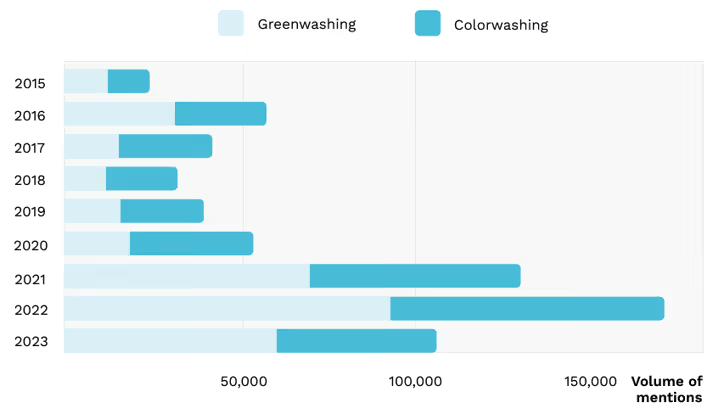
Let’s start with some definitions. Reputational laundering is deliberately hiding unethical behavior with highly visible positive actions. Greenwashing is just one component of reputational laundering. Another component is the social aspect of it, and it includes various forms of color washing such as purplewashing, pinkwashing, purpose washing, etc. So far, in 2023, greenwashing accounted for 55% of all the volume of reputational laundering mentions on the web. So, the remaining 45% represents color-washing.
TerraChoice defines greenwashing as “the act of misleading consumers regarding the environmental practices of a company or the environmental performance and positive communication about environmental performance."
Colorwashing, on the other hand, refers to a strategy used by organizations to create a positive public image by associating themselves with specific causes, ethics, or moral standpoints.
Beyond the conventional understanding of deliberate greenwashing, there’s a more nuanced concept and less discussed: unintentional greenwashing, where companies inadvertently convey misleading environmental claims. This can occur due to a lack of understanding of the true impact of their products or services, unverified claims, overlooking hidden consequences, unintentional confusion in marketing materials, or insufficient transparency. While these companies may not have malicious intent, their actions can inadvertently misrepresent their environmental efforts and mislead consumers about their commitment to sustainability.
Reputational laundering at a glance
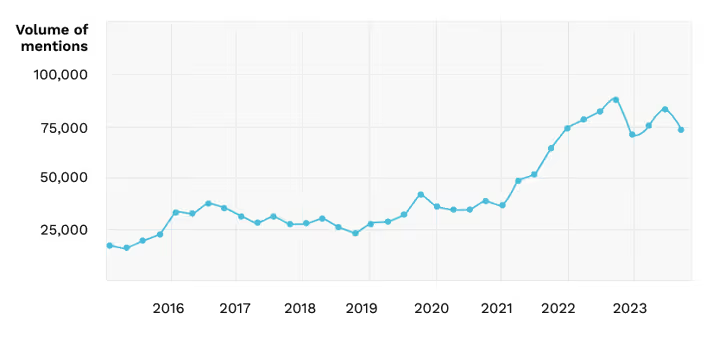
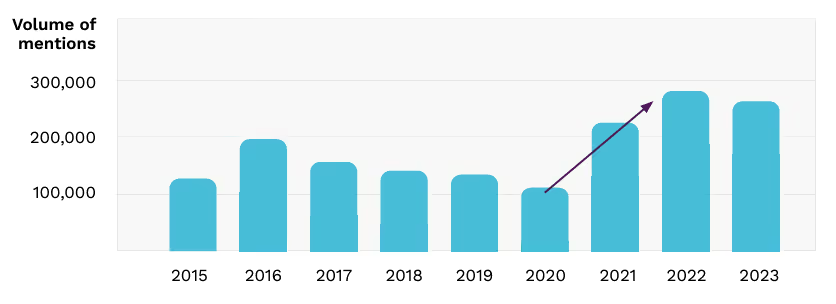
Figure 1: Reputation laundering mentions.
Over the past eight years, reputational laundering mentions have increased steadily. However, from 2021 onwards, they’ve grown a staggering 3.3x. The mentions of reputational laundering are coming from different topics, from false advertising, and misleading practices to lawsuits regarding greenwashing. Furthermore, we have observed a growing number of references regarding the declining trust of the public in corporate pledges, such as those related to 'net-zero' climate goals.
This increase can be attributed to two main reasons: the actual increase in reputational laundering and, more interestingly, the growing awareness from stakeholders (i.e., Investors and eco-conscious consumer base).
According to a report published by the UN Environment Programme (UNEP), climate change lawsuits have continuously surged over the past five years. Consequently, we analyze mentions of lawsuits related to environmental breaches and detect a significant increase in 2021 – which continues to the present day.
While greenwashing often dominates the conversation around reputational risks, it's crucial not to overlook the social dimension, which tends to receive less attention from the public. Since 2020, we've observed a significant uptick in mentions of greenwashing and its less-discussed counterpart, colorwashing.
Historically, up until 2020, the distribution of mentions leaned toward one-third greenwashing compared to two-thirds colorwashing. However, post-2021, this pattern has shifted. We've witnessed a rise in the frequency of greenwashing mentions, surpassing those of colorwashing and signaling an evolution in the focus of reputational laundering concerns.
Figure 3: Breakdown by type of washing.
During the COP27 conference at the end of 2022, a call was made to verify carbon and other environmental claims and show zero greenwashing tolerance. As a result, there has been a rise in scrutiny, and data now shows an increase in the number of allegations related to greenwashing. Here are a few examples:
In analyzing advertisements, we found instances of reputational laundering through various means. Some companies engaged in social washing, while others used sportwashing to bolster their reputation. The mining and energy industries were particularly guilty of this practice. Meanwhile, the communication industry, including companies such as Netflix and Disney, was associated with black and whitewashing.
Inspecting the Regulatory Landscape
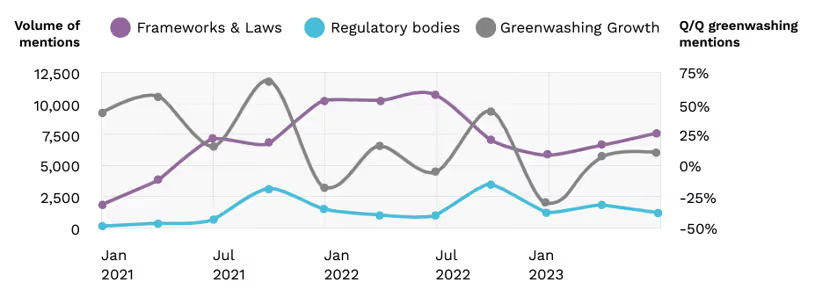
To analyze the regulatory environment of reputational laundering, we studied the effects of different legal frameworks and government organizations on greenwashing and other forms of reputational laundering. We measured the influence of legal frameworks and regulatory bodies on greenwashing by analyzing the quarterly growth of greenwashing mentions over the study period.
In this analysis, we define the concept of legal frameworks by capturing references related to the 'Green Claims' directive, Sustainable Finance Disclosure Regulation, EU Taxonomy, Green Product Certification, Fair Labeling and Advertising Act, Non-Financial Reporting Directive, FTC Act, FTC Green Guides, etc.
Concepts of Regulation bodies are defined by references to governments and Supranational entities (i.e., US government, FTC, SEC, Chinese government, Japanese government, etc.) or regulatory agencies established to safeguard the environment (United Nations Environment Programme (UNEP), Environmental Protection Agency (EPA), European Environment Agency (EAA), Intergovernmental Panel on Climate Change (IPCC), etc.)
Figure 4: Anti-greenwashing regulation vs greenwashing growth.
There has been a slight increase in the mentions of regulatory bodies over the years, mainly due to the growing interest in greenwashing, which has peaked during events like COP26 and COP27. Legal frameworks and regulatory bodies have played a significant role in the fight against greenwashing. Although there is no decrease in the mentions of this topic, the growth rate has reduced significantly. In fact, the quarter-on-quarter growth for greenwashing web mentions has been decreasing lately.
The trends reveal an interesting fact that there is a negative correlation between the growth in mentions of frameworks, laws, and regulatory bodies and the growth in mentions of greenwashing. Though the mentions of greenwashing are still increasing, the growth rate has significantly decreased from a 75% quarterly growth rate to 10% in the last year (except for spikes related to controversial events such as Greta Thunberg labeling COP26 as a “greenwash festival,” and not attending COP27).
Conclusion
As we navigate the landscape of corporate sustainability, it becomes evident that distinguishing genuine efforts from greenwashing is not just a matter of skepticism but a necessity. This exploration underscores the importance of vigilant analysis and the role of AI in unmasking deceptive practices. It calls for a collective commitment to transparency and accountability, empowering stakeholders to make informed decisions and advocating for a future where corporate responsibility aligns authentically with sustainable development.
At SESAMm, we used AI to study billions of articles and analyze greenwashing trends. Download this comprehensive ebook for an in-depth understanding of the evolving landscape of reputational laundering, notably greenwashing, and dive into its trends in the corporate world.
SESAMm’s AI Technology Reveals ESG Insights
Discover unparalleled insights into ESG controversies, risks, and opportunities across industries. Learn more about how SESAMm can help you analyze millions of private and public companies using AI-powered text analysis tools.
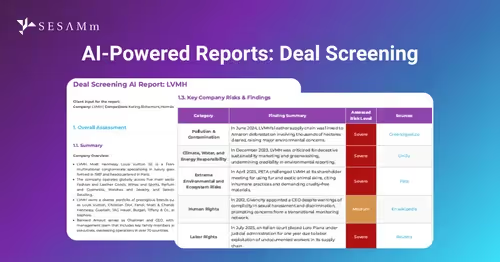
Private equity deal teams and M&A teams are under constant pressure to move faster, screen more opportunities, and avoid costly blind spots. To meet this challenge, SESAMm is expanding its suite of AI Reports with a new offering: the AI-powered Deal Screening Report.
This latest addition gives deal teams the ability to conduct pre-commercial due diligence on any company or project in minutes, not weeks. Not only does it surface insights and risks on the target company, it also provides a full competitive and market analysis.
Faster, Smarter Deal Screening
Built for high-volume, time-sensitive deal environments, SESAMm’s Deal Screening reports act as an early-stage radar: surfacing hidden risks, growth signals, and market dynamics before significant expenses are incurred.
Delivering weeks of manual research in just hours, these reports provide a structured view of target companies to guide where deeper diligence should focus.
Key benefits include:
Faster prioritization: Eliminate weak targets early and shrink the funnel.
Sharper focus: Direct consultants and expert networks to areas that matter most.
Greater confidence: Make earlier, more strategic go/no-go decisions.
Lower costs: Reduce wasted hours and consultant spend on low-value deals.
Supporting the Full Diligence Cycle
Deal Screening reports fit seamlessly into every stage of the diligence process:
Pre-CIM: Shape hypotheses and spot risks before significant time and budget are invested.
During CIM review: Use SESAMm insights to challenge claims and guide expert calls.
Post-CIM: Monitor ongoing sentiment and emerging risks as diligence deepens.
By acting as a bridge to deep diligence, SESAMm ensures consultants and expert calls are focused on what truly matters, helping deal teams allocate resources more effectively and move forward with sharper decision confidence.
A Growing Suite of AI Reports
These new Deal Screening reports are the latest addition to SESAMm’s expanding portfolio of AI-generated reports. From ESG assessments to supply chain and business exclusion screenings, SESAMm provides scalable, AI-powered insights that help firms make faster, smarter, and more confident decisions.
Get Started Today
SESAMm is trusted by 7 of the top 10 private equity firms worldwide, such as Carlyle and Warburg, to deliver AI-powered intelligence at the speed of deal flow. Request a free trial of the Deal Screening report and experience how SESAMm can transform your early diligence process.
SESAMm’s AI Technology Reveals ESG Insights
Discover unparalleled insights into ESG controversies, risks, and opportunities across industries. Learn more about how SESAMm can help you analyze millions of private and public companies using AI-powered text analysis tools.
In our newest research, "ESG Controversies: A Comparative Study of Public vs Private Sectors," our ESG and Research & Analytics teams present an exhaustive study on the nuances of ESG controversies across public and private sectors. We combined artificial intelligence with our extensive dataset of over 25 billion documents to extract ESG controversies in both sectors. This research highlights the increased visibility and scrutiny of public companies compared to the more discretion in private companies. A case study on IKEA uncovers challenges in product safety and human capital, underlining the importance of proactive sustainability practices. The study examines these sectors' alignment with major ESG frameworks, including the UN Global Compact and Sustainable Development Goals, offering invaluable insights for enhancing corporate ESG strategies.
Key takeaways:
Public companies are under constant observation, leading to higher exposure to ESG risks such as pollution, labor disputes, and governance failures. This visibility is partly due to regulatory requirements for transparency, making every aspect of their operations subject to public and investor scrutiny.
Private companies, while benefiting from less regulatory oversight, encounter substantial repercussions from ESG controversies. These can manifest as sudden shifts in investor confidence, challenges in securing financing, or damage to reputation, underscoring the critical need for comprehensive risk management approaches that encompass environmental, social, and governance factors.
The case study on IKEA provides an in-depth look at specific issues like product recalls due to safety concerns and the complexities of managing a global workforce. It highlights IKEA's efforts to implement forward-thinking sustainability initiatives and human capital management practices as key components of its corporate strategy, demonstrating the tangible benefits of such measures in mitigating ESG risks.
ESG controversies and breaches of SDG goals vary notably between public and private sectors. Public companies frequently encounter more visible and consistent ESG risks, while private companies, although subject to less scrutiny, experience significant impacts when controversies occur.
Dive deeper into ESG controversies and uncover strategies for navigating these challenges effectively. Download "ESG Controversies: A Comparative Study of Public vs Private Sectors" and equip your organization with the insights needed to enhance your ESG practices for a sustainable future. Fill out the form below to access your copy and lead the way in corporate sustainability.
Fill out the form to download the ebook.
Stay ahead with the latest in ESG and AI intelligence
Join our mailing list to receive new reports, event invites, and updates from SESAMm directly to your inbox.






.png)