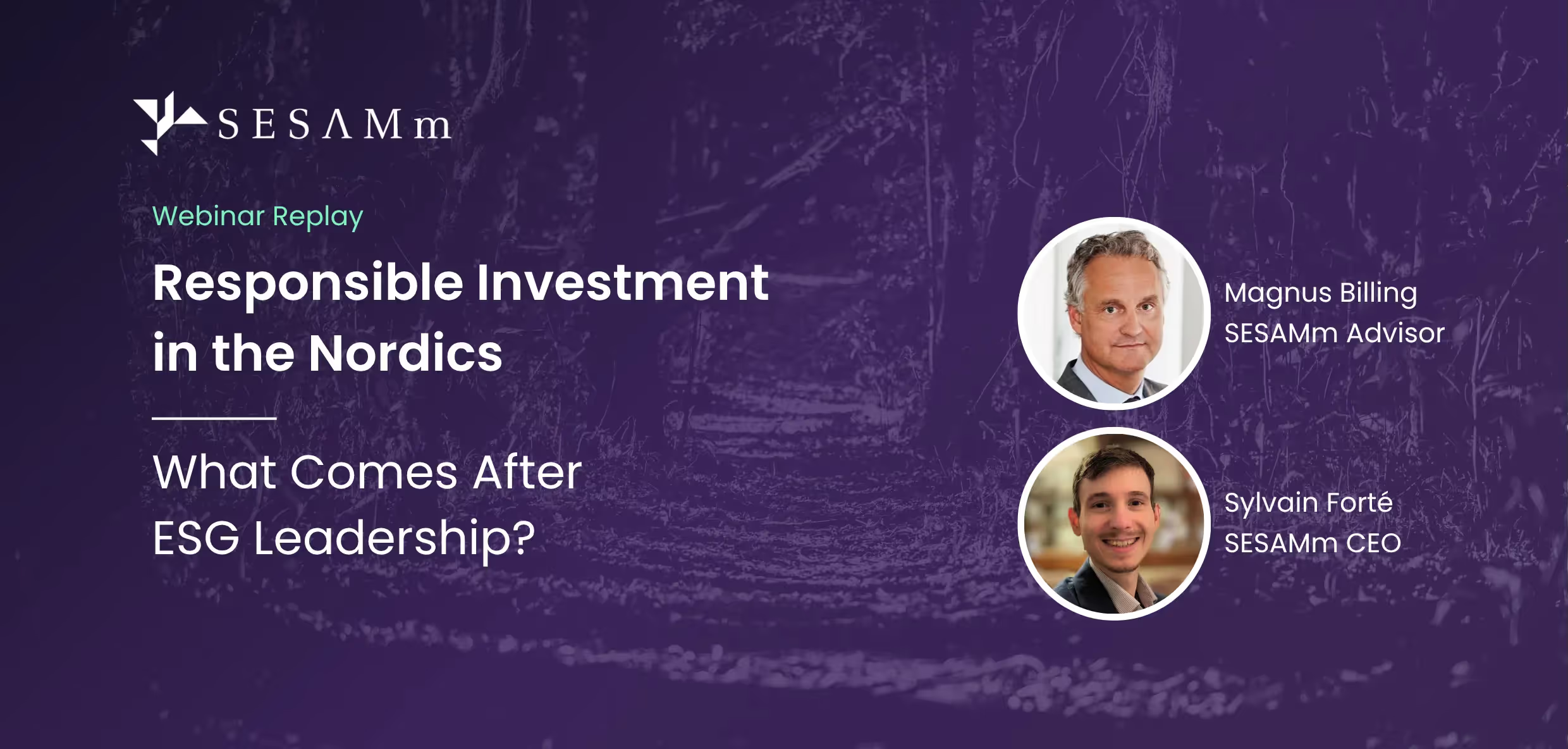
Responsible Investment in the Nordics: What Comes After ESG Leadership?
•
5 mins read
The Nordics have long been global leaders in responsible investment. Nordic banks, pension funds, and asset managers were among the first to integrate ESG considerations into portfolio management and stewardship practices.
But the landscape is changing. Investors now face new types of risks that go beyond traditional ESG frameworks, including geopolitical tensions, supply chain controversies, and fast-moving reputational crises. At the same time, new technologies such as artificial intelligence are transforming how investors detect and interpret these signals.
Join Magnus Billings, SESAMm Advisor, and Sylvain Forté, SESAMm CEO,on April 28th at 4pm to explore how Nordic investors are adapting their responsible investment strategies and what the next decade of risk monitoring may look like.
When Meta's market value declined by $307 billion over four trading days in October 2025, it demonstrated a fundamental shift in how markets process reputation risk. Algorithmic systems detected, interpreted, and priced a narrative misalignment faster than the company's internal coordination process could respond.
This wasn't an isolated event. It reflects how AI has restructured the relationship between reputational events and market consequences.
The Collapse of Sequential Crisis Management
Corporate crisis management has historically relied on sequential stakeholder awareness. A controversy would surface in local media, then spread to analysts, then national coverage, then institutional investors, with retail awareness coming last. This sequence provided time, days, or weeks to investigate, coordinate across functions, and craft targeted responses. AI has eliminated that sequence.
Today, hedge funds run real-time controversy models that trigger trades within hours. Institutional investors receive automated NLP alerts. ESG vendors update scores continuously by scanning billions of multilingual sources. Proxy advisors flag governance risks in near real-time. Retail investors access sentiment apps that surface issues instantly. NGOs monitor local-language supply chain incidents globally. Regulators deploy automated surveillance that detects patterns before companies file reports.
The result: external stakeholders now see the same signals simultaneously. The response window has compressed from 24–48 hours to sometimes just hours.
How Fast Has “Fast” Become?
The compression is measurable. Compare crisis timelines before and after AI became standard:
Pre-AI Era (2010-2020)
BP Deepwater Horizon (2010): Destroyed $60B in market value in one month, ultimately reaching $100–105B over two months.
Wells Fargo fake accounts (2016): Evolved over three weeks, creating multiple response windows.
Boeing 737 Max (2019): Erased $27B in two days, $40B in two weeks, and $62B over five months as investigations unfolded sequentially.
AI Era (2023-2025)
Meta (Oct 2025): Lost $307B in four days once algorithms flagged narrative misalignment.
Bud Light (2023–2025): A single controversy generated $27B in value destruction within two months and sustained 40% sales declines.
Tesla: Recalls and investigations repeatedly triggered rapid volatility across compressed time frames.
The pattern is consistent: crisis timelines have collapsed from months to weeks to days. Regulatory cycles have accelerated as well. The SEC and other agencies now deploy automated surveillance tools, and in several cases, enforcement actions have been disclosed before companies completed internal investigations.
Why Companies Discover Crises Late
Most companies learn about reputational issues after external stakeholders have already detected and acted on them.
Four Categories of Monitoring Tools
Basic keyword tools: Fast, but lack sentiment, context, and depth.
Media monitoring platforms: Broad coverage, high volume, and low material clarity.
AI extraction engines: Add interpretation, but lack access to investor-grade sources.
AI-driven controversy analytics (SESAMm, RepRisk, TruValue Labs, Verisk Maplecroft): Apply large-scale NLP to billions of multilingual data points, including regulatory filings, NGO reports, and local-language media. Platforms operating at this scale - SESAMm alone monitors over 5 million companies across 4 million+ sources, including private firms in low-disclosure markets - provide visibility most corporates do not have.
This is where the detection gap originates: most corporates rely on categories 1–2; markets rely on category 4.
The Coordination Gap
Reputation responsibilities typically sit across Communications, IR, ESG, Risk, Legal, Public Affairs, regional leads, and business units. Each has separate systems and approval paths.
When crises unfold over hours, this structure becomes a bottleneck.
Sector-Specific Amplification Patterns
AI accelerates information flow differently by industry:
Pharmaceuticals: Clinical data travels through medical networks → hedge funds within 4–6 hours.
Financial Services: Disclosure anomalies → lawyers → regulators in days, not weeks.
Consumer/Energy (complex supply chains): Supplier issue → local media → NGOs → retail boycotts in 48–72 hours.
Generic plans fail because velocity is industry-specific.
What Leading Organizations Are Building
Companies adapting to machine-speed markets are focused on closing the detection gap and compressing coordination cycles.
A Pre-release AI Content Analysis
Before major disclosures, leading organizations now assess:
What controversy categories may be triggered
Expected sentiment scores
Governance themes algorithms will extract
Phrases correlated with a negative reaction in their sector
This is not message sanitization, it's anticipating how machines will interpret the content.
Compressed Coordination Frameworks
Organizations have implemented pre-authorized workflows enabling response in 2–4 hours:
Pre-cleared language templates
Simplified approvals
Clear escalation thresholds
Regular simulation exercises
Stakeholder ecosystem mapping
Understanding who detects what and how issues escalate allows for proactive engagement with NGOs, analysts, sentiment communities, short sellers, and others.
Unified monitoring infrastructure
Shared dashboards give all functions real-time visibility into:
Sentiment shifts
Controversy score changes
ESG rating movements
Supply-chain signals
Retail sentiment trends
Some organizations have begun deploying AI agents to automate entire steps: summarizing incidents, assessing severity, and routing them to the correct teams, helping move from detection to coordinated action with far less manual effort.
Financial Quantification
Boards increasingly expect:
Expected volatility ranges
Funding cost implications
Correlation with institutional flows
Proxy voting impacts
Reputation must now be expressed in capital markets language.
The Governance Shift
Reputation is migrating into integrated risk committees with representation from Finance, Risk, Legal, Corporate Affairs, and IR. Some boards now use real-time dashboards with automated escalation.
Controversy detection is being incorporated into materiality assessments, proxy preparation, and disclosure committee processes.
Practical Implications Across Functions
IR explains volatility driven by algorithmic pricing of signals not yet internally detected
Communications must prioritize speed alongside accuracy
Risk quantifies reputation financially
ESG manages real-time score shifts
Legal faces enforcement that may precede internal review
Public Affairs addresses issues that now cross borders instantly
C-Suite must increase coordination speed
Conclusion
AI has compressed crisis timelines from months to days and eliminated sequential stakeholder awareness. Markets now detect, interpret, and act on reputational signals faster than traditional internal processes.
Organizations that close the detection gap and compress coordination to hours rather than days gain measurable advantages in volatility management and stakeholder confidence. The assumption that companies can control when stakeholders become aware of reputational issues is no longer valid. Crisis response must now match the speed at which markets process risk.
Reach out to SESAMm
TextReveal’s web data analysis of over five million public and private companies is essential for keeping tabs on ESG investment risks. To learn more about how you can analyze web data or to request a demo, reach out to one of our representatives.
As the 2022 United Nations Climate Change Conference wraps up, governments and, by proxy, companies are charged with fulfilling new recommendations, especially for non-State entities to commit with integrity to Net-Zero. COP27, as the conference is also called, is the time and place where we claim as a united society at the world's center to make change for the better.
But COP27 is over. Now what? Do we go back to business as usual? Do we wait and see if we stick to any of these new agreements? Or worse, do we say we'll make changes but fall short of making those changes?
I say no. We can do better, and here's why…
We need to talk about climate change
Climate change effects are more than global warming. Global warming consequences include:
Rising sea levels
Stronger and more intense hurricanes
More droughts and heat waves
Longer wildfire seasons
And more
Why do I bring these up? Because all of these effects will impact your business in one way or another.
For example, did you know that the Rhine River, one of Europe's major rivers, is suffering from drought? Water levels are so low that barges are limited, and it's disrupted river cruises because levels are currently 38 centimeters below the minimum required.
The same goes for the Mississippi River in the U.S. The Mississippi River has dropped to the lowest levels they've ever been in 34 years, driving up shipping costs. This challenge is also a big deal because the river carries 92% of agricultural exports.
Also, in the past year, damaging hurricanes and typhoons have damaged infrastructure in South Korea, South Africa, China, Japan, and the U.S., to name a few countries, affecting crops, manufacturing operations, supply chains, and much more across the globe.
I could go on about how each effect influences enterprise, but the bottom line is climate change is bad for business. And supporting companies that enable climate change is also bad for business, which brings us to the topic of environmental, social, and governance (ESG) measures.
We need to talk about ESG
ESG has become mainstream since the UN shared a report in 2006, a joint initiative by a group of financial institutions to develop policies and guidance on how to better incorporate ESG issues in securities brokerage services, asset management, and associated research functions. This introduction has helped industries establish goals through:
Managing ESG risks
Anticipating regulatory action or accessing new markets
Contributing to the sustainable development of their societies
However, with ESG policies come ESG data challenges. For example, ESG measuring, its data, and how companies report them are inconsistent. ESG data providers deal with "data gaps" differently, so their approaches can lead to discrepancies. And as ESG data becomes available publicly, how ESG data providers interpret the data varies, too.
We need to talk about greenwashing
In simplest terms, greenwashing occurs when a company misleads its stakeholders, investors, and consumers about its environmental practices, specifically by communicating positive environmental performance contrary to its actual, less flattering execution.
On the surface, you might think, "What's the big deal? We all exaggerate, right?" But as sustainability awareness among investors and eco-conscious customers grows, so has their scrutiny over business conduct to disclose information about a company's performance and its "environmental-friendly" products. Their scrutiny, coupled with the growing number of companies reporting their environmental footprints, reveals that many companies misreport and publish information about their ecological impacts, which regulators consider misleading or deceptive.
How do we know? Let's take a look at greenwashing mentions by industry.
We analyzed greenwashing mentions in web data. On the X-axis, we list the industries. The Y-axis measures the ratio of greenwashing mentions by N° of companies per industry (N=1166 companies) since 2015; this extraction method corrects sampling bias. Each industry is defined by a significant sample of large- and mid-capitalization-sized companies in developed countries.
This greenwashing mention chart clearly shows that the Energy industry has the highest ratio of greenwashing allegations. While many fossil fuel companies claim to be transitioning into clean energy, most mentions link these companies to advertisements and campaigns that don't align with the Paris Agreement goals. In contrast, fossil fuel companies are growing their carbon-intensive operations and products. It's a concerning trend because according to The Intergovernmental Panel on Climate Change (IPCC) report, "Climate Change 2021: The Physical Science Basis.", the data shows that emissions from fossil fuels are the primary cause of global warming, contributing up to 91% of global carbon dioxide emissions in 2018 as an example.
Second, on this chart is the Financial industry. It has fallen short of its commitments to climate action while continuing to finance fossil fuels. According to eMarketer, financial institutions have allocated $4.6 trillion for fossil fuels while promoting sustainable finance and supporting global energy transition.
Further, the mentions volume has grown year over year since 2015—when it was almost zero—to more than 1500 present day.
Clearly, this greenwashing problem is getting worse. So what can we do about it?
We need to talk about a solution
We don't have any control over what companies will do to fulfill their agreements, but we can understand their ESG data better and make better investment and portfolio decisions.
How? With AI.
AI, specifically natural language processing (NLP) algorithms, help us read billions of news articles, forums, and web text and extract unstructured data for analysis. With SESAMm's TextReveal®, we can see an entity's ESG controversies or events in near real time, providing a unique perspective to ESG data and details, filling the data gaps more accurately.
So when Company A reports on its ESG goals, we can help verify if the results are accurate and find any potential controversies that didn't make the report. We also don't need to wait until ESG reports come out; we can extract this data from the web on an as-needed basis. Moreover, we can look at all types of companies across the globe, public or private. As long as web data exists for an entity (or concept), we can analyze it.
My final thoughts
COP27 might be over, but our agreements and commitments carry on. We have an opportunity today to make a positive difference toward climate change while still maintaining profits. In fact, I think we can be even more profitable if we support green and sustainable initiatives.
I'd like to hear your thoughts; feel free to reach out on LinkedIn and share them with me.
About Alexandre Tiesset
Alexandre Tiesset is the Head of ESG at SESAMm. He's worked in finance for seven years in various ESG-related roles, such as Credit Analyst, Sustainable Investing Specialist, Index Product Specialist, and more. He holds a Master of Science degree in Finance and Financial Analysis. His passion lies in the intersection of finance and general knowledge and making new connections.
Reach out to SESAMm
SESAMm is a leading NLP technology company serving global investment firms, corporations, and investors, such as private equity firms, hedge funds, and other asset management firms, by providing datasets or NLP capabilities to generate their own alternative data for use cases, such as ESG and SDG, sentiment, private equity due diligence, corporation studies, and more.
To learn how you can generate NLP-enhanced ESG data for your firm, or to request a demo, reach out today.
U.S. banks have dramatically increased fossil fuel financing in a notable contradiction with the narrative established after COP26. According to the 2025 Banking on Climate Chaos report, compiled by the Rainforest Action Network and its partners, global banks significantly scaled up their support for the fossil fuel industry in 2024, with a staggering $162 billion increase, pushing total financing to $869 billion.
U.S. institutions are at the forefront of this backslide. JPMorgan Chase, Bank of America, Citigroup, and Wells Fargo accounted for one-third of global fossil fuel financing, approximately $289 billion. JPMorgan alone provided $53.5 billion, a 35% rise in funding that placed it at the top of the global list. Bank of America and Citi each contributed over $44 billion, while Barclays led among European banks, increasing its lending by 55% ($35.4 billion).
Why the Sudden Surge?
This resurgence coincides with the political shift in the U.S. following the Trump administration’s departure from the Paris Agreement and weakened climate policies. In parallel, several major banks have exited the Net-Zero Banking Alliance, prompting environmental groups to accuse them of “walking away from climate commitments.”
What This Means for Climate Risk
The spike in fossil fuel financing carries profound implications. First, it increases banks’ exposure to climate liability risk. A Financial Times analysis cites growing concerns that banks may face litigation due to their financing practices in relation to climate change. Second, funneling money back into carbon-intensive sectors undermines global efforts to limit warming to 1.5 °C; long-term goals rest on systemic transitions away from fossil fuels.
Public Relations vs. Funding Reality
Banks have defended their actions by emphasizing fossil fuels and clean energy investments. JPMorgan, for instance, claims it invested $1.29 in green energy for every dollar in fossil fuel financing. Nevertheless, critics argue that green financing claims ring hollow when fossil fuel funding is simultaneously ramping up.
Rebuilding Credibility in Sustainable Finance
The disconnect between words and actions is a challenge for the financial sector. With growing scrutiny on climate claims, stakeholders demand greater transparency and accountability. Greenwashing has evolved from a reputational issue to a regulatory one, impacting trust and market access. Banks that emphasize climate commitments while increasing fossil fuel investments risk losing credibility. To maintain stakeholder confidence, a genuine transition to clean energy financing is crucial. Trust now hinges on consistent actions rather than just marketing promises, allowing us to build a sustainable future together.
SESAMm’s AI Technology Reveals ESG Insights
Discover unparalleled insights into ESG controversies, risks, and opportunities across industries. Learn more about how SESAMm can help you analyze millions of private and public companies using AI-powered text analysis tools.
Stay ahead with the latest in ESG and AI intelligence
Join our mailing list to receive new reports, event invites, and updates from SESAMm directly to your inbox.