Ebook: Beyond Greenwashing: Unveiling the Spectrum of Colorwashing
July 3, 2025
•
5 mins read
As social values shape consumer expectations, companies are under growing pressure to align with progressive causes. But not all support is genuine. SESAMm’s latest report, Beyond Greenwashing: Unveiling the Spectrum of Colorwashing, explores how brands adopt the language of inclusion, without the action to match.
Colorwashing refers to the use of social justice themes in marketing—such as gender, race, or LGBTQ+ rights—to appear ethical or inclusive while avoiding meaningful change. The report analyzes major forms, including pinkwashing, rainbowwashing, racialwashing, bluewashing, and orangewashing.
Key Takeaways:
Colorwashing is on the rise: Mentions of pinkwashing, rainbowwashing, and blackwashing have grown sharply since 2020.
It’s about image, not impact: Many companies leverage social issues for PR, but fail to back them with policy or internal reform.
Consumers are calling it out: There’s an increasing backlash against symbolic gestures that lack substance, especially during high-visibility moments like Pride Month.
AI can help: Real-time controversy detection enables investors and communications teams to monitor and address potential colorwashing early.
This report is designed specifically for procurement teams, compliance officers, and risk managers who need a fast, scalable way to screen suppliers against exclusion lists, whether for onboarding, third-party due diligence, or ongoing monitoring.
With just a list of company names, the report flags potential involvement in restricted or high-risk business activities, helping you identify potential exposure to sensitive sectors such as:
Fossil Fuels & Nuclear
Weapons & Military Equipment
Predatory Lending
Gambling & Betting
Adult & Violent Content
Severe Human Rights & Labor Violations
Tobacco, Alcohol & Recreational Drugs
Each result is backed by cited sources and a clear explanation of why the company was flagged, bringing transparency to your decision-making process. Delivered in a structured, easy-to-share format, the report helps teams move beyond static exclusion lists and legacy classifications to surface material and reputational risks across their supplier network.
Supply chain complexity is growing - and so is scrutiny from regulators, customers, and investors. With SESAMm’s Supply Chain Screening Report, you can meet this challenge head-on.
As AI continues to reshape how risk and compliance teams operate, we’re expanding our report offerings to cover even more use cases and industries. Stay tuned for what’s next.
Want to see the report in action?
Contact us to learn more or request a sample tailored to your needs.
Sylvain Forté, CEO and co-founder of SESAMm, presented the following at Finovate 2022. In the presentation, Sylvain explains who SESAMm is, what SESAMm does, including examples, and how it benefits our financial clients.
Below is an approximation of this video’s audio content. Watch the video for a better view of graphs, charts, graphics, images, and quotes to which the presenter might be referring to in context.
Hi, everyone. Thank you very much for the opportunity to be with you today. I’m very glad to introduce you to SESAMm. I’m Sylvain, CEO and co-founder of SESAMm.
We’re an artificial intelligence company specializing in analytics for investment professionals and [corporations]. We basically extract billions of articles and messages from the web and transform them into actionable insights to make better decisions. We’re a team of close to 100 people now, and we generate insights from more than 20 billion articles and messages.
Immediate access to daily insights
Let me jump straight to the demo and give you a practical example of what we do. So imagine you’re, for example, a bank looking to compute environmental, social, and governance risks on your portfolio on your clients or on your suppliers. Right now, you may have access to ratings, which are updated once per quarter or once per year. We can give you access immediately to timely daily data on all of your companies in order for you to better assess risks and raise early warnings.
Wirecard use case
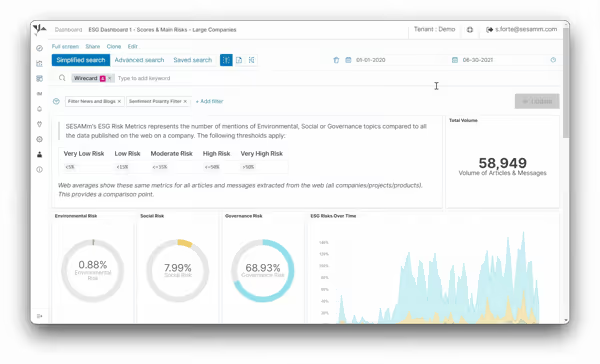
In this specific example (Figure 1), we look at Wirecard, a company that went bankrupt due to a 2 billion fraud scandal in Germany.
We extracted dozens of thousands of articles and messages on the company, and we can immediately see that there is a huge anomaly in terms of governance risk. The company is basically exposed to fraud accusations, to lawsuits, and the like, things that you don’t really want to see in your clients or your own portfolio.
Furthermore, we can see on this chart that we can get that type of indicator every single day. And we can see that six months prior to the company’s bankruptcy, there were already huge alerts actually here in January 2020, indicating that the company was in a pretty bad situation from the perspective of web content and web data from news to social platforms, blogs, and forums.
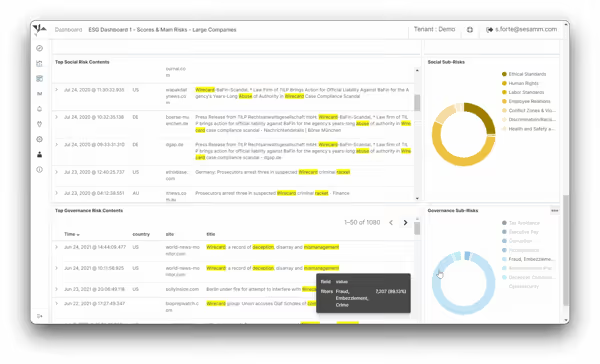
We really have the ability to compute live insights for ESG risk, sustainability monitoring, credit, and similar topics. The advantage of the platform is that we can go very deep. You can see here (Figure 2) some of the underlying governance topics associated with Wirecard, such as fraud, embezzlement, and crime—the main accusation—but also things related to anti-competitive practices or corruption.
Figure 2: Underlying governance topics associate with Wirecard.
And furthermore, the platform enables full transparency. This is AI at scale, but the underlying content is actually text articles and messages that you can read in order to understand the situation and see why the company is in that risk position. So with our platform, with our text analysis engine (TextReveal®), you can immediately extract content on your portfolio, your clients, your suppliers, and for example, generate ESG insights, competitive insights, sentiment insights, or credit warnings, for example.
Trusted, reliable, and abundant insights
We are today trusted by major financial institutions, such as Nomura [Holdings] or Raiffeisen Bank in the banking sector, for example, or large private equity firms worldwide. The reason why they trust us is that we can provide data more quickly—so waiting one day instead of waiting three months—to get an indicator. In addition to that, we have better coverage. We’re the only company in the world that can provide information on five million different public and private companies, meaning all of your banking clients, for example, are covered. And finally, we have access to a large variety of sources, from social content to news and blogs.
Insights beyond companies
Another example that is very common—sadly right now—is clients asking us to follow the Ukraine Russia War and to understand the current situation, including by getting access to local content in local languages in Ukrainian, in Polish, in Russian, to really understand the news and social media out there.
You can see here that beyond companies, we actually track sectors, infrastructure projects, and concepts.
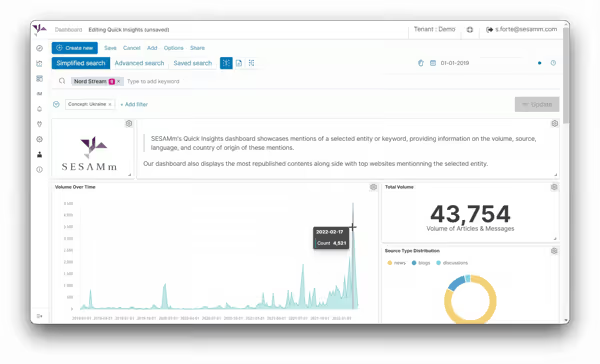
Figure 3: A dashboard view into Nord Stream in the context of Ukraine.
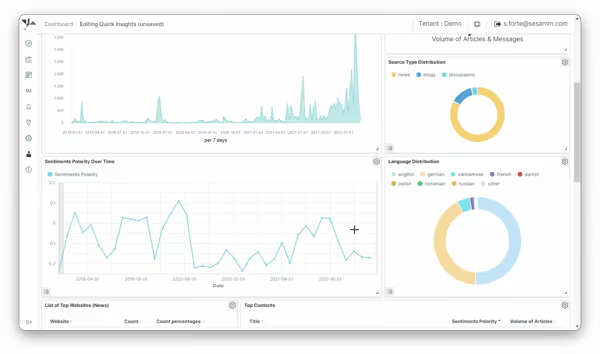
Here (Figure 3), Nord Stream, for example, in the context of Ukraine specifically—so as to understand how these two topics are associated on the web—we can see an explosion in terms of volumes of data over time, the news associating this concept more and more, with more than 40,000 pieces of content. And we can see that sentiment over time, as displayed on this curve (Figure 4), decreases very rapidly, so we see the shock on e-reputation, and we can observe that immediately. And, for example, as a bank or as an asset manager, we can use that to assess the potential risk to clients or portfolio companies.
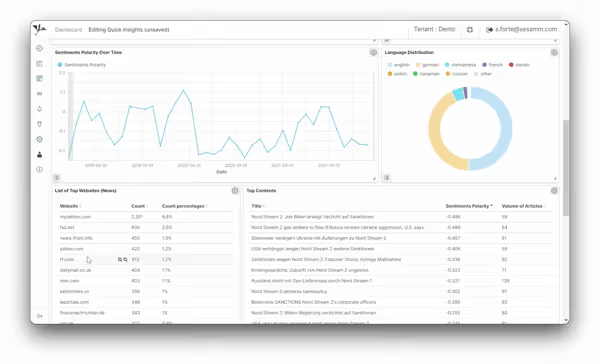
The interesting thing here is that, beyond the graphs and the raw contents, we can look at where the information comes from. Here (Figure 5), you see a lot of information in German, for example, which is not surprising. And you can even follow the Russian propaganda directly from the platform, looking at Russia Today or Sputnik straight from the engine, as these are also sources that we monitor.
Figure 5: The dashboard on Nord Stream shows sources from Germany and Russia.
And as you can see, these contents are highly customizable and can be used in very specific situations. So this is really a platform as a service (PaaS) that we offer. This is an engine that tracks four million different sources of information, and we can track millions of companies but also even fuzzy concepts, countries, or topics of interest.
Generate analytics from big data with API
One last thought. A lot of our clients integrate with our API; it’s a technical solution. We work a lot with data science teams, data engineering teams, risk teams, quantitative analysts, and heads of innovation. All of these teams are looking to generate analytics from big data and from web content at scale, with solutions that are currently used by dozens of clients worldwide and for which we provide very relevant analytics.
I’ll leave you with three final calls to action.
The first one is come see us at our booth. We would be very happy to present the solution in a bit more detail.
The second is, please request a demo. You understand that these indicators can be tailored to your needs in real time. So we’ll be very happy to show you a demo at SESAMm.com.
And finally, come see us for a free proof-of-concept (POC). We would be very happy to show you how we incorporate these solutions in actual banking tools and in risk management tools.
So the web is now readily available as a system that you can use and that you can rely on in order to generate valuable insights. We’re very happy to provide the solution to the market and to help inform better decisions and to help monitor risks.
2018 proved to be an eventful year for SESAMm with multiple renowned customers acquired, our A series fundraising campaign, numerous prizes won and milestones reached. Here is a look back at our rewarding year 2018 followed by our next steps for 2019.
Successful market entry in the US and around the world
The rapid growth of the alternative data industry and of SESAMm
As a Fintech company specialized in alternative data for Asset Management, 2018 represented a thrilling year in our industry and 2019 already promises to be even more exciting.
During 2018, after our very first business trip in the United States, our international sales development beyond Europe began accelerating. In just one year, we already signed contracts with multiple clients. These include major hedge funds in the US and a major global trading company managing $100 billion in financial assets and part of the Top 10 in its market. The US market represents a powerful strategic growth driver and we are already preparing to open an office there soon!
SESAMm signed its first contract with a client in Africa: Ipro Investment, renown asset manager established for 25 years specialized in emerging markets. Finally, we also signed a contract with our first Japanese client, Nikko Global Wrap, one of the subsidiaries of Sumitomo Mitsui Asset Management which is a major asset manager in Japan managing JPY 1.7 trillion.
Strengthening and developing our position in Europe
At the European level, SESAMm has also extended its customer portfolio:
Groupama AM: new major clients and leading French Asset Management players managing €103 billion Asset under Management (AuM);
Société Générale: leading French bank present all over the world;
Raiffeisen Bank International: one of the leading banks in Europe with more than 50,000 employees servicing over 16.5 million customers and possessing around 2,400 business outlets;
GT Patrimoine : the largest consulting and private management firm in the Lorraine area and based in France for 12 years.
In addition, after our 1st successful collaboration, a new contract was signed with Candriam, leading Asset Management firm and members of the New York Life Group, managing more than $112 billion AuM worldwide.
We are very proud to see how much traction we gained in just a year. The growing use and interest in alternative data for the Asset Management industry, both for quantitative and fundamental funds and asset managers, lead us to prepare for new opportunities of growth & business development.
Cutting edge solutions to respond to market needs
Big Data & AI for Cryptocurrencies
Our first cryptocurrency project began in early 2018. Initially, we started tracking the evolution of the most popular cryptocurrencies, such as Bitcoin (BTC) and Ethereum (ETH) and we analyzed their social data to produce social sentiment & emotions indicators. These indicators have since been integrated into our visualization platform of market sentiment, L’Humeur des Marchés.
This led us to establish a unique partnership based on L’Humeur des Marchés with NapoleonX, a major player as the leading French cryptocurrency manager: the first sentiment and emotion cryptocurrencies analysis destined for the general public. Since then, ETH and BTC sentiment, emotions & opinion value from SESAMm has been available to individual investors and the general public on NapoleonX platform.
The evolution of L’Humeur des Marchés
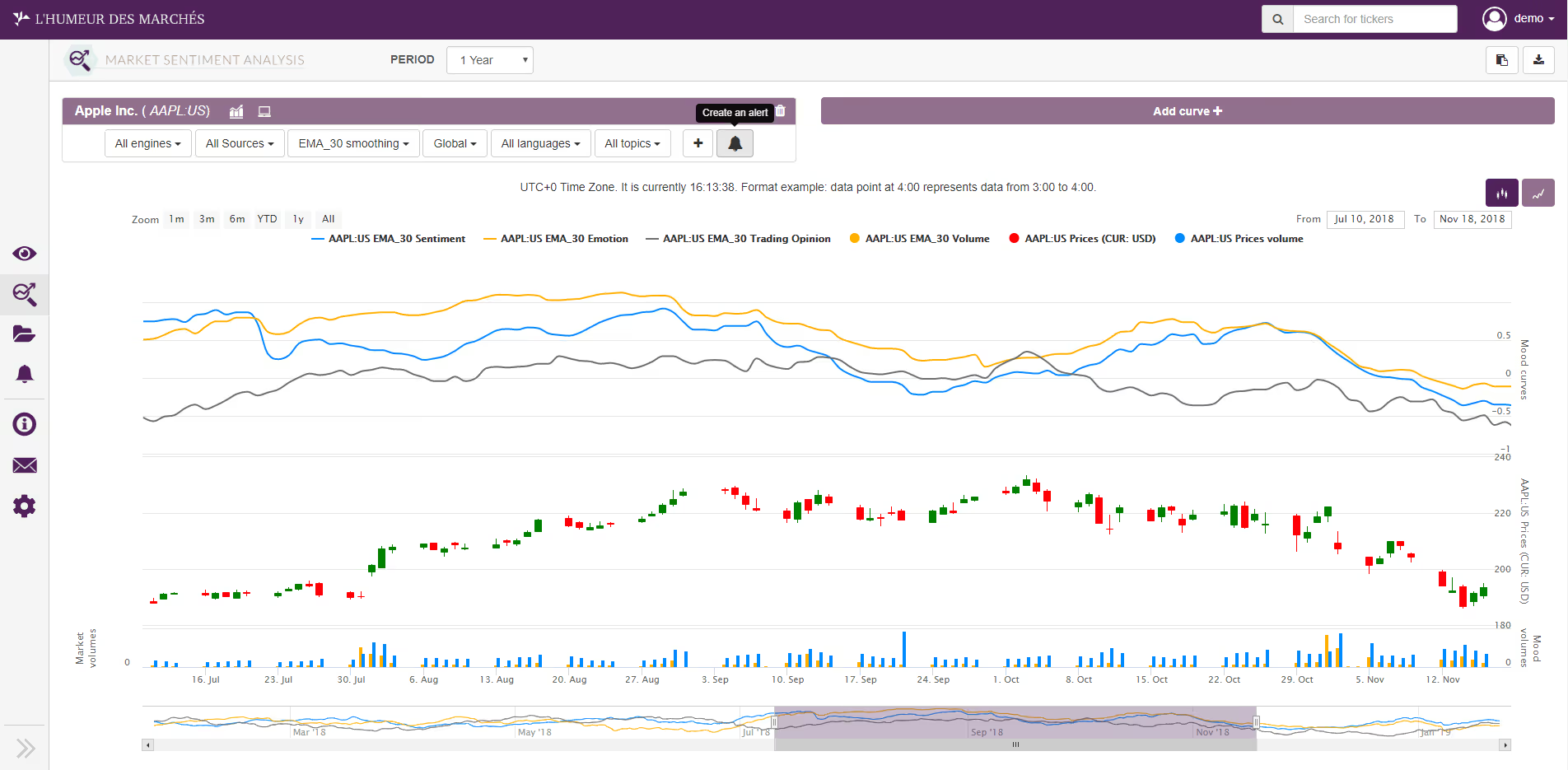
Our platform L’Humeur des Marchés is an essential tool to guide companies in their investments. During 2018, multiple improvements were added into L’Humeur des Marchés to further enhance its insights & analytics. For example, users have now the possibility to build automated strategies which can generate daily trading signals. Multiple new features were also added such as a strategic backtesting system, daily alerts with 3 years of history and day+1 signal to forecast market movements giving asset managers an edge over competitors.
"L'humeur des marchés" is SESAMm's data visualization platform to analyze market sentiment & emotion for asset management
L’Humeur des Marchés, our data visualization platform
Finally, additional filters have been added to better study & analyze market sentiment: there are now 6 different filters for data sources (sort by sources from web & press, news, blogs, discussions, social trading or all of them) and 9 languages covered (sort by English, French, Spanish, Chinese, Japanese, Portuguese, Italian, German or all of them). These new filters allow for a wider and more accurate coverage of assets, leading to improved tools & insights for investment decision.
Global recognition & awards for SESAMm
To accomplish our worldwide ambitions, we have started being more and more present abroad, especially at international events. They represent great occasions to promote SESAMm, demonstrate the unique benefits and advantages brought by our technologies & solutions and finally create business opportunities.
This year, we participated in many international events in the US and in Japan, including New York and Hong Kong for Eagle Alpha’s Alternative Data event, Canada, Africa and even London at the French Fintech Tour.
Having been selected for unique international awards reinforces our confidence in the benefits of our solutions for the Asset Management industry, for example with “Talk data to me” by Neudata, Elevator Lab Competition, and Groupama’s award “Créateur de confiance” (Trust Creator) among others.
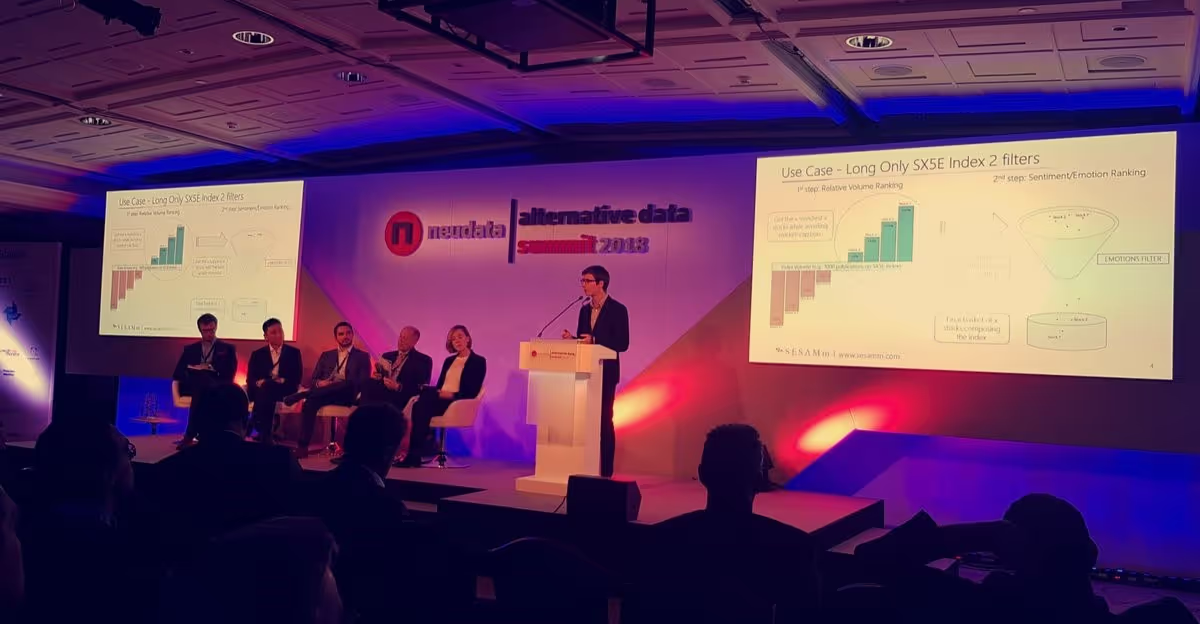
SESAMm won the pitch "Talk data to Me" of Alternative Data Summit event by Neudata
SESAMm pitch “Talk Data to Me” winner during Alternative Data Summit by Neudata
Moreover, SESAMm has competed in several acceleration programs, in which we were selected in the following ones:
Fintech Business Camp Tokyo, the Tokyo Metropolitan Government accelerator program by Invest Tokyo and powered by Accenture;
Elevator Lab, Acceleration program of Raiffeisen Bank International where SESAMm competed and was selected;
French Tech Tour America, IMPACT USA’s program to prepare and discover North America’s markets & opportunities;
Pass French Tech, La French Tech’s highly selective program for hyper-growth startups & companies.
SESAMm’s Demo Day Presentation during Fintech Business Camp Tokyo
SESAMm’s plans for 2019: recruitment, development and growth
This year, we are very proud to see our team grow so much in so little time: we had 16 collaborators at the beginning of January 2018 and we are now a team of 28 members! Talented profiles have joined SESAMm team with NLP, AI & Quant engineers & experts from world-renowned schools. New collaborators will join SESAMm in the first quarter of 2019 and we are still recruiting in various fields such as Data Science, Quantitative Analysis, IT and Natural Language Processing among others. You can find all our offers on our dedicated page SESAMm Career!
Following our international success, especially in the US and in Japan, we are now preparing to open an office in the US in the following months and are already considering this option for Japan. Next month’s promise to be exciting and we will be participating in multiple events such as AI & Data Science for trading in New York in March, Machine Learning in Quant Finance by GFMI in April, and many events & conferences on alternative data, data science, Artificial Intelligence and Big Data for Asset Management around the world.
As you can see, 2018 represented SESAMm an exceptional year for its growth with new customers, including global companies, technological improvements for our solutions & services and a bigger and even more motivated team! Our major event in 2018 was the accomplishment of a €2.6 million Series A fundraising campaign, which enabled us to continue our international development, mainly in America and Asia, and the recruitment of many profiles. 2019 will represent another step for SESAMm to become a leading company in the alternative data solutions in the world. Stay tuned: SESAMm news will arrive soon!
Stay ahead with the latest in ESG and AI intelligence
Join our mailing list to receive new reports, event invites, and updates from SESAMm directly to your inbox.



.avif)



.png)