Forced labor remains among the most pressing human rights challenges for companies worldwide. Despite stronger regulations and corporate pledges, millions remain trapped in exploitative conditions, often deep within complex global supply chains.
As new laws increase scrutiny and liability, the cost of blind spots is rising. Investors, corporates, and private equity firms alike must now demonstrate active due diligence or face legal, financial, and reputational consequences.
In this whitepaper, SESAMm explores:
The tightening global regulatory landscape on forced labor
Exclusive data-driven insights from SESAMm’s AI platform on labor-related controversies
Real-world case studies revealing how risks can remain hidden despite compliance efforts
Download the report to learn how data and AI are transforming the fight against forced labor - and how organizations can move from reactive to proactive risk management.
Tokio Marine & Nichido Fire Insurance Co., Ltd. (TMNF) tapped SESAMm for a joint research venture to predict future stock price movements and discovered two key findings:
NLP data from news and social networking websites can have strong relationships with investor behavior. Thus, it’s possible to forecast investors’ rational reactions to changes in data and price movements based on those relationships.
NLP data proved to help anticipate tail events. For example, given the macroeconomic environment of the last 10 years, the stock market performed well. So in this context, investors are sensitive to negative narratives in times of uncertainty, such as the 2015 market sell-off, the U.S.-China trade war, the coronavirus pandemic, and the start of the Ukraine-Russian war, and post their concerns online.
Providing safety and security since 1879
Tokio Marine Insurance Company was first established in 1879. Over the years, it has added products and services, acquired other businesses, and merged with other companies to eventually become Tokio Marine & Nichido Fire Insurance Co., Ltd. Commonly called Tokio Marine Nichido today, the company is a property and casualty insurance subsidiary of Tokio Marine Holdings, the largest non-mutual private insurance group in Japan. Its products and services provide safety and security to its clients and partners, contributing to more fulfilling lifestyles and business development.
One of the company’s philosophies is to be a good corporate citizen and fulfill its social responsibilities, including protecting the global environment, promoting human rights, creating a responsible working environment, and contributing to society and individual local communities. Recently, the Emperor of Japan awarded Tokio Marine Holdings, Inc. the Medal with Dark Blue Ribbon for donating to the Japan Student Services Organization to support students who face financial difficulty during the COVID-19 pandemic. Individuals, corporations, or organizations are awarded the Medal with Dark Blue Ribbon for their outstanding contributions to the public.
Transforming and accepting the challenge to grow
According to TMNF, “The business environment surrounding the insurance industry is changing at a faster pace than ever due to changes in demographics, advances in technologies, such as autonomous driving and AI, and longer-term trends, such as the intensification and frequent occurrence of natural disasters, as well as further progress in digitalization due to the COVID-19 pandemic.”
“The business environment surrounding the insurance industry is changing at a faster pace than ever…”
“While these changes in the business environment pose a threat, we consider them to be excellent opportunities for transformation and the creation of new value.” So they’ve adopted the concept, “Transformation (“X”) and Challenge to Growth 2023: Aiming to be the company most chosen for quality and its passion.” Ultimately, it strives to support customers and local communities in times of need while contributing to social responsibility. Five social issues that it will prioritize are:
Global climate change and the increase in natural disasters
The increased burden of long-term care and healthcare due to the aging of society and advances in medical technology
Technological innovation and its effects on the environment
Symbiotic society and responding to the novel coronavirus
Industrial infrastructure and how it supports economic growth and innovation
Leveraging a partner with the right technology
To secure and protect its clients’ assets while elevating social issues, Tokio Marine Nichido sought out an edge in the stock market. Under these circumstances, it was fortunate that TMNF discovered SESAMm in 2020 through the Plug and Play Japan program, a platform with an event that connects Japan to markets abroad. SESAMm had presented its NLP alternative data solution, TextReveal®, to which TMNF considered the platform for access to alternative data and sought collaboration with the SESAMm team for a research project.
“SESAMm has the technology to extract text sentiment from news data with a neural network.” – Tokio Marine & Nichido Fire Insurance Co. Ltd representative
Extract relations between NLP data and the financial market
In 2021, Tokio Marine Nichido Insurance began collaborating with SESAMm to develop an AI analytics model for alternative data. It models the impact of news and social networking data on investor behavior for stock and bond markets, transforming text information into knowledge usable by TMNF. For instance, when the model detects a negative narrative raising uncertainty in the market, investors can use this signal to reduce their risk exposure.
Predicting future stock price movements from news and social media data
Tokio Marine Nichido and SESAMm’s joint research found that natural language data from news and social networking sites effectively predict future stock price movements. In the case involving the pandemic, for example, there was a time lag of as long as a month between the time COVID-19 became news and the time it affected the U.S. stock market (Figure 1). By using SESAMm’s technology to analyze news data during this period, the team found that US news and social networking sentiment had already deteriorated sharply before stock prices reacted. This sentiment deterioration is due to the fear of the coronavirus-spread effect on the global economy. In an all-time high S&P 500, U.S. investors did not initially consider this risk. In comparison, HSI companies were closer to the coronavirus spread risk, resulting in HSI investors reacting ahead of those in the U.S.
Figure 1: In 2020, U.S. news sentiment falls ahead of the stock market in response to COVID-19 concerns.
The model can calculate sentiment for each company by analyzing the news of individual companies. It’s also possible to create a composite to measure the sentiment related to a stock index. The sentiment data also helps management and investor relations because it provides a quantitative means of understanding the extent to which investors are concerned about certain news about their company.
Verifying the results
Verification using Japanese has revealed that the timing of bottoming and ceiling of text sentiment precedes those of stock prices. The collaborating team compared the performance of:
A model that uses only orthodox financial and economic data as inputs
A model that considers NLP and financial and economic data, confirming that the latter could generate higher alpha
Figure 2: Back-testing confirms that SESAMm’s equity model can predict a market downturn, capturing changes in text sentiment and reducing positions ahead of market crashes.
Since measuring sentiment is mean reversionary by nature, the TMNF team believes it provides good support for position management during rallies and crashes. It’s also valuable for avoiding forced loss-cut at the bottom when liquidity temporarily evaporates and the market crashes.
Expanding the research to other use cases
In addition to analyzing the stock market, Tokio Marine Nichido also expanded the scope of the research to include R&D on using natural language data in trading U.S. high-yield bonds. Research shows that NLP data can help provide a hedging signal for the negatively skewed high-yield market (Figure 3) by capturing deteriorating text sentiment (Figure 5). For example, these signals can inform investors to reduce positions before market reactions.
Figure 3: NLP data can help provide a hedging signal by capturing deteriorating text sentiment.
Figure 4: An NLP-informed high-yield strategy can outperform the U.S. high-yield total return index and a strategy without NLP. Same volatility level for the three back-tests.
TMNF is also applying the research to estimate the Fed’s stance—hawkish or dovish—using natural language data, too. It hypothesizes that the market will be focused on the Fed’s stance on interest rate hikes in the next few years.
“The model developed in collaboration with SESAMm is simple in structure, yet, it’s an orthodox and robust model that uses valid data as input.”
Summarizing the collaboration
In developing models, Tokio Marine Nichido believes it is essential to consider “what data to consider” and to keep it simple. And TMNF achieved these tenets. The model developed in collaboration with SESAMm is simple in structure, yet, it’s an orthodox and robust model that uses valid data as input which is preferable to a risky over-fitting by increasing complexity.
Figure 6: The joint Tokio Marine Nichido and SESAMm NLP alternative data model: Simple yet robust.
Get in touch with SESAMm
To learn more about Tokio Marine Nichido’s case study or to request a TextReveal demo, reach out to us here:
In theory, a portfolio with no ESG controversies signals low risk. In practice, experienced analysts treat it as a warning sign. The absence of alerts often reflects not resilience, but limited coverage, fragmented data, or incomplete aggregation. What looks like reassurance may instead point to a gap in visibility.
This dynamic matters more than ever as private market due diligence intensifies. With fewer deals, longer holding periods, and higher selectivity, investors are spending more time scrutinizing assets before acquisition and monitoring them for longer after entry. Yet the informational foundation behind many ESG assessments has not caught up with these expectations.
When "No Data" Becomes "No Risk"
Private assets operate under persistent disclosure constraints. Unlike public companies, most private firms do not produce standardized, recurring ESG disclosures, nor do they benefit from consistent analyst coverage. These gaps are structural and unlikely to disappear in the near term.
In this context, silence is ambiguous. A clean ESG screen may indicate the absence of material issues, but it may just as easily signal that no relevant information was captured. Language limitations, fragmented sources, and uneven coverage across geographies and asset types all contribute to this uncertainty.
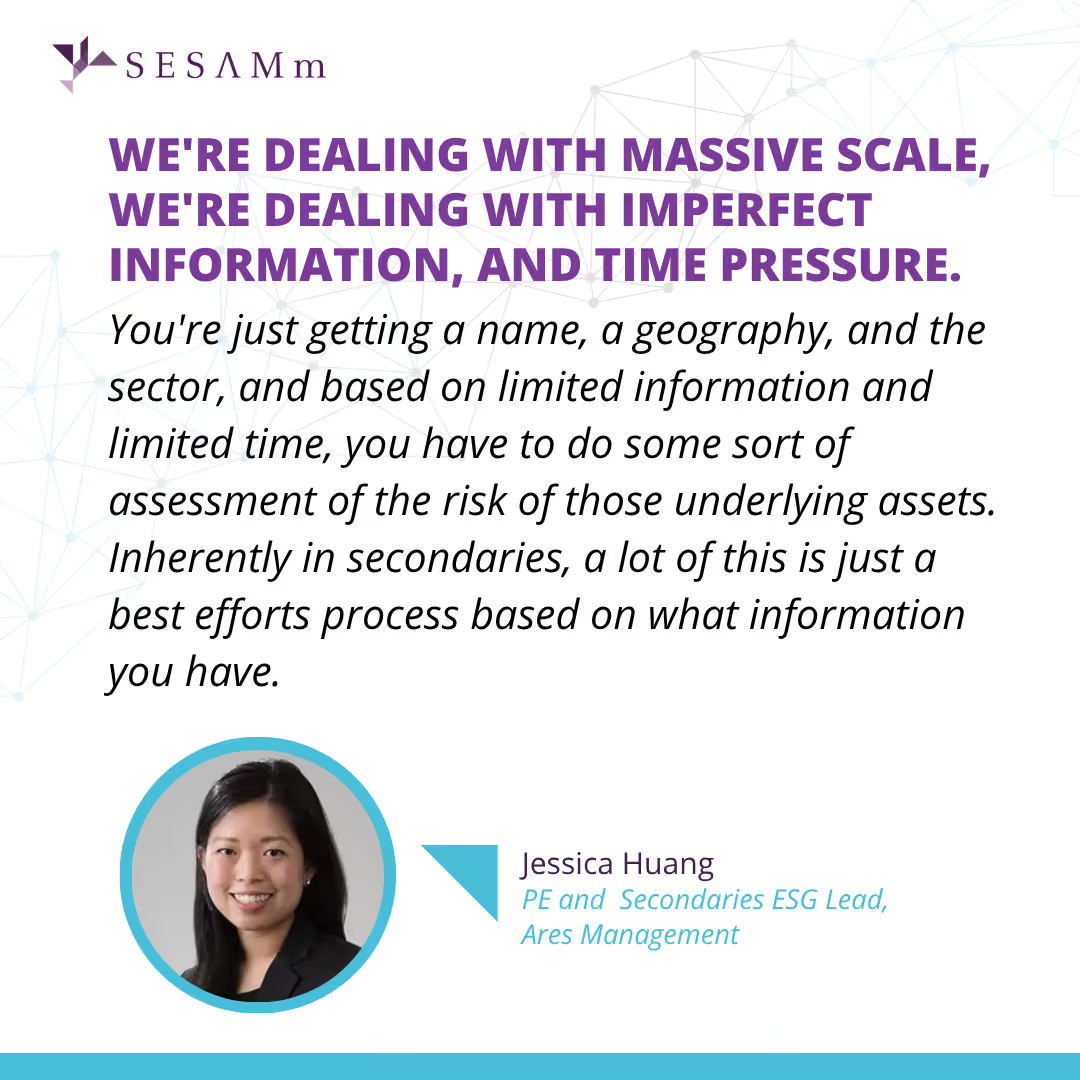
This dynamic is particularly visible in secondary transactions. Deal teams often need to assess large portfolios under tight time pressure, with limited access to management and incomplete identifiers. In such cases, relying on the absence of signals can create false confidence rather than reduce risk.
How Weak Coverage and Duplicated Signals Create Blind Spots
Even when information exists, it is not always immediately actionable. Adverse media has become a valuable substitute where structured ESG data is limited, offering outside-in visibility into private assets. However, it is not without challenges. Without robust aggregation and cross-language consolidation, the same issue can appear repeatedly across multiple articles, jurisdictions, and languages, creating duplication rather than clarity. At the same time, gaps in coverage or weak filtering can allow other material risks to go undetected.
At the same time, some portfolios appear unusually quiet simply because the underlying assets fall outside the scope of traditional datasets. ESG and reputational expectations in private markets remain fragmented, with bespoke workflows driven by LP-specific requirements. This lack of convergence makes it difficult to distinguish between genuinely low exposure and analytical gaps.
More data does not automatically resolve this problem. Without traceability, source quality, and a way to assess financial, legal, or operational materiality, increased volume can add noise without improving decisions. In that environment, silence can be just as misleading as signal overload.
What Meaningful ESG Visibility Looks Like Under Disclosure Constraints
A core takeaway from the webinar was that point-in-time ESG assessments are no longer fit for purpose in private markets. A single diligence exercise conducted at entry cannot capture emerging governance failures, litigation, reputational issues, or supply chain risks over multi-year holding periods.
Instead, meaningful ESG visibility combines three elements:
Broad coverage, to avoid portfolios appearing "low risk" simply because assets are not captured.
Aggregation and severity assessment, to separate isolated news from controversies with real financial or operational implications.
Continuous monitoring, so the original risk thesis evolves as new information emerges rather than remaining static.
This approach reframes ESG from a compliance exercise into a source of informational advantage. Rather than concluding that no alerts mean no risk, investors use ESG signals to guide follow-up questions, prioritize deeper diligence, and identify issues that were not visible at entry.
Replacing False Comfort with Informed Uncertainty
Private markets will continue to operate with imperfect information. Disclosure gaps, opaque supply chains, and bespoke reporting demands are inherent to the asset class.
Treating “no issues detected” as a conclusion creates false comfort. Treating it as a hypothesis, contingent on coverage quality and monitoring depth, aligns ESG analysis with how risk actually emerges in private assets.
SESAMm’s AI Technology Reveals ESG Insights
Discover unparalleled insights into ESG controversies, risks, and opportunities across industries. Learn more about how SESAMm can help you analyze millions of private and public companies using AI-powered text analysis tools.
November 11, 2022, FTX, a $32 billion cryptocurrency exchange company that many believed would “change the world,” filed for bankruptcy. This news shook the crypto and financial communities, compelling many to debate the future of the crypto market and its platforms.
How did FTX collapse?
You could say that FTX’s collapse began before the news broke, but here’s a summary of events as The New York Times and ABC News details:
Breaking news
In early November, CoinDesk, a crypto publication, broke the news on a leaked document from FTX. The balance sheet showed that the hedge fund run by Sam Bankman-Fried (SBF), Alameda Research, held a substantial amount of FTT tokens. In short, SBF had set up Alameda (his trading firm) and FTX (his exchange firm) in such a way that if one unit experienced trouble, such as dropping cryptocurrency prices, the other experienced it, too.
First domino falls
By the way, FTT is used for various functions, including traders’ payment of operation fees. Also, by the way, Changpeng Zhao, Binance’s Chief Executive, sold his stake in FTX to SBF in 2021, partially with FTT. So, “due to recent revelations,” Binance (Zhao) announced on November 6, 2022, that it would sell its FTT tokens.
Other dominos follow
Traders responded; they hurried to pull funds out of FTX out of fear, and FTT’s price fell. Meanwhile, FTX processed withdrawal requests over three days, amounting to an estimated $6 billion. The liquidity crunch was upon it.
Then, on November 8, Binance said it would bail out FTX. But on November 9, Binance backtracked and announced in a Tweet that it would not “as a result of corporate due diligence,” while also citing regulatory investigations and reports of mishandled funds.
Things get worse
The next day, November 10, the Securities Commission of the Bahamas froze FTX’s assets, citing the public statement about potentially “mishandled” and “mismanaged” customer funds. On November 11, FTX filed for Chapter 11 bankruptcy protections, and SBF resigned as CEO. John J. Ray III—famously known as the CEO who headed the infamously known energy company, Enron, through its collapse in the 2000s—replaced SBF on November 17.
Fallout
Today, FTX faces federal investigation for securities laws violations based on a report by The Wall Street Journal regarding FTX lending customer deposits to Alameda Research for liabilities, of which the company’s top executives were aware. Investors have suffered loss, traders have suffered loss, and the greater crypto community and regulators are asking questions.
FTX and SBF web data analysis
News about FTX’s collapse generated tons of web data for us to scour. With this data, here’s what we aimed to find out:
How did the public web react to FTX’s collapse?
Could we have seen red flags before the news broke?
What was FTX’s collapse’s effect on the cryptocurrency market’s sentiment?
Is it possible to evaluate cryptocurrency exchange companies’ ESG risks and opportunities?
Was FTX’s collapse unprecedented? If not, what does web data tell us about that?
FTX and Sam Bankman-Fried mentions analysis
Web public sentiment for FTX and SBF was consistently positive until Q1 of 2022. As mentions volume increased, their sentiment polarity decreased (Figure 1). The mentions spike for both in November when CoinDesk broke the news. Likewise, polarity dips into the negative range for both.
Definition: Polarity represents the aggregate of positive and negative sentiments (opinions or reviews) on a company. A 0 score means there is as much positive as negative sentiment expressed. The dotted and dashed lines represent sentiment in the following charts.
Figure 1: FTX and SBF mentions and sentiment over time.
Looking closer at Q1 (Figure 2), we find that mentions affecting sentiment increased for FTX and SBF during this period. What are the mentions about, and why did they affect polarity negatively?
Figure 2: FTX and SBF pre-bankruptcy mentions and sentiment.
It turns out that SBF is linked to other keywords—we call these co-mentions—and between January 2022 and November 2022, SBF/withdrawal co-mentions (Figure 3) spiked in July when SBF defended Terra Luna’s founder, who was accused of peddling a Ponzi scheme.
Figure 3: FTX and SBF withdrawal co-mentions.
If withdrawal co-mentions brought up possible reasons why SBF and FTX experienced dips in sentiment, what other co-mentions could give us more insight? How about donations, SEC, and U.S. elections?
Figure 4: Donations, SEC, and U.S. elections co-mentions with SBF.
Corporate governance stands out when evaluating SBF’s ESG risks, but his social risks are nothing to ignore either.
Figure 5: SBF governance risks over time.
Two areas of governance risks to note are money laundering and board of directors (Figure 5). Money laundering as a co-mention has been an issue as early as February 2022, but it became a bigger issue in October. These risks may be popping up due to allegations of manipulating the price of the APT token and a securities violations probe.
If you’ve read this far, you by now get an impression of FTX and SBF, from mention volume to sentiment analysis and ESG risk. But how did FTX’s collapse affect the overall cryptocurrency market? Let’s find out.
In comparing the sentiment polarities for FTX and the crypto market from January 2021 through November 2022 (Figure 6), the sentiment for crypto remains relatively steady despite FTX’s sentiment taking a hit.
Figure 6: Effect of FTX collapse on the crypto market.
When comparing other cryptocurrency exchanges to FTX (Figure 7), sentiment polarity for them is hardly affected, except Binance, because of its connection with FTX. Oddly enough, eToro experienced a boost in sentiment, possibly because of its core values around openness and transparency, the fact that they’ve been around since 2007, its early compliance with regulations (i.e., AMF, FCA, ASIC, BaFin, and ACPR), and that it also proposes investing in stocks and ETFs, a contrast to most other crypto market exchanges. Bitfinex has its own issues, so its dip in sentiment might not be correlated.
Figure 7: FTX sentiment comparison across competitors.
At this time, FTX’s ESG risks based on the mention volume are only surpassed by Bitfinex (Figure 8), which its risks are based on many other reasons we won’t get into in this article.
Figure 8: FTX and competitors ESG risks by mention volume.
Centralized vs. decentralized crypto exchange platforms
FTX’s collapse also affected sentiment around the centralized vs. decentralized debate. Since October 2022, sentiment for centralized exchange platforms, such as FTX and its competitors, has fallen (Figure 9).
Figure 9: Centralized vs. decentralized mentions and sentiment over time.
Likewise, the mention volume for self-custody has more than doubled in the last couple of months (Figure 10). Although centralized platforms offer quicker and easier access to crypto trading, traders are considering complex but more secure options such as crypto wallets and keys because, like banks, centralized exchanges can do what they will with cryptocurrency while it’s in their possession. With self-custody, owners are in control.
Believe it or not, FTX was not the first crypto exchange to collapse. In 2014, Mt. Gox—the biggest crypto exchange at the time—lost half a billion dollars worth of Bitcoin due to a hack. How did Mt. Gox’s collapse affect sentiment for the crypto market then? The short answer is: It didn’t.
Figure 11 shows that while Mt. Gox’s sentiment polarity fluctuated, even reaching negative territories, the sentiment for the crypto market remained relatively stable and positive.
Figure 11: Mt. Gox and crypto sentiment comparison.
Is FTX’s collapse a warning for investors?
Our analysis is that investors should treat cryptocurrency exchanges like any investment opportunity. Do your due diligence and monitor your portfolio with tools like SESAMm’s TextReveal®.
As for the cryptocurrency market, data shows that sentiment for it remains level and positive. We speculate that cryptocurrency and centralized exchanges are here to stay. However, based on historical data and current news, we suspect conversations about crypto regulations to increase.
Reach out to SESAMm
For a deeper analysis of FTX’s collapse and access to all charts and supportive-article links, reach out to a representative today.
Stay ahead with the latest in ESG and AI intelligence
Join our mailing list to receive new reports, event invites, and updates from SESAMm directly to your inbox.