SESAMm Recognized in the AIFinTech100 List for Pioneering AI Solutions in Financial Services
June 26, 2024
•
5 mins read
Paris, France – June 25, 2024 – SESAMm, a leader in AI-powered text analysis for financial services, proudly announces its inclusion in the AIFinTech100 list by FinTech Global for the second consecutive year. This recognition highlights SESAMm's commitment to sustainability and ESG through the application of advanced AI technologies.
FinTech Global's annual AIFinTech100 list, now in its fourth year, showcases the top 100 AI companies that are revolutionizing the financial services industry. The list is carefully curated by a panel of industry experts who evaluate over 2,000 fintech companies worldwide. This year’s criteria focused on the transformative impact and the innovative use of generative AI in financial services, from banking and insurance to investment and customer experience.
"We are honored to be listed again on the AIFinTech100. This recognition highlights our leadership in employing AI to detect ESG controversies, helping our clients proactively manage risks and uphold sustainability commitments,” said Sylvain Forté, SESAMm’s CEO. “At SESAMm, we aim to transform financial analysis by ensuring it is as responsible as innovative."
FinTech Global director Richard Sachar said "SESAMm has been selected for the AIFinTech100 list due to their exceptional capabilities in ESG controversy detection using AI. Their technology plays a pivotal role in enabling the financial industry to address and navigate ESG risks effectively, marking a significant advancement in sustainable finance."
The inclusion of SESAMm in this year's AIFinTech100 comes at a time when the financial sector is increasingly relying on AI to enhance operational efficiencies and customer interactions. With AI investments in FinTech expected to reach $44.08 billion by 2024, SESAMm continues to lead the charge by providing cutting-edge solutions that address the complex needs of today’s financial institutions.
About SESAMm
SESAMm is an innovative fintech firm specializing in AI-powered text analysis for asset managers, private equity firms, and financial institutions. Its flagship product, TextReveal, offers actionable insights into ESG risks and investment opportunities, cementing SESAMm’s role as a leading provider of financial intelligence and predictive analytics.
For more information about SESAMm and its innovative solutions, please visit www.sesamm.com.
SESAMm’s AI Technology Reveals ESG Insights
Discover unparalleled insights into ESG controversies, risks, and opportunities across industries. Learn more about how SESAMm can help you analyze millions of private and public companies using AI-powered text analysis tools.
In a landmark move for sustainable finance, the UK government has announced plans to regulate ESG (Environmental, Social, and Governance) ratings providers. The Financial Conduct Authority (FCA) will soon be tasked with overseeing these firms, marking a major shift from the current hands-off approach. This development comes amid growing concerns about the inconsistency, opacity, and influence of ESG ratings on investment decisions.
Why Regulate ESG Ratings Providers?
The regulatory gap in ESG ratings is clear when compared to traditional credit ratings. Credit rating agencies (like S&P, Moody’s, and Fitch) operate under strict regulatory oversight and well-defined methodologies, which is one reason their assessments tend to be closely aligned. In fact, one study found the top credit agencies’ ratings are 99% correlated, whereas ESG ratings from different providers showed only about 60% correlation. In practice, that means two ESG raters might disagree as wildly as “AAA” vs “BBB” for the same firm in the same period. By contrast, it’s rare to see such divergence in credit ratings because that industry has long been supervised and standardized.
Absent regulation, ESG ratings have been opaque and inconsistent. Regulators and market watchdogs have likened the ESG ratings arena to a “Wild West” in need of a sheriff. An environment “unregulated and opaque” where even companies with poor environmental track records can sometimes score surprisingly well. The lack of transparency in how ratings are determined makes it hard for investors to trust what an ESG score truly reflects. This opacity not only fuels skepticism but also raises the risk of greenwashing, where unsustainable companies might hide behind inflated ESG scores.
New oversight aims to bring transparency, consistency, and trust to ESG ratings. Authorities around the world are now stepping in. For instance, the UK government has introduced legislation to bring ESG rating providers under the Financial Conduct Authority’s remit. Similarly, European regulators (ESMA in the EU) and others in Japan and India are moving toward tighter standards. The consensus is that ESG ratings need basic guardrails, much like credit ratings, to ensure they are rigorous, reliable, and free of conflicts of interest. As one analysis noted, if a credit rating agency were to suddenly downgrade scores at the scale we’ve seen with ESG re-ratings, regulators would have intervened immediately. Treating ESG ratings “similarly” to credit ratings in terms of oversight is increasingly seen as necessary to prevent nasty surprises (read: unexpected discrepancies) and to maintain market stability.
Regulation can address several issues: it can mandate clearer methodological transparency, require disclosure of rating drivers, and enforce governance standards (for example, to manage conflicts of interest if a rater also offers paid consulting). All of these steps would help investors and companies finally peek behind an ESG rating. In other words, examine the underlying factors, rather than taking scores at face value. Ultimately, effective regulation should turn ESG ratings from a black box into a more consistent, credible tool for decision-making.
What the UK Plans to Do
Under the new legislation, any ESG ratings provider serving UK clients will be required to obtain authorization from the FCA. These firms will need to disclose their methodologies, manage conflicts of interest, and maintain proper governance controls. The regulation is designed to align with international recommendations, such as those from IOSCO, and mirrors similar efforts already underway in the EU.
The goal is to bring greater transparency, comparability, and accountability to a market expected to grow significantly in the years ahead. The FCA plans to consult on specific rules later this year, with implementation expected to phase in over time.
Why This Matters
Bringing ESG ratings under regulatory oversight could be a turning point for sustainable investing. With consistent standards and greater clarity on how scores are determined, investors can better understand the rationale behind ratings and compare them more effectively. It could also reduce the risk of greenwashing by forcing providers to show their work.
Of course, some concerns remain. Smaller ESG ratings firms may struggle with the cost of compliance. Others worry that regulation could stifle innovation or lead to market consolidation. But broadly, the move has been welcomed by investors and industry groups as a necessary step toward improving trust in ESG data.
As global regulators push for greater alignment, the UK's framework could help shape a more transparent and robust ESG ratings ecosystem - one that better serves both capital markets and long-term sustainability goals.
SESAMm’s AI Technology Reveals ESG Insights
Discover unparalleled insights into ESG controversies, risks, and opportunities across industries. Learn more about how SESAMm can help you analyze millions of private and public companies using AI-powered text analysis tools.
SESAMm is pleased to announce the appointment of David Platt to its Advisory Board. David has spent his career at the intersection of M&A, corporate strategy, and risk intelligence - most recently as Senior Vice President, Chief Strategy Officer at Moody’s Corporation, where he contributed to the diversification of one of the world's leading financial data companies.
During his twelve years at Moody’s, David helped architect the firm’s diversification into data, analytics, and technology-driven risk assessment. He oversaw more than 75 transactions valued at $9 billion, including landmark acquisitions in climate risk, cybersecurity, and private company data. Before Moody’s, he held senior M&A roles at Deutsche Bank, Bank of America, Citigroup, and Credit Suisse First Boston, advising on complex transactions and corporate strategy for global clients.
“Over the course of my career, I’ve focused on helping organizations scale by expanding into new markets, strengthening their strategic foundations, and building platforms that help institutions better measure, manage, and understand risk,” said David Platt. "SESAMm has built an impressive platform at the intersection of AI and risk intelligence, and I’m excited to support the team as they shape their strategy and scale the business globally.”
David’s appointment comes as SESAMm continues to scale its AI-powered risk intelligence platform and expand its global presence. His experience driving profitable and strategic growth initiatives and scaling data and analytics platforms will help guide the company’s strategic direction.
"David has sat on both sides of the table, as a buyer of data and analytics capabilities, and as a trusted advisor to some of the world's largest financial institutions," said Sylvain Forté, CEO and Co-Founder of SESAMm. "That perspective will be invaluable as we shape SESAMm’s strategic direction and execute our next phase of growth."
David is a CFA charterholder and has served on the boards of BitSight Technologies and ICRA, an Indian credit rating agency. He holds an MBA from the University of Chicago Booth School of Business.
Tokio Marine & Nichido Fire Insurance Co., Ltd. (TMNF) tapped SESAMm for a joint research venture to predict future stock price movements. SESAMm provided various NLP indicators, such as digital sentiment calculated for single stocks or indices (seen as an entity), as well as its experience in machine learning to work on this task.
These studies concluded with two key findings:
Relationships exist between NLP data from news and social networking sites and investor behavior under specific circumstances. Researchers and investors can use the “digital sentiment” as an indicator of investor sentiment to anticipate price changes. They can then use this anticipation for a specific company or, more generally, any entity that can be isolated in a text (like an index).
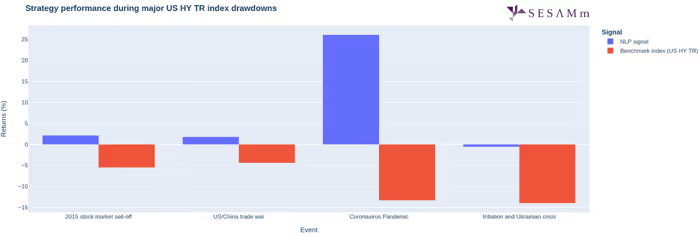
By focusing on more stressed situations, like the 2015 market sell-off, the U.S.-China trade war, the coronavirus pandemic, and the start of the Ukrainian crisis, we could show that digital sentiment is beneficial in times of significant stress in the market. Digital sentiment more accurately reflects the stress level in these complicated situations. It, therefore, helps to predict stock price movements more accurately in these stressed cases, providing a tail hedge. It’s not biased by an excess of confidence linked to the “central banks put” for instance.
Providing safety and security since 1879
Tokio Marine Insurance Company was first established in 1879. Over the years, it has added products and services, acquired other businesses, and merged with other companies to eventually become Tokio Marine & Nichido Fire Insurance Co., Ltd. Commonly called Tokio Marine Nichido today, the company is a property and casualty insurance subsidiary of Tokio Marine Holdings, the largest non-mutual private insurance group in Japan. Its products and services provide safety and security to its clients and partners, contributing to more fulfilling lifestyles and business development.
One of the company’s philosophies is to be a good corporate citizen and fulfill its social responsibilities, including protecting the global environment, promoting human rights, creating a responsible working environment, and contributing to society and individual local communities. Recently, the Emperor of Japan awarded Tokio Marine Holdings, Inc. the Medal with Dark Blue Ribbon for donating to the Japan Student Services Organization to support students who face financial difficulty during the
COVID-19 pandemic. Individuals, corporations, or organizations are awarded the Medal with Dark Blue Ribbon for their outstanding contributions to the public.
Transforming and accepting the challenge to grow
According to TMNF, “The business environment surrounding the insurance industry is changing at a faster pace than ever due to changes in demographics, advances in technologies, such as autonomous driving and AI, and longer-term trends, such as the intensification and frequent occurrence of natural disasters, as well as further progress in digitalization due to the COVID-19 pandemic.”
“The business environment surrounding the insurance industry is changing at a faster pace than ever…”
“While these changes in the business environment pose a threat, we consider them to be excellent opportunities for transformation and the creation of new value.” So they’ve adopted the concept, “Transformation (“X”) and Challenge to Growth 2023: Aiming to be the company most chosen for quality and its passion.” Ultimately, it strives to support customers and local communities in times of need while contributing to social responsibility. Five social issues that it will prioritize are:
Global climate change and the increase in natural disasters
The increased burden of long-term care and healthcare due to the aging of society and advances in medical technology
Technological innovation and its effects on the environment
Symbiotic society and responding to the novel coronavirus
Industrial infrastructure and how it supports economic growth and innovation
Leveraging a partner with the right technology
To secure and protect its clients’ assets while elevating social issues, Tokio Marine Nichido sought out an edge in the stock market. Under these circumstances, it was fortunate that TMNF discovered SESAMm in 2020 through the Plug and Play Japan program, a platform with an event that connects Japan to markets abroad. SESAMm had presented its NLP alternative data solution, TextReveal®, to which TMNF considered the platform for access to alternative data and sought collaboration with the SESAMm team for a research project.
“SESAMm has the technology to extract sentiment from news data with a neural network.” – Tokio Marine & Nichido Fire Insurance Co. Ltd representative
Extracting relations between NLP data and the financial market
In 2021, Tokio Marine Nichido Insurance began collaborating with SESAMm to develop an AI analytics model for alternative data. It models the effect of news and social networking data on investor behavior for stock and bond markets. In other words, it structures text information into knowledge usable by TMNF.
Monitor risks and topics
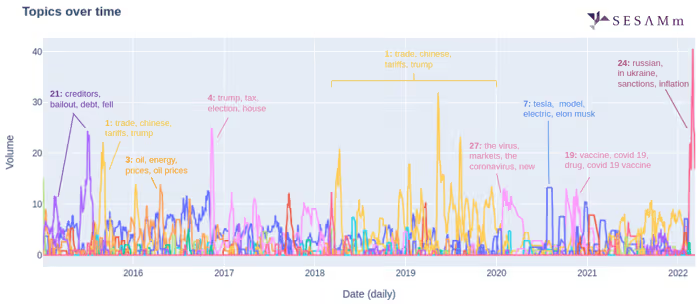
NLP data can improve the understanding of the market’s behavior by exhibiting the most important topics over time, with a direct indication of the importance of the topics through the text volume (Figure 1).
Figure 1: Automatic detection of the main topics in the U.S. market since 2015, thanks to topic modeling.
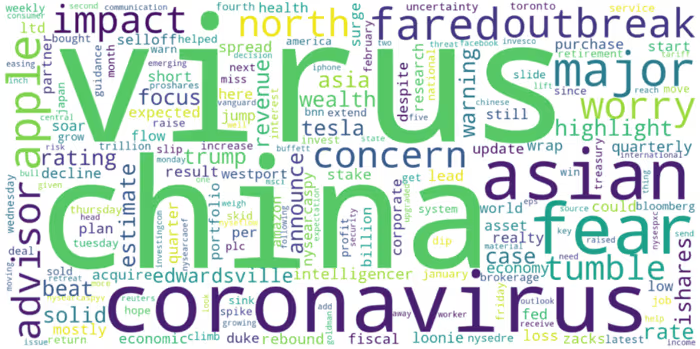
Researchers can also use it to focus on a specific topic or a certain period. For instance, a short analysis of the most frequent keywords in the press, which preceded the market fall during the COVID-19 pandemic, showed the significant predominance of pandemic-related terms (Figure 2).
Figure 2: Most frequent keywords in English S&P 500-related articles between 17 Jan. 2020 and 19 Feb. 2020.
Focusing on the equity market
NLP tools provide specific data, like sentiment, to get more detailed information at the company level and for many underlyings. Indicators for equity indices, for instance, can be calculated and provide a clean sentiment to monitor markets.
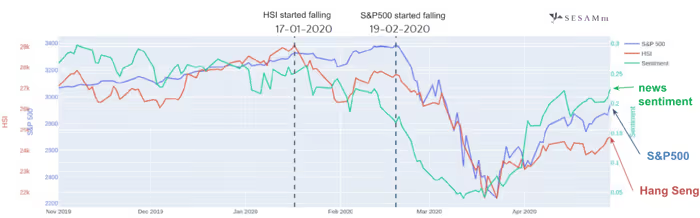
In many situations of stress over recent years, such sentiment proved to be an early indicator of the market’s future degradation. For example, there was a time lag of as long as a month between the time COVID-19 became the main news focus and the time it affected the U.S. stock market. By using SESAMm’s technology to analyze news data during this period, the team found that the U.S. digital sentiment had already deteriorated sharply before stock prices reacted (Figure 3).
Figure 3: In 2020, U.S. news sentiment falls ahead of the stock market in response to COVID-19 concerns.
This sentiment deterioration occurred because of the fear of the coronavirus’s spread’s effect on the global economy (see Figure 2). Even with an all-time high S&P 500, U.S. investors didn’t initially consider this risk. In comparison, HSI companies were closer to the coronavirus spread risk. So as a result, HSI investors reacted ahead of their U.S. counterparts. In other words, by using natural language data, it was possible to capture a risk overlooked by U.S. investors but related in the publicly available texts and take action ahead of the market deleveraging.
Generalizing the results to the credit market
Tokio Marine Nichido also expanded the scope of the research to U.S. high-yield bonds index trade. In the credit market, a high yield has a high beta, which makes its risk comparable to the equity market.
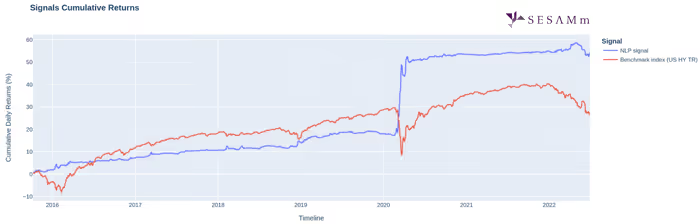
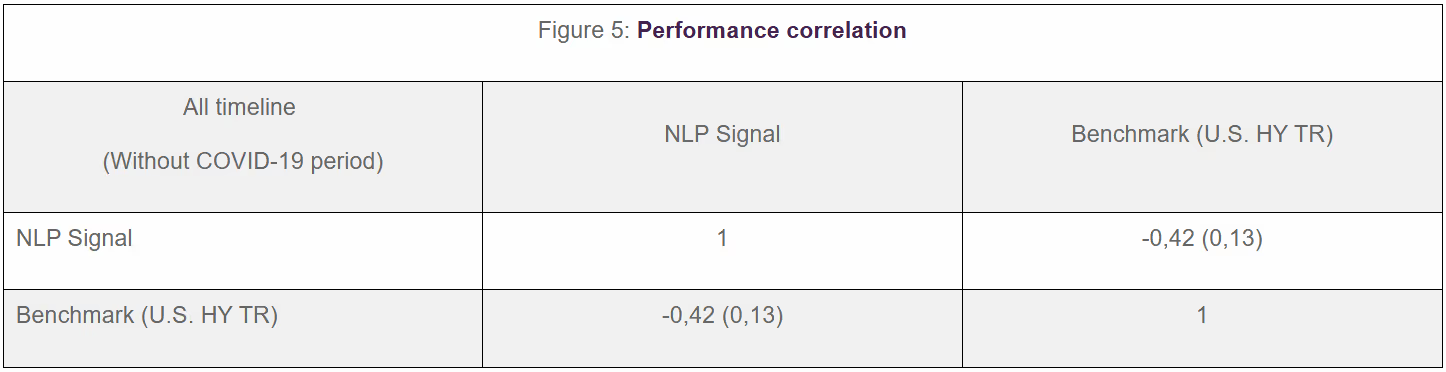
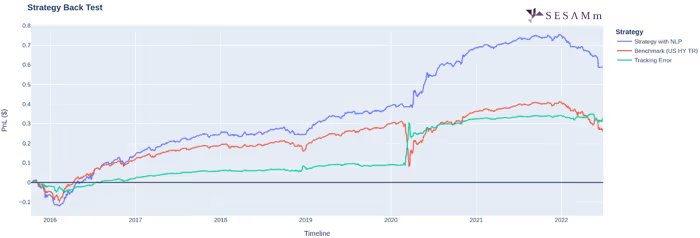
Research shows that, on a risk-adjusted basis, the NLP-data-built signal has a positive and consistent performance through the timeline compared to the U.S. HY T.R. index benchmark (Figure 4). Its performance has a low correlation with the index (Figure 5), so the sentiment is diversifying. It not only acts as a diversifier but delivers higher returns than the benchmark when the U.S. High Yield market sold off (Figure 6). As such, the NLP signal diversifies, hedges, and protects against adverse periods. It provides a mechanical pick-up in risk-adjusted return when running alongside traditional strategy.
Figure 4: An NLP-informed signal has positive and consistent performance. The volatility level is the same for both curves.
Figure 5: The NLP signal and market daily performances are de-correlated.
Figure 6: The NLP signal delivers higher performance during adverse periods.
The NLP signal outperforms the index in realistic backtest conditions, including long allocation only, turnover constraints, and trading fees (Figure 7). The quantitative model integrates some macro indicators, but the previous NLP signal induces the main source of outperformance and risk mitigation.
Figure 7: An NLP-informed high-yield strategy outperforms the U.S. high-yield total return index.
TMNF is also applying the research to estimate the Fed’s stance—hawkish or dovish—using natural language data, too. It hypothesizes that the market will be focused on the Fed’s stance on interest rate hikes in the next few years.
“The model developed in collaboration with SESAMm is simple in structure, yet, it’s an orthodox and robust model that uses valid data as input.”
Summarizing the collaboration
In developing models, Tokio Marine Nichido believes it’s essential to consider “what data to consider” and to keep it simple. And TMNF achieved these tenets. The model developed in collaboration with SESAMm is simple in structure, yet, it’s an orthodox and robust model that uses valid data as input which is preferable to a risky over-fitting by increasing complexity.
Get in touch with SESAMm
To learn more about Tokio Marine Nichido’s case study or to request a TextReveal demo, reach out to us.
Stay ahead with the latest in ESG and AI intelligence
Join our mailing list to receive new reports, event invites, and updates from SESAMm directly to your inbox.







.png)