Pioneering ESG Innovation: SESAMm Included in Elaia's 2023 Sustainability Report
July 3, 2024
•
5 mins read
SESAMm has been spotlighted in Elaia's 2023 Sustainability Report as a key innovator driving positive change through AI technologies. This inclusion underscores SESAMm's role in advancing ESG principles within its operations and the financial industry.
Elaia, a prominent venture capital firm, has recognized SESAMm for its advanced AI-driven solutions which significantly enhance ESG data analysis, providing useful insights that empower investors to make more informed, responsible decisions. The report highlights how SESAMm’s cutting-edge technologies help firms navigate the complex landscape of ESG investing, turning over 25 billion articles and social forums in more than 100 languages into actionable intelligence using AI.
SESAMm's commitment goes beyond mere compliance; it is about leadership and responsibility in shaping the future of sustainable investing. By leveraging natural language processing and machine learning, SESAMm enables its clients to swiftly identify and act on ESG risks and opportunities, thereby contributing to more sustainable global markets.
This accolade from Elaia celebrates SESAMm’s achievements and sets a benchmark for sustainability in tech. It encourages continuous innovation and ethical practices that lead to a better, more sustainable future.
To learn more about SESAMm’s role in advancing sustainable finance, we invite you to download the full report.
Reach out to SESAMm
TextReveal’s web data analysis of over five million public and private companies is essential for keeping tabs on ESG investment risks. To learn more about how you can analyze web data or to request a demo, reach out to one of our representatives.
Public companies, due to their large market presence and mandatory financial disclosures, often receive a lot of attention on the Internet. Their operations and regulatory obligations put them under a media spotlight, which amplifies any ESG controversies they face in public and online discussions. In contrast, private companies operate with a higher degree of discretion and are generally less exposed to intense external scrutiny.
Although private companies are less visible to the public, there is still an underlying interest and, more importantly, a need to understand the nature of ESG controversies they face. Are these controversies different in any way, such as being less significant or having unique characteristics? This raises questions about whether certain types of risks are more susceptible to controversies in the private sector. When comparing prominent public companies with their private counterparts, do controversies differ within the same industry?
ESG Overview
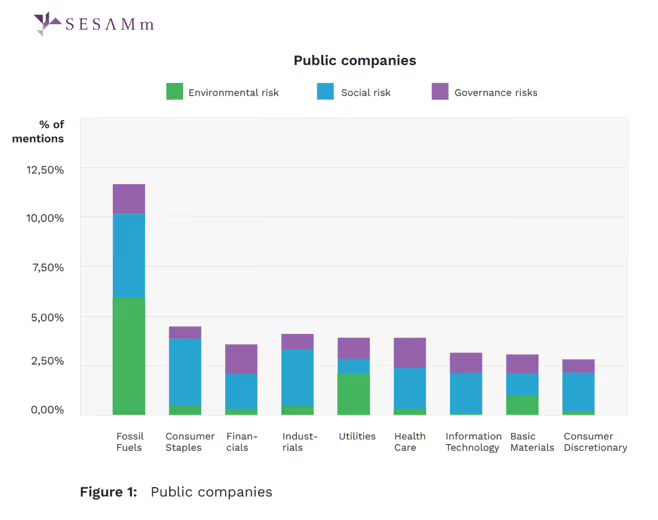
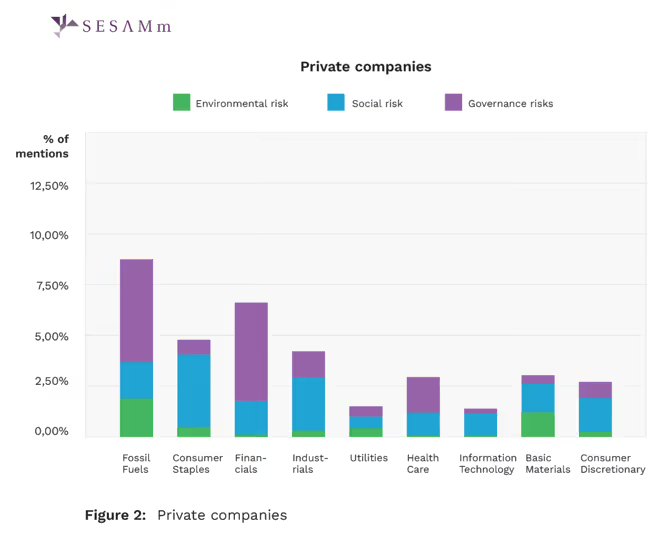
In exploring the ESG landscape, a compelling comparison emerges between private and public companies. Public companies predominantly grapple with environmental and social risks. On the other hand, private companies, especially in the financial sector, are more frequently embroiled in governance-related controversies. This section highlights the ESG challenges each sector faces and the varying degrees of visibility and scrutiny these issues receive in the public and private domains.
Within the fossil fuel industry, a distinct difference emerges: public companies are predominantly associated with environmental and social risks, while private companies face more governance-related issues.
This disparity is partly due to the more visible and significant environmental impacts often linked to public companies, such as BP's gasoline spill cleanup in Washington state and the devastating impacts of Shell's oil spills in Nigeria. Public companies also tend to experience more social issues, like employee strikes, protests, and human rights infringements.
In contrast, private companies, particularly in the financial sector, show a higher frequency of governance risks. Examples include controversies surrounding FTX and Binance, highlighting issues like corruption, substantial fines, and money laundering allegations. This trend mirrors the earlier observation in the fossil fuel sector, where private companies, despite fewer controversies, experience more pronounced impacts when significant ESG issues arise.
It's noteworthy that private sector controversies, due to their relatively lower level of scrutiny, can gain significant traction and visibility when they do surface. This differs from the public sector, where the constant exposure to ESG risks leads to more frequent detection but not necessarily the same level of virality for each event. Public companies regularly encounter ESG risks, but the prevalence of such issues in their operations means that individual events may not always attain widespread attention.
ESG Deep-dive
Environmental risks deep-dive
Looking at environmental risks, public companies often face significant issues like emissions, climate change, and water pollution, while private firms encounter these challenges on a smaller scale and with different focuses, such as animal cruelty and environmental strategy.
In the Consumer Discretionary sector, both types of companies encounter environmental risks, but the nature of these risks differs. Public companies, particularly in the automotive industry, are often involved in incidents like fires and lawsuits related to harmful emissions. Private companies, while also dealing with fires and automotive issues, face additional problems like animal cruelty allegations in retail.
The Fossil Fuel sector shows a clear distinction in ESG issues. Public companies frequently face controversies related to climate change and atmospheric pollution, often involved in significant incidents like legal actions and fines. Private companies, on the other hand, are more focused on general environmental strategy, though their controversies tend to be of a smaller scale.
In Utilities, public companies are more involved in water pollution controversies, with significant incidents like fines for unlawful water extraction making headlines. Private companies, while also dealing with water pollution, do so less frequently and on a smaller scale.
The Healthcare sector, particularly in public companies, shows a focus on biodiversity-related controversies. Issues like animal cruelty in biotechnology are prominent.
Overall, public companies tend to be at the center of more significant and high-profile environmental controversies, particularly in sectors like fossil fuels, utilities, and financials. Private companies, while also facing environmental and ethical challenges, often do so on a different scale, indicating different approaches and impacts in their management.
Social risks deep-dive
Public companies across sectors like Consumer Discretionary, IT, Financials, and Fossil Fuels frequently confront a broad spectrum of social risks, including human rights breaches and human capital concerns. Private companies, while also facing these issues, tend to have a more focused approach, with specific concerns in areas like telecommunications, social media, and health & safety. This indicates differing strategies and impacts on their social management.
Public companies in the Consumer Discretionary sector struggle with a substantial volume of data related to human rights breaches and human capital issues. These challenges are widespread across various industries, with incidents in telecommunications, social media, and the automobile industry being particularly noteworthy. In contrast, private companies in this sector primarily confront human rights breaches, with a significant focus on issues within telecommunications and social media. This contrast indicates a more specialized concern for private companies in this sector.
Both public and private companies in the Information Technology sector experience significant risks related to fundamental human rights breaches and human capital concerns. However, public companies, particularly those in software and hardware, are more frequently linked to these issues. Private companies, while also implicated, tend to have a different focus within the same concerns.
In the Financial world, public companies exhibit a pronounced focus on human capital issues, surpassing their private counterparts. This focus spans the banking and insurance industries with notable instances of discriminatory dismissals and wage disputes. Additionally, public companies in this sector also navigate complexities related to human rights and customer relations, including racial discrimination lawsuits and data breaches. Conversely, private financial companies face significant customer relations issues, especially highlighted in financial services, and human rights concerns, such as charges against Binance for child pornography and terrorism financing.
Private companies in the Consumer Staples sector lead in mentions related to health and safety, particularly in the Food/Beverage and tobacco manufacturing industry. These references often involve serious incidents like industrial accidents and lapses in COVID protocols. Additionally, customer relations issues are slightly more pronounced in private companies compared to their public counterparts. Public companies, meanwhile, have a slightly higher proportion of mentions related to human rights risks, including labor law violations and privacy concerns.
Public companies in the Fossil Fuel sector are notable for their focus on human capital issues, with references to industry-wide strikes and layoffs. In contrast, private companies in this sector demonstrate a significant focus on human rights issues, as exemplified by the case of the ex-Citgo CEO.
A divergence is seen in the Basic Materials sector, where private companies face more prevalent human capital issues, particularly in mining & metals and the chemical industry. Public companies, on the other hand, encounter a higher proportion of human rights breaches, including harassment lawsuits and violations of indigenous rights.
In summary, public companies across these sectors tend to face a wider range of social controversies, encompassing both human rights and human capital issues, often on a larger and more varied scale. Private companies, while also dealing with similar challenges, tend to do so with a more specific focus, suggesting different approaches and impacts in their social management strategies.
Governance risks deep-dive
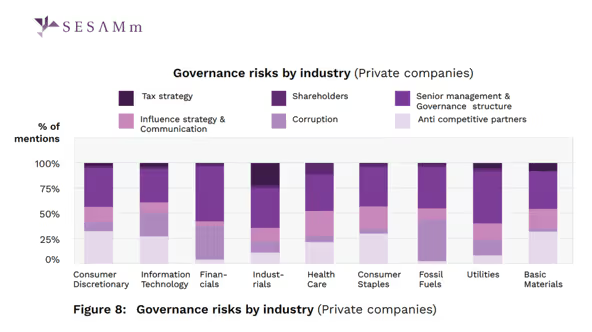
In scrutinizing governance, we found that public firms face risks in management and governance, while private entities encounter issues like anti-competitive practices and corruption. Financial and Industrial sectors see public companies dealing with strategy and compliance challenges, whereas private firms face tax strategy risks. Overall, public companies are more involved in high-profile governance controversies, while private companies focus on specific areas like tax and anti-competitive behavior.
In the Consumer Discretionary sector, governance issues vary notably between public and private entities. Public companies, particularly in telecommunications and Social Media, encounter significant risks in senior management and governance structures, evidenced by legal actions and allegations against companies like Verizon and Ericsson. Conversely, private companies in Media & Entertainment are more embroiled in anti-competitive practices, as highlighted by Epic Games' antitrust trial against Google.
Information Technology presents a clear distinction. Private companies are frequently linked to substantial corruption issues, with the FTX scandal serving as a prime example. Public companies, on the other hand, are more inclined towards engaging in anti-competitive practices, as seen in the cases of technology giants like Google and Microsoft facing antitrust lawsuits and scrutiny for monopolistic behavior.
In the Financials sector, governance risks are predominantly tied to senior management and corporate structure. Public companies face challenges primarily in their influence on strategy and communication, with notable instances including BlackRock's lawsuit over an alleged misleading ESG strategy. Meanwhile, prominent financial services companies like PayPal have faced regulatory scrutiny, further illustrating the sector's vulnerabilities.
The Industrials sector shows similar trends among public and private companies but with a specific emphasis on tax strategy risks in private firms. This is exemplified by the PwC tax leaks scandal, indicating the deep impact of governance issues in private entities.
In the Fossil Fuels sector, corruption issues are more pronounced, especially among privately-held companies. Incidents such as the lawsuit against Citgo and the Amec bribery case settlement underscore the sector's susceptibility to governance-related controversies.
Lastly, the Utilities sector shows a higher prevalence of corruption among public companies, as demonstrated by the investigation into FirstEnergy's public corruption scandal and subsequent legal actions.
Overall, governance risks manifest differently in public and private companies across various sectors. Public companies are often at the forefront of high-profile governance controversies, dealing with issues related to management, strategy, and regulatory compliance. Private companies, while also grappling with governance challenges, tend to face issues like anti-competitive practices and tax strategy risks, reflecting a variance in operational focus and impact on governance risk management.
Conclusion
By diving into the complexities of ESG, both public and private sectors have a unique opportunity not only to enhance their financial performance but also to drive positive societal and environmental impacts. As we further examine corporate controversies and gain a deeper understanding of the nuances within the ESG landscape, it becomes increasingly clear that a commitment to these principles is essential for long-term success and global well-being. Our journey highlights the tremendous potential for positive change when corporations embrace the pressing demands of today's ESG landscape, paving the way for a more sustainable, equitable, and governance-focused world.
Download the full report to discover how different sectors navigate regulatory pressures and sustainability challenges with real-world examples to guide your strategy.
Reach out to SESAMm
TextReveal’s web data analysis of over five million public and private companies is essential for keeping tabs on ESG investment risks. To learn more about how you can analyze web data or to request a demo, reach out to one of our representatives.
Discussions around nuclear weapons and defense have recently highlighted how differently investors interpret weapons exclusions. In particular, Russia’s invasion of Ukraine has brought security considerations back into focus across Europe and prompted some investors to revisit long-standing exclusion policies.
At the same time, regulatory frameworks such as the Sustainable Finance Disclosure Regulation (SFDR) encourage investors to screen portfolios for controversial activities and disclose how those risks are managed. However, these frameworks do not impose a single global definition of weapons exposure. As a result, policies can vary widely between institutions.
Controversial Weapons
What Do We Mean by Controversial Weapons?
In responsible investment policies, the term “controversial weapons” has a relatively clear meaning. It refers to weapons that are prohibited or heavily restricted under international conventions because of their indiscriminate or humanitarian impacts. Typical examples include:
cluster munitions
anti-personnel landmines
chemical weapons
biological weapons
nuclear warheads
Because these weapons are banned or widely condemned under international treaties, investors usually apply strict zero-tolerance exclusions. Any company involved in producing these weapons, or supplying critical components for them, is typically excluded from ESG-focused portfolios.
What Counts as Weapons Exposure?
The broader category of weapons exposure is more complex and is where investor interpretations often begin to diverge. Recent discussions across Europe’s sustainable finance community have focused on whether defense companies should remain excluded from ESG portfolios, particularly in light of renewed security concerns following Russia’s invasion of Ukraine.
Many exclusion frameworks distinguish between controversial weapons and other forms of military-related activity. Companies may be involved in conventional weapons manufacturing, such as firearms, missiles, bombs, or military electronics. Others produce defense systems and equipment, including radar, communications technology, or aircraft components. Civilian firearms are also frequently treated as a separate category within exclusion policies.
In these cases, investors often rely on revenue thresholds rather than absolute bans. A company may be excluded if more than five to ten percent of its revenue comes from weapons manufacturing, while smaller or indirect exposure may still be permitted depending on the investor’s mandate.
A key challenge in these screenings is that a company’s weapons exposure is not always obvious from its core business description. A firm may supply components, software, or materials used in weapons systems or operate as part of a broader defense supply chain. This is particularly difficult to identify in private markets, where companies are not required to disclose detailed segment revenues or defense-related contracts.
As a result, defining and detecting weapons exposure requires clear policy definitions and structured screening logic. What counts as weapons involvement, and where the exclusion threshold lies, ultimately depends on each investor’s mandate and risk tolerance.
What's Different Now?
These questions are no longer abstract. Since Russia's invasion of Ukraine, major asset managers have visibly shifted their positions. Allianz Global Investors, for instance, updated its Article 8 fund policies in 2025 to allow defense companies. Global Trading UBS and Franklin Templeton made similar moves, each removing revenue-based weapons thresholds that had been standard practice for years. At the regulatory level, Hortense Bioy, Head of Sustainable Investing Research at Morningstar Sustainalytics, noted that "since the start of the war in Ukraine in 2022, it has become increasingly clear that geopolitics plays a more significant role in shaping the boundaries of sustainable investing than ethics." What these shifts share is a common thread: the thresholds and definitions that once felt settled are now being redrawn, which is precisely why screening frameworks need to be flexible enough to reflect each investor's current policy, whatever that may be.
Customizable Screening
Because exclusion policies are defined at different levels, it’s rarely as simple as establishing a generic exclusion list. Limited partners often impose their own restrictions or revenue thresholds, which general partners must apply alongside the fund’s internal ESG policy and regulatory restraints. In some cases, LP requirements may further restrict or override the fund’s baseline approach.
As a result, acceptable levels of exposure to activities such as conventional weapons can vary significantly across portfolios.
Screening frameworks, therefore, need to adapt to the investor’s policy rather than forcing the policy to adapt to the tool.
In this case, SESAMm’s AI-generated exclusion screening report can be customized to match each investor’s requirements. Threshold-based classifications help identify different levels of involvement, allowing investors to distinguish between companies with no exposure, limited exposure, or significant involvement in controversial activities. Each classification is supported by underlying evidence and source documentation, allowing analysts to verify the reasoning behind the flag.
This approach makes it possible to apply a consistent methodology across both public and private companies while remaining aligned with the investor’s specific exclusion framework.
Discussions around defense and responsible investment will continue to evolve as geopolitical and regulatory contexts shift. Recent debates around nuclear deterrence and defense participation illustrate how differently investors can interpret weapons exclusions, even when they operate under the same regulatory frameworks.
For investors, the challenge is therefore not only defining exclusion policies but ensuring that those policies can be applied consistently and transparently across portfolios. As definitions of weapons exposure vary, and as supply chains and private market structures add further complexity, screening frameworks must be capable of translating policy into clear, operational rules.
It's a word that most of us in the U.S. despise, almost as much as the word taxes. It's probably because, like taxes, we can't escape its wallet-draining effect when it increases. Maybe the way we feel about it is because the last time the U.S. economy deflated—giving us relief from it—was in the 1930s, when "Prices dropped an average of nearly 7% every year between the years of 1930 and 1933," according to Investopedia. But I digress.
We won’t go into how inflation works, but how the government calculates it—and how its categories affect it—has always been consistent. At least it was until the COVID-19 pandemic hit, that is.
What NLP text mining reveals about the U.S. economy inflation-rate factors and the online conversations about them
To ensure we're on the same page about how we came to the forthcoming information in this use case, let's cover a couple of basics on NLP text mining and inflation rate indexes.
What are NLP and text mining?
Natural language processing (NLP), an A.I. technology, automates the data analysis of mined textual, unstructured data. It includes natural language understanding and natural language generation to simulate a human’s ability to create language, and it’s a component of text mining that performs a special kind of linguistic analysis by deep learning algorithms so a machine can “read” text. Apps like Grammarly or Wordtune analyze text to improve a written text, for example, and chatbots use this technology to interact with customers. Text mining, or text analytics, is the process of examining big data document collections. It’s a computer science discipline that converts unstructured text data in documents and databases into normalized, structured data and datasets for analysis by machine learning models. Deep learning machine-learning algorithms then analyze this data, analyzing semantics and grammatical structures, to gain new insight or aid research from human language. Together, NLP and text mining are like a search engine on steroids.
The Consumer Price Index (CPI)
According to this Forbes Advisor article, "The two most frequently cited indexes that calculate the inflation rate in the U.S. are the Consumer Price Index (CPI) and the Personal Consumption Expenditures Price Index (PCE)." For this article, however, we'll only use the Bureau of Labor Statistics (BLS) method of CPI inflation calculation as a reference. CPI observes a specific group of commonly-purchased goods and services to gauge how prices fluctuate. These foods and services include:
Apparel: Women's and men's clothes, jewelry, etc.
Alcoholic beverages: Beers, wine, liquor, etc.
Energy and commodities: Gasoline, natural gas, electricity, etc.
Food: Items bought by the average consumer, such as breakfast cereal, milk, meat, fruits, vegetables, etc.
Housing and shelter: Rent, housing insurance, bedroom furniture, hotel or motel accommodation costs, etc.
Medical care services: Physicians' services, prescription drugs, medical supplies, etc.
New and used vehicles: Trucks, vans, sedans, SUVs, etc.
Tobacco and smoking products: Tobacco-related items, such as cigarettes, cigars, bidis, kreteks, loose tobacco, etc.
Transportation services: Airline fares, vehicle insurance, etc.
NLP text-mining process: web mentions matched to CPI categories
Using SESAMm's web text analysis engine TextReveal®, we analyzed textual data relating to the inflation topic within the U.S. from 2017 until now. For this analysis, we defined co-mentions as the articles and social media posts that mention "inflation" and at least one of the CPI categories. Note: Although we can analyze more than 100 languages, we focused on English in this case. Also, we didn’t conduct a sentiment analysis from the information extraction.
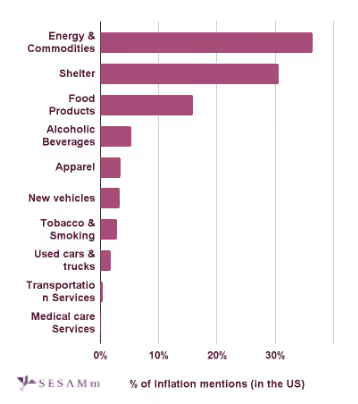
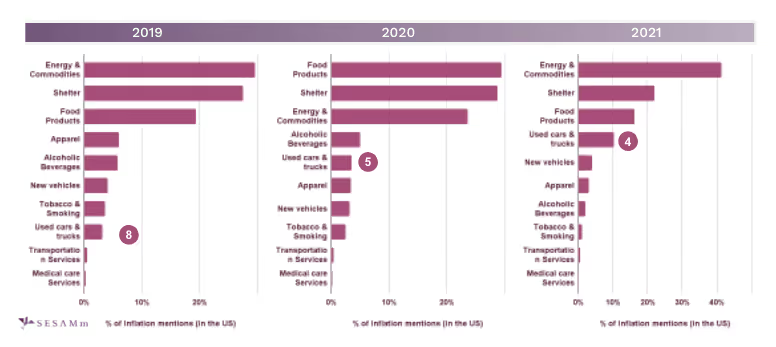
Figure 1: Inflation co-mentions by category and percentage.
From 2017 to 2019, inflation co-mentions within the U.S. are relatively stable (see Figure 1). But this trend changes with the first shift in 2020, continuing its rapid growth and peak by the end of 2021 due to this surge of inflation reaching record levels.
What was one of the main drivers of the inflation surge? Used cars.
3 used-car and inflation trends uncovered through NLP Text Mining
According to the U.S. Bureau of Labor Statistics, the cost of used vehicles was one of the main drivers of the inflation spike. How did used cars contribute to inflation? The chain of events occurred like so: The increased used-car demand was fueled by a new-vehicle supply shortage caused by a chip shortage generated by supply-chain interruptions due to the COVID-19 pandemic.
As the pandemic-induced supply-chain interruption unfolded, used-car trends developed. Here are three we found in our data mining research:
Trend 1: Co-mentions percentage for used vehicles more than doubled
Figure 2: Used vehicles co-mentions increase percentage-wise.
Based on the percentage of co-mentions compared to other topics, the used-car topic moves from the number eight spot to the number four spot in 2021 (see Figure 2).
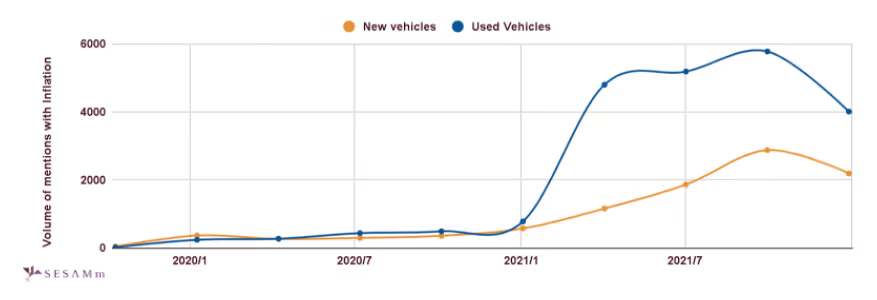
Figure 3: Used-car co-mentions begin in early 2021 and exceed those for new cars.
Before 2020, mentions were relatively steady. However, we observe an increase in used-vehicles mentions caused by disruptions in supply chains leading to chip shortages (see Figure 3) as early as January 2020. These shortages led to a decrease in new vehicle inventory. The Statista report, indicating an increase of the used vehicle value index by 49 points compared to the price index recorded in 2020, supports our findings.
Trend 2: Used vehicle prices rose with used-car co-mentions
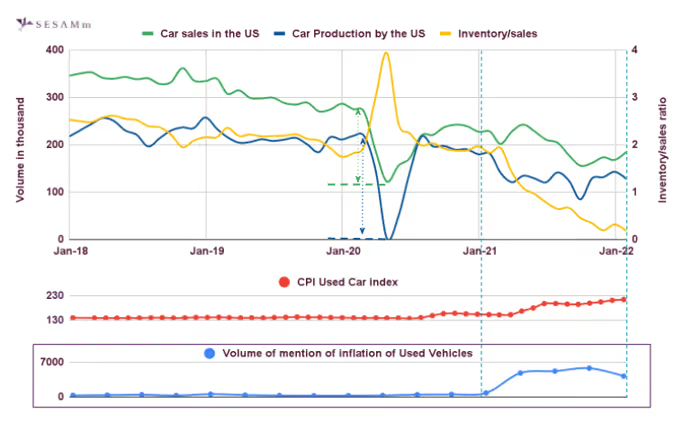
Figure 4: In 2020, inventory spikes as production and sales plummet, affecting inflation.
Because of the pandemic, car production nearly stopped along with the sale of cars, which created two situations: 1. high inventory to sales ratio and 2. historically low car production (see Figure 4). Vehicles sales picked up later, but car production was still suffering because of supply-chain disruption. That meant the inventory to sales ratio dropped to virtually zero.
So consumers with little-to-no options for new vehicles turned to used cars, increasing their demand and therefore increasing their prices. We confirm this hypothesis with increasing mentions within the used-vehicles topic, coinciding with an inventory volume decrease. All in all, used-vehicle prices rose 40.5%.
Trend 3: The COVID-19 pandemic and new vehicle inventory shortage increased demand
A smaller new-vehicle inventory wasn't the only reason consumers sought out used vehicles. They also wanted used cars because of the pandemic.
Figure 5: The pandemic and new-vehicle supply shortage became bigger reasons for consumers to seek out used cars over cost.
For 2020, we observe that consumers avoided public transportation by rising co-mentions between pandemic-related mentions and the demand for secondhand vehicles (see Figure 5).
Used-car and inflation trends summary
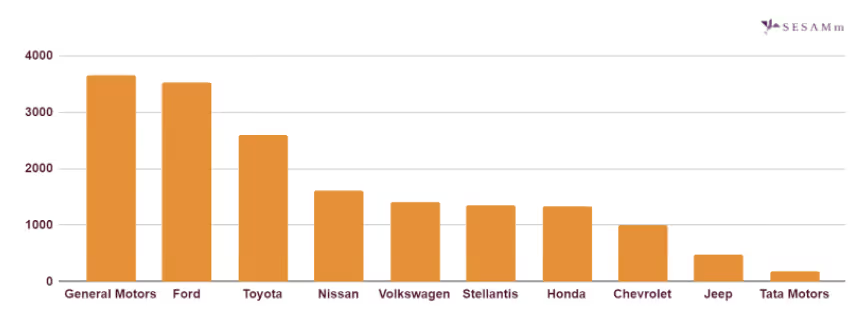
We can summarize the used-car and inflation trends with one phrase: It's a used-car seller's market. For example, online retailers like Carvana have leveraged these factors to grow significantly. In contrast, due mainly to significant supply chain disruptions, motor companies have had the opposite effect, with the Automotive industry projected to lose $210 Billion. Judging by the number of mentions in public web forums and social media, the chip shortage and used-car boom affected General Motors, Ford, and Toyota the most (see Figure 6).
Figure 6: General Motors, Ford, and Toyota suffered pandemic-related shortages the most based on co-mentions.
About SESAMm and TextReveal’s® NLP Text-mining Capabilities
SESAMm is a leading company in alternative data and artificial intelligence, delivering global investment firms and corporations descriptive, prescriptive, or predictive investment analytics worldwide. TextReveal is SESAMm's premiere NLP text-mining product, a solution that allows you to fully leverage NLP-driven insights and receive high-quality results through data streams, modular API and dashboard visualization, and signals and alerts. In other words, we organize, categorize, and capture relevant information from raw data for you.




.avif)


-converti-depuis-png.avif)




.png)