Paris, France and London, UK – July 11, 2024 – SESAMm, a leader in AI-powered text analysis for ESG insights, is pleased to announce that Sustainable Fitch, a leading provider of ESG data, analysis, and research for the sustainability and fixed-income market, will be integrating SESAMm’s data into its ESG Scores and Ratings.
Sustainable Fitch provides ESG data and analytics to both the public and private markets, including asset owners and asset managers. Sustainable Fitch will use SESAMm analytics to monitor companies and industries at a granular level, allowing them to provide further insights to clients to aid their investment and due diligence decision-making.
Sylvain Forté, CEO of SESAMm, commented, “We are excited that a recognized leader in ESG analysis is using our insights for their ESG analysis. Our AI-powered text analysis will provide deeper insights and broader coverage, helping Sustainable Fitch to deliver high-quality ESG data and ratings.”
Gianluca Spinetti, Global Head of ESG Analytics at Sustainable Fitch, added, “Working with SESAMm technology allows us to leverage their advanced solutions to enhance our ESG Scores and Ratings offering. By integrating SESAMm’s extensive data coverage, we can offer our clients more comprehensive ESG insights.”
About SESAMm
SESAMm is a global leader in AI-powered text analytics, specializing in providing insights on ESG controversies and positive-impact events. With its cutting-edge technology, SESAMm helps private equity firms, asset managers, and other financial institutions, as well as ESG consulting firms and rating agencies, monitor and analyze vast amounts of textual data to identify potential risks and opportunities in their investments. For more information, visit SESAMm.
About Sustainable Fitch
Sustainable Fitch provides rigorous, human-powered sustainability research, analysis, and data for the fixed-income market, including ESG Ratings, Second Party Opinions, thought leadership, and more, with a focus on ESG impact. Our objective and substantive suite of products provides transparency, consistency, and granularity that enables confidence in decision-making. Powered by the human insight that has differentiated Fitch for over 100 years, Sustainable Fitch brings experience and heritage to help the financial community make smarter decisions using the best ESG information available.
Discover unparalleled insights into ESG controversies, risks, and opportunities across industries. Learn more about how SESAMm can help you analyze millions of private and public companies using AI-powered text analysis tools.
November 11, 2022, FTX, a $32 billion cryptocurrency exchange company that many believed would “change the world,” filed for bankruptcy. This news shook the crypto and financial communities, compelling many to debate the future of the crypto market and its platforms.
How did FTX collapse?
You could say that FTX’s collapse began before the news broke, but here’s a summary of events as The New York Times and ABC News details:
Breaking news
In early November, CoinDesk, a crypto publication, broke the news on a leaked document from FTX. The balance sheet showed that the hedge fund run by Sam Bankman-Fried (SBF), Alameda Research, held a substantial amount of FTT tokens. In short, SBF had set up Alameda (his trading firm) and FTX (his exchange firm) in such a way that if one unit experienced trouble, such as dropping cryptocurrency prices, the other experienced it, too.
First domino falls
By the way, FTT is used for various functions, including traders’ payment of operation fees. Also, by the way, Changpeng Zhao, Binance’s Chief Executive, sold his stake in FTX to SBF in 2021, partially with FTT. So, “due to recent revelations,” Binance (Zhao) announced on November 6, 2022, that it would sell its FTT tokens.
Other dominos follow
Traders responded; they hurried to pull funds out of FTX out of fear, and FTT’s price fell. Meanwhile, FTX processed withdrawal requests over three days, amounting to an estimated $6 billion. The liquidity crunch was upon it.
Then, on November 8, Binance said it would bail out FTX. But on November 9, Binance backtracked and announced in a Tweet that it would not “as a result of corporate due diligence,” while also citing regulatory investigations and reports of mishandled funds.
Things get worse
The next day, November 10, the Securities Commission of the Bahamas froze FTX’s assets, citing the public statement about potentially “mishandled” and “mismanaged” customer funds. On November 11, FTX filed for Chapter 11 bankruptcy protections, and SBF resigned as CEO. John J. Ray III—famously known as the CEO who headed the infamously known energy company, Enron, through its collapse in the 2000s—replaced SBF on November 17.
Fallout
Today, FTX faces federal investigation for securities laws violations based on a report by The Wall Street Journal regarding FTX lending customer deposits to Alameda Research for liabilities, of which the company’s top executives were aware. Investors have suffered loss, traders have suffered loss, and the greater crypto community and regulators are asking questions.
FTX and SBF web data analysis
News about FTX’s collapse generated tons of web data for us to scour. With this data, here’s what we aimed to find out:
How did the public web react to FTX’s collapse?
Could we have seen red flags before the news broke?
What was FTX’s collapse’s effect on the cryptocurrency market’s sentiment?
Is it possible to evaluate cryptocurrency exchange companies’ ESG risks and opportunities?
Was FTX’s collapse unprecedented? If not, what does web data tell us about that?
FTX and Sam Bankman-Fried mentions analysis
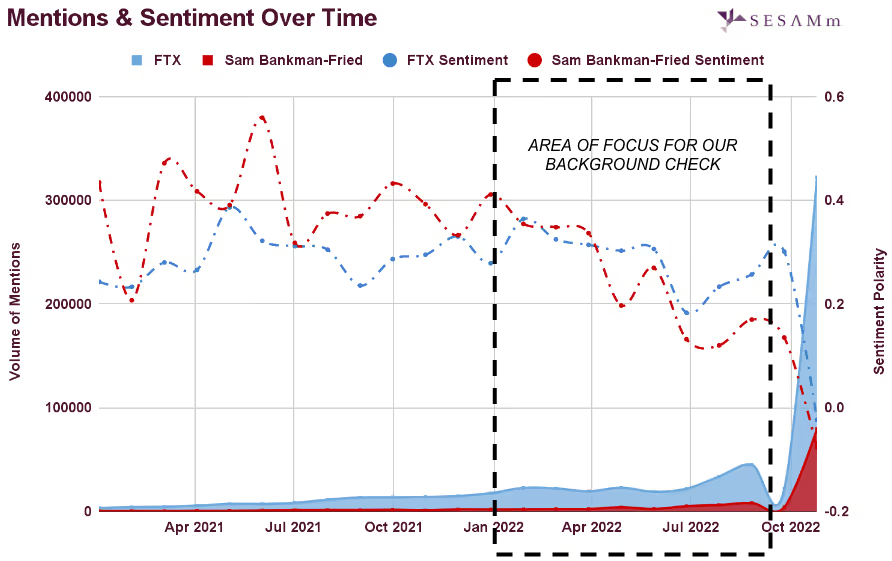
Web public sentiment for FTX and SBF was consistently positive until Q1 of 2022. As mentions volume increased, their sentiment polarity decreased (Figure 1). The mentions spike for both in November when CoinDesk broke the news. Likewise, polarity dips into the negative range for both.
Definition: Polarity represents the aggregate of positive and negative sentiments (opinions or reviews) on a company. A 0 score means there is as much positive as negative sentiment expressed. The dotted and dashed lines represent sentiment in the following charts.
Figure 1: FTX and SBF mentions and sentiment over time.
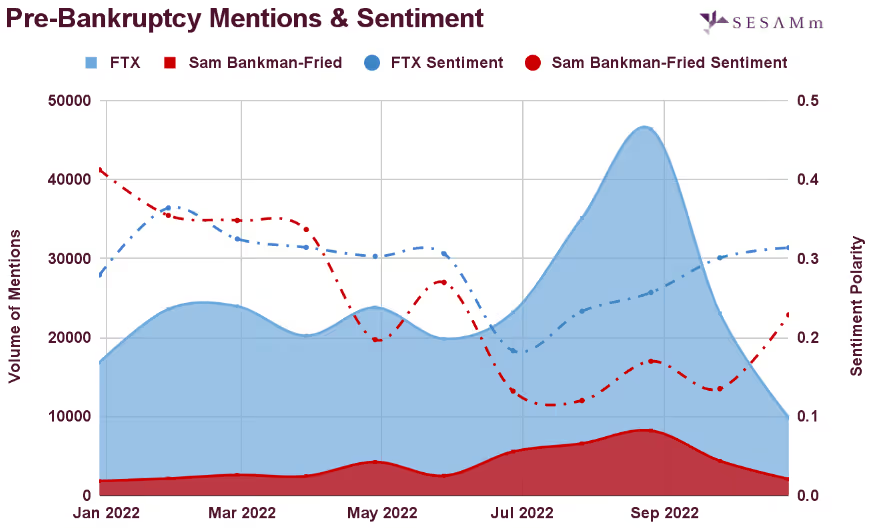
Looking closer at Q1 (Figure 2), we find that mentions affecting sentiment increased for FTX and SBF during this period. What are the mentions about, and why did they affect polarity negatively?
Figure 2: FTX and SBF pre-bankruptcy mentions and sentiment.
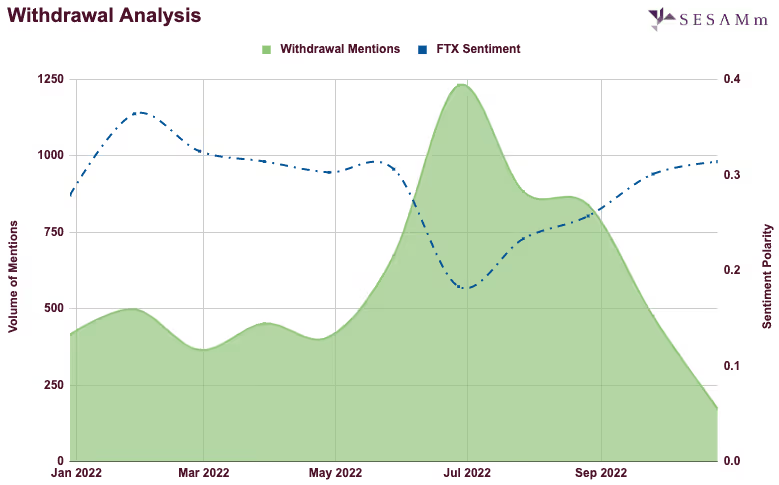
It turns out that SBF is linked to other keywords—we call these co-mentions—and between January 2022 and November 2022, SBF/withdrawal co-mentions (Figure 3) spiked in July when SBF defended Terra Luna’s founder, who was accused of peddling a Ponzi scheme.
Figure 3: FTX and SBF withdrawal co-mentions.
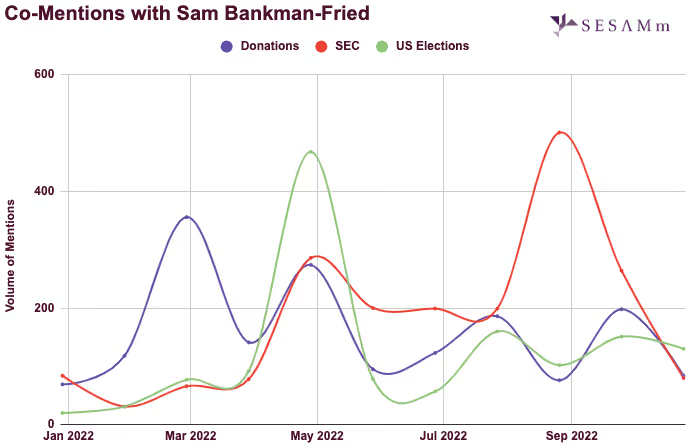
If withdrawal co-mentions brought up possible reasons why SBF and FTX experienced dips in sentiment, what other co-mentions could give us more insight? How about donations, SEC, and U.S. elections?
Figure 4: Donations, SEC, and U.S. elections co-mentions with SBF.
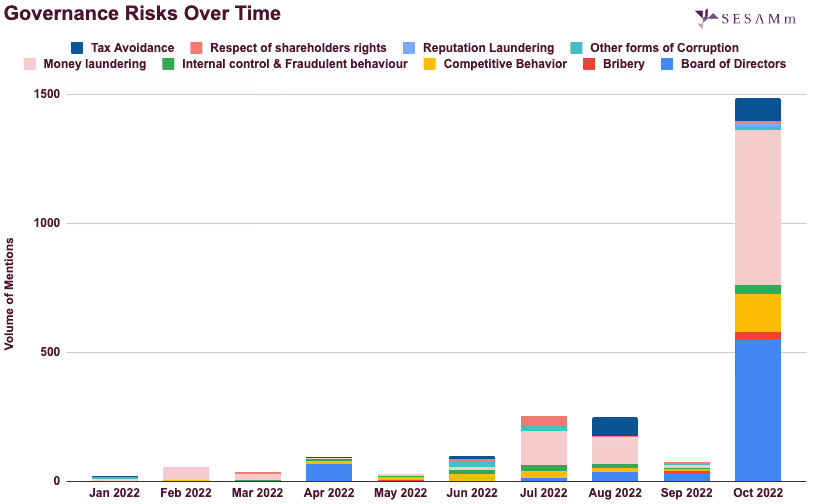
Corporate governance stands out when evaluating SBF’s ESG risks, but his social risks are nothing to ignore either.
Figure 5: SBF governance risks over time.
Two areas of governance risks to note are money laundering and board of directors (Figure 5). Money laundering as a co-mention has been an issue as early as February 2022, but it became a bigger issue in October. These risks may be popping up due to allegations of manipulating the price of the APT token and a securities violations probe.
If you’ve read this far, you by now get an impression of FTX and SBF, from mention volume to sentiment analysis and ESG risk. But how did FTX’s collapse affect the overall cryptocurrency market? Let’s find out.
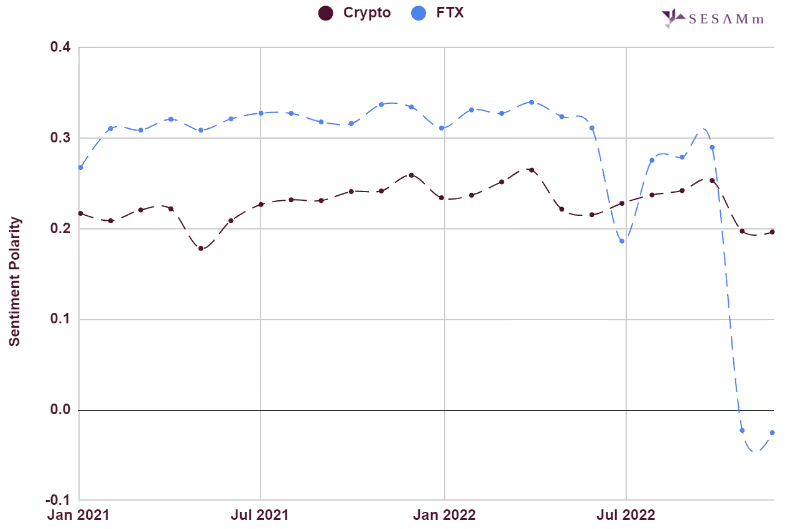
In comparing the sentiment polarities for FTX and the crypto market from January 2021 through November 2022 (Figure 6), the sentiment for crypto remains relatively steady despite FTX’s sentiment taking a hit.
Figure 6: Effect of FTX collapse on the crypto market.
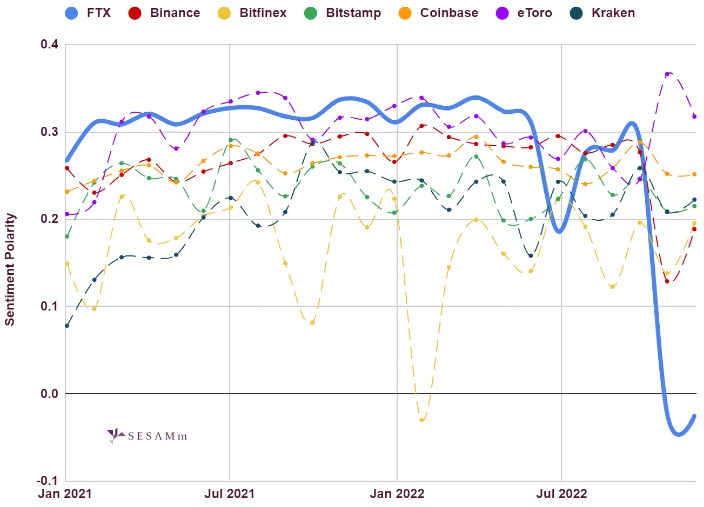
When comparing other cryptocurrency exchanges to FTX (Figure 7), sentiment polarity for them is hardly affected, except Binance, because of its connection with FTX. Oddly enough, eToro experienced a boost in sentiment, possibly because of its core values around openness and transparency, the fact that they’ve been around since 2007, its early compliance with regulations (i.e., AMF, FCA, ASIC, BaFin, and ACPR), and that it also proposes investing in stocks and ETFs, a contrast to most other crypto market exchanges. Bitfinex has its own issues, so its dip in sentiment might not be correlated.
Figure 7: FTX sentiment comparison across competitors.
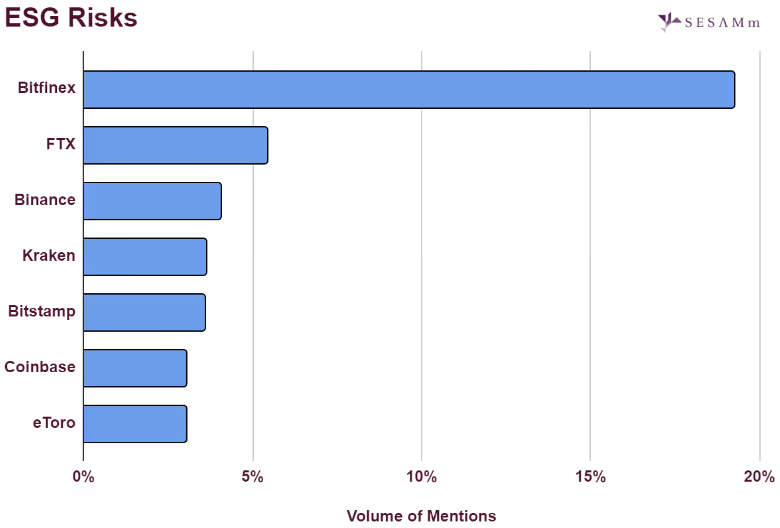
At this time, FTX’s ESG risks based on the mention volume are only surpassed by Bitfinex (Figure 8), which its risks are based on many other reasons we won’t get into in this article.
Figure 8: FTX and competitors ESG risks by mention volume.
Centralized vs. decentralized crypto exchange platforms
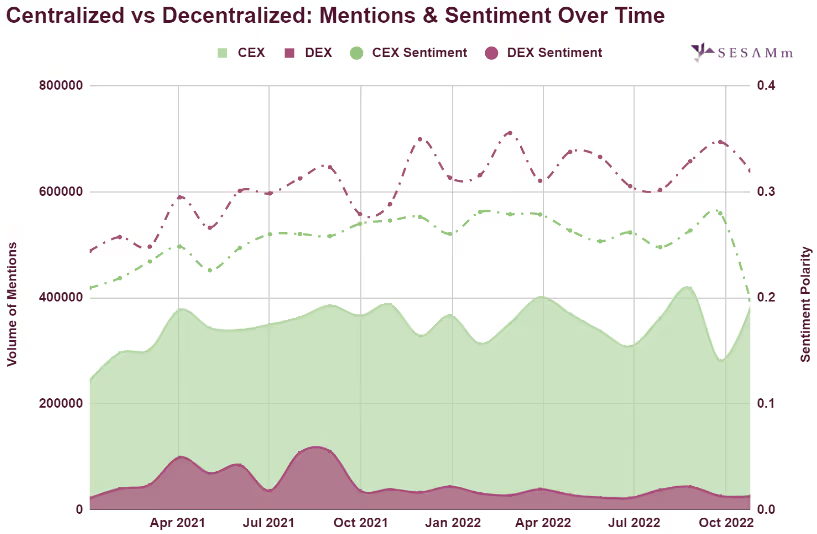
FTX’s collapse also affected sentiment around the centralized vs. decentralized debate. Since October 2022, sentiment for centralized exchange platforms, such as FTX and its competitors, has fallen (Figure 9).
Figure 9: Centralized vs. decentralized mentions and sentiment over time.
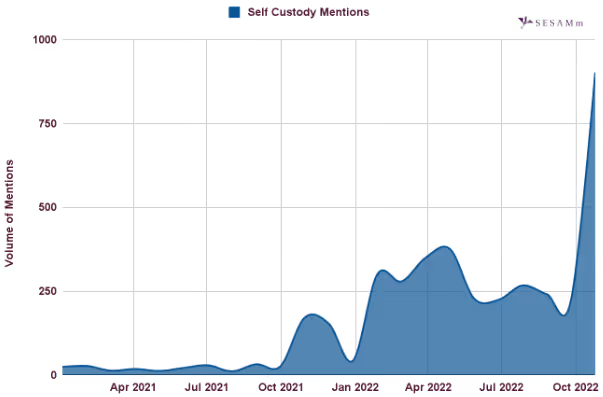
Likewise, the mention volume for self-custody has more than doubled in the last couple of months (Figure 10). Although centralized platforms offer quicker and easier access to crypto trading, traders are considering complex but more secure options such as crypto wallets and keys because, like banks, centralized exchanges can do what they will with cryptocurrency while it’s in their possession. With self-custody, owners are in control.
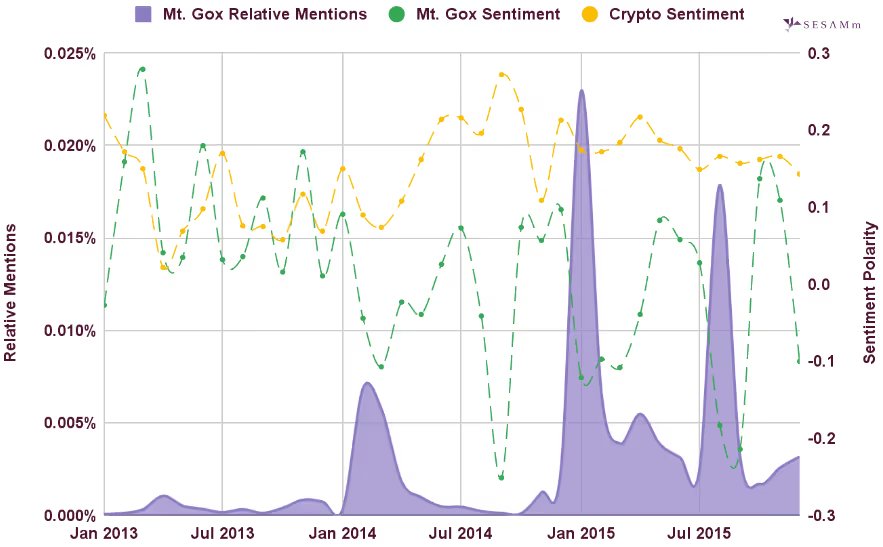
Believe it or not, FTX was not the first crypto exchange to collapse. In 2014, Mt. Gox—the biggest crypto exchange at the time—lost half a billion dollars worth of Bitcoin due to a hack. How did Mt. Gox’s collapse affect sentiment for the crypto market then? The short answer is: It didn’t.
Figure 11 shows that while Mt. Gox’s sentiment polarity fluctuated, even reaching negative territories, the sentiment for the crypto market remained relatively stable and positive.
Figure 11: Mt. Gox and crypto sentiment comparison.
Is FTX’s collapse a warning for investors?
Our analysis is that investors should treat cryptocurrency exchanges like any investment opportunity. Do your due diligence and monitor your portfolio with tools like SESAMm’s TextReveal®.
As for the cryptocurrency market, data shows that sentiment for it remains level and positive. We speculate that cryptocurrency and centralized exchanges are here to stay. However, based on historical data and current news, we suspect conversations about crypto regulations to increase.
Reach out to SESAMm
For a deeper analysis of FTX’s collapse and access to all charts and supportive-article links, reach out to a representative today.
Corporate responsibility and sustainability are not just buzzwords anymore but integral aspects of business strategy. The importance of Environmental, Social, and Governance (ESG) compliance cannot be overstated. With the introduction of stringent and complex regulations like the CS3D, corporations face an unprecedented challenge in aligning their operations with these evolving standards. This is where Artificial Intelligence (AI) steps in, offering not just a solution but a transformative approach to staying ahead in the ESG compliance game.
The New ESG Compliance Challenge: CS3D Regulation and Beyond
The CS3D regulation marks a pivotal change in the corporate world, demanding greater diligence and transparency in sustainability practices. This regulation encompasses a broad spectrum of ESG aspects, from environmental impact to social responsibility and governance standards. It necessitates a comprehensive approach to due diligence, extending beyond the corporation to its entire supply chain. This means every partner, supplier, and stakeholder must align with these stringent standards, complicating compliance efforts.
However, CS3D is just the tip of the iceberg. Other regulations like the EU Green Taxonomy and the German Supply Chain Law further add layers to this complex regulatory tapestry. Each of these regulations brings its own set of challenges and nuances, making it increasingly difficult for corporations to keep pace using traditional compliance methods.
Understanding CS3D in Depth
Delving deeper into the CS3D regulation, it's clear that its impact is far-reaching. Corporations are now required to ensure their practices are sustainable and ethical and verify that their suppliers and partners adhere to similar standards. This means conducting thorough audits, maintaining a high level of transparency, and being accountable for the entire supply chain's ESG impact. The regulation also demands regular reporting and public disclosure of these practices, adding another layer of complexity to compliance.
Broader ESG Regulatory Landscape
While focusing on CS3D, it's essential to understand its place within the broader ESG regulatory landscape. Regulations like the EU Green Taxonomy, which classifies sustainable activities and investments, and the German Supply Chain Law, which focuses on human rights and environmental standards in supply chains, complement CS3D's objectives. Together, they create a comprehensive framework that guides corporations toward more ethical, sustainable, and socially responsible business practices.
AI: A Game-Changer in ESG Compliance
The advent of AI technologies has opened new avenues for corporations to manage their ESG compliance needs effectively. AI's capability to process vast amounts of data, identify patterns, and predict outcomes is invaluable in navigating the complexities of ESG regulations.
Real-Time Controversy and Reputational Risk Monitoring
One of the most significant advantages of AI in ESG compliance is its ability to monitor and analyze textual data in real-time. This is crucial in the context of regulations like CS3D, where ongoing vigilance is necessary. AI algorithms can sift through vast amounts of text data from various sources – news, reports, social media, etc., to identify potential controversies and non-compliance issues. This proactive approach enables corporations to address issues before they escalate, ensuring continuous alignment with regulatory standards.
Enhanced Supply Chain Management
Another critical area where AI makes a significant impact is in supply chain management. Under regulations like CS3D, corporations must ensure that their entire supply chain complies with ESG standards. AI-driven tools can analyze supplier data, audit reports, and other relevant information to provide a comprehensive view of the supply chain's compliance status. This helps identify potential risks, assess supplier performance, and make informed decisions about partnerships and procurement strategies.
Case Studies and Success Stories
Illustrating the power of AI in ESG compliance, several corporations have successfully leveraged these technologies to meet regulatory requirements. For instance, a leading multinational company used AI-driven analytics to monitor its global supply chain, ensuring compliance with CS3D and other ESG regulations. The AI system provided real-time insights into supplier practices, flagged potential risks, and enabled the company to take proactive measures to maintain compliance.
SESAMm: Pioneering AI-Driven ESG Compliance
At SESAMm, we specialize in providing AI-powered solutions tailored to the unique challenges of ESG compliance. Our flagship product, TextReveal, is a testament to our commitment to innovation in this field.
SESAMm utilizes advanced natural language processing and machine learning algorithms to analyze unstructured data from multiple sources. It provides actionable insights that help corporations monitor ESG risks, understand regulatory changes, and maintain compliance. By leveraging TextReveal, corporations can:
Continuously monitor global news, social media, and other data sources for ESG-related risks and opportunities.
Conduct thorough sentiment analysis and trend forecasting to anticipate potential compliance issues.
Gain a deeper understanding of the ESG landscape and the evolving regulatory requirements.
Partnering for Success
Our partnership with leading corporations and financial institutions exemplifies the effectiveness of our AI-driven approach. By collaborating with SESAMm, these organizations have enhanced their ESG compliance strategies, effectively navigated the regulatory landscape, and made more informed decisions.
Staying ahead of the curve in the rapidly evolving world of ESG compliance is not just about meeting regulatory requirements – it's about leading the way in corporate responsibility and sustainability. AI technologies, with their unparalleled capabilities in data analysis and predictive insights, are the key to this leadership.
As pioneers in AI-driven ESG compliance solutions, SESAMm is committed to helping corporations navigate these challenges. Our innovative tools and expertise are designed to empower you to meet and exceed regulatory standards confidently. We invite you to explore the potential of AI in transforming your ESG compliance strategy and join us in shaping a more sustainable, ethical, and compliant corporate future.
SESAMm’s AI Technology Reveals ESG Insights
Discover unparalleled insights into ESG controversies, risks, and opportunities across industries. Learn more about how SESAMm can help you analyze millions of private and public companies using AI-powered text analysis tools.
Generative Artificial Intelligence has burst onto the scene, bringing with it significant ESG challenges, particularly around data privacy, labor practices, and corporate governance.
A major issue is the source of AI training data, with lawsuits against OpenAI, Anthropic, and Google DeepMind over alleged copyright violations. Global regulatory bodies are also investigating AI companies for anti-competitive behavior and privacy breaches.
Concerns over transparency in AI and the spread of misinformation continue to grow, with AI models accused of generating false or biased content. Additionally, worries about cybersecurity vulnerabilities, such as data leaks and hacking risks, have further fueled scrutiny. Labor and working conditions also remain a concern in the industry, with reports of low wages and weak protections, while whistleblowers call for better safeguards and highlight governance instability.
What does the GenAI landscape look like for ESG issues? Read on to find out.
OpenAI: Navigating Copyright Infringement and Regulatory Scrutiny
As a leader in Gen AI, OpenAI has faced increasing scrutiny over ESG issues, particularly copyright infringement. It has been sued by major news outlets, publishers, and music labels for allegedly using copyrighted content without permission to train its AI models. Beyond copyright concerns, OpenAI has been fined for privacy violations and is under regulatory scrutiny, including antitrust investigations in the U.S. and Europe. Data security risks, working conditions for AI data workers, and internal governance challenges—such as whistleblower concerns and executive upheaval—have also drawn criticism.
Anthropic: Balancing Ethical AI Practices with Data Privacy Challenges
Despite lower volumes of ESG controversies, Anthropic still faces scrutiny over data privacy, ethical AI, and corporate governance. The company has been sued for allegedly using copyrighted material in AI training and accused of bypassing anti-scraping rules. Security concerns grew after vulnerabilities in its Claude AI model and a confirmed data leak. Its ethical AI stance has also been questioned over reported military ties. Meanwhile, former employees have called for stronger whistleblower protections, highlighting transparency and accountability concerns.
Microsoft AI: Facing Antitrust and Intellectual Property Controversies
Microsoft's AI controversies have grown into serious legal challenges from 2023 to 2025. The company faces lawsuits over its Copilot chatbot, raising intellectual property concerns. Ongoing antitrust inquiries are examining Microsoft’s AI partnerships, while publishers have filed copyright claims against the company. With investigations by U.S. regulators, the EU, and UK watchdogs, scrutiny has intensified globally. Microsoft’s hiring practices have also come under fire, particularly its recruitment of key talent from AI startups, raising concerns over potential anti-competitive behavior.
DeepSeek: Data Privacy and Ethical Use in AI-Powered Discovery
Although relatively new, DeepSeek has been the center of attention for the past few months. It has been involved in anti-competitive practices scandals over its disruption of OpenAI and issues linked to data privacy and cybersecurity. Countries like Australia, South Korea, France, and India have criticized and, in some instances, banned the AI platform. Additionally, DeepSeek has been questioned about its supply chain and forced labor practices.
Mistral AI: Open-Source Development and Accountability in AI Systems
Mistral AI, a French AI startup, has been hit with data privacy and cybersecurity controversies, anti-competitive practices, and senior management issues.
The rise of Gen AI has come with significant ESG challenges. Its major players, like OpenAI, Anthropic, and Microsoft, face issues such as copyright infringements, privacy violations, labor practices, and environmental impacts. As regulators step up their investigations, these firms will have to focus on transparency, ethical practices, and sustainability or risk additional controversies.
Reach out to SESAMm
TextReveal’s web data analysis of over five million public and private companies is essential for keeping tabs on ESG investment risks. To learn more about how you can analyze web data or to request a demo, reach out to one of our representatives.
Stay ahead with the latest in ESG and AI intelligence
Join our mailing list to receive new reports, event invites, and updates from SESAMm directly to your inbox.