Mastering CS3D and ESG Compliance: The Role of AI in 2024
December 15, 2023
•
5 mins read
Introduction
Corporate responsibility and sustainability are not just buzzwords anymore but integral aspects of business strategy. The importance of Environmental, Social, and Governance (ESG) compliance cannot be overstated. With the introduction of stringent and complex regulations like the CS3D, corporations face an unprecedented challenge in aligning their operations with these evolving standards. This is where Artificial Intelligence (AI) steps in, offering not just a solution but a transformative approach to staying ahead in the ESG compliance game.
The New ESG Compliance Challenge: CS3D Regulation and Beyond
The CS3D regulation marks a pivotal change in the corporate world, demanding greater diligence and transparency in sustainability practices. This regulation encompasses a broad spectrum of ESG aspects, from environmental impact to social responsibility and governance standards. It necessitates a comprehensive approach to due diligence, extending beyond the corporation to its entire supply chain. This means every partner, supplier, and stakeholder must align with these stringent standards, complicating compliance efforts.
However, CS3D is just the tip of the iceberg. Other regulations like the EU Green Taxonomy and the German Supply Chain Law further add layers to this complex regulatory tapestry. Each of these regulations brings its own set of challenges and nuances, making it increasingly difficult for corporations to keep pace using traditional compliance methods.
Understanding CS3D in Depth
Delving deeper into the CS3D regulation, it's clear that its impact is far-reaching. Corporations are now required to ensure their practices are sustainable and ethical and verify that their suppliers and partners adhere to similar standards. This means conducting thorough audits, maintaining a high level of transparency, and being accountable for the entire supply chain's ESG impact. The regulation also demands regular reporting and public disclosure of these practices, adding another layer of complexity to compliance.
Broader ESG Regulatory Landscape
While focusing on CS3D, it's essential to understand its place within the broader ESG regulatory landscape. Regulations like the EU Green Taxonomy, which classifies sustainable activities and investments, and the German Supply Chain Law, which focuses on human rights and environmental standards in supply chains, complement CS3D's objectives. Together, they create a comprehensive framework that guides corporations toward more ethical, sustainable, and socially responsible business practices.
AI: A Game-Changer in ESG Compliance
The advent of AI technologies has opened new avenues for corporations to manage their ESG compliance needs effectively. AI's capability to process vast amounts of data, identify patterns, and predict outcomes is invaluable in navigating the complexities of ESG regulations.
Real-Time Controversy and Reputational Risk Monitoring
One of the most significant advantages of AI in ESG compliance is its ability to monitor and analyze textual data in real-time. This is crucial in the context of regulations like CS3D, where ongoing vigilance is necessary. AI algorithms can sift through vast amounts of text data from various sources – news, reports, social media, etc., to identify potential controversies and non-compliance issues. This proactive approach enables corporations to address issues before they escalate, ensuring continuous alignment with regulatory standards.
Enhanced Supply Chain Management
Another critical area where AI makes a significant impact is in supply chain management. Under regulations like CS3D, corporations must ensure that their entire supply chain complies with ESG standards. AI-driven tools can analyze supplier data, audit reports, and other relevant information to provide a comprehensive view of the supply chain's compliance status. This helps identify potential risks, assess supplier performance, and make informed decisions about partnerships and procurement strategies.
Case Studies and Success Stories
Illustrating the power of AI in ESG compliance, several corporations have successfully leveraged these technologies to meet regulatory requirements. For instance, a leading multinational company used AI-driven analytics to monitor its global supply chain, ensuring compliance with CS3D and other ESG regulations. The AI system provided real-time insights into supplier practices, flagged potential risks, and enabled the company to take proactive measures to maintain compliance.
SESAMm: Pioneering AI-Driven ESG Compliance
At SESAMm, we specialize in providing AI-powered solutions tailored to the unique challenges of ESG compliance. Our flagship product, TextReveal, is a testament to our commitment to innovation in this field.
SESAMm utilizes advanced natural language processing and machine learning algorithms to analyze unstructured data from multiple sources. It provides actionable insights that help corporations monitor ESG risks, understand regulatory changes, and maintain compliance. By leveraging TextReveal, corporations can:
Continuously monitor global news, social media, and other data sources for ESG-related risks and opportunities.
Conduct thorough sentiment analysis and trend forecasting to anticipate potential compliance issues.
Gain a deeper understanding of the ESG landscape and the evolving regulatory requirements.
Partnering for Success
Our partnership with leading corporations and financial institutions exemplifies the effectiveness of our AI-driven approach. By collaborating with SESAMm, these organizations have enhanced their ESG compliance strategies, effectively navigated the regulatory landscape, and made more informed decisions.
Staying ahead of the curve in the rapidly evolving world of ESG compliance is not just about meeting regulatory requirements – it's about leading the way in corporate responsibility and sustainability. AI technologies, with their unparalleled capabilities in data analysis and predictive insights, are the key to this leadership.
As pioneers in AI-driven ESG compliance solutions, SESAMm is committed to helping corporations navigate these challenges. Our innovative tools and expertise are designed to empower you to meet and exceed regulatory standards confidently. We invite you to explore the potential of AI in transforming your ESG compliance strategy and join us in shaping a more sustainable, ethical, and compliant corporate future.
SESAMm’s AI Technology Reveals ESG Insights
Discover unparalleled insights into ESG controversies, risks, and opportunities across industries. Learn more about how SESAMm can help you analyze millions of private and public companies using AI-powered text analysis tools.
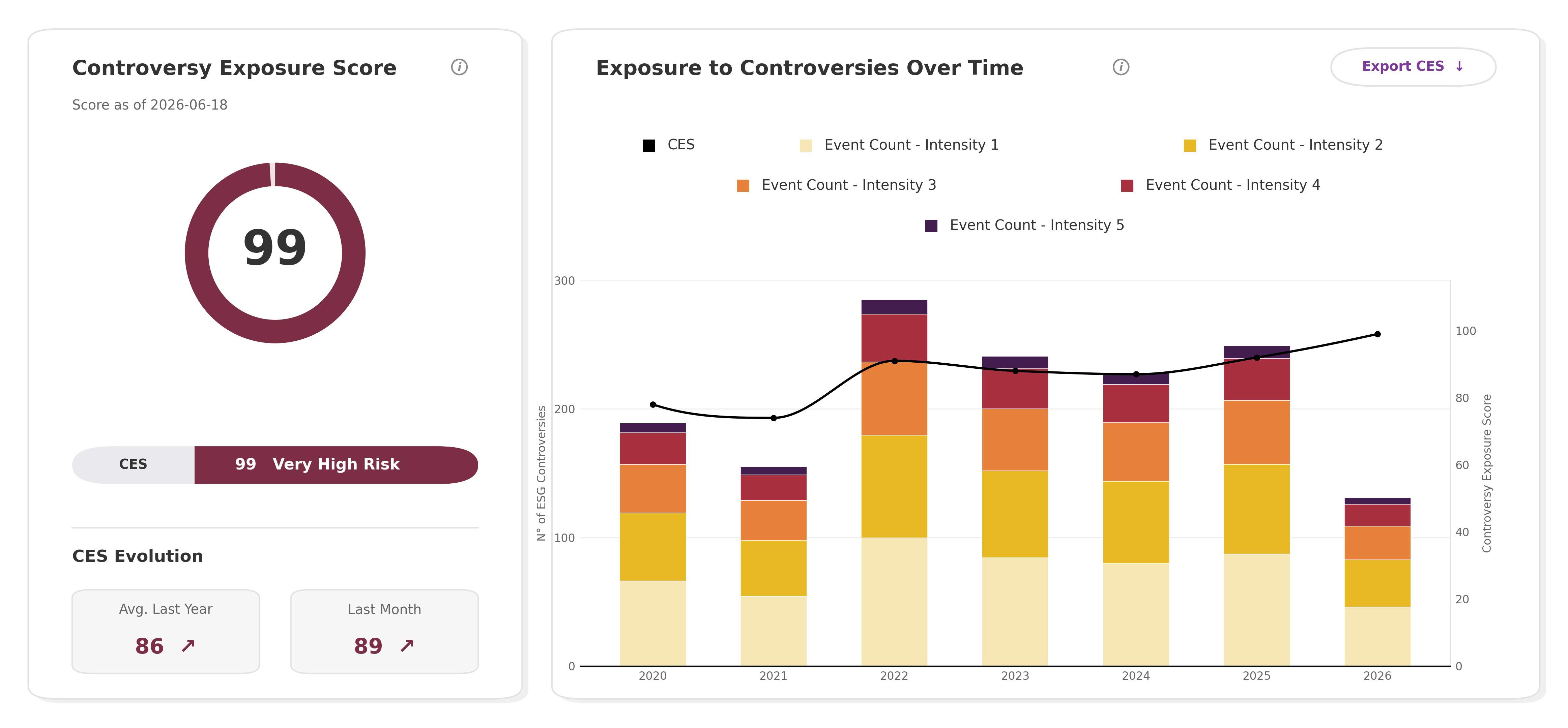
SESAMm's ESG data shows FIFA's Controversy Exposure Score has stayed High to Very High since 2020. See why continuous monitoring beats the four-year cycle.
With the 2026 World Cup now underway, FIFA is back in the global spotlight, and its risk profile is once again being narrated in four-year cycles, as though controversy arrives with the tournament and recedes with the closing ceremony. The data points to a different pattern. Across the period from January 2020 to June 2026, the large majority of FIFA's most serious controversies were recorded outside any World Cup window. Tournaments concentrate global attention on FIFA's existing liabilities, but the evidence suggests they do not drive the underlying volume. Many of the substantive events, including court verdicts, regulator rulings, fund decisions, and bid matters, occur in the periods between tournaments.
For investors, sponsors, and anyone screening exposure to football's governing body, this distinction matters. If controversy were cyclical, it could be assessed around the calendar. Because the data indicates it is closer to continuous, it is better suited to ongoing monitoring. To examine this, the analysis below draws on SESAMm's controversy data, which captures and classifies FIFA's reputational, regulatory, and operational controversies.
Context: How FIFA's Structure Shapes Its Risk
Controversy Exposure Over Time
*Unsolicited ratings - produced from public sources, not commissioned by the rated company. For more information, visit here.
It helps to start with how FIFA is organized, because its governance structure has a direct bearing on the type of risk it carries. As a Swiss-law association, FIFA answers to a membership rather than to shareholders or a securities regulator, and its decision-making body, the FIFA Council, is composed of representatives from the regional confederations whose commercial interests the Council also oversees. This means the regulatory functions of sanctioning, eligibility, and integrity sit close to the commercial function of awarding and selling tournaments. Arrangements of this kind tend to produce a steady stream of governance-related questions as part of normal operations, which is consistent with SESAMm’s controversy data.
One useful illustration is procedural rather than criminal. The Blatter and Platini proceedings span the entire time period without reaching a clear resolution, running from a 2020 complaint through a fraud indictment, an acquittal, a prosecutorial appeal, and a second acquittal, before Platini opened a fresh action against FIFA and Infantino in June 2026. As a corruption narrative, the sequence is inconclusive. As a governance observation, it illustrates a broader dynamic in which matters are litigated and re-litigated over long periods, in part because resolution often depends on external courts operating on their own timelines. The result is a long-running procedural footprint rather than discrete, time-bound events.
The CES is an aggregate, entity-level score (0–100) that measures an entity's overall exposure to ESG controversies over time. It's built from individual ESG events and their intensities, synthesizing both event volume and severity into a single trackable figure. The intensity score, by contrast, operates one level down: it's applied at the event level, measuring how severe or important each individual ESG event is on a scale from 1 (least severe) to 5 (most severe). In short, the CES tells you how exposed an entity is overall, while the intensity score tells you how serious each underlying event is.
ESG Risk Over Time
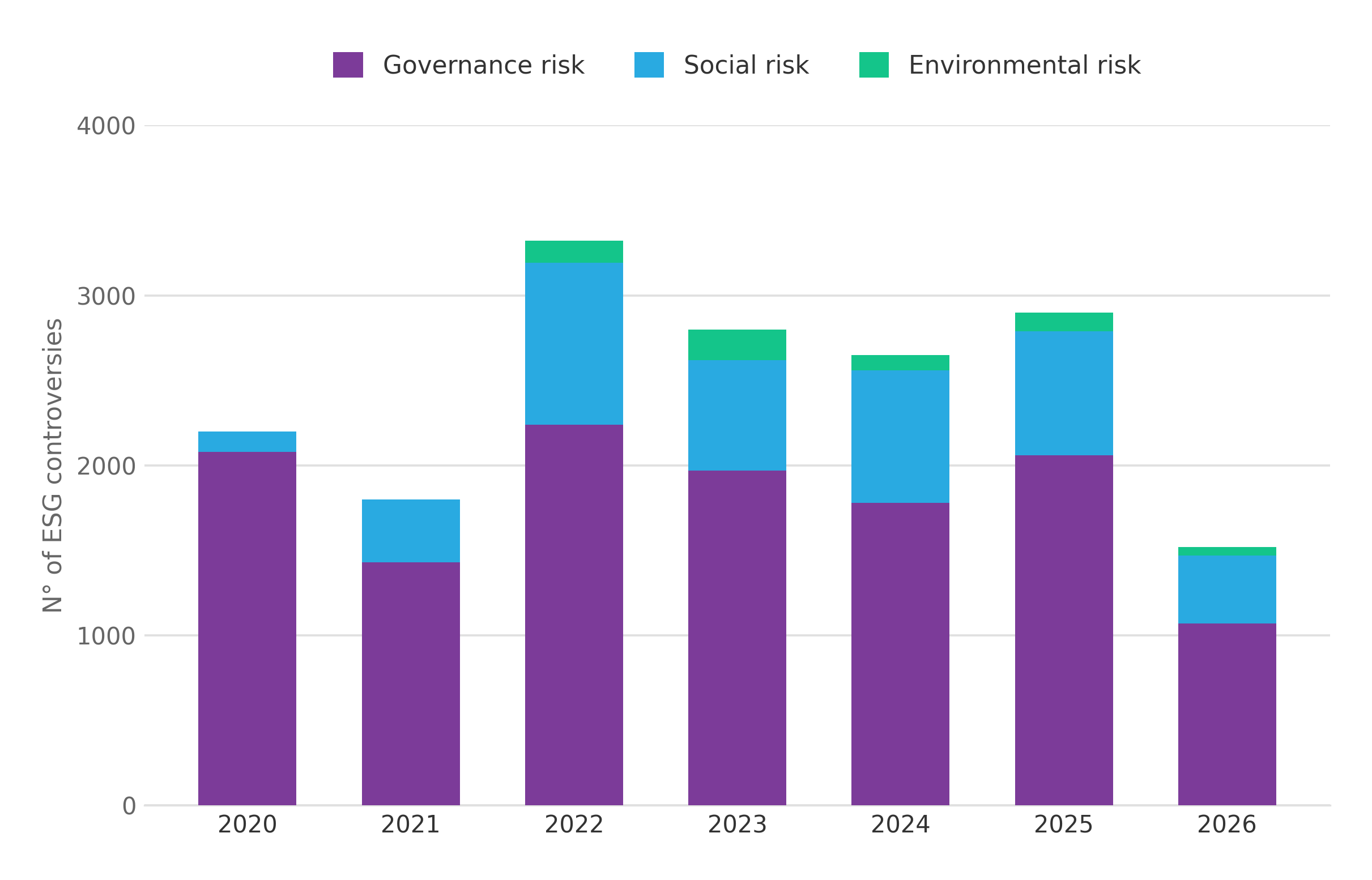
This chart tracks FIFA's ESG controversies per year from 2020 to 2026, stacked by risk pillar. Governance dominates every bar, with social forming a secondary band and environmental barely visible. Volume climbs from a governance-heavy opening year to a clear peak in 2022, then holds at a stable plateau through 2025 before the short 2026 bar. The shape is driven by a handful of major events. The 2020 corruption investigations kept the opening-year baseline elevated and were almost purely governance-related, following a US DOJ indictment unsealed that April, which alleged bribes were paid for the votes that awarded Russia and Qatar the 2018 and 2022 World Cups.
The 2022 Qatar World Cup marked the clear inflection point, drawing sportswashing accusations and pushing total controversies to their peak, while migrant-worker conditions and human-rights coverage around Qatar thickened the social band into a permanent quarter-to-third of each bar from 2022 onward. Rather than reverting, controversies settled into a post-2022 "new normal," plateauing well above the pre-tournament level.
Underneath it all, corruption-and-bribery and legal/investigative exposure account for the bulk of total risk across 2020 to 2026, while environmental risk stays statistically negligible throughout.
ESG Risk by Type
Environmental Risks
Environmental risk accounts for a small share of FIFA's total controversy volume, but that low frequency masks cases of genuine severity. The Swiss Fairness Commission ruled against FIFA's Qatar 2022 carbon-neutrality marketing, turning a greenwashing accusation into a formal regulatory matter still active in June 2026. Related controversies extend the theme, including criticism of the Saudi Aramco and Coca-Cola sponsorships, the cooling and water-use controversies at Qatar, and the animal-welfare outcry over stray-dog culling ahead of Morocco's 2030 hosting.
Beyond these, FIFA has drawn criticism over its marketing and communications, notably branding the 2022 Qatar World Cup as "carbon neutral," and has dealt with fraud and embezzlement, exemplified by the case of former FIFA and CONCACAF official Chuck Blazer. Issues tied to its board and senior management leadership round out the picture, though the overall pattern is one of an organization reacting to the weight of its legal and ethical past rather than getting ahead of it.
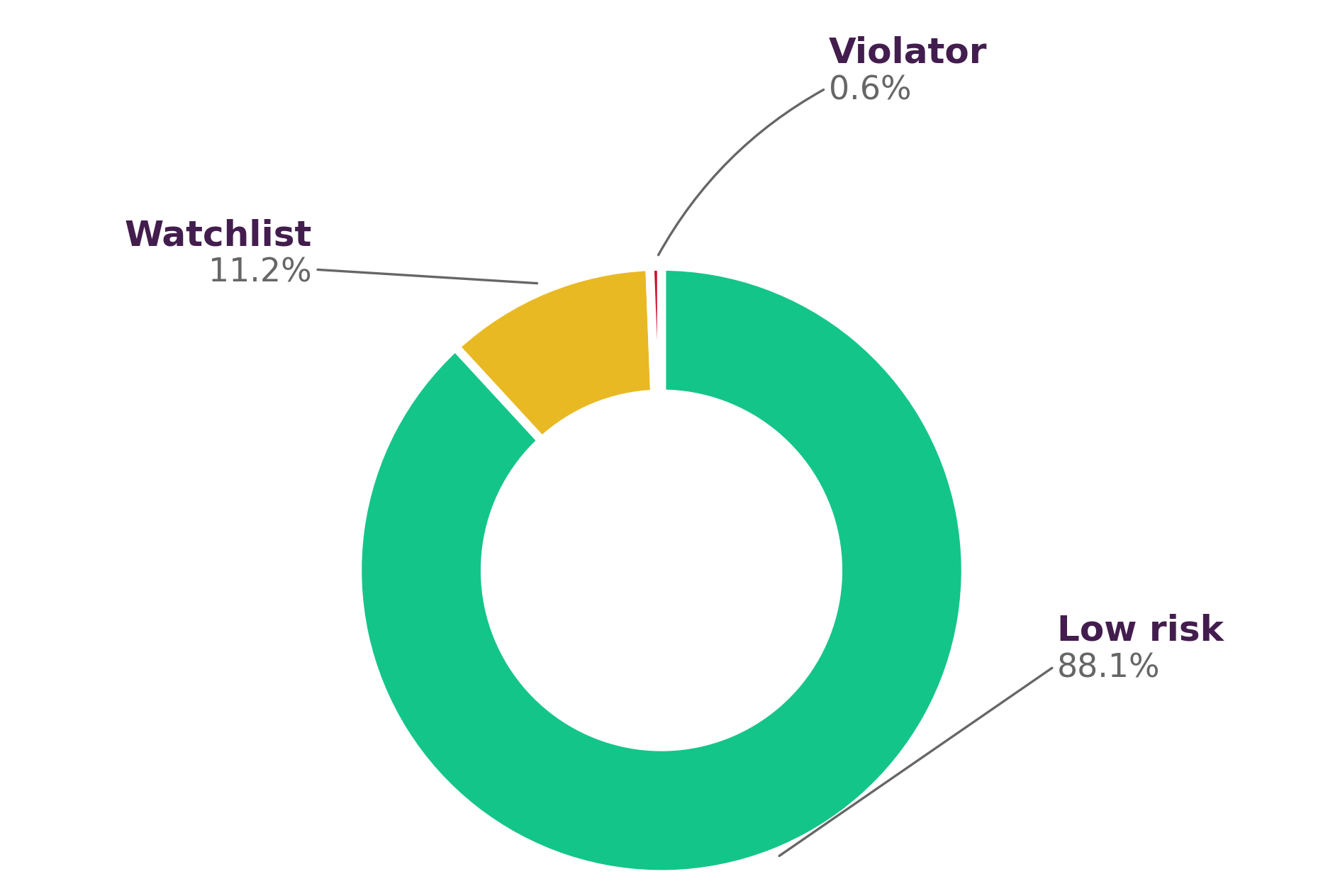
As the breakdown above shows, the overwhelming majority of FIFA's screened ESG events fall into the low-risk tier (1,294, or 88.1%), with 165 (11.2%) on the watchlist and 9 (0.6%) classified as Violator, the highest-risk tier under SESAMm's UN Global Compact screening. That tier is assigned only where there is clear evidence of a breach, such as formal sanctions, court findings, or regulatory condemnations, rather than unresolved allegations. For investors with SFDR Article 8 or 9 obligations, or internal exclusion policies tied to UNGC compliance, a Violator flag on a core holding or counterparty is a material signal rather than a monitoring note, which is why the profile is best read as governance-led: the nine Violator events reflect adjudicated breaches concentrated in FIFA's governance history, not the live controversies surrounding the current tournament.
The composition that emerges is a governance core of long-running legal cases, a Qatar-rooted social overlay that has proven durable, and a small but genuinely high-severity environmental tail now being contested through formal channels.
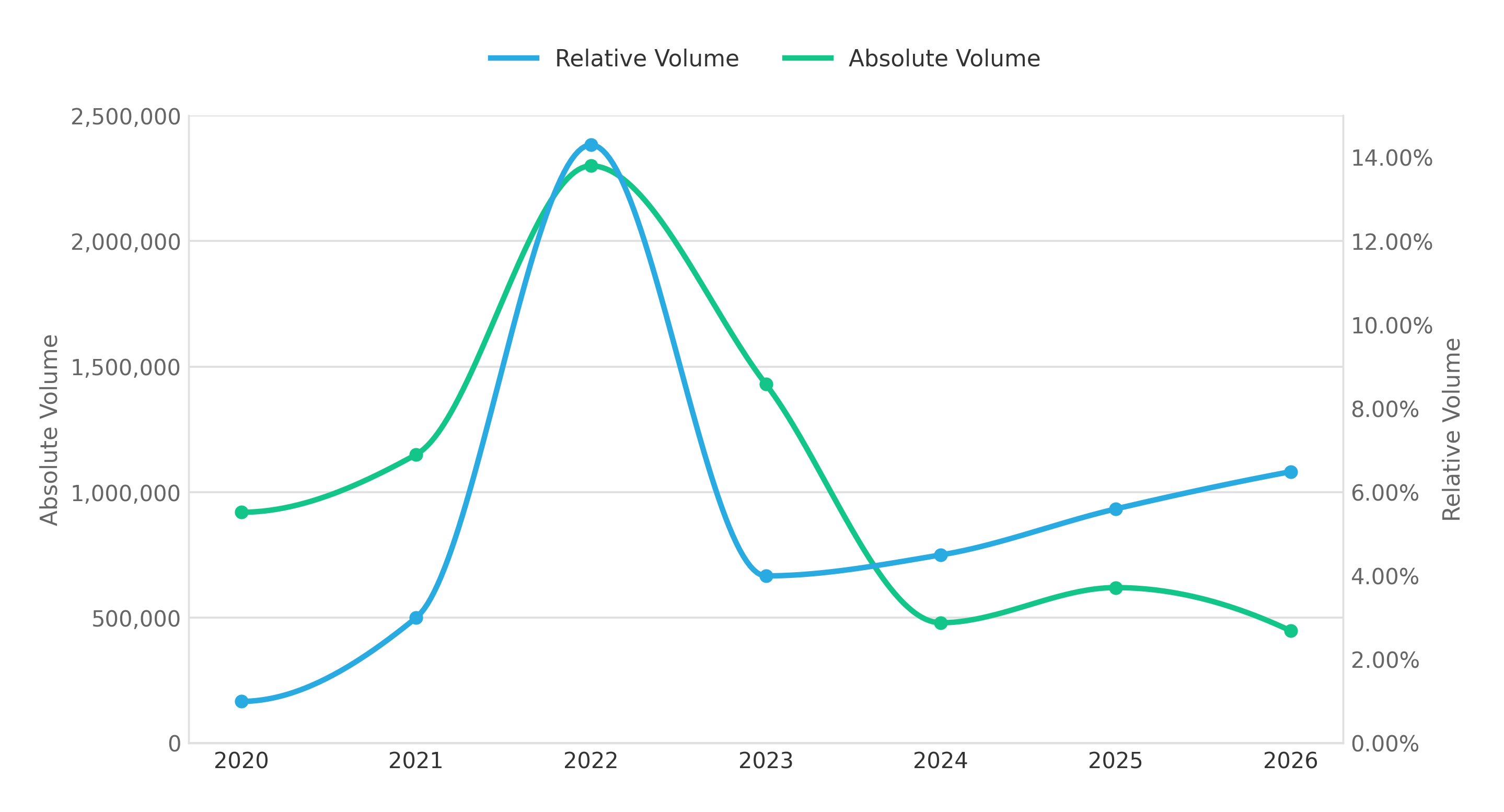
Both lines explode together, but unevenly: absolute volume roughly doubles while the relative share more than quadruples, briefly making Qatar roughly one in seven of all FIFA-related items, because nearly every controversy fires at once. The spike packs in wider labor abuses, and the jailing of whistleblower Abdullah Ibhais; the OneLove armband ban and Qatar's criminalization of same-sex relations and the broader sportswashing and carbon-neutral greenwashing charges; and the unresolved bribery allegations over the 2010 hosting vote. On its own, this acute cluster would suggest a controversy that lives and dies with the tournament.
Phase 3: Off-Season Accumulation (2023–2026)
This is where the two lines part ways, and the accumulation shows itself. After the tournament, the relative share deflates sharply in 2023, the acute spike clearing, but it never returns to baseline; instead, it grinds steadily upward every subsequent year, ending in 2026 at roughly four-and-a-half times its pre-tournament level. Over the same stretch, the absolute volume collapses, from 1.43M in 2023 to around 448K in 2026, under a fifth of the 2022 peak. The two movements together are the key finding: even as total FIFA coverage shrank dramatically, the Qatar migrant-worker case captured a larger and larger share of what remained. Driving that residual are post-tournament findings: The non-payment of the migrant workers during the 2022 World Cup, the campaign for a migrant-worker compensation and remedy fund, and Amnesty's continued push for FIFA to fund remediation.A storyline that merely echoes the event would fade with the falling volume; one that accumulates does the opposite. The controversy is no longer powered by the match calendar but by its own momentum.
The Case Underneath
Underneath that residual sits the report's single heaviest case: the human-rights strand of 135 events running from 2020 to 2026, the longest-running and most densely populated case in the dataset. What stops it fading is that each turn of the hosting cycle reactivates it: the 2026 uptick to 6.49%, the highest reading outside the tournament year itself, coincides with the 2026 World Cup now underway in North America, which revives retrospective scrutiny of Qatar, and the emerging human-rights questions around Saudi Arabia's 2034 tournament, which carries the same migrant-labour lens straight to the next host. The case is not simply failing to fade; it is being actively topped up by each new host, which is why the social exposure reads as structural rather than event-bound.
Key Takeaways
Taken together, the data describes a profile that is primarily governance-related, with the most severe and persistent cases concerning legal exposure, corruption, and bribery, supported by a durable Qatar-rooted social overlay and a small but high-severity environmental tail. All three pillars reach maximum case intensity, so severity is not confined to any single dimension.
The most consistent feature is persistence. FIFA's Controversy Exposure Score has remained in the High-to-Very-High band throughout the period and sits at 99 today. The largest cases run continuously from 2020 to 2026, and a significant share of binding decisions occur outside tournament windows. None of this reduces the significance of the World Cup, which clearly concentrates attention and scrutiny. But the underlying controversy is produced across the quarters between tournaments, and several of FIFA's most consequential outcomes are set during lower-attention periods. For those screening FIFA, the practical implication is that continuous monitoring suits this profile better than event-triggered review, because much of the relevant activity occurs between tournaments rather than during them.
The data suggests that for an entity like FIFA, a four-year review cycle misses most of what matters. Request a demo to see how SESAMm supports the kind of ongoing monitoring this profile requires.
*The Controversy Exposure Score (CES) is a continuous score from 0 to 100 measuring a company's exposure to ESG controversies over time, based on the severity of incidents and their media volume. This is an unsolicited rating: it is not commissioned by the rated company. The company is notified before its score is first issued, does not take part in the rating, and SESAMm has no access to its management or non-public documents. Ratings are produced only from public and licensed sources. The methodology is available here.
2018 proved to be an eventful year for SESAMm with multiple renowned customers acquired, our A series fundraising campaign, numerous prizes won and milestones reached. Here is a look back at our rewarding year 2018 followed by our next steps for 2019.
Successful market entry in the US and around the world
The rapid growth of the alternative data industry and of SESAMm
As a Fintech company specialized in alternative data for Asset Management, 2018 represented a thrilling year in our industry and 2019 already promises to be even more exciting.
During 2018, after our very first business trip in the United States, our international sales development beyond Europe began accelerating. In just one year, we already signed contracts with multiple clients. These include major hedge funds in the US and a major global trading company managing $100 billion in financial assets and part of the Top 10 in its market. The US market represents a powerful strategic growth driver and we are already preparing to open an office there soon!
SESAMm signed its first contract with a client in Africa: Ipro Investment, renown asset manager established for 25 years specialized in emerging markets. Finally, we also signed a contract with our first Japanese client, Nikko Global Wrap, one of the subsidiaries of Sumitomo Mitsui Asset Management which is a major asset manager in Japan managing JPY 1.7 trillion.
Strengthening and developing our position in Europe
At the European level, SESAMm has also extended its customer portfolio:
Groupama AM: new major clients and leading French Asset Management players managing €103 billion Asset under Management (AuM);
Société Générale: leading French bank present all over the world;
Raiffeisen Bank International: one of the leading banks in Europe with more than 50,000 employees servicing over 16.5 million customers and possessing around 2,400 business outlets;
GT Patrimoine : the largest consulting and private management firm in the Lorraine area and based in France for 12 years.
In addition, after our 1st successful collaboration, a new contract was signed with Candriam, leading Asset Management firm and members of the New York Life Group, managing more than $112 billion AuM worldwide.
We are very proud to see how much traction we gained in just a year. The growing use and interest in alternative data for the Asset Management industry, both for quantitative and fundamental funds and asset managers, lead us to prepare for new opportunities of growth & business development.
Cutting edge solutions to respond to market needs
Big Data & AI for Cryptocurrencies
Our first cryptocurrency project began in early 2018. Initially, we started tracking the evolution of the most popular cryptocurrencies, such as Bitcoin (BTC) and Ethereum (ETH) and we analyzed their social data to produce social sentiment & emotions indicators. These indicators have since been integrated into our visualization platform of market sentiment, L’Humeur des Marchés.
This led us to establish a unique partnership based on L’Humeur des Marchés with NapoleonX, a major player as the leading French cryptocurrency manager: the first sentiment and emotion cryptocurrencies analysis destined for the general public. Since then, ETH and BTC sentiment, emotions & opinion value from SESAMm has been available to individual investors and the general public on NapoleonX platform.
The evolution of L’Humeur des Marchés
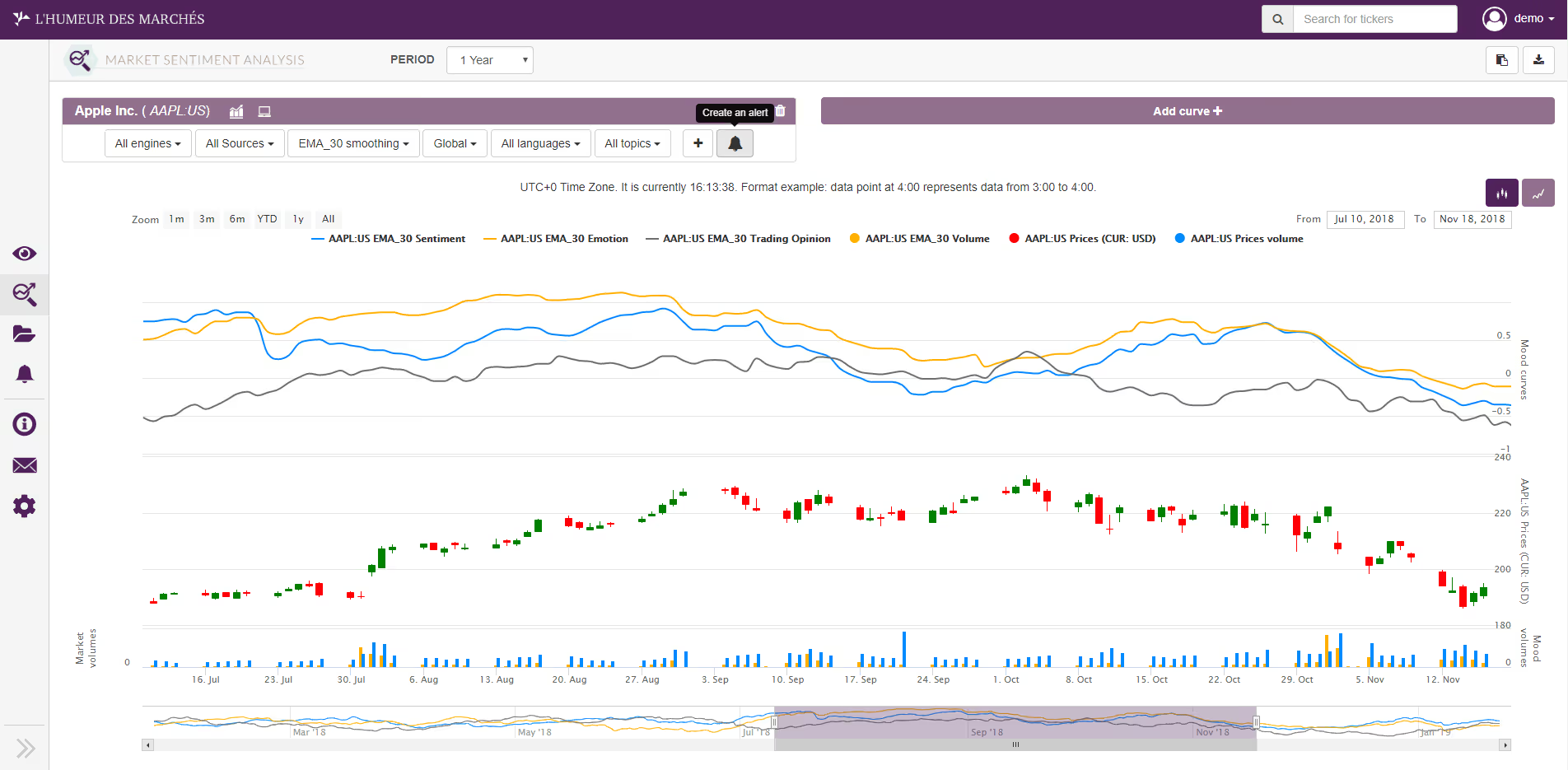
Our platform L’Humeur des Marchés is an essential tool to guide companies in their investments. During 2018, multiple improvements were added into L’Humeur des Marchés to further enhance its insights & analytics. For example, users have now the possibility to build automated strategies which can generate daily trading signals. Multiple new features were also added such as a strategic backtesting system, daily alerts with 3 years of history and day+1 signal to forecast market movements giving asset managers an edge over competitors.
"L'humeur des marchés" is SESAMm's data visualization platform to analyze market sentiment & emotion for asset management
L’Humeur des Marchés, our data visualization platform
Finally, additional filters have been added to better study & analyze market sentiment: there are now 6 different filters for data sources (sort by sources from web & press, news, blogs, discussions, social trading or all of them) and 9 languages covered (sort by English, French, Spanish, Chinese, Japanese, Portuguese, Italian, German or all of them). These new filters allow for a wider and more accurate coverage of assets, leading to improved tools & insights for investment decision.
Global recognition & awards for SESAMm
To accomplish our worldwide ambitions, we have started being more and more present abroad, especially at international events. They represent great occasions to promote SESAMm, demonstrate the unique benefits and advantages brought by our technologies & solutions and finally create business opportunities.
This year, we participated in many international events in the US and in Japan, including New York and Hong Kong for Eagle Alpha’s Alternative Data event, Canada, Africa and even London at the French Fintech Tour.
Having been selected for unique international awards reinforces our confidence in the benefits of our solutions for the Asset Management industry, for example with “Talk data to me” by Neudata, Elevator Lab Competition, and Groupama’s award “Créateur de confiance” (Trust Creator) among others.
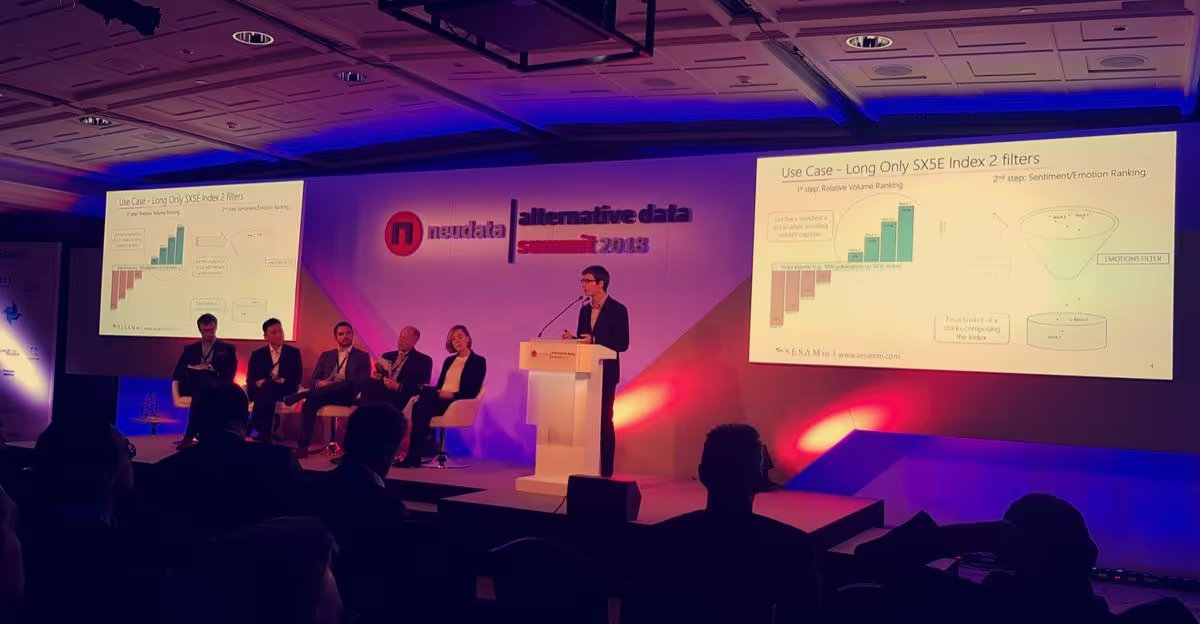
SESAMm won the pitch "Talk data to Me" of Alternative Data Summit event by Neudata
SESAMm pitch “Talk Data to Me” winner during Alternative Data Summit by Neudata
Moreover, SESAMm has competed in several acceleration programs, in which we were selected in the following ones:
Fintech Business Camp Tokyo, the Tokyo Metropolitan Government accelerator program by Invest Tokyo and powered by Accenture;
Elevator Lab, Acceleration program of Raiffeisen Bank International where SESAMm competed and was selected;
French Tech Tour America, IMPACT USA’s program to prepare and discover North America’s markets & opportunities;
Pass French Tech, La French Tech’s highly selective program for hyper-growth startups & companies.
SESAMm’s Demo Day Presentation during Fintech Business Camp Tokyo
SESAMm’s plans for 2019: recruitment, development and growth
This year, we are very proud to see our team grow so much in so little time: we had 16 collaborators at the beginning of January 2018 and we are now a team of 28 members! Talented profiles have joined SESAMm team with NLP, AI & Quant engineers & experts from world-renowned schools. New collaborators will join SESAMm in the first quarter of 2019 and we are still recruiting in various fields such as Data Science, Quantitative Analysis, IT and Natural Language Processing among others. You can find all our offers on our dedicated page SESAMm Career!
Following our international success, especially in the US and in Japan, we are now preparing to open an office in the US in the following months and are already considering this option for Japan. Next month’s promise to be exciting and we will be participating in multiple events such as AI & Data Science for trading in New York in March, Machine Learning in Quant Finance by GFMI in April, and many events & conferences on alternative data, data science, Artificial Intelligence and Big Data for Asset Management around the world.
As you can see, 2018 represented SESAMm an exceptional year for its growth with new customers, including global companies, technological improvements for our solutions & services and a bigger and even more motivated team! Our major event in 2018 was the accomplishment of a €2.6 million Series A fundraising campaign, which enabled us to continue our international development, mainly in America and Asia, and the recruitment of many profiles. 2019 will represent another step for SESAMm to become a leading company in the alternative data solutions in the world. Stay tuned: SESAMm news will arrive soon!
Sylvain Forté, CEO and co-founder of SESAMm, presented the following at Finovate 2022. In the presentation, Sylvain explains who SESAMm is, what SESAMm does, including examples, and how it benefits our financial clients.
Below is an approximation of this video’s audio content. Watch the video for a better view of graphs, charts, graphics, images, and quotes to which the presenter might be referring to in context.
Hi, everyone. Thank you very much for the opportunity to be with you today. I’m very glad to introduce you to SESAMm. I’m Sylvain, CEO and co-founder of SESAMm.
We’re an artificial intelligence company specializing in analytics for investment professionals and [corporations]. We basically extract billions of articles and messages from the web and transform them into actionable insights to make better decisions. We’re a team of close to 100 people now, and we generate insights from more than 20 billion articles and messages.
Immediate access to daily insights
Let me jump straight to the demo and give you a practical example of what we do. So imagine you’re, for example, a bank looking to compute environmental, social, and governance risks on your portfolio on your clients or on your suppliers. Right now, you may have access to ratings, which are updated once per quarter or once per year. We can give you access immediately to timely daily data on all of your companies in order for you to better assess risks and raise early warnings.
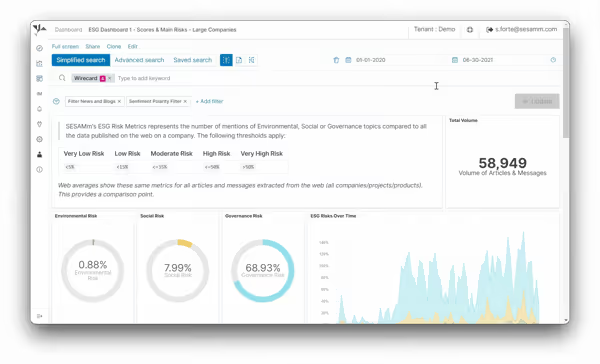
Wirecard use case
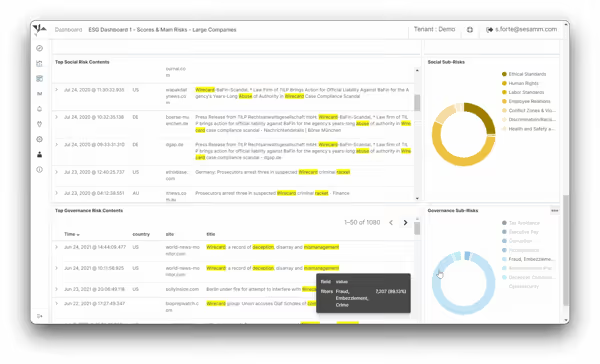
In this specific example (Figure 1), we look at Wirecard, a company that went bankrupt due to a 2 billion fraud scandal in Germany.
We extracted dozens of thousands of articles and messages on the company, and we can immediately see that there is a huge anomaly in terms of governance risk. The company is basically exposed to fraud accusations, to lawsuits, and the like, things that you don’t really want to see in your clients or your own portfolio.
Furthermore, we can see on this chart that we can get that type of indicator every single day. And we can see that six months prior to the company’s bankruptcy, there were already huge alerts actually here in January 2020, indicating that the company was in a pretty bad situation from the perspective of web content and web data from news to social platforms, blogs, and forums.
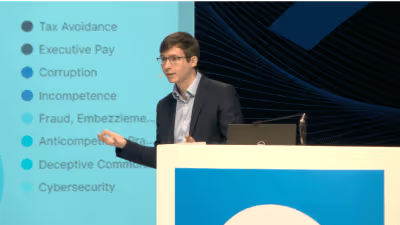
We really have the ability to compute live insights for ESG risk, sustainability monitoring, credit, and similar topics. The advantage of the platform is that we can go very deep. You can see here (Figure 2) some of the underlying governance topics associated with Wirecard, such as fraud, embezzlement, and crime—the main accusation—but also things related to anti-competitive practices or corruption.
Figure 2: Underlying governance topics associate with Wirecard.
And furthermore, the platform enables full transparency. This is AI at scale, but the underlying content is actually text articles and messages that you can read in order to understand the situation and see why the company is in that risk position. So with our platform, with our text analysis engine (TextReveal®), you can immediately extract content on your portfolio, your clients, your suppliers, and for example, generate ESG insights, competitive insights, sentiment insights, or credit warnings, for example.
Trusted, reliable, and abundant insights
We are today trusted by major financial institutions, such as Nomura [Holdings] or Raiffeisen Bank in the banking sector, for example, or large private equity firms worldwide. The reason why they trust us is that we can provide data more quickly—so waiting one day instead of waiting three months—to get an indicator. In addition to that, we have better coverage. We’re the only company in the world that can provide information on five million different public and private companies, meaning all of your banking clients, for example, are covered. And finally, we have access to a large variety of sources, from social content to news and blogs.
Insights beyond companies
Another example that is very common—sadly right now—is clients asking us to follow the Ukraine Russia War and to understand the current situation, including by getting access to local content in local languages in Ukrainian, in Polish, in Russian, to really understand the news and social media out there.
You can see here that beyond companies, we actually track sectors, infrastructure projects, and concepts.
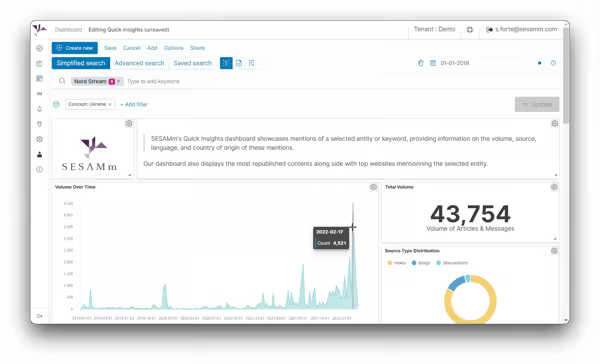
Figure 3: A dashboard view into Nord Stream in the context of Ukraine.
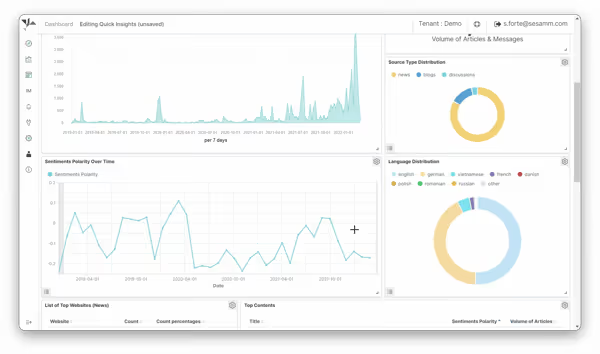
Here (Figure 3), Nord Stream, for example, in the context of Ukraine specifically—so as to understand how these two topics are associated on the web—we can see an explosion in terms of volumes of data over time, the news associating this concept more and more, with more than 40,000 pieces of content. And we can see that sentiment over time, as displayed on this curve (Figure 4), decreases very rapidly, so we see the shock on e-reputation, and we can observe that immediately. And, for example, as a bank or as an asset manager, we can use that to assess the potential risk to clients or portfolio companies.
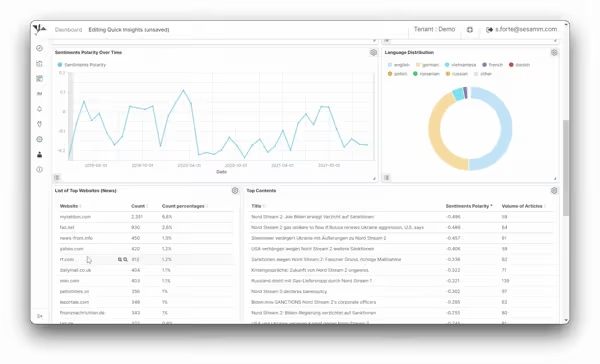
The interesting thing here is that, beyond the graphs and the raw contents, we can look at where the information comes from. Here (Figure 5), you see a lot of information in German, for example, which is not surprising. And you can even follow the Russian propaganda directly from the platform, looking at Russia Today or Sputnik straight from the engine, as these are also sources that we monitor.
Figure 5: The dashboard on Nord Stream shows sources from Germany and Russia.
And as you can see, these contents are highly customizable and can be used in very specific situations. So this is really a platform as a service (PaaS) that we offer. This is an engine that tracks four million different sources of information, and we can track millions of companies but also even fuzzy concepts, countries, or topics of interest.
Generate analytics from big data with API
One last thought. A lot of our clients integrate with our API; it’s a technical solution. We work a lot with data science teams, data engineering teams, risk teams, quantitative analysts, and heads of innovation. All of these teams are looking to generate analytics from big data and from web content at scale, with solutions that are currently used by dozens of clients worldwide and for which we provide very relevant analytics.
I’ll leave you with three final calls to action.
The first one is come see us at our booth. We would be very happy to present the solution in a bit more detail.
The second is, please request a demo. You understand that these indicators can be tailored to your needs in real time. So we’ll be very happy to show you a demo at SESAMm.com.
And finally, come see us for a free proof-of-concept (POC). We would be very happy to show you how we incorporate these solutions in actual banking tools and in risk management tools.
So the web is now readily available as a system that you can use and that you can rely on in order to generate valuable insights. We’re very happy to provide the solution to the market and to help inform better decisions and to help monitor risks.
Thank you very much.
Stay ahead with the latest in ESG and AI intelligence
Join our mailing list to receive new reports, event invites, and updates from SESAMm directly to your inbox.