Behind the scenes: Carlyle leverages SESAMm’s alternative data for a $475 million investment in YipitData
February 8, 2022
•
5 mins read
Context
In December 2021, Carlyle led a $475 million Series E funding round for YipitData. As part of its diligence process, Carlyle used SESAMm’s Natural Language Processing (NLP) models to help inform this investment decision.
Results
YipitData is an alternative data firm that extracts billions of data points from the web and other alternative data sources to generate proprietary data and KPIs on industries and individual companies.
SESAMm’s TextReveal® platform enabled Carlyle to extract valuable insights on the alternative data market to assess the global market opportunity based on the analysis of more than 17 billion web articles and messages. Using NLP in its due diligence process, Carlyle’s deal team was able to confirm YipitData’s leading market position and growth prospects across multiple industries and geographies. Furthermore, a risk analysis drawn from social discussions, anonymous forums and dark web content concluded there was very low risk associated with the company.
SESAMm provided valuable insights based on the analysis of billions of documents for this specific deal and helped translate unstructured contents into industry-level trends, competitive insights and risk analytics. These types of analytics can add value to the entire investment lifecycle, from sourcing to due diligence and portfolio monitoring — providing investment teams with key insights to assess investment opportunities and build a competitive edge.
“SESAMm provided us with valuable and timely insights for our investment process through its NLP alternative data. They helped us gain even more confidence in YipitData’s strong potential by confirming the company’s leading position. We are very happy with the insights provided by SESAMm and look forward to further collaborations.” Senior Associate – Technology Private Equity, The Carlyle Group
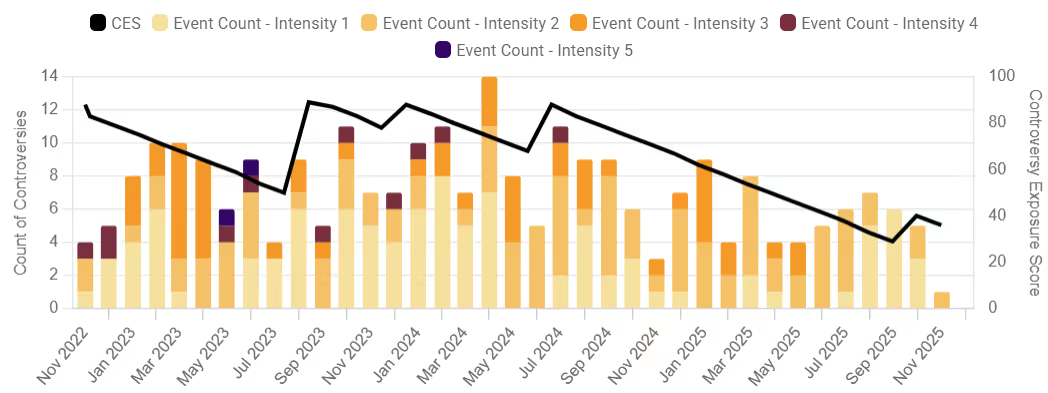
Despite its promises, the clean energy sector, featuring companies like NextEra Energy, First Solar, and Siemens Energy, faces significant challenges across ESG fronts. Governance issues include lawsuits over misleading financial practices and greenwashing accusations. Environmentally, the sector struggles with defective technology and product performance failures, eroding trust in renewable energy solutions. Social and labor challenges are also prevalent, including discrimination lawsuits, unsafe working conditions, and customer dissatisfaction stemming from product failures and poor service. Furthermore, the growing threat of cybersecurity vulnerabilities within clean energy infrastructure poses risks to both operational systems and consumer data.
What are the most pressing ESG challenges currently facing the clean energy sector? Read on to find out.
NextEra Energy: ESG Challenges and Legal Disputes
NextEra Energy faces several ESG controversies despite being less exposed than its peers. Governance issues include a $1.2 billion impairment related to the Mountain Valley Pipeline and a $350 million antitrust lawsuit for allegedly obstructing a competitor’s clean energy project. It has also faced legal challenges, notably investigations into its political donations connected to its bid for Jacksonville’s public utility. Environmental concerns involve growing opposition to its solar and battery projects and lobbying against rooftop solar policies, along with protests over its wind and drilling operations in Florida, which are subject to a class-action lawsuit for environmental risks. Additionally, the company is investigating wind turbine collapses and is engaged in legal disputes regarding employee rights, including a retaliation lawsuit and a $500,000 settlement over debt collection practices.
First Solar has been dealing with a mix of ESG challenges. The solar manufacturer is locked in patent litigation with JinkoSolar while struggling with broader industry headwinds like polysilicon oversupply, hurting bookings, and creating manufacturing problems. CEO Mark Widmar has pointed to policy uncertainty as a major roadblock, saying failed climate legislation is hampering domestic solar production. The company is also cleaning house with its Malaysian contractors over unethical labor practices. Despite proposed subsidy cuts dragging down the stock, RBC analysts still see nearly 40% upside potential as First Solar works through these operational and regulatory pressures.
Siemens Energy: ESG Controversies and Operational Challenges
Siemens Energy is facing multiple ESG controversies, including criticism for its reliance on fossil fuels and accusations of greenwashing. Its Siemens Gamesa unit struggles with turbine quality issues, resulting in financial losses, employee layoffs, and legal disputes, including a blocked asset sale in India and corruption allegations. The company is also under legal scrutiny for delays in the Akkuyu nuclear project and past sanctions violations. Additionally, Siemens Energy has been criticized for a data breach involving MOVEit software and vulnerabilities in its products. Socially, it has faced backlash for abolishing its women’s quota in the U.S. and labor unrest at Siemens Gamesa facilities, including strikes over working conditions.
In conclusion, the clean energy sector faces critical ESG challenges that threaten its potential for sustainable growth. Companies like Tesla, Siemens Energy, and NextEra Energy must prioritize transparency, improve governance, and address environmental and social issues to regain stakeholder trust. By proactively tackling these concerns, the sector can strengthen its credibility and better contribute to global sustainability efforts. The path forward is challenging, but addressing these challenges is essential for the clean energy industry's success in combating climate change.
Reach out to SESAMm
TextReveal’s web data analysis of over five million public and private companies is essential for keeping tabs on ESG investment risks. To learn more about how you can analyze web data or to request a demo, reach out to one of our representatives.

BNP Paribas has released its 2025 ESG Global Survey, revealing how institutional investors are adapting their sustainability strategies in the face of shifting market dynamics, rising regulatory scrutiny, and increased public skepticism. The report surveyed 420 asset owners, asset managers, and private capital firms across 29 countries, representing a combined $33.8 trillion in assets under management, and paints a complex but ultimately optimistic picture of ESG’s evolution.
Resilient Commitment Amid a Changing Landscape
Despite growing political backlash and accusations of greenwashing in various markets, investor commitment to ESG remains strong. A large majority, 87%, said their ESG or sustainability objectives have remained stable, and fewer than 3% expect to scale back their commitments. Furthermore, 84% anticipate that their organizations will continue to progress on sustainability goals through 2030.
However, this confidence is paired with a new sense of caution. Forty-one percent of respondents reported a more restrained approach to publicly promoting their ESG activities. This shift reflects broader concerns about reputational risk and regulatory ambiguity, particularly in markets where ESG has become politicized. Still, the underlying momentum toward long-term ESG integration appears undeterred.
From Broad ESG to Thematic and Impact Strategies
The report also signals a shift from general ESG investing toward more targeted strategies, especially thematic investing. Eighty-five percent of participants now apply sustainability criteria to investment decisions, and 59% actively pursue thematic strategies such as climate resilience or social equity. Top investment priorities over the next two years include increasing allocations to the energy transition, divesting from carbon-intensive assets, and using active ownership to push portfolio companies toward improved ESG outcomes. This thematic focus suggests a maturation of ESG strategies, with more precise goals and performance expectations.
Emergence of ESG “Pacesetters”
A standout insight from the survey is the rise of “pacesetters,” the 19% of respondents that have achieved the highest levels of ESG integration. These advanced investors have already embedded ESG factors across portfolios, including metrics related to social impact, biodiversity, and “The Just Transition Mechanism”. Nearly all pacesetters are actively decarbonizing their portfolios and report alignment with broader societal and environmental goals.
This group is not only more sophisticated in managing ESG risk but also more likely to view ESG as a long-term value driver. Their practices highlight what comprehensive ESG adoption can look like when paired with sufficient resources, internal alignment, and robust data.
Private Capital’s Expanding ESG Role
Private capital managers are also emerging as key ESG players. More than half are using active ownership strategies, while 76% emphasize social impact, and 63% are engaged in just transition initiatives. These firms see ESG as an opportunity to generate alpha, align with stakeholder expectations, and lead in sustainability-driven innovation.
The Critical Role of Data and Partnerships
Finally, the survey underscores the growing importance of ESG data and trusted partners. Nearly half of all respondents expect to increase budgets for ESG data acquisition and analysis. When selecting financial partners, ESG reputation and expertise are increasingly decisive factors.
Overall, the 2025 survey shows that institutional investors remain deeply committed to ESG, but are evolving in how they execute and communicate these strategies. The future of ESG appears less about bold declarations and more about targeted, data-driven action.
SESAMm’s AI Technology Reveals ESG Insights
Discover unparalleled insights into ESG controversies, risks, and opportunities across industries. Learn more about how SESAMm can help you analyze millions of private and public companies using AI-powered text analysis tools.
Tokio Marine & Nichido Fire Insurance Co., Ltd. (TMNF) tapped SESAMm for a joint research venture to predict future stock price movements. SESAMm provided various NLP indicators, such as digital sentiment calculated for single stocks or indices (seen as an entity), as well as its experience in machine learning to work on this task.
These studies concluded with two key findings:
Relationships exist between NLP data from news and social networking sites and investor behavior under specific circumstances. Researchers and investors can use the “digital sentiment” as an indicator of investor sentiment to anticipate price changes. They can then use this anticipation for a specific company or, more generally, any entity that can be isolated in a text (like an index).
By focusing on more stressed situations, like the 2015 market sell-off, the U.S.-China trade war, the coronavirus pandemic, and the start of the Ukrainian crisis, we could show that digital sentiment is beneficial in times of significant stress in the market. Digital sentiment more accurately reflects the stress level in these complicated situations. It, therefore, helps to predict stock price movements more accurately in these stressed cases, providing a tail hedge. It’s not biased by an excess of confidence linked to the “central banks put” for instance.
Providing safety and security since 1879
Tokio Marine Insurance Company was first established in 1879. Over the years, it has added products and services, acquired other businesses, and merged with other companies to eventually become Tokio Marine & Nichido Fire Insurance Co., Ltd. Commonly called Tokio Marine Nichido today, the company is a property and casualty insurance subsidiary of Tokio Marine Holdings, the largest non-mutual private insurance group in Japan. Its products and services provide safety and security to its clients and partners, contributing to more fulfilling lifestyles and business development.
One of the company’s philosophies is to be a good corporate citizen and fulfill its social responsibilities, including protecting the global environment, promoting human rights, creating a responsible working environment, and contributing to society and individual local communities. Recently, the Emperor of Japan awarded Tokio Marine Holdings, Inc. the Medal with Dark Blue Ribbon for donating to the Japan Student Services Organization to support students who face financial difficulty during the
COVID-19 pandemic. Individuals, corporations, or organizations are awarded the Medal with Dark Blue Ribbon for their outstanding contributions to the public.
Transforming and accepting the challenge to grow
According to TMNF, “The business environment surrounding the insurance industry is changing at a faster pace than ever due to changes in demographics, advances in technologies, such as autonomous driving and AI, and longer-term trends, such as the intensification and frequent occurrence of natural disasters, as well as further progress in digitalization due to the COVID-19 pandemic.”
“The business environment surrounding the insurance industry is changing at a faster pace than ever…”
“While these changes in the business environment pose a threat, we consider them to be excellent opportunities for transformation and the creation of new value.” So they’ve adopted the concept, “Transformation (“X”) and Challenge to Growth 2023: Aiming to be the company most chosen for quality and its passion.” Ultimately, it strives to support customers and local communities in times of need while contributing to social responsibility. Five social issues that it will prioritize are:
Global climate change and the increase in natural disasters
The increased burden of long-term care and healthcare due to the aging of society and advances in medical technology
Technological innovation and its effects on the environment
Symbiotic society and responding to the novel coronavirus
Industrial infrastructure and how it supports economic growth and innovation
Leveraging a partner with the right technology
To secure and protect its clients’ assets while elevating social issues, Tokio Marine Nichido sought out an edge in the stock market. Under these circumstances, it was fortunate that TMNF discovered SESAMm in 2020 through the Plug and Play Japan program, a platform with an event that connects Japan to markets abroad. SESAMm had presented its NLP alternative data solution, TextReveal®, to which TMNF considered the platform for access to alternative data and sought collaboration with the SESAMm team for a research project.
“SESAMm has the technology to extract sentiment from news data with a neural network.” – Tokio Marine & Nichido Fire Insurance Co. Ltd representative
Extracting relations between NLP data and the financial market
In 2021, Tokio Marine Nichido Insurance began collaborating with SESAMm to develop an AI analytics model for alternative data. It models the effect of news and social networking data on investor behavior for stock and bond markets. In other words, it structures text information into knowledge usable by TMNF.
Monitor risks and topics
NLP data can improve the understanding of the market’s behavior by exhibiting the most important topics over time, with a direct indication of the importance of the topics through the text volume (Figure 1).
Figure 1: Automatic detection of the main topics in the U.S. market since 2015, thanks to topic modeling.
Researchers can also use it to focus on a specific topic or a certain period. For instance, a short analysis of the most frequent keywords in the press, which preceded the market fall during the COVID-19 pandemic, showed the significant predominance of pandemic-related terms (Figure 2).
Figure 2: Most frequent keywords in English S&P 500-related articles between 17 Jan. 2020 and 19 Feb. 2020.
Focusing on the equity market
NLP tools provide specific data, like sentiment, to get more detailed information at the company level and for many underlyings. Indicators for equity indices, for instance, can be calculated and provide a clean sentiment to monitor markets.
In many situations of stress over recent years, such sentiment proved to be an early indicator of the market’s future degradation. For example, there was a time lag of as long as a month between the time COVID-19 became the main news focus and the time it affected the U.S. stock market. By using SESAMm’s technology to analyze news data during this period, the team found that the U.S. digital sentiment had already deteriorated sharply before stock prices reacted (Figure 3).
Figure 3: In 2020, U.S. news sentiment falls ahead of the stock market in response to COVID-19 concerns.
This sentiment deterioration occurred because of the fear of the coronavirus’s spread’s effect on the global economy (see Figure 2). Even with an all-time high S&P 500, U.S. investors didn’t initially consider this risk. In comparison, HSI companies were closer to the coronavirus spread risk. So as a result, HSI investors reacted ahead of their U.S. counterparts. In other words, by using natural language data, it was possible to capture a risk overlooked by U.S. investors but related in the publicly available texts and take action ahead of the market deleveraging.
Generalizing the results to the credit market
Tokio Marine Nichido also expanded the scope of the research to U.S. high-yield bonds index trade. In the credit market, a high yield has a high beta, which makes its risk comparable to the equity market.
Research shows that, on a risk-adjusted basis, the NLP-data-built signal has a positive and consistent performance through the timeline compared to the U.S. HY T.R. index benchmark (Figure 4). Its performance has a low correlation with the index (Figure 5), so the sentiment is diversifying. It not only acts as a diversifier but delivers higher returns than the benchmark when the U.S. High Yield market sold off (Figure 6). As such, the NLP signal diversifies, hedges, and protects against adverse periods. It provides a mechanical pick-up in risk-adjusted return when running alongside traditional strategy.
Figure 4: An NLP-informed signal has positive and consistent performance. The volatility level is the same for both curves.
Figure 5: The NLP signal and market daily performances are de-correlated.
Figure 6: The NLP signal delivers higher performance during adverse periods.
The NLP signal outperforms the index in realistic backtest conditions, including long allocation only, turnover constraints, and trading fees (Figure 7). The quantitative model integrates some macro indicators, but the previous NLP signal induces the main source of outperformance and risk mitigation.
Figure 7: An NLP-informed high-yield strategy outperforms the U.S. high-yield total return index.
TMNF is also applying the research to estimate the Fed’s stance—hawkish or dovish—using natural language data, too. It hypothesizes that the market will be focused on the Fed’s stance on interest rate hikes in the next few years.
“The model developed in collaboration with SESAMm is simple in structure, yet, it’s an orthodox and robust model that uses valid data as input.”
Summarizing the collaboration
In developing models, Tokio Marine Nichido believes it’s essential to consider “what data to consider” and to keep it simple. And TMNF achieved these tenets. The model developed in collaboration with SESAMm is simple in structure, yet, it’s an orthodox and robust model that uses valid data as input which is preferable to a risky over-fitting by increasing complexity.
Get in touch with SESAMm
To learn more about Tokio Marine Nichido’s case study or to request a TextReveal demo, reach out to us.
Stay ahead with the latest in ESG and AI intelligence
Join our mailing list to receive new reports, event invites, and updates from SESAMm directly to your inbox.