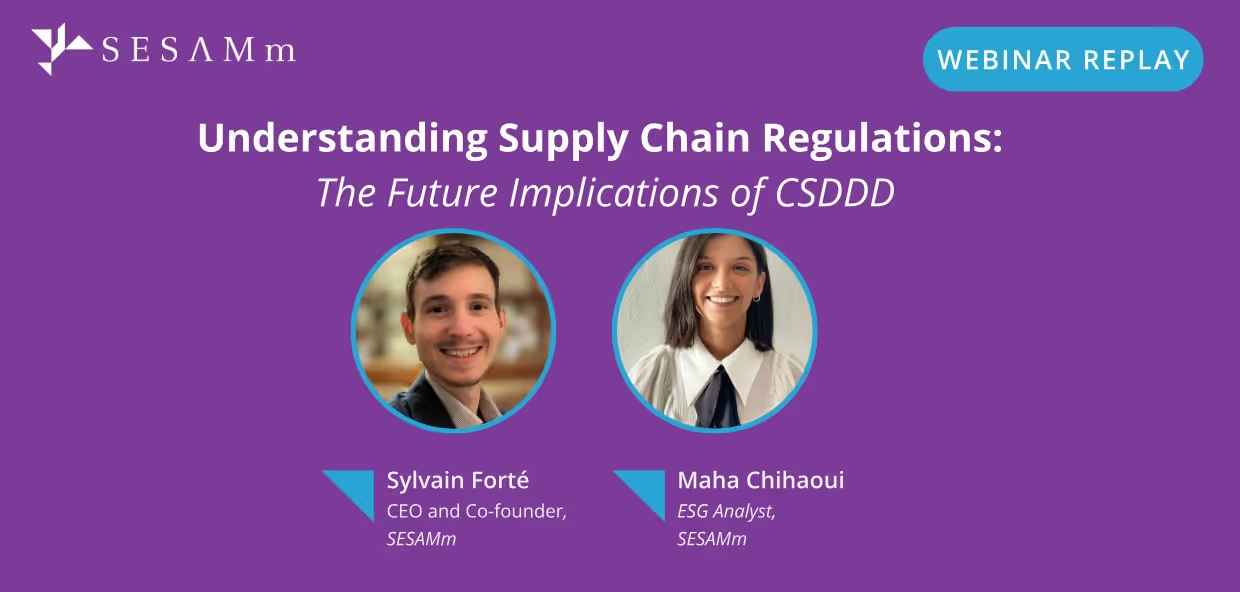

Webinar Replay: Understanding Supply Chain Regulations: The Future Implications of CSDDD
June 5, 2024
•
5 mins read
Today, it's important to understand the complexities of supply chain regulations. This was the main topic of a recent SESAMm webinar, “Understanding Supply Chain Regulations: The Future Implications of CSDDD”, which explored the implications of the Corporate Sustainability Due Diligence Directive (CSDDD) and other important regulatory frameworks that affect global supply chains.
The webinar, led by SESAMm's CEO, Sylvain Forte, and ESG analyst Maha Chihaoui, explored the evolving landscape of ESG frameworks, laws, and regulations that influence supply chain operations. As businesses strive to enhance transparency, accountability, and ethical practices, they face a multitude of challenges and opportunities. The session highlighted how these initiatives could lead to substantial benefits such as environmental conservation, improved social conditions, and strengthened governance structures.
During the webinar, Maha Chihaoui emphasized the shift from non-binding guidelines to binding laws in the regulatory spectrum, signaling a more robust approach to enforcing corporate accountability and responsibility. Sylvain Forte also discussed the importance of moving beyond mere compliance to ensure genuine adherence to ESG principles, advocating for a systematic and continuous evaluation process to ensure businesses act on their promises.
The session also touched on real-life applications and challenges in implementing these frameworks. For example, the discussion included case studies on companies like Shein and Temu, highlighting how regulatory focus on supply chain controversies has increased visibility and accountability.
As regulatory frameworks around supply chains continue to evolve, the dialogue between various stakeholders—regulators, businesses, and the public—becomes crucial. SESAMm's webinar effectively shed light on these critical issues, offering insights and fostering a deeper understanding of the dynamic relationship between ESG initiatives and supply chain management.
Watch the webinar replay now:
Unlock a deeper understanding of supply chain regulations' complexities and future implications.
The first and second parts of this series discussed the differences between public and private companies from the Environmental, Social, and Governance (ESG) and the United Nations Sustainable Development Goals (UNSDG) perspectives. In this part, we’re using IKEA as a prime example; we can explore how its private ownership impacts its sustainability practices and governance. This analysis aims to reveal how IKEA's strategies align with broader ESG goals, shedding light on the implications of private versus public company frameworks.
We chose IKEA as an example for this use case for two main reasons. Firstly, as a private company, it provides a suitable basis for comparison with other private companies in the same industry. Secondly, IKEA is known for promoting sustainable practices, such as using renewable energy, responsibly sourced materials, and minimizing waste. However, despite the company's claims about the eco-friendliness of its products, our goal is to investigate whether these claims and products are perceived as environmentally friendly. We also aim to identify any issues affecting any of its stakeholders beyond the environment.
ESG Industry Benchmark
In our study, we focused on a detailed comparative analysis of IKEA's Environmental, Social, and Governance (ESG) risk mentions over the past three years, particularly in the context of the consumer discretionary sector. Our findings indicate a lower prevalence of environmental controversies both for IKEA and the sector overall. However, regarding governance risks, the consumer discretionary sector appears to encounter these issues more frequently than IKEA does.
Figure 1: ESG risks in IKEA and Consumer Discretionary.
On the other hand, IKEA stands out with a more significant presence of social risks than the sector average. This includes a notable number of product safety concerns, exemplified by instances of product recalls due to choking hazards, laceration risks, and even products infested with bugs. The analysis also brought to light several instances of human rights breaches at IKEA, particularly concerning privacy issues, such as data leaks and illegal filming incidents involving staff and customers. Labor rights violations are another area of concern, with instances ranging from union-busting activities to allegations of religious and gender discrimination within the company. Additionally, human capital risks are conspicuous, with mentions of strikes driven by dissatisfaction over wages and layoffs, as well as health and safety issues. Risks in customer relations have also been documented, including incidents of overcharging customers and discriminatory practices against certain customer groups.
Detecting ESG Risks Through the Industry SDG Lens
In our comparative analysis of IKEA's controversies against the average adverse behaviors in its sector concerning the Sustainable Development Goals (SDGs), we noticed both similarities and distinctions. A key finding is that Goal 1, "End poverty," features prominently for both IKEA and the sector, highlighting a common vulnerability to controversies under this goal.
These breaches predominantly pertain to issues around labor rights and human capital, aligning with the findings from our ESG controversy analysis. Additionally, a smaller yet significant portion of controversies is linked to internal control deficiencies within the company. This pattern suggests that both IKEA and its sector face similar challenges in addressing labor rights and human capital issues, contributing to breaches of Goal 1. In examining the differences, Goal 3, "Health and well-being," stands out for IKEA, exceeding the sector norm. This is largely attributed to numerous product recalls, alongside health and safety concerns related to IKEA's workforce. Moreover, in Goals 11 ("Sustainable Cities") and 12 ("Responsible Production and Consumption"), IKEA shows a higher-than-average proportion of controversies, mainly due to issues in human capital and customer relations. This highlights a specific focus on product safety and human capital challenges at IKEA, pointing to areas of heightened risk or difficulty compared to industry peers. Additionally, our study reveals distinct variations in Goals 9 ("Industry, Innovation, and Infrastructure") and 16 ("Peace, Justice, & Strong Institutions"), where IKEA shows a lower proportion of issues compared to the sector average. This suggests that, unlike its industry counterparts, IKEA has been more effective in mitigating risks in these areas.
Detecting ESG Risks Through the Industry SDG Lens
Our methodology analyzes the controversies detected for IKEA and maps them to identify which ones constitute breaches of the United Nations Global Compact (UNGC) principles.
Figure 2: UNGC principles in IKEA and Consumer Discretionary.
Consistent with the identified ESG risks, human rights breaches at IKEA are notably more prominent than the sector average. This is primarily due to multiple instances of privacy, security, and dignity violations, as well as issues in diversity & inclusion. Additionally, labor rights issues at IKEA, while exceeding the industry average, are not markedly higher. Our study also reveals that IKEA has a slightly higher proportion of breaches in the environmental pillar compared to its sector. These include incidents like gas leaks, allegations of greenwashing, and cases of illegal logging.
Conclusion
ESG controversies and breaches of SDG goals vary notably between public and private sectors. Public companies frequently encounter more visible and consistent ESG risks, while private companies, although subject to less scrutiny, experience significant impacts when controversies do occur. The case study of IKEA particularly sheds light on the unique challenges faced in product safety and human capital. This highlights the critical need for rigorous and proactive risk management strategies to maintain sustainable corporate practices tailored to the specific nature and scale of the entity in question.
Download the full report to discover how different sectors navigate regulatory pressures and sustainability challenges with real-world examples to guide your strategy.
Reach out to SESAMm
TextReveal’s web data analysis of over five million public and private companies is essential for keeping tabs on ESG investment risks. To learn more about how you can analyze web data or to request a demo, reach out to one of our representatives.
The chemicals industry, often perceived as the backbone of modern economies, is undergoing a notable shift. With the world's focus now fixed on environmental, social, and governance (ESG) initiatives, this sector finds itself at the crossroads of risk and opportunity. In this “ESG Data Trends,” we dive deeper into the chemicals’ market ESG performance, studying the example of Ineos.
The chemicals industry: riding the ESG wave
Post-2020, the chemical market has seen an increase in web mentions. Several factors—from gas shortages rattling this energy-intensive market to escalating environmental concerns—have ushered in a new era of sustainability discussions. But which chemicals are stealing the limelight? Chlorine, Ammonia, and Base Chemicals like Ethylene and Propylene account for over half of the chemical web mentions. And it's not just about their volume. The narrative is changing too. The industry is leaning towards eco-conscious production, championing innovations like recycled propylene, Renewable-Benzene, and Green ammonia.
Figure 1: Chemical market volume of mentions.
What's interesting about this is the emphasis on ESG initiatives over ESG risks. It's a clear signal that the industry is taking action toward sustainability and is making tangible strides. When looking at the industry’s ESG risks mentions, we found that Arkema has the highest percentage of ESG Risks driven mainly by environmental incidents and impact on biodiversity due to a chemical plant explosion in 2017, followed by UOP LLC, which displays the highest proportion of Social related risks as a consequence of layoffs.
Figure 2: ESG risks by company.
Conversely, across the industry, the volume of ESG initiatives indicates a significant commitment to sustainable related practices. Environmental-related practices are the most mentioned initiatives in the chemicals industry; precisely, two pillars stand out in ESG initiatives: climate change reduction and circular economy strategies. LyondellBasell displays the highest percentage of ESG initiatives mentions due to its climate change reduction and circular economy strategies, where the company is working towards greenhouse gas reductions and advancing plastic waste recycling. Despite having the highest environmental risk mentions, Arkema has the highest social-related initiatives with corporate social responsibility.
Figure 3: ESG initiatives by company.
Case study: Ineos
The TextReveal Dashboard detected another chemicals company with an increasing number of mentions, the British multinational Ineos. After the announcement of Ineos Grenadier's off-roader in 2020, the number of mentions more than doubled, increasing Ineos' overall volume. Later on, the company’s mentions have been relatively increasing after cooling down from the announcement, with a significant increase in 2022 following M&A and collaboration announcements, sustainability actions, and controversies around its CEO, Jim Ratcliffe.
Figure 4: Ineos volume of mentions and relative volumes.
We also detected a geographical shift in mentions. Once dominant in the US, Ineos mentions dropped from 65% in 2015 to roughly 30% in 2022. Europe, on the other hand, has seen a spike from 25% to over 65%. Sentiment analysis offers another layer of insight.
Figure 5: Geographical distribution over time.
While the sentiment has largely remained steady, there have been dips, especially during periods associated with fracking controversies and environmental incidents, including a toxic chemical spill. Digging deeper into Ineos’ ESG risks, there has been a decrease over the recent years; nonetheless, before 2019, we captured a relatively higher number of risks, mainly environmental–related controversies, coming from mentions about overexploitation of resources, namely fracking. Social-related risks display a significant proportion of data driven by social dialogue controversies as we capture multiple mentions of protests, particularly in 2017.
Figure 6: Ineos ESG risks over time.
While Ineos ESG risks mentions represent 2.46% of its overall data share, its ESG initiatives mentions represent 5.91% of its web presence, signaling a more positive outlook for the firm, at least from a perception point of view. Furthermore, we detected that environmental–related initiatives are the main focus for Ineos, particularly climate change, while social initiatives arise, particularly in 2018, due to product safety mentions.
Figure 7: Ineos ESG initiatives over time.
Data sources
To produce this analysis, we combined natural language processing with billions of textual web data related to the chemicals market. Using NLP-powered models gives us an edge as we can extract ESG, SDG, and financial insights that aren’t necessarily obvious or easy to detect. These insights help investors make better investment decisions. SESAMm leverages artificial intelligence and machine learning technologies to help you decipher and understand timely sentiment, trends, and ESG metrics on a wide range of public and private companies.
Reach out to SESAMm
TextReveal's web data analysis of over five million public and private companies is essential for keeping tabs on ESG investment risks. To learn more about how you can analyze web data or request a demo, contact one of our representatives.
Stay ahead with the latest in ESG and AI intelligence
Join our mailing list to receive new reports, event invites, and updates from SESAMm directly to your inbox.