Webinar Replay: How to Spot Greenwashing vs Real Sustainability with AI
May 28, 2025
•
5 mins read
Greenwashing is evolving—and so are the tools to uncover it.
In our most recent webinar, "How to Spot Greenwashing vs Real Sustainability Using AI," SESAMm CEO Sylvain Forté and Fingreen AI CEO Louis Frank sat down and unpacked the complexities of ESG credibility in today’s climate-conscious market. From emerging patterns in greenwashing to the rise of corporate silence—greenhushing—they explored what the latest data tells us and how AI is changing the game.
What you'll learn:
Breaking Down ESG Buzzwords: An Introduction to Greenwashing, Greenhushing, and Greenwishing, showing how their mentions have surged in recent years—across sectors and regions.
The Data Doesn’t Lie: While oil and gas and industrials are frequent offenders, every industry faces reputational risks—case in point: the controversies surrounding firms like DWS and BNY Mellon.
Traceability & Transparency: How open methodologies can help verify commitments like Net Zero and SDG alignment.
Fill out the form to access the webinar replay now!
The aerospace and defense industry is essential to global technology and transportation, playing a crucial role in maintaining international security and connectivity. However, this sector faces intense scrutiny due to its significant impact on environmental, social, and governance (ESG) factors. Amidst challenges like safety lapses and whistleblower revelations, stakeholders are increasingly relying on advanced AI technologies to gain insights into potential controversies. Such technologies have enabled a deeper understanding of the complex ESG issues that permeate the industry, revealing not only the specific challenges faced by companies like Boeing but also providing a broader view of the sector's commitment to corporate responsibility and sustainability. This article explores the aerospace industry and its ESG challenges, backed up by a case study of industry giant Boeing. It also explains how we used SESAMm’s AI-powered tools to detect these controversies beforehand.
This article is a preview of the webinar entitled "The Boeing Scandal: Can AI Predict Controversies Before Traditional Tools?" based on SESAMm's proprietary research. Sylvain Forté, CEO and Cofounder, and Emna Abid, Research and Analytics Team Lead at SESAMm, will lead the webinar and will share SESAMm's findings in detail on the Boeing case and the use of AI to detect these types of controversies ahead of time.
Aerospace and Defense Market Mentions
The top market players in the aerospace and defense industry command 8.3% of the overall market's online mentions. This sector is increasingly scrutinized for its ESG practices amidst technological advancements and global policy shifts.
Overview
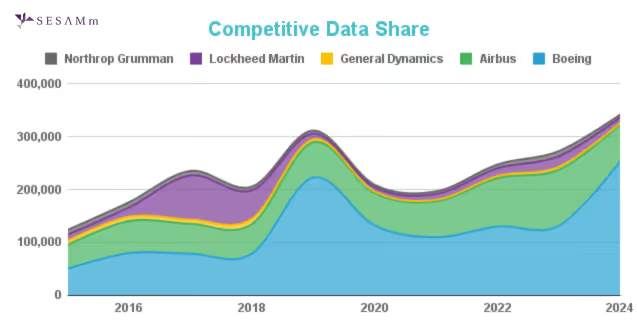
Our study processed our large data lake to identify key aerospace players: Northrop Grumman, Lockheed Martin, General Dynamics, Airbus, and Boeing, from 2015 onwards. It found a surge in online mentions, especially after Boeing's plane crashes post-2018. Both Airbus and Boeing saw increased attention, highlighting the competitive and evolving aerospace industry, where online presence correlates with market position shifts and significant events.
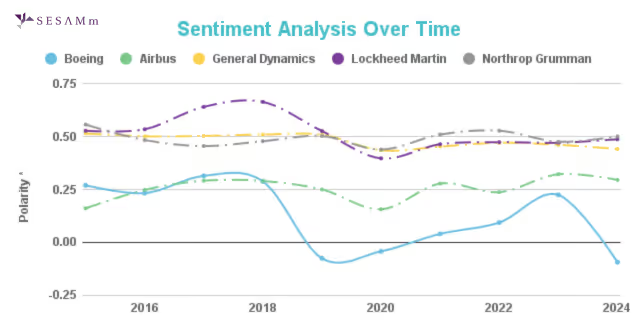
Polarity, indicating a company's mix of positive and negative opinions, ranges from -1 to 1. A zero score shows equal positive and negative sentiment. Brands with high e-reputation often score above 0.5. The aerospace market experiences significant highs and lows. Lockheed Martin has seen a positive impact from new contracts and technological advancements, particularly between 2016 and 2018, boosting its reputation and value. In contrast, Boeing faces significant challenges due to safety lapses, including 737 MAX crashes, legal issues, and whistleblower claims, negatively affecting its perception and highlighting the industry's vulnerability to reputational risks.
Deep Dive: Boeing
The aerospace industry has faced increasing scrutiny over its ESG practices. Among the key players, the American aerospace company Boeing has been prominently featured in media discussions, not only due to its market distinction but also because of its ESG challenges that have sparked significant controversy.
Boeing Word Cloud
The word cloud displays key topics about Boeing, particularly the 737 Max controversies, including safety issues and FAA oversight. "737 Max," "Boeing," "safety," "death," and "FAA" are the main terms that show their prominence in discussions. The visualization also touches on "lawsuits," "Senate hearings," and "missed inspections," indicating the wide range of concerns surrounding Boeing's regulatory, safety, and ethical challenges.
Conclusion
These incidents underscore the aerospace industry's urgent need for reforms to prioritize safety and ethics over profit. SESAMm's TextReveal® platform plays a key role in detecting such ESG controversies early by analyzing vast amounts of data and helping stakeholders understand and address the intricacies of corporate accountability and regulatory compliance.
Reach out to SESAMm
TextReveal’s web data analysis of over five million public and private companies is essential for keeping tabs on ESG investment risks. To learn more about how you can analyze web data or to request a demo, reach out to one of our representatives.
Discover our whitepaper highlighting the power of web data on predictive analytics for the financial industry: how alternative data strengthen the market, the challenges of collecting web data and case studies presenting different approaches, such as ESG, showcasing TextReveal features and capacities for investment purposes.
In the past, investment management institutions relied mostly on traditional data to gain an edge in investing. Traditional data ranges from SEC filings to earnings reports and pricing information any type of data produced by the company itself. The rise of the digital age, however, has opened up new sources of data for investors beyond the scope of traditional data. The seemingly infinite scope of alternative data includes data produced from credit cards, satellites, social media and perhaps most importantly the web.
With the additional integration of alternative data, investment management institutions and hedge funds in particular that once relied only on traditional data now have an edge in predicting the rise and fall of the markets. As increasing numbers of financial institutions jump on the bandwagon of alternative data, spending on alternative data by trading and asset management firms is set to exceed $7 billion by 2020.[1]
What was only a few years ago a question of when institutions should start using data has shifted to the question of howthey can organize and structure these mostly unstructured datasets. And with 4 billion webpages and 1.2 million terabytes of data on the internet estimated to be generated globally by 2025, there is no shortage of web data to sort through. As increasing numbers of investment management institutions incorporate alternative web data into their predictive algorithms, it will change the face of investment as we know it.
This white paper is intended to be a guide for investment management (IMs) institutions to better understand how alternative web data is quickly becoming an essential component for generating alpha and mitigating investment risk. In addition, it explores different models of web data crawlers and what IMs need to look for as they incorporate alternative web data into their predictive analytics models.
Section 1: Beating the Market with Alternative Web Data
“Your company’s biggest database isn’t your transaction, CRM, ERP or other internal database. Rather it’s the Web itself…Treat the Internet itself as your organization’s largest data source.” — Gartner
As previously mentioned, alternative data includes any type of data that is beyond the scope of traditional data: satellite imagery, social media data, and web data (which includes news sites, blogs, discussions and forums) along with credit card data. Alternative web data, which falls under the broader category of big data, is typically unstructured and demands a process for structuring it in order to deliver insights.
[1]
Alternative data for investment decisions: Today’s innovation could be tomorrow’s requirement.
Deloitte Center for Financial Services. 2017.
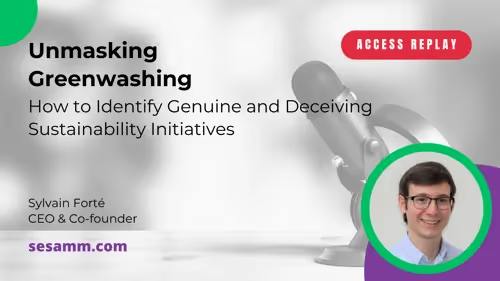
In our most recent webinar, "Unmasking Greenwashing: How to Identify Genuine and Deceiving Sustainability Initiatives with AI," Sylvain Forté, SESAMm’s CEO and Co-founder, discussed our recent ebook entitled with the same name focusing on the vital role of AI in identifying and understanding ESG controversies, focusing on greenwashing and reputational laundering.
Greenwashing, the act of misleadingly portraying products or services as environmentally friendly, and reputational laundering, where companies create a facade of ethical behavior, are increasingly prevalent challenges. These practices mislead investors and consumers, obscuring the reality of a company's environmental impact. Our webinar highlighted the complexity of these issues and their relevance across various industries.
We discussed how AI technology is revolutionizing the detection of greenwashing and reputational laundering. By analyzing vast amounts of web data, including news articles, social media, and public records, AI uncovers patterns and red flags that might indicate deceptive practices. This is particularly pertinent for stakeholders in the financial sector, such as private equity firms, who must navigate the intricate landscape of ESG compliance and sustainability.
Our recent research study underscored the importance of this technology. We found that mentions of greenwashing and related controversies have grown exponentially over the years. This increase aligns with a rising global awareness of environmental issues and the demand for corporate transparency. AI's ability to sift through and analyze this growing body of data is invaluable in providing accurate, timely insights into potential ESG risks.
We also noted an interesting trend: while greenwashing mentions are increasing, their growth rate is slowing down. This suggests that as regulatory frameworks around ESG become more formalized and the market becomes more educated, instances of unintentional greenwashing decrease. It's a sign that clearer rules are helping companies avoid these pitfalls.
Our analysis also revealed that different industries experience varying levels of exposure to greenwashing claims. Sectors like food, drug retail, and oil and gas have seen significant increases in accusations of reputational laundering. However, we also observed a positive trend in the fashion industry, where regulatory frameworks have led to a decrease in greenwashing mentions.
Lastly, we highlighted the importance of distinguishing between negative and positive ESG mentions. While it's crucial to identify and monitor greenwashing allegations, it's equally important to recognize and support genuine sustainability initiatives. Our analysis showed that positive ESG initiatives often have a more significant impact on public perception than negative ones.
Watch the webinar replay now:
Reach out to SESAMm
TextReveal's web data analysis of over five million public and private companies is essential for keeping tabs on ESG investment risks. To learn more about how you can analyze web data or request a demo, contact one of our representatives.
Stay ahead with the latest in ESG and AI intelligence
Join our mailing list to receive new reports, event invites, and updates from SESAMm directly to your inbox.







.png)