VIDEO: Monitor Clients and Suppliers Using AI - FinovateSpring 2023
June 22, 2023
•
5 mins read
CEO Sylvain Forté demonstrates SESAMm’s NLP platform TextReveal® ESG Alerts and Monitoring for public and private companies at FinovateSpring 2023. He uses Wirecard, a German FinTech company that went bankrupt following a fraud accusation, as an example to illustrate the platform's ability to identify potential controversies and assign them severity scores automatically.
Furthermore, he demonstrates another use case with Twilio, an API messaging and phone services provider, which had previously been exposed to major cybersecurity issues. TextReveal ESG Alerts and Monitoring was able to immediately identify the controversial events, providing valuable insights to users.
In this video, Sylvain Forté also showcases what differentiates our solution from competitors while shedding light on our massive 20-billion article data lake, our advanced AI technology and algorithms, and how we combine both to provide major financial institutions, private equity funds, and banks with timely and accurate data to help them detect any issues with investments, suppliers, or clients.
Watch the full recording:
Reach out to SESAMm
TextReveal’s web data analysis of over five million public and private companies is essential for keeping tabs on ESG and other investment risks. To learn more about how you can analyze web data or to request a demo, reach out to one of our representatives.
In this issue of the "what investors ought to know about…" series, we'll cover natural language processing (NLP), a tool that draws from the computer science and computational linguistics disciplines. In the last topic, we discussed knowledge graphs as the core of text analysis. And if knowledge graphs are the core of the data’s context, NLP is the transition to understanding the data.
What is natural language processing?
Natural language processing is an artificial intelligence (AI) technology that automates the data analysis of mined textual, unstructured data to include natural language understanding and natural language generation to simulate a human's ability to create language. It combines computational linguistics with machine learning and deep learning models, performing a special linguistic analysis by algorithms so a machine can "read" text.
Where is natural language processing used?
Today, various industries use NLP, from email filters to virtual assistants and search engines to chatbots. Here's a list of common ways natural language processing is used:
Chatbots: Chatbots are computer programs that use NLP. They simulate human conversation by identifying a sentence's intent, determining suitable topics, keywords, and emotions, and calculating the best response based on the data's interpretation.
Email filters: Email filters apply machine learning using many data samples to sort emails into the right inbox.
Machine translation: Translation software like Google Translate or Microsoft Translator use NLP to translate text from one language to another, such as English to French.
Natural language generation (NLG): NLG, a subfield of NLP, builds applications or computer systems that can automatically produce natural language texts of various types by using a semantic representation as input. Applications of NLG include question answering and text summarization.
Predicting and autocorrecting text: Predictive text and autocorrect use NLP to recognize and recall commonly used words and names to make text suggestions and correct common errors.
Search engines: Search engines like Google search use NLP machine learning to interpret a searcher's intent and provide relevant results. It can even suggest subjects and topics related to the query the searcher might be interested in.
Virtual and voice assistants: Virtual assistants like Apple's Siri or Amazon's Alexa use NLP technology to understand and respond to voice requests. Speech-to-text can dictate messages and notes, and speech recognition can control everything from smartphone apps and smart speakers to thermostats and home security systems.
Web sentiment analysis: Sentiment analysis automates classifying opinions in a text as positive, negative, or neutral. It's a method companies like SESAMm use to monitor sentiments like a brand's sentiment on the web and social media.
Why natural language processing is important to uncover financial-related alternative data
NLP is important because it helps resolve human language ambiguity in big datasets (big data). Languages are complex, diverse, and expressed in unlimited ways, from speaking hundreds of languages and dialects to having a unique set of grammar and syntax rules, slang, and terms for each. In text form, these variables are unstructured text. But with NLP, we can transform unstructured data into structured data and make sense of it.
Because of NLP's power, investors can research and analyze unstructured data from the web to gain insights into financial and ESG data. You can use this wealth of information to focus on systematic data processing, risk management, and alpha discovery through contexts, such as:
Major global indices sentiment
Euronext exchange sentiment
Private company sentiment
ESG risks for public and private companies worldwide
A quick overview of how natural language processing works at SESAMm
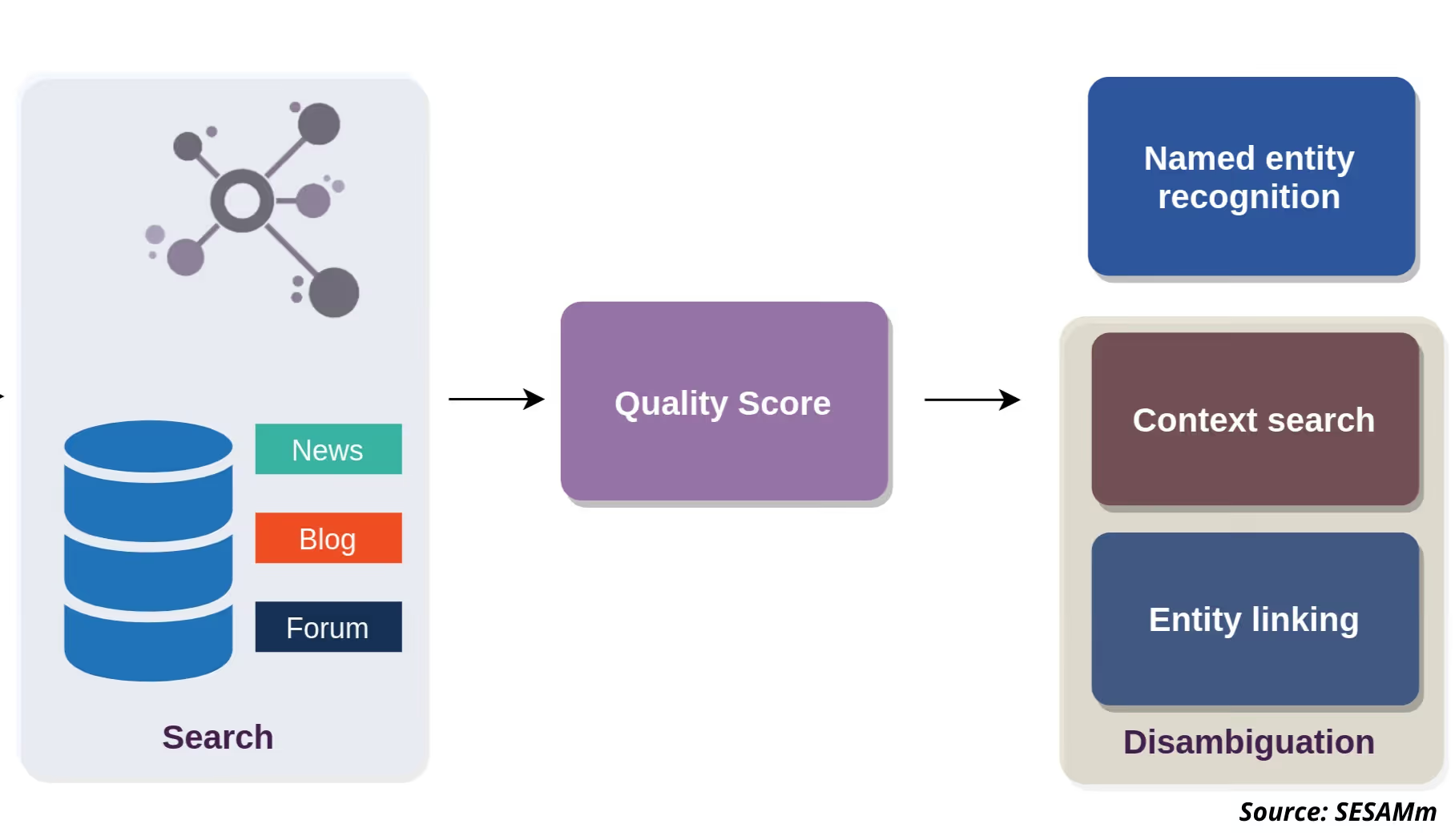
At SESAMm, we use named entity recognition (NER), which extracts the names of people, places, and other entities from text, and then named entity disambiguation (NED) to identify named entities based on their context and usage. For example, text referencing "Elon" could refer indirectly to Tesla through its CEO or a university in North Carolina. NED considers the context when classifying entities for an accurate match. Compared to simple pattern matching, which limits the number of possible matches, requires frequent manual adjustments, and can't distinguish homophones, NED is superior.
Process representation for NER and NED.
When identifying entities and creating actionable insights, SESAMm uses three other NLP tools: lemmatization and stemming, embeddings, and similarity. The lemmatization process normalizes a word into its base form (morphology) to help identify and aggregate entities. Embedding assigns the entity a numerical value to help analyze how words change meaning depending on context and understand the subtle differences between words that refer to the same concept—similarity measures whether two words, sentences, or objects are close to one another in meaning.
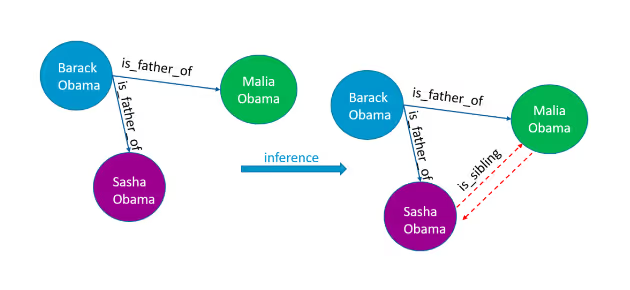
Representation of nodes in a knowledge graph.
Of course, NLP couldn't function without the core of the text analytics process: knowledge graphs. A knowledge graph is a digital representation of a network of real-world entities, the foundation of a search engine or question-answering service. This structured data model puts the schema in context through semantic metadata and linking, providing a framework for analytics, data integration, sharing, and unification. In other words, it's like a map and legend, with the legend labeling the concepts, entities, and events and the map connecting and identifying their relationships. These details are stored in a graph database and visualized as a graph representation, hence the term knowledge graph.
SESAMm's natural language processing platform for investment research and analysis
SESAMm is the leading provider of natural language processing and machine learning solutions and analytics for investment firms and corporations.
In recent years, the field of natural language processing (NLP) has seen significant advancements that have enabled more effective processing and analysis of large volumes of textual data. This has had major and disrupting implications for many industries, including finance and investment.
One area where NLP has been particularly useful is in the design of baskets and indices on all asset classes. One of them, where we can definitely observe key value-added, is related to digital assets and cryptocurrencies. A crypto basket is a group of cryptocurrencies that are bundled together and traded as a single unit, while a crypto index is a measurement of the overall performance of a group of cryptocurrencies.
Traditionally, the process of designing a crypto basket or index involved manually selecting a group of cryptocurrencies based on various criteria such as market capitalization, trading volume, and price history. However, this process is time-consuming and can be subject to bias. Moreover, it can be difficult for investors to invest in the crypto market as a whole. NLP technology has allowed it to analyze vast amounts of data from various sources such as news, articles, social media posts, and blogs to identify trends and sentiment around specific cryptocurrencies. This information can then be used to inform the design of crypto baskets and indices, making them more accurate and reflective of market sentiment.
By leveraging sentiment analysis through NLP-based indicators, robust indices can be created to serve as market benchmarks and investment vehicles. These indices can provide relevant performance measurement tools, allowing investors to understand the performance of their investments better and make more informed decisions. Furthermore, using NLP-based indicators to design crypto baskets and indices can also help generate alpha compared to a single basket of tokens. By tracking sentiment and emerging trends over time, investment professionals can gain valuable insights into which cryptocurrencies will likely perform well in the future and which may be less favorable.
Overall, using NLP in the design of crypto baskets and indices has significant potential to improve the accuracy and reliability of these investment products. By leveraging the power of NLP to analyze large volumes of text data, investment professionals can gain valuable insights into market sentiment and emerging trends, allowing them to make more informed investment decisions and potentially generate alpha. This is why we have entered a collaboration with Compass FT to design the first AI & NLP crypto sentiment index.
Index objective
The Compass SESAMm Crypto Sentiment Index aims to give investors exposure to the crypto market with a sentiment tilt to determine the selection and weights of underlying tokens. The index selects tokens based on financial filters such as average trading volume and market capitalization. Using NLP-based sentiment scores in the weighting mechanism allows the index to rebalance towards the coins with the best sentiment scores efficiently and, therefore, those with the highest expected relative returns.
Key features
Provides smart and dynamic exposure to the cryptocurrency market
Monthly review to adapt to the fast-moving crypto ecosystem and capture up-to-date/representative sentiment for each coin
Unique quantitative weightings mechanism based on liquidity filters and sentiment scores
Invests in a basket composed of the 20 main crypto coins
Constituents are selected based on rigorous criteria considering liquidity, tokenomics, sentiment, custody, and security
Methodology and governance in line with the most constraining financial indices regulation, the European Benchmark Regulation (EU BMR)
Index mechanisms
The Compass SESAMm Crypto-Sentiment Index is a diversified digital asset index designed to offer broad exposure to the market’s top crypto assets (all sectors included) while capping each component exposure at 30%. Weightings are based on sentiment scores, liquidity, and market capitalization constraints.
SESAMm’s NLP technology carries out a granular and transparent analysis of publicly available articles. More than 20 billion articles from over 4 million international and local sources are analyzed to identify each coin’s associated mentions. For each source, indicators of sentiment and volume of mentions are determined. These indicators are then aggregated daily to create a historical time series per cryptocurrency, which acts as the basis for the overall score used by Compass Financial Technologies. For each day and each coin, SESAMm calculates crypto sentiment scores based on several indicators, such as polarity, volume, and memory functions, to provide up-to-date and representative scores. SESAMm’s Crypto sentiment scores are based on the sentiment scores (negative, positive, and neutral) computed on articles related to the 50 digital assets universe.
Analytics
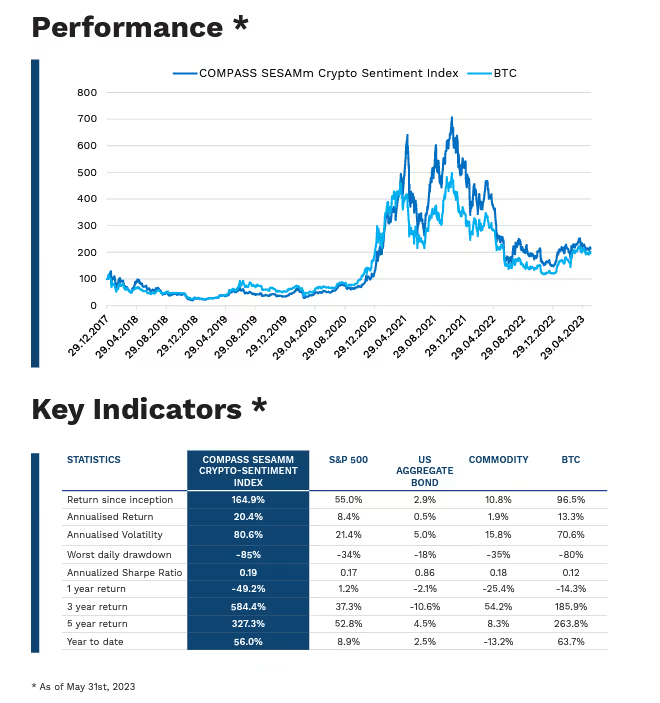
Figure 1: Performance and key indicators
Reach out to SESAMm
TextReveal's web data analysis of over five million public and private companies is essential for keeping tabs on ESG investment risks. To learn more about how you can analyze web data or request a demo, contact one of our representatives.
The NZBA's announcement comes after a series of high-profle departures that began in late 2024. What started as a coalition of 43 banks at its 2021 launch had grown to over 140 institutions representing $74 trillion in assets by 2024. However, political pressure, particularly from Republican politicians in the US, warning of potential legal violations, triggered a mass exodus.
The departures followed a predictable pattern: Goldman Sachs led the way in December 2024, followed rapidly by all major Wall Street peers within weeks. Canadian banks soon followed, and the bleeding continued through 2025 with HSBC, UBS, and Barclays all exiting. Barclays' departure statement was particularly telling, noting that "with the departure of most of the global banks, the organisation no longer has the membership to support our transition."
Proposed Restructuring
The NZBA has now proposed transitioning from a membership-based alliance to what it calls a "framework initiative." This fundamental change would essentially transform the organization from an active coalition with binding commitments to a more passive guidance provider. The steering group believes this approach would be "the most appropriate model to continue supporting banks across the globe to remain resilient and accelerate the real economy transition in line with the Paris Agreement."
A member vote on this restructuring is currently underway, with results expected at the end of September. However, given the exodus of major institutions, the outcome seems predetermined.
Broader Climate Coalition Collapse
The NZBA's troubles reflect a wider crisis affecting climate-focused financial coalitions:
A member vote on this restructuring is currently underway, with results expected at the end of September. However, given the exodus of major institutions, the outcome seems predetermined.
Recent developments include a 23-state coalition warning the Science Based Targets initiative (SBTi) about potential antitrust risks, demonstrating that the pressure extends beyond banking to other ESG frameworks.
Market Implications
The NZBA's effective dissolution has several implications:
Fragmented Approach
Without coordinated frameworks, banks will likely develop individual approaches to climate commitments, potentially leading to:
Inconsistent standards and methodologies
Reduced transparency and comparability
Weakened collective bargaining power with policymakers
Regulatory Response
The vacuum left by voluntary coalitions may accelerate regulatory intervention:
Mandatory climate disclosure requirements
Government-imposed transition standards
Regional divergence in approaches
Investment Impact
For investors, this development signals:
Increased difficulty in assessing bank climate commitments
Greater need for individual due diligence
Potential opportunities in banks with strong standalone commitments
Looking Forward
The NZBA's pause represents more than just one organization's troubles; it symbolizes a broader retreat from coordinated climate finance at precisely the moment when such coordination is most needed. With climate risks accelerating and the urgent need for massive capital deployment, the financial sector's inability to maintain collective action represents a significant setback.
However, this may also create opportunities for more resilient, legally defensible approaches to climate finance. Banks that remain committed to transition goals may find competitive advantages in developing robust standalone frameworks, while regulatory bodies may step in to fill the coordination gap.
SESAMm’s AI Technology Reveals ESG Insights
Discover unparalleled insights into ESG controversies, risks, and opportunities across industries. Learn more about how SESAMm can help you analyze millions of private and public companies using AI-powered text analysis tools.
Stay ahead with the latest in ESG and AI intelligence
Join our mailing list to receive new reports, event invites, and updates from SESAMm directly to your inbox.









.png)