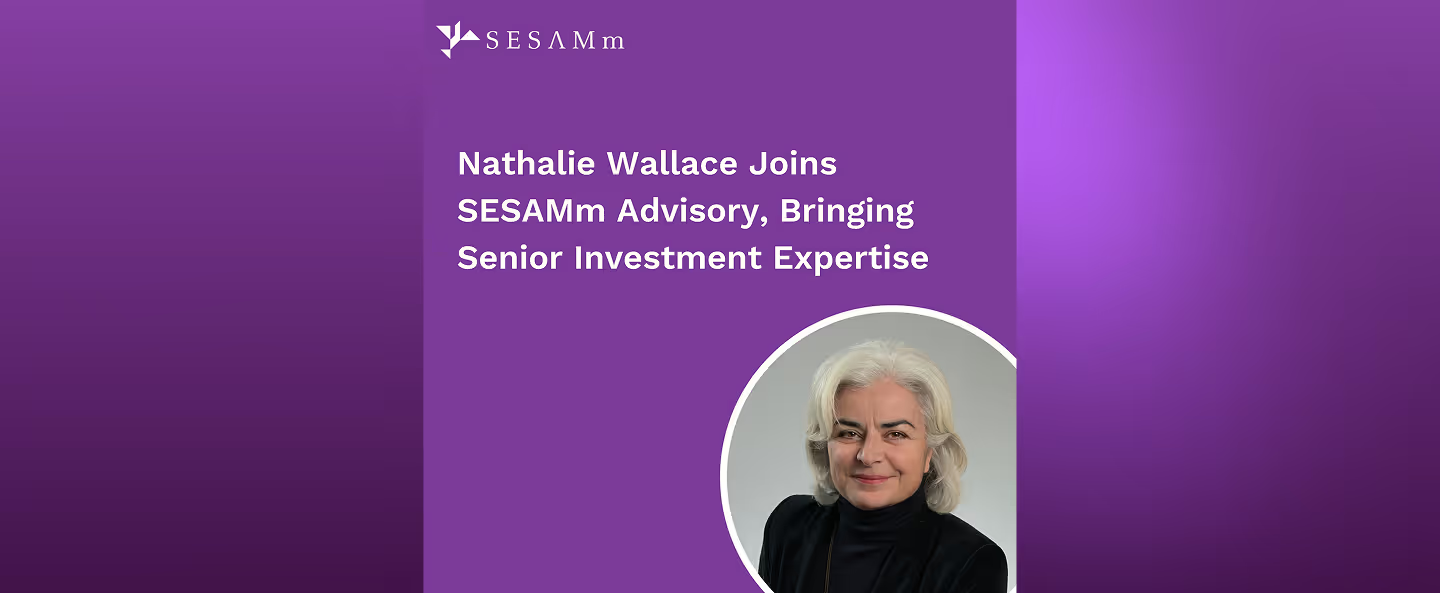
SESAMm is pleased to announce that Nathalie Wallace is joining our Advisory Board. Nathalie brings more than 20 years of experience at the intersection of investment management, sustainability strategy, and executive leadership. She has built a career helping global investment organizations integrate sustainability into investment decision-making and capital allocation.
Commenting on the appointment, Sylvain Forté, CEO of SESAMm, said, “Nathalie brings a rare combination of investment experience, strategic vision, and deep understanding of how sustainability considerations translate into real-world investment decisions. Her perspective will be invaluable as SESAMm continues to support financial institutions navigating increasingly complex risk and regulatory environments.”
She previously served as Chief Sustainability Officer at Edmond de Rothschild, where she contributed to the firm’s sustainability strategy across asset classes. Prior to that, Nathalie was Global Head of Sustainable Investment at Natixis Investment Managers, where she was a member of the executive, investment, and seed committees, chaired the CSR–Sustainable Investment committee, and served on the boards of Mirova and Ostrum Asset Management. Earlier in her career, she was Global Head of Strategy and Business Development at Mirova, supporting its growth and positioning as a leading sustainable investment platform.
As Senior Advisor to SESAMm, Nathalie will support the company’s strategic direction, bringing her perspective on sustainable finance, investor expectations, and the evolving role of data and AI in risk analysis and investment processes.
“SESAMm’s approach to risk and sustainability intelligence reflects how investment teams are evolving their processes,” said Nathalie Wallace. “I’m excited to contribute my perspective as the firm continues to support investors with timely, decision-relevant insights.”
We are delighted to welcome Nathalie to SESAMm and look forward to working together as we continue to support financial institutions with forward-looking risk and sustainability insights.
SESAMm’s AI Technology Reveals ESG Insights
Discover unparalleled insights into ESG controversies, risks, and opportunities across industries. Learn more about how SESAMm can help you analyze millions of private and public companies using AI-powered text analysis tools.
After months of hard work from our team, we closed on a €35 million Series B2 funding round led by Elaia and Opera Tech Ventures (BNPP), which followed a €7.5M B1 round led by New Alpha and Carlyle in January 2021. That means we can now pursue the next phase of SESAMm’s growth.
We want to accomplish many things with this investment, and I’m incredibly grateful to all of our investors, partners, and clients who helped us during this process. But before I talk about them and SESAMm’s future, I can’t help but think about how the company started.
Academic beginnings
It’s still hard to believe that SESAMm sprouted from an idea, an academic project, and three college students. I still remember Pierre Rinaldi asking me to develop the first algorithms that used social media to analyze financial markets while in school. Pierre worked at a bank trading desk while finishing his studies and doing a research internship at a behavioral finance lab, where the idea came up for the project. I studied engineering and was passionate about AI already, so I started coding, and the first project was born.
Eventually, this project outgrew my capabilities. The volume of data involved needed hardcore algorithms to process them, the kind of algorithms Florian Aubry could build. Florian was the best developer in my engineering school, and lucky for us, he was also my friend.
From left to right: COO Pierre Rinaldi, CEO Sylvain Forté, and CTO Florian Aubry.
Before long, we started renting servers, optimizing code, and building signals based chiefly on Twitter data, reproducing research papers that also used text data to generate sentiment indicators for financial markets. You could say that this project had become more than academic at this point. But it really only became a company once we won our first startup award.
The award that sparked the launch of a company
We participated in a competition organized by local incubator SEMIA with support from Société Générale as a way to gain credibility for the project, and would you know, we won. The award was monetary, and we could receive it on one condition: that we launch an actual company.
You probably already know that starting a business is a big decision, at least it was for Pierre, Florian, and me. After all, we were still in school, trying to finish our degrees and looking to start new careers. Our choices could be life-altering. Pierre, for instance, planned to take a full-time job at the bank he was working at.
In the end, we chose SESAMm. Pierre didn’t take the job at the bank. I did my end-of-study internship at SESAMm, which allowed me to focus on the company 100% while finishing my degree. And Florian dedicated all his time and energy to the startup, too. In other words, we were all in, and our school project had officially become a business.
Pressure to build
Setting up a company was relatively easy. Building a business, as it turns out, is way harder. How would we take SESAMm’s product and put it to work? Pierre’s contacts, that’s how.
One by one, Pierre called on everyone he knew from school that worked in trading, offering them a chance to be the first to test the latest AI innovation: using social media for financial analysis. Back then, Pierre had more of a sales role. He’s now COO and head of HR, in case you were wondering.
Our first client was a trader from London. He put $50,000 into a strategy based on SESAMm’s signals. With our signals, the trader grew his portfolio with such performance that he began to raise capital, including for a hedge fund. Ultimately, he was trading $50 million from the strategy. It was the kind of success and track record we needed in the finance industry to take SESAMm to the next level.
Compelled to move…literally
Having demonstrated success, an investment firm, a venture firm called Fonds Venture Numérique Lorrain, reached out to us with interest in investing in SESAMm’s first round of funding. But they had two conditions:
SESAMm must move to Metz, a startup-friendly hub in the Lorraine region in France.
SESAMm must seek additional funding from other investors.
At the time, SESAMm was based in Strasbourg because that’s where Florian and I studied. And for all intents and purposes, we hadn’t planned on moving.
Also, aside from Pierre reaching out to school acquaintances to try our solution, we had never pitched anyone to fund our company before. Pierre, Florian, and I faced a serious choice and challenge.
What did we do, and how did we fare?
We reached out to business angels and pitched numerous times while continuing to work on the product and starting to plan the first recruitments. We learned a lot during this initial period about how to structure a company and present it to investors. At the time, startups were less common in the region and using online content from YC and other accelerators was invaluable for us.
SESAMm’s headquarters is now in Metz, and we currently have offices in Paris, London, Tunis, New York, and Tokyo. We’ve also diversified our technology and clientele, particularly in ESG and corporate spaces. In other words, we faced the challenge, moved our headquarters, and grew and evolved a lot!
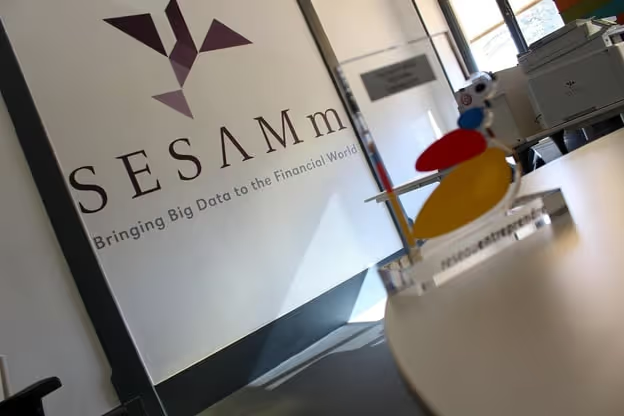
Our first sign, our first footprint, our first home office in Metz.
Series B2 funding round challenges
That brings us to the recent past. We’ve grown our company so much that it was time for another funding round, and the timing wasn’t the best. Our teamwork and ability to communicate effectively across regions and cultures were vital in tackling this latest fundraising round. We decided to run the entire process in-house as it was important to us to not only demonstrate our ability to do so but also to build our own VC relationships.
Moreover, we’ve had a unique previous fundraising experience. Having been funded by FinTech venture capital firm NewAlpha Asset Management and a large private equity firm like Carlyle Group Inc. in earlier rounds helped us improve our processes and standardize our communications. We felt ready for this challenge.
Frankly speaking, though, between the COVID-19 pandemic and the Russia-Ukraine war, startup funding had become a much bigger challenge. Things weren’t popping like they were a couple of years ago, so we needed to be cautious and conservative yet bold and compelling. Regardless, we dug deep and stuck with the plan, with a focus on our numbers and our vision.
To achieve our goal, we created an internal team, onboarded two advisors, and created a scalable process. The internal team included SESAMm’s C-suite: CEO (Sylvain Forté), COO (Pierre Rinaldi), CTO (Florian Aubry), CFO (Marie-Charlotte Deucher), CMO (Jorge Alvarez), and CDO (Eric Sionnet). Our advisors provided guidance around strategy, gave feedback, and supplied operational help when needed. And from our pitch deck variations to our storage and sharing policies, we established a fine-tuned communication and project management process to keep us on task and on time. It was a good process, and it really helped us manage things efficiently while maintaining control over day-to-day operations. I can’t say it enough: process is always the key.
Fundraising wasn’t easy, but the process was worthwhile. And all this to say that I couldn’t be happier to announce that SESAMm has wrapped up its Series B2 funding round. With this money, we plan to further expand into the U.S. and Asian markets and continue SESAMm’s exponential growth. We’ll also seek key talent to sustain this growth and support the development of our AI technology.
Pleased, grateful, and excited for what comes next
Today, SESAMm is a healthy and fast-growing company. And as COO, CTO, and CEO, respectively, Pierre, Florian, and I are now more than a scrappy group of students. We’re a crew with the support of many contributors, consisting of more than 100 employees across many offices and cultures. It’s because of the teamwork and collaboration that SESAMm is where it is today. And I’m immensely grateful for all our team’s effort and the tremendous support we get from clients, investors, and advisors every day.
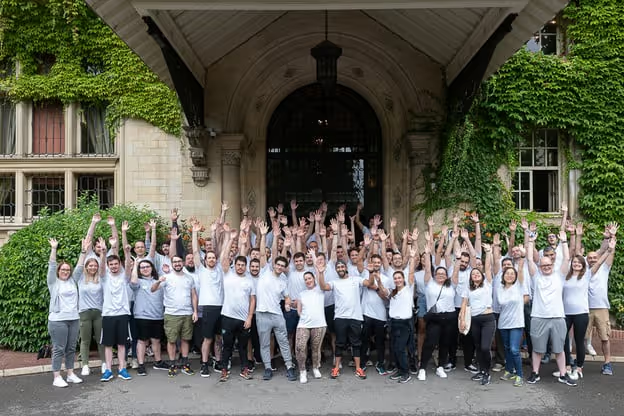
Paris, France, September 2022: Many of the 100+ SESAMmers gathered for a company retreat.
Thank you for being a part of our journey, and see you at SESAMm’s next milestone. Cheers!
Housing and construction fees have skyrocketed over the past few years. This increase goes back to multiple factors: economic unrest, raw materials disruption, and labor shortage, to name a few. What does web data have to say about all this?
In this week’s “Alternative Data Trends” issue, we’ll talk about commercial real estate, unveiling the industry’s ESG and SDG conformity and the effects of COVID-19 on the supply chain and labor.
Commercial real estate volume of mentions
While analyzing web data dealing with commercial real estate, we detected an evident increase in the industry’s volume of mentions. This trend spiked in April 2020 and was initially hindered by the COVID pandemic, which resulted in a drop in sentiment polarity. Still, it witnessed a rapid recovery leveraging digitalization and e-solutions (Figure 1).
Figure 1: Commercial real estate market mentions Feb 2015 to Mar 2022.
Case study: Unibail-Rodmaco-Westfield
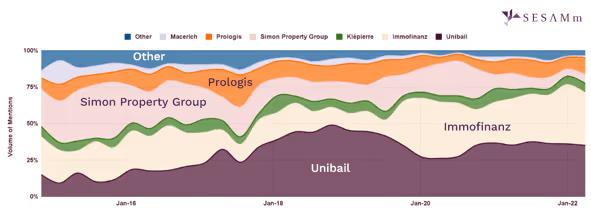
To further understand the commercial real estate industry, we studied Unibail-Rodamco-Westfield and its competitors. Unibail-Rodmaco, a French commercial real estate company, acquired Westfield, a U.S. company, in December 2017. This acquisition accentuated its market share and grew its web voice share compared to its competitors (Figure 2).
Figure 2: Unibail volume of mentions compared to the market.
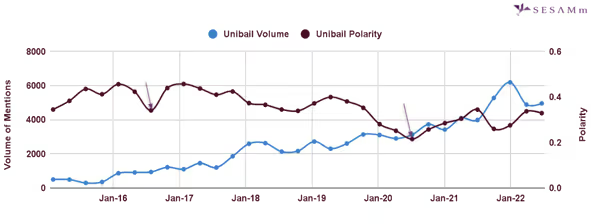
The chart in Figure 3 shows that the company’s volume of mentions has been increasing ever since the acquisition occurred. However, a negative sentiment polarity has been steadily increasing due to social ESG risks related to collective health crises during COVID and security-disrupting threats. In addition, the company faced difficulties collecting rent from retailers leading to lawsuits.
The arrows in this chart indicate Unibail ESG risks in time. The first arrow points to the social risks generated by security threats, in 2016, and the second arrow points to the issue of unpaid rent and lawsuits filed regarding the matter, in 2020.
Figure 3: Unibail ESG risks.
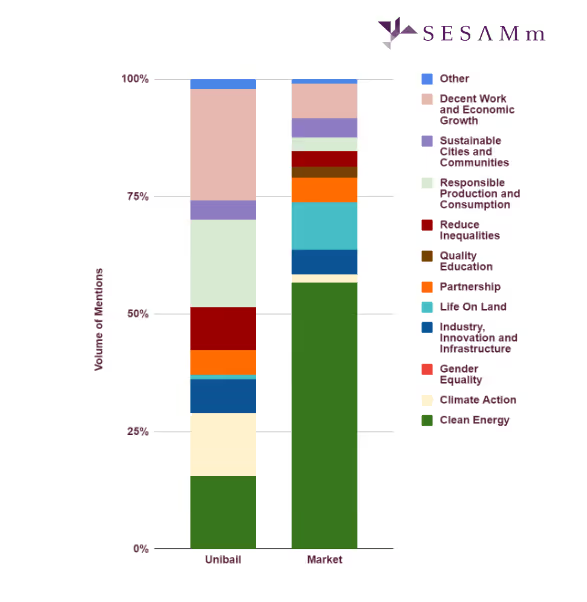
According to web data, Unibail has the second highest volume of sustainability mentions among analyzed groups. The company was notably related to sustainable development goals number 8* and number 12**. This volume is manifested in their initiatives to help unemployed people and maintain sustainable ethics and practices when launching their malls and shopping centers (Figure 4).
* Social development goal for decent work and economic growth.
** Social development goal for responsible consumption and production.
Figure 4: Unibail SDG volume of mentions compared to the market.
The impact of COVID on the emerging commercial real estate market
As previously mentioned, COVID had several effects on the industry, both negative and positive. Furthermore, it reshaped the market and its work policies. Some companies, as well, chose to switch to remote work and digitalization. In Figure 5, we can see that sentiment related to remote work policies has steadily improved since the pandemic started. However, in the last few months, we’ve seen a sharp decline, potentially signaling a negative reaction to some companies requiring employees back to their offices.
Figure 5: Remote work policies’ volume of mentions.
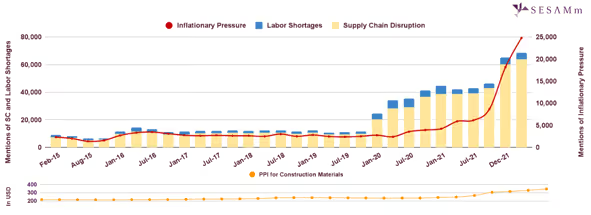
In addition, the pandemic has resulted in labor shortage and supply chain disruption, eventually leading to tremendous inflationary pressure. Raw materials prices, including oil, gas, iron, and wood, have witnessed a drastic increase and a disequilibrium between the volume of demand and the quantity available (Figure 6).
Figure 6: Labor shortage and supply chain disruption Feb 2015 - Dec 2021.
Data source
To produce this analysis, we combined natural language processing with billions of textual web data related to the real estate market, commercial real estate in particular. Using NLP-powered models gives us an edge as we can extract ESG, SDG, and financial insights that aren’t necessarily obvious or easy to detect. These insights help investors make better investment decisions.
SESAMm leverages artificial intelligence and machine learning to help you decipher and understand timely sentiments, trends, and ESG metrics on a wide range of public and private companies.
Stay in touch with SESAMm
Thanks for reading this issue of Alternative Data Trends. Be sure to catch the next issue by subscribing to our blog. And if you'd like a TextReveal® demo, send us a message via the form.
SESAMm has been prominently featured in the Datos Insights Commercial Banking & Payments Fintech Spotlight Report for Q2 of 2024. This recognition highlights SESAMm’s innovative capabilities and its significant impact on the financial industry, particularly within private equity and asset management.
SESAMm's Capabilities and Impact
SESAMm's AI-driven platform excels in processing vast amounts of data, offering deep insights, and enhancing decision-making for financial institutions and corporations. With a proprietary data lake comprising over 25 billion articles in more than 100 languages, SESAMm provides comprehensive ESG data that supports detailed risk assessments, controversy monitoring, and positive impact identification. This extensive database is continuously updated, adding approximately 10 million new articles daily, ensuring users have access to the most current information.
Our services are available as a SaaS or API plug-in, allowing banks and other financial institutions to leverage hyper-local data. This feature enables clients to understand the nuances of ESG criteria impacts, both positive and negative, on public and private companies. The platform’s customizable filters and alert systems, based on 90 ESG risk categories and the United Nations Sustainable Development Goals (SDGs), offer an unparalleled level of detail and usability.
SESAMm’s primary clientele includes private equity firms, asset managers, corporates, and financial institutions, including some of the largest European banks. By partnering with these entities, SESAMm helps expedite due diligence processes, investment monitoring, and ESG risk assessments, addressing a critical need for timely and accurate data in these sectors.
About the Datos Insights Fintech Spotlight
The Datos Insights Fintech Spotlight is a quarterly report that highlights leading fintech companies making significant changes in the industry. The report focuses on innovations and solutions that address current market challenges, providing financial institutions with valuable insights into emerging technologies and best practices.
Why SESAMm Stood Out
SESAMm’s selection for this spotlight recognizes our robust data processing capabilities, comprehensive ESG insights, and tangible value to its clients. Our ability to streamline complex research processes, support thorough due diligence, and offer real-time monitoring makes it a valuable tool for financial professionals. SESAMm continues to lead the way in leveraging AI to navigate the evolving landscape of ESG and sustainability, solidifying its position as a key player in the fintech space.
Discover unparalleled insights into ESG controversies, risks, and opportunities across industries. Learn more about how SESAMm can help you analyze millions of private and public companies using AI-powered text analysis tools.
Stay ahead with the latest in ESG and AI intelligence
Join our mailing list to receive new reports, event invites, and updates from SESAMm directly to your inbox.




-01066.avif)



.avif)


.png)