
Introduction
The OECD Guidelines for Multinational Enterprises on Responsible Business Conduct are built into EU sustainable finance rules. The EU Taxonomy's minimum safeguards are based on them, and investors reporting under the Sustainable Finance Disclosure Regulation (SFDR) must show how much of their portfolio contains companies that break them. But the organization behind these Guidelines is better known for its economic forecasts and international education rankings.
The Organization for Economic Co-operation and Development (OECD) is a forum where governments compare policies, review each other's work, and agree on shared standards. This overview covers how the OECD works, what it does, and why its responsible business conduct rules matter for ESG screening and due diligence.
What the OECD is
The OECD is based in Paris and has 38 member countries. Rather than lending money or enforcing laws, its role is to set standards that countries agree to follow. It began in 1948 as the Organization for European Economic Co-operation (OEEC), set up to manage Marshall Plan aid. In 1961, it became the OECD, added the United States and Canada as full members, and took on a wider, global economic role. Membership is still growing: Argentina, Brazil, Bulgaria, Croatia, Indonesia, Peru, Romania and Thailand are in the process of joining, with Romania and Bulgaria furthest along as of early 2026.
Three features explain how it has influence:
- Decisions by consensus. Decisions are made by the OECD Council, where every member government has a seat, usually by mutual agreement.
- Soft law. Most OECD instruments are recommendations, guidelines and declarations, not binding treaties. Their power comes from governments, regulators and markets choosing to adopt them.
- Data and peer review. The OECD publishes statistics that can be compared across countries and regularly reviews members' policies. Peer pressure is its main tool for getting countries to comply.
Mathias Cormann has been Secretary-General since 2021. The Council renewed his mandate for a second and final five-year term starting 1 June 2026.
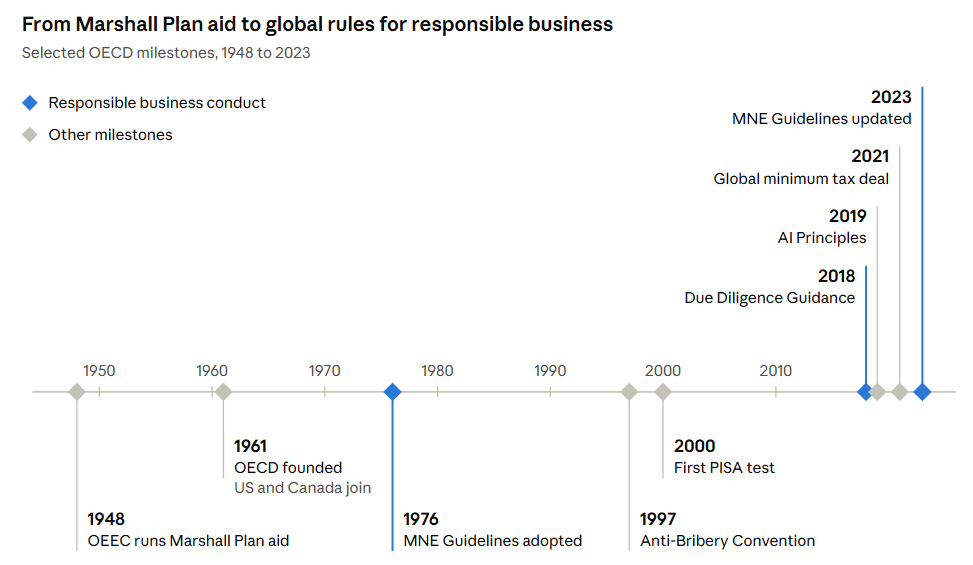
The responsible business conduct framework dates back to 1976, but much of its practical detail is newer, including the 2018 Due Diligence Guidance and the 2023 update of the Guidelines.
What it does
The OECD's work follows the same pattern. Committees of government officials, supported by OECD analysts, first gather comparable data on a policy problem. They then compare how countries deal with it and, when they agree, turn the best approaches into formal instruments. Countries outside the OECD, groups like the G20, and companies often adopt these instruments too, so their reach goes well beyond OECD members. Four flagship instruments show how this works:
Behind these instruments is a steady stream of economic analysis: the twice-yearly Economic Outlook, country economic surveys, and statistical databases that governments, central banks and investors all rely on.
Why it matters for ESG Investors
For ESG professionals, the OECD's most important contribution is its framework for responsible business conduct. It sets out what companies are expected to do and how they should show they are doing it. Key elements include:
The MNE Guidelines. First adopted in 1976 and last updated in June 2023, the Guidelines cover human rights, labor relations, the environment, bribery, consumer interests, disclosure and taxation. The 2023 update added clearer expectations on climate change, biodiversity, technology, business integrity and supply chain due diligence, and changed the rules for National Contact Points.
National Contact Points (NCPs). Every government that signs up to the Guidelines runs an NCP. It is a non-judicial complaints process where trade unions, NGOs and others can file a "specific instance" claiming a company has not followed the Guidelines. These cases are public, so they often become ESG controversies themselves. Under the EU Taxonomy's minimum safeguards, an NCP finding against a company counts as a sign of failure.
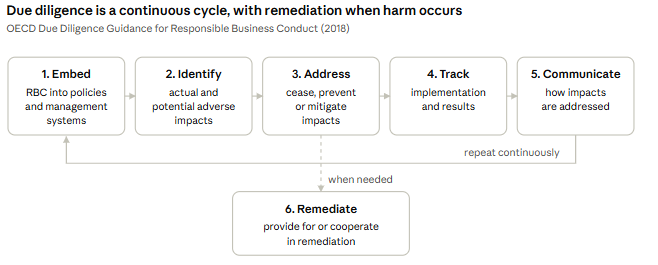
The Due Diligence Guidance. Published in 2018, the OECD Due Diligence Guidance for Responsible Business Conduct turns the Guidelines into a six-step, risk-based process. Companies, and by extension their investors, are expected to follow it.
From soft law to legal requirement. More and more, the framework is the basis for binding rules. The EU Taxonomy's minimum safeguards are directly based on the Guidelines. Two of the SFDR's social principal adverse impact indicators cover breaches of the Guidelines and the lack of processes to check compliance with them (Nordea). The EU Corporate Sustainability Due Diligence Directive also builds on the OECD framework, though OECD Watch says the two only partly match (OECD Watch).
Where controversy data fits. Good due diligence means seeing what is really happening inside a company and its value chain, not just relying on what the company says about itself. AI-driven analysis of public web content at scale can provide that view. SESAMm uses AI on news, NGO reports, blogs and forums to spot ESG controversies as they are reported. This helps investors find adverse impacts (step 2). Its UNGC violation screening is also aligned with SFDR PAI 10, which covers violations of both the UN Global Compact principles and the OECD Guidelines.
Takeaway
The OECD rarely makes headlines, but its standards shape how responsible business conduct is defined, assessed and, more and more, regulated. As the Guidelines become part of EU sustainable finance rules, investors need to back up their assessments with evidence, not just company policy statements. Ongoing, systematic controversy monitoring is one practical way to get that evidence.
Coming soon: OECD Guidelines screening. SESAMm is extending its violation screening to flag controversies linked to the OECD Guidelines for Multinational Enterprises. Request a demo to see it in action.
Sources
- OECD Guidelines for Multinational Enterprises on Responsible Business Conduct (2023)
- OECD Council extends the mandate of Secretary-General Mathias Cormann to 2031
- Bulgaria works to become the 39th member of OECD by 2027 (BNR, Feb 2026)
- Romania receives 24th favorable opinion out of 25 needed to join OECD (Romania Insider, Apr 2026)
- EU Taxonomy minimum safeguards: what are they and why do they matter (Nordea)
- Alignment within reach: CSDDD and the OECD Guidelines (OECD Watch)