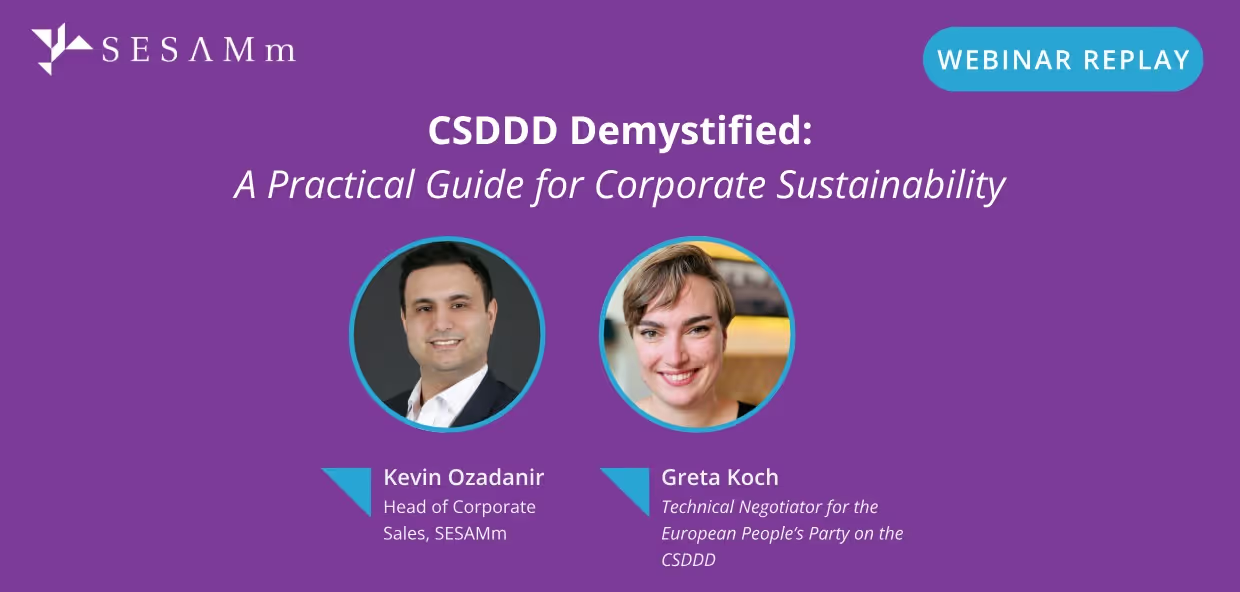
Webinar Replay: CSDDD Demystified: A Practical Guide for Corporate Sustainability
December 11, 2024
•
5 mins read
Watch the replay of our webinar, "CSDDD Demystified: A Practical Guide for Corporate Sustainability," to gain the actionable insights your business needs to navigate the complexities of the Corporate Sustainability Due Diligence Directive (CSDDD).
In this session, Kevin Ozadanir, Head of Corporate Sales at SESAMm, and Greta Koch, Technical Negotiator for the European People’s Party on the CSDDD, break down the directive's objectives and provide practical guidance for companies tackling compliance challenges. This is your opportunity to:
Understand the CSDDD's objectives and its role in strengthening the EU's sustainability agenda.
Learn how the directive compares to other regulations, such as the German Supply Chain Act, and what sets it apart.
Prepare for compliance by exploring strategies to integrate sustainable systems and address diverse regulatory expectations across the EU.
Get a blueprint for effective risk analysis and supply chain management tailored to companies operating across multiple jurisdictions.
Stay ahead of political developments, including the potential repeal of Germany's Supply Chain Act and what it means for global sustainability.
The webinar wraps up with a deep dive into integrating CSDDD with other frameworks, such as the EU Taxonomy and CSRD, and provides a clear roadmap for aligning your operations with evolving corporate sustainability standards.
Don't miss this chance to equip your team with the knowledge to tackle regulatory challenges with confidence. Fill out the form to access the webinar replay now!
Financial and ESG insights begin with big data coupled with data science.
At SESAMm, our artificial intelligence (AI) and natural language processing (NLP) platform analyzes text in billions of web-based articles and messages. It generates investment insights and ESG analysis used in systematic trading, fundamental research, risk management, and sustainability analysis.
This technology enables a more quantitative approach to leveraging the value of web data that is less prone to human bias. It addresses a growing need in public and private investment sectors for robust, timely, and granular sentiment and environment, social, and governance (ESG) data. This article will outline how the data is derived and illustrate its effectiveness and predictive value.
Content coverage and ESG data collection
The genesis of SESAMm’s process is the high-quality content that comprises its data lake, the source from which it draws its insights. SESAMm scans over four million data sources rigorously selected and curated to maximize coverage of both public and private companies. Three guiding criteria—quality, quantity, and frequency—ensure a consistently high input value.
Every day the system adds millions of articles to the 16 billion already in the data lake, going back to 2008. The coverage is global, with 40% of the sources in English (the U.S. and international) and 60% in multiple languages. The data lake, expanding every month, comprises over 4 million sources, including professional news sites, blogs, social media, and discussion forums.
The following tables illustrate SESAMm’s data lake distribution (Q1 2022):
Respect for personal privacy figures highly in the data gathering process. We don’t capture personal data, like personally identifiable information (PII), and respect all website terms of service and global data handling and privacy laws. SESAMm’s data also doesn’t contain any material non-public information (MNPI).
Deriving financial signals and ESG performance indicators
SESAMm’s new TextReveal® Streams platform applies NLP and AI expertise to process the premium quality content gathered in its data lake. This complex process involves named entity recognition (NER) and disambiguation (NED)—the process of identifying entities and distinguishing like-named entities using contextual analysis—and mapping the complex interrelationships between tens of thousands of public and private entities, connecting companies, products, and brands by supply chain, location, or competitive relationship.
Process representation for NER and NED
Using SESAMm’s TextReveal Streams, this wealth of information is filtered to focus on four crucial contexts for systematic data processing, risk management, and alpha discovery:
Sentiment covering major global indices: world equities (and Small Caps, Emerging), U.S. 3000, Europe 600, KOSPI 50, Japan 500, Japan 225
Sentiment covering all assets and derivatives traded on the Euronext exchange
Private company sentiment on more than 25,000 private companies
ESG risks covering 90 major environmental, social, and governance risk categories for the entire company universe, which includes more than 10,000 public and more than 25,000 private companies with worldwide coverage
TextReveal Streams data sets and assessments are used by financial institutions, rating agencies, and the financial services sector, such as hedge funds (quantitative and fundamental) and asset managers, to optimize trade timing and identify new sustainable investment opportunities. Private equity deal and credit teams also use the data for deal sourcing and due diligence. Private equity ESG teams use it to manage initiatives like portfolio company environmental, social, and governance risk and reporting.
Methodology and technology for processing unstructured data
NLP workflow, from data extraction to granular insight aggregation
Data is continually extracted from an expanding universe of over four million sources daily. As it enters the system, it is time-stamped, tagged, indexed, and stored in our data lake to update a point-in-time history extending from 2008 to the present. The source material is then transformed from raw, unstructured text data into conformed, interconnected, machine-readable data with a precise topic.
NLP workflow for TextReveal Streams
Mapping relationships between entities with the Knowledge Graph
At the heart of the text analytics process is SESAMm’s proprietary Knowledge Graph, a vast map connecting and integrating over 70 million related entities and their keywords. It’s essentially a cross-referenced dictionary of keywords, relating each organization to its brands, products, associated executives, names, nicknames, and their exchange identifiers in the case of public companies.
Entities within the Knowledge Graph are updated weekly and tagged to ensure changes are correctly tracked. The CEO of a company today, for example, may not be the CEO tomorrow, and brands may be bought and sold, changing the parent company with each sale. Weekly updates within the Knowledge Graph ensure the system is aware of these changes.
Named entity disambiguation (named entity recognition plus entity linking) is one of the NLP techniques used to identify named entities in text sources using the entities mapped within the Knowledge Graph universe.
At SESAMm, NED identifies named entities based on their context and usage. Text referencing “Elon,” for example, could refer indirectly to Tesla through its CEO or to a university in North Carolina. Only the context allows us to differentiate, and NED considers that context when classifying entities. This method is superior to simple pattern matching, limiting the number of possible matches, requiring frequent manual adjustments, and cannot distinguish homophones.
SESAMm uses three other NLP tools to identify entities and create actionable insights. These are lemmatization, embeddings, and similarity. Each is explained in more detail below.
Analyzing the morphology of words with lemmatization
News articles, blog posts, and social media discussions reference organizations and associated entities in various forms and functions. Lemmatization seeks to standardize these references so the system knows they mean the same thing.
For example, “Tesla,” “his firm,” “the company,” and “it” are all noun phrases that can appear in a single article and refer to a single entity. Even where the reference is apparent, it can take different forms. For example, “Tesla” and “Teslas” both refer to the same entity but have slightly different meanings (semantics) and shapes (morphology).
The lemmatization process standardizes reference shape (morphology) to facilitate identification and aggregation. Lemmatization is a more sophisticated process than stemming, which truncates words to their stem and sometimes deletes information.
Encoding context and meaning with word embedding
In NLP, embedding is a numerical representation of a word that enables its manifold contextual meanings to be calculated relationally. Embeddings are typically real-valued vectors with hundreds of dimensions that encode the contexts in which words appear and, thus, also encode their meanings. Because they are vectors in a predefined vector space, they can be compared, scaled, added, and subtracted. An example of how this works is that the vector representations of king and queen bear the same relation to each other as the representations of man and woman once you subtract the vector that represents royal.
Vectorized representation of embeddings
Using embedding is key to analyzing how words change meaning depending on context and understanding the subtle differences between words that refer to the same concept: synonyms. For example, the words business, company, enterprise, and firm can all refer to the same thing if the context is “organizations.” But they represent different things and even different parts of speech if the context changes.
In the phrase, “[Tesla] will be by far the largest firm by market value ever to join the S&P,” for example, one could replace the word firm with company or enterprise without affecting the meaning significantly. Contrast that with “a firm handshake,” where a similar substitution would render the phrase meaningless.
Also, words referring to the same concept can emphasize slightly different aspects of the concept or imply specific qualities. For example, an enterprise might be assumed to be larger or to have more components than a firm. Embeddings enable machines to make these subtle distinctions.
One advantage of using embedding is that it’s practical because it’s empirically testable. In other words, we can look at actual usage to determine what a word means.
Another advantage is that embeddings are computationally tractable. This understanding of a word’s definition allows us to transform words into computation objects to programmatically examine the contexts in which they appear and, thus, derive their meaning.
As lemmatization is an improvement on stemming, embeddings improve techniques such as one-hot encoding, which is close to the common conception of a definition as a single entry in a dictionary.
SESAMm uses the global vectors for word representation (GloVe) algorithm to generate embeddings. It’s an unsupervised learning algorithm that begins by examining how frequently each word in a text corpus co-occurs with other words in the same corpus. The result is an embedding that encapsulates the word and its context together, allowing SESAMm to identify specific words in a list and different forms of the listed words and unlisted synonyms.
GloVe is an extension of recent approaches to vector representation, combining the global statistics of matrix factorization techniques like latent semantic analysis (LSA) with the local context-based learning of word2vec. The result is an unsupervised algorithm that performs well at capturing meaning and demonstrating it on tasks like calculating analogies and identifying synonyms.
BERT is another algorithm used by SESAMm to generate embeddings. BERT produces word representations that are dynamically informed by the words around them. Google developed the technique, and it’s what’s known as a transformer-based machine learning technique, which means it doesn’t process an input sequence token by token but instead takes the entire sequence as input in one go. This technique is a significant improvement over sequential recurrent neural network (RNN) based models because it can be accelerated by graphics processing units (GPUs).
SESAMm uses BERT for multilingual NLP of its extensive foreign language text because it has been retained using an extensive library of unlabeled data extracted from Wikipedia in over 102 languages. BERT model was trained to predict words from context and next sentence prediction where it was trained to predict if a chosen following sentence was probable or not given the first sentence. As a result of this training process, BERT learned contextual embeddings for words. Due to this comprehensive pre-training, BERT can be finetuned with fewer resources on smaller datasets to optimize its performance on specific tasks.
Linking words, sentences, and topics with cosine similarity
Cosine similarity with centered means it’s identical to the correlation coefficient, which highlights another element of the computational tractability of the embeddings approach. It makes it easy to compare words and contexts for similarity.
Converting words to vector representations means we can quickly and easily compare word similarity by comparing the angle between two vectors. This angle is a function of the projection of one vector onto another. It can identify similar, opposite, or wholly unrelated vectors, which allows us to compute the similarity of the underlying word that the vector represents.
Two vectors aligned in the same orientation will have a similarity measurement of 1, while two orthogonal vectors have a similarity of 0. If two vectors are diametrically opposed, the similarity measurement is -1. In practice, negative similarities are rare, so we clip negative values to 0.
Vectorized representation of cosine similarities
Cosine similarity measures whether two words, sentences, or corpora are close to one another in vector space or “about” the same thing in semantic space. To answer the question, “Is this sentence referencing company X?” we embed the sentence using the process described above and compute the cosine similarity between the sentence and the embedded company profile. Analogously, we compute similarities between sentences and the ESG topics SESAMm monitors by taking the maximum similarity between a sentence and each embedded keyword associated with an ESG topic.
These similarities allow us to identify whether a sentence references fraud, tax avoidance, pollution, or any other ESG risk topic among the more than 90 that SESAMm tracks across the web.
Similarities within ESG topics combine with word counts to resolve the recall and precision problem. Word counts are precise because if a word is identified within a context, then that context, by construction, references the topic.
The virtue of using these NLP techniques is that even if a given keyword list does not include every possible combination of words that a person might use to discuss a topic, relevant entities missed by the word-count process will be identified through vector similarity.
This is the power of SESAMm’s NLP expertise. We can scan many lifetimes’ worth of data in seconds to find the concepts you explicitly ask for and the concepts relevant to your search but that you did not think of yourself.
Sentiment analysis with deep learning and neural networks
Once we’ve identified the concepts and contexts of interest in all the forms they appear, we analyze the context to determine the speakers’ attitudes.
We use sentiment classification models to score a sentence with three possible outcomes: negative, neutral, or positive. The current classification models are based on deep learning AI technologies. Specifically, we stack convolutional neural networks with word embeddings and bayesian optimized hyperparameters—parameters not learned during training. This architecture improves the accuracy and enables fast shipping of production-ready models for a given language. We also produce state-of-the-art frameworks with architecture variations enabling multilingual capabilities, such as transformers and universal sentence encoders.
Condensing information and extracting insights with daily aggregation
Similarities, embedded word counts, and sentiment are state-of-the-art tools for processing unstructured text data. The same tools are effective cross-linguistically.
Once the information has been extracted from millions of data points, it’s aggregated and condensed into actionable insights.
All entities are referenced directly or indirectly within an article. Then, sentence-level references are aggregated to obtain an article-level perspective, and finally, all relevant articles are aggregated to gain an entity-level view of that day.
In this way, reams of data are compressed into several metrics to provide a daily aggregate view for each entity, highlighting trends at a sentence, article, and entity-level comparable over a multi-year history.
ESG analysis use cases
SESAMm’s TextReveal Streams is used in various investment domains, from asset selection to alpha generation and risk management. Systematic hedge funds track retail interest in real time to identify investment opportunities and protect their existing positions. In the Private Equity industry, equity and credit-deal teams use the data in various ways, from monitoring consumer perspectives via forums and customer reviews for evaluating deal prospects to estimating due diligence risks, all to help make investment decisions. Dedicated teams use our data for monitoring portfolio companies for ESG red flags that conventional ESG reporting might miss.
Below are two examples of how aggregated TextReveal Streams data can be used to help identify investment risk and opportunity.
LFIS CapitalL: ESG signals for equity trading
ESG controversies can significantly impact asset prices in the short term, and it’s now estimated that intangible assets, including a company’s ESG rating, account for 90% of its market value.
Working in partnership with LFIS Capital (LFIS), a quantitative asset manager and structured investment solutions provider, SESAMm developed machine learning and NLP algorithms that could analyze ESG keywords in articles, blogs, and social media, to generate a daily ESG score specific to each stock, which is part of the TextReveal Streams’ platform’s core functionality.
The results were promising when these scores were incorporated into a simulated strategy for trading stocks in the Stoxx600 ESG-X index.
A simulated long-only strategy running between 2015 and 2020, using the signals, delivered a 7.9% annualized return, 2.9% higher than the benchmark for similar annualized volatility (17.3% vs. 17.1%). The information ratio of the strategy was greater than 1, with a tracking error of 2.8%. Results for the previous three years were compelling, reflecting the growing interest and news flow around ESG themes.
Researchers also backtested a hypothetical long-short strategy for all stocks in the Stoxx600 ESG-X index with a market cap of over $7.5bn. This investment strategy delivered a Sharpe ratio of approximately 1 with annualized returns and volatility of 6.1% and 5.9%, respectively, between 2015 and 2020. Like the long-only strategy, returns were particularly robust over the three years up to 2020: +6.0% in 2018, +7.3% in 2019, and +11.3% in 2020.
Finally, a simulated “130/30” ESG strategy that combined 100% of the long-only ESG strategy and 30% of the long-short ESG strategy delivered a 10.8% annualized return, 5.8% higher than that of the Stoxx600 ESG-X index. Annualized volatility was similar at 16.9% vs. 17.1%. The strategy experienced a tracking error of 3.8% and an information ratio of over 1.5, with a consistent outperformance each year.
Disclaimer: Past performance is not an indicator of future results. Theoretical calculations are provided for illustrative purposes only. The investment theme illustrations presented herein do not represent transactions currently implemented in any fund or product managed by LFIS.
Wirecard: ESG sentiment and volume as predictive indicators
The Wirecard scandal broke on June 21, 2020, when newswires carried the story that the major German payment processor had filed for bankruptcy after admitting that €1.9 billion ($2.3 billion) of purported escrow deposits did not exist.
Could SESAMm’s TextReveal Streams platform have provided investors with an early warning that the scandal was about to break?
The following chart derived from the platform shows how key ESG metrics, including ESG scores (volumes) and ESG scores (sentiment), reacted to the news.
An analysis of the charts pinpoints a shallow rise in the ESG scores (volumes) time series in the early part of June before the eruption on June 21.
The ESG scores (sentiment) metric also shows a steady increase in negative sentiment for governance, the most relevant of the three ESG factors regarding the scandal.
How key ESG metrics, including ESG scores (volumes) and ESG scores (sentiment), reacted to the Wirecard scandal news.
Additionally, before the crash, governance was the most negative of the three ESG factors most of the time. This was especially the case from late March to early April, and then before the scandal in early June, negative governance sentiment diverged higher from the other two.
The rate-of-change of negative governance sentiment as it rose and peaked in early June before the scandal broke was also extremely high, perhaps providing the basis for an early warning signal.
Portfolio managers who had been keeping an eye on the reputational slide in Governance for Wirecard may have decided the company was at high risk of a negative controversy emerging, giving them cause to drop the stock before the event.
In this way, it can be seen how while not providing a hard and fast early warning signal, SESAMm’s ESG scores can, nevertheless, be used as the basis for developing a data-driven, rules-based portfolio management approach that can help investors avoid high-risk candidates like Wirecard.
SESAMm takes on ESG data challenges
SESAMm’s NLP and AI tools analyze over four million data sources daily to identify thousands of public and private companies and their related products, brands, identifiers, and nicknames, turning reams of unstructured text into structured and actionable data.
SESAMm’s TextReveal Streams platform can be used in many quantitative, quantamental, and ESG investment use cases. TextReveal is a solution that allows you to fully leverage NLP-driven insights and receive high-quality results through data streams, modular API and dashboard visualization, and signals and alerts.
Learn how SESAMm can support you in your investment decision-making and request a demo today.
To request a demo or for access to the full SESAMm Wirecard or LFIS reports, contact us here:
COP30 has just begun in Belém, Brazil. Every year, the Conference of the Parties (COP) serves as the world’s central stage for climate diplomacy, where governments, scientists, and civil society gather to decide how to respond to the global climate emergency. Over the decades, these meetings have shaped major milestones, from the Kyoto Protocol to the Paris Agreement. Yet behind the speeches and pledges, questions persist: how much progress is being made on the ground, and how inclusive are these negotiations in practice?
As countries meet again to assess their collective efforts, looking back at the most recent COPs offers a perspective on how politics, accountability, and competing interests continue to influence the global climate agenda.
What Is the COP?
The Conference of the Parties (COP) is the annual United Nations summit that brings together the 198 signatories to the 1992 UN Framework Convention on Climate Change (UNFCCC). Its purpose is to coordinate international action on climate change through negotiation, progress assessment, and new commitments to reduce greenhouse gas emissions.
COPs are usually held in November or December and last about two weeks. The first took place in 1995 in Berlin, and the tradition has continued ever since. COP27 was hosted by Egypt in 2022, COP28 by the United Arab Emirates in 2023, and COP29 by Azerbaijan in 2024. This year, COP30 marks Brazil’s turn to host the event in the Amazonian city of Belém.
Over the years, COPs have produced landmark outcomes, from the Kyoto Protocol (1997) to the Paris Agreement (2015). More recent debates have focused on climate finance, adaptation, and the global transition away from fossil fuels. Yet, as recent conferences show, progress often comes with friction, delays, and controversy.
The COP Controversies Over the Years
COP27 (2022) - Egypt
Held in Sharm el-Sheikh, COP27 centered on the question of climate justice. Developing nations demanded compensation for loss and damage caused by climate impacts that they did little to create. Therefore, the creation of a Loss and Damage Fund was a landmark step, though details on financing and governance were deferred.
Egypt’s hosting of the summit drew criticism over restrictions on civil society. Amnesty International reported hundreds of arrests before the event, including activists detained for online content. Tight surveillance and limited protest spaces highlighted how political control intersected with the climate agenda.
Meanwhile, energy security concerns following the war in Ukraine exposed inconsistencies in global climate policy. Some European nations resumed coal use or sought new gas projects in Africa, while methane leaks from natural gas infrastructure were found to be worse than estimated. These developments raised questions about whether short-term energy strategies were undermining long-term climate goals.
COP28 (2023) - United Arab Emirates
The 2023 summit in Dubai was among the most debated in COP history. The appointment of Sultan Al Jaber, CEO of the Abu Dhabi National Oil Company, as COP president drew immediate criticism over conflicts of interest. Al Jaber’s comments, suggesting there was “no science” supporting a fossil fuel phase-out, only deepened the controversy.
Leaked letters from OPEC revealed coordinated lobbying to block references to phasing out fossil fuels in the final text. Despite this, over 100 countries advocated for clear language on ending fossil fuel use. The resulting “UAE Consensus” included the phrase “transitioning away from fossil fuels,” the first such mention in COP history. However, critics noted that the wording allowed broad interpretation and loopholes for continued production through “abatement” and carbon capture.
The summit also drew scrutiny for restrictions on activism. Human Rights Watch documented limits on protests, surveillance of delegates, and constraints on speech. Still, COP28 produced incremental steps on renewable energy commitments and adaptation finance, even as it highlighted the influence of the fossil fuel industry on global negotiations.
COP29 (2024) - Azerbaijan
In Baku, COP29 took place under similar scrutiny. Azerbaijan’s record on press freedom and civil rights was a major concern, with several journalists and activists arrested in the months before the event. Human rights advocate Anar Mammadli and economist Gubad Ibadoghlu were among those detained on politically motivated charges.
The negotiations were dominated by debates over climate finance. Wealthy countries announced a target of $300 billion annually by 2035, largely relying on private capital and multilateral banks. Developing nations argued that the proposal lacked direct grant funding and risked increasing debt burdens. Observers reported confusion and frustration over the agreement’s final approval, with some delegations absent when it was gaveled through.
COP29 concluded with calls for greater transparency, inclusivity, and consistency in how future summits are hosted and managed.
Patterns and Lessons
Across COP27, COP28, and COP29, several common threads emerge. Each conference underscored both the urgency of global climate action and the difficulties of collective decision-making. The creation of new financial mechanisms and the first explicit reference to moving away from fossil fuels were significant steps. Still, they came alongside persistent divisions over fairness, responsibility, and implementation.
A recurring criticism has been greenwashing: the gap between rhetoric and reality. Host countries often present themselves as champions of sustainability while remaining heavily dependent on fossil fuels. At the same time, the presence of record numbers of industry lobbyists, particularly from oil and gas companies, has raised concerns about the balance of influence in climate negotiations.
These issues point to a broader tension: how to ensure that the COP process remains a platform for genuine progress rather than symbolic gestures. Many observers argue that transparency, stronger accountability mechanisms, and better inclusion of civil society are essential to rebuilding trust in the process.
Conclusion
As COP30 unfolds in Brazil, the focus is again on implementation and credibility. The last three conferences demonstrated how progress can coexist with controversy, and how global ambition must be matched by local action and political will.
While the COP framework remains the cornerstone of international climate cooperation, its effectiveness depends on whether commitments are translated into tangible outcomes. The coming days in Belém will show whether lessons from past conferences can help turn dialogue into decisive progress.
Reach out to SESAMm
TextReveal’s web data analysis of over five million public and private companies is essential for keeping tabs on ESG investment risks. To learn more about how you can analyze web data or to request a demo, reach out to one of our representatives.
The EU’s Corporate Sustainability Reporting Directive (CSRD) promised a new era of transparency and comparability in sustainability reporting. But as the first wave of CSRD-aligned reports emerges in 2025, the reality is proving more complex. Some companies are racing ahead with detailed disclosures, while others are taking a minimalist approach. Investors? Many are struggling to make sense of it all.
We’re only at the beginning of the CSRD journey, but the early lessons are already clear: The gap between reporting ambition and data quality is widening. And the path forward may be shaped as much by simplification as by regulation.
Early CSRD Reporting: A Diverse Landscape Takes Shape
Since early 2025, over 250 companies have published sustainability reports aligned with CSRD — with report lengths ranging from 30 pages to over 300. One striking takeaway: The number of sustainability-related Impacts, Risks, and Opportunities (IROs) disclosed varies dramatically. Some companies report on fewer than 15 IROs. Others disclose more than 80. This variation highlights not only the complexity of CSRD implementation but also differences in how companies interpret their reporting obligations — and their readiness to meet them.
A PwC analysis shows that 90% of the first 100 CSRD reports came from just five European countries, including Germany, Spain, and the Netherlands, none of which have yet transposed CSRD into national law. Why report early? The answer is clear: mounting pressure from investors, regulators, and other stakeholders demanding greater transparency on sustainability performance.
But just as the first reports hit the market, uncertainty looms. The European Commission’s February Omnibus package could remove up to 80% of companies from the directive’s scope — a move that may significantly reshape the reporting landscape.
Data Quality: The New Focus Area for Reporting and Investors
At the heart of CSRD reporting lies the double materiality assessment, a process that requires companies to disclose sustainability matters that affect both enterprise value and broader environmental and social impacts. But execution varies widely.
According to PwC, while nearly all companies engage with internal stakeholders during the materiality process, few provide detailed information about engagement with external stakeholders.
The most commonly reported topics include:
Climate Change (mitigation, adaptation, energy use)
Business Conduct (ethics, anti-corruption measures)
As PwC notes, the goal is to help companies and stakeholders “understand more clearly the interplay between sustainability and value creation.” But when reporting approaches differ so dramatically, comparison becomes difficult, leaving investors to navigate a patchwork of methodologies and disclosures.
Sondre Myge, head of ESG at Skagen Funds, said that while it’s still early, his “first impression is that it complicates comparability. Investors are now drowning in a mix of voluntary and legal disclosures requiring them to make assessments through a kaleidoscope of standards and methodologies. Sifting critically through hundreds of pages of text just for one company is a huge undertaking. While first movers will provide glossy reports that convey a convincing impression, it is important to remember that disclosures are not necessarily representative.”
Jan Kaeraa Rasmussen, head of ESG and sustainability at PensionDanmark, agreed, stating that initial disclosures tend to be “more narrative than quantitative. This limits our ability to draw robust, forward-looking insights from the information provided.”
What’s Next: Simplification or More Complexity?
Despite these challenges, the direction of travel is clear: sustainability reporting in the EU is becoming more structured, more transparent, and more data-driven. But we are still in a period of transition.
Companies are building internal systems and capabilities to support CSRD compliance. Best practices are only now emerging. And regulatory changes, like the proposed Omnibus package, could dramatically alter the scope of reporting obligations.
For investors and stakeholders, the challenge will be to sift through early reports critically, distinguishing between narrative-heavy disclosures and data-rich insights that can drive better decision-making.
How SESAMm Helps Investors Navigate ESG Data Complexity
As sustainability reporting evolves, so too does the need for faster, more scalable ways to uncover ESG and reputational risks. At SESAMm, we help investors and companies cut through the noise.
Using advanced Generative AI, we automate ESG monitoring and due diligence on public and private assets — providing real-time coverage of over 5 million companies globally. Leading firms like Carlyle, Warburg, Natixis, RBI, Fitch, and Oddo trust SESAMm to uncover risks in seconds, not weeks.
Discover unparalleled insights into ESG controversies, risks, and opportunities across industries. Learn more about how SESAMm can help you analyze millions of private and public companies using AI-powered text analysis tools.
Stay ahead with the latest in ESG and AI intelligence
Join our mailing list to receive new reports, event invites, and updates from SESAMm directly to your inbox.