Northern Trust is the latest name on a growing list of managers losing business over the same issue. Since early 2025, several asset owners have reallocated capital away from managers that stepped back from climate coalitions:
For risk and ESG teams, the lesson isn't about picking a side in the US-Europe ESG divide. Instead, it's that a governance decision made for one audience can create material commercial exposure with another. Northern Trust's exit was a defensible response to conditions in its home market, but that still cost the firm a nine-figure mandate.
Coalition memberships and public commitments used to be treated as background credentials, not something clients actively screened for. However, asset owners are now treating a manager's stewardship posture as a live signal, and they're willing to act on it.
NZAM officially relaunched on February 25, 2026, with softer requirements (the updated commitment dropped references to the 2050 net zero investment goal) and without most large US managers. More than 250 asset managers, including Amundi, signed on. The managers who didn't rejoin are now operating with a visible, trackable gap between their public stance and what a growing subset of clients expect.
The takeaway
Climate coalition membership has become a proxy that a segment of asset owners actively screen for, and reversing course is now a reputational event with a dollar figure attached. Whether that logic holds up for managers with less European or sustainability-focused client exposure is a separate question. But for those who do, the message from this string of mandate losses is clear: walking back a public commitment doesn't just draw criticism, it costs money..
SESAMm helps ESG, risk, and secondaries teams monitor and screen for ESG and reputational risk across public and private companies, drawing on a data lake of 30+ billion documents in 100+ languages. Screening criteria, whether regulatory (SFDR, EU Taxonomy), LP-driven, or values-based, are fully customizable to a firm's own policy. Learn more about SESAMm's approach to controversial business involvement screening and secondaries exclusion diligence.
Environmental, Social, and Governance (ESG) factors have moved from the periphery to the core of investment and risk management discussions. While positive ESG actions are often linked to better financial stability, new research from the Norwegian University of Science and Technology reveals the flip side: ESG controversies significantly increase a company’s exposure to systemic risk.
The researchers analyzed 463 non-financial companies listed in the STOXX Europe 600 index between 2016 and 2022. Their objective was to assess whether ESG controversies, such as environmental violations, social misconduct, or governance failures, impact a company’s systematic risk, measured by its beta coefficient (a key risk indicator in finance).
Importantly, the study leveraged a Random Forest machine learning model combined with Explainable AI (XAI) methods to predict and interpret firm-level risk.
The study's core conclusion is clear: ESG controversies significantly raise a firm’s systematic risk. In other words, when a company is embroiled in environmental scandals, social misconduct, or governance failures, investors perceive it as riskier, leading to greater stock volatility and sensitivity to market shocks.
Sondre Myge, head of ESG at Skagen Funds, said that while it’s still early, his “first impression is that it complicates comparability. Investors are now drowning in a mix of voluntary and legal disclosures requiring them to make assessments through a kaleidoscope of standards and methodologies. Sifting critically through hundreds of pages of text just for one company is a huge undertaking. While first movers will provide glossy reports that convey a convincing impression, it is important to remember that disclosures are not necessarily representative.”
Jan Kaeraa Rasmussen, head of ESG and sustainability at PensionDanmark, agreed, stating that initial disclosures tend to be “more narrative than quantitative. This limits our ability to draw robust, forward-looking insights from the information provided.”
What’s Next: Simplification or More Complexity?
Interestingly, the study found that the relationship between ESG controversies and risk is non-linear:
Firms experiencing their first ESG controversy ("first-timers") see a pronounced jump in risk.
For firms regularly facing controversies ("regulars"), the effect on risk remains high but stabilizes.
Small controversies matter most for firms with otherwise clean records. For already controversial
firms, additional issues have less incremental impact.
This pattern aligns with investor behavior: markets tend to overreact to initial controversies while becoming desensitized to repeated issues.
Machine Learning: A Powerful Risk Prediction Tool
The researchers used Random Forest regression, a machine learning technique that captures complex, non-linear relationships in data, to predict systematic risk.
Compared to traditional models, the Random Forest approach reduced the prediction error by nearly 30%. The model achieved a mean absolute error of 0.25 for 2022 risk predictions, outperforming a naïve benchmark model that assigned every company the same average risk.
This reinforces the value of machine learning in financial risk management — particularly when assessing non-traditional factors like ESG controversies.
Industry Matters: Some Sectors Are More Vulnerable
The study also highlights that the impact of ESG controversies on risk is highly sector-specific.
Industries with Highest Sensitivity to ESG Controversies:
Machinery
Oil, Gas & Consumable Fuels
Chemicals
Metals & Mining
Professional Services
These industries tend to face greater investor scrutiny due to their environmental footprint or governance challenges.
Industries with Lowest Sensitivity:
Real Estate
Food Products
Electric Utilities
The lower sensitivity in these sectors may reflect stronger sustainability practices, regulatory protections, or reduced operational exposure to ESG risks.
Geographic Differences in Risk
In addition to industry effects, the research found that firms in certain countries face higher systematic risk linked to ESG controversies.
Countries with the highest predicted systematic risk included:
Finland
Portugal
Poland
Netherlands
Sweden
Meanwhile, firms in Italy and Germany showed lower ESG-related risk exposure.
Implications for Investors, Risk Managers, and Companies
This study provides clear takeaways for finance professionals and ESG practitioners:
ESG Controversy Monitoring Is Critical Investors need advanced ESG monitoring tools to detect early signs of controversy, particularly for first-time incidents, which have the highest risk impact.
Tailor Risk Management to Industry Risk managers should take into account industry-specific vulnerabilities.
Machine Learning Enhances Risk Prediction Traditional risk models may overlook non-linear ESG effects. Machine learning offers a powerful, data-driven approach to anticipate market reactions to ESG incidents.
Proactive ESG Management Reduces Risk Companies should address ESG risks early before they escalate into high-profile controversies that damage reputation and investor trust.
Conclusion
This groundbreaking research bridges ESG and AI, demonstrating that ESG controversies are not just a reputational issue; they are a quantifiable financial risk. Machine learning models provide finance professionals with more accurate tools to assess and mitigate this risk.
About SESAMm
Discover SESAMm provides AI-powered solutions to help investors and companies identify ESG controversies and risks before they escalate. Using state-of-the-art AI, SESAMm analyzes millions of sources in near real-time, detecting ESG controversies across public and private companies worldwide. Whether for due diligence, portfolio monitoring, or supplier risk management, SESAMm enables financial professionals to stay ahead of emerging risks and make more informed decisions. Learn more at www.sesamm.com.
SESAMm’s AI Technology Reveals ESG Insights
Discover unparalleled insights into ESG controversies, risks, and opportunities across industries. Learn more about how SESAMm can help you analyze millions of private and public companies using AI-powered text analysis tools.
After months of hard work from our team, we closed on a €35 million Series B2 funding round led by Elaia and Opera Tech Ventures (BNPP), which followed a €7.5M B1 round led by New Alpha and Carlyle in January 2021. That means we can now pursue the next phase of SESAMm’s growth.
We want to accomplish many things with this investment, and I’m incredibly grateful to all of our investors, partners, and clients who helped us during this process. But before I talk about them and SESAMm’s future, I can’t help but think about how the company started.
Academic beginnings
It’s still hard to believe that SESAMm sprouted from an idea, an academic project, and three college students. I still remember Pierre Rinaldi asking me to develop the first algorithms that used social media to analyze financial markets while in school. Pierre worked at a bank trading desk while finishing his studies and doing a research internship at a behavioral finance lab, where the idea came up for the project. I studied engineering and was passionate about AI already, so I started coding, and the first project was born.
Eventually, this project outgrew my capabilities. The volume of data involved needed hardcore algorithms to process them, the kind of algorithms Florian Aubry could build. Florian was the best developer in my engineering school, and lucky for us, he was also my friend.
From left to right: COO Pierre Rinaldi, CEO Sylvain Forté, and CTO Florian Aubry.
Before long, we started renting servers, optimizing code, and building signals based chiefly on Twitter data, reproducing research papers that also used text data to generate sentiment indicators for financial markets. You could say that this project had become more than academic at this point. But it really only became a company once we won our first startup award.
The award that sparked the launch of a company
We participated in a competition organized by local incubator SEMIA with support from Société Générale as a way to gain credibility for the project, and would you know, we won. The award was monetary, and we could receive it on one condition: that we launch an actual company.
You probably already know that starting a business is a big decision, at least it was for Pierre, Florian, and me. After all, we were still in school, trying to finish our degrees and looking to start new careers. Our choices could be life-altering. Pierre, for instance, planned to take a full-time job at the bank he was working at.
In the end, we chose SESAMm. Pierre didn’t take the job at the bank. I did my end-of-study internship at SESAMm, which allowed me to focus on the company 100% while finishing my degree. And Florian dedicated all his time and energy to the startup, too. In other words, we were all in, and our school project had officially become a business.
Pressure to build
Setting up a company was relatively easy. Building a business, as it turns out, is way harder. How would we take SESAMm’s product and put it to work? Pierre’s contacts, that’s how.
One by one, Pierre called on everyone he knew from school that worked in trading, offering them a chance to be the first to test the latest AI innovation: using social media for financial analysis. Back then, Pierre had more of a sales role. He’s now COO and head of HR, in case you were wondering.
Our first client was a trader from London. He put $50,000 into a strategy based on SESAMm’s signals. With our signals, the trader grew his portfolio with such performance that he began to raise capital, including for a hedge fund. Ultimately, he was trading $50 million from the strategy. It was the kind of success and track record we needed in the finance industry to take SESAMm to the next level.
Compelled to move…literally
Having demonstrated success, an investment firm, a venture firm called Fonds Venture Numérique Lorrain, reached out to us with interest in investing in SESAMm’s first round of funding. But they had two conditions:
SESAMm must move to Metz, a startup-friendly hub in the Lorraine region in France.
SESAMm must seek additional funding from other investors.
At the time, SESAMm was based in Strasbourg because that’s where Florian and I studied. And for all intents and purposes, we hadn’t planned on moving.
Also, aside from Pierre reaching out to school acquaintances to try our solution, we had never pitched anyone to fund our company before. Pierre, Florian, and I faced a serious choice and challenge.
What did we do, and how did we fare?
We reached out to business angels and pitched numerous times while continuing to work on the product and starting to plan the first recruitments. We learned a lot during this initial period about how to structure a company and present it to investors. At the time, startups were less common in the region and using online content from YC and other accelerators was invaluable for us.
SESAMm’s headquarters is now in Metz, and we currently have offices in Paris, London, Tunis, New York, and Tokyo. We’ve also diversified our technology and clientele, particularly in ESG and corporate spaces. In other words, we faced the challenge, moved our headquarters, and grew and evolved a lot!
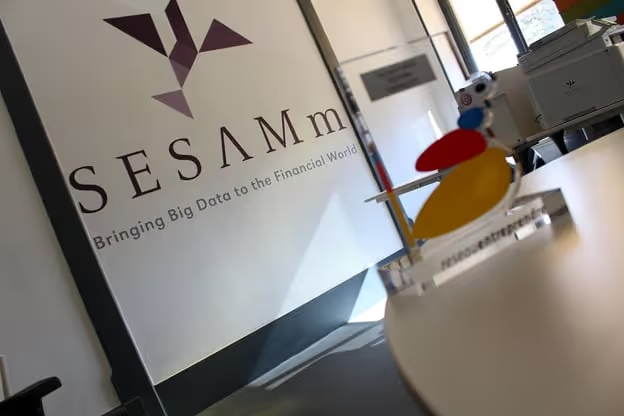
Our first sign, our first footprint, our first home office in Metz.
Series B2 funding round challenges
That brings us to the recent past. We’ve grown our company so much that it was time for another funding round, and the timing wasn’t the best. Our teamwork and ability to communicate effectively across regions and cultures were vital in tackling this latest fundraising round. We decided to run the entire process in-house as it was important to us to not only demonstrate our ability to do so but also to build our own VC relationships.
Moreover, we’ve had a unique previous fundraising experience. Having been funded by FinTech venture capital firm NewAlpha Asset Management and a large private equity firm like Carlyle Group Inc. in earlier rounds helped us improve our processes and standardize our communications. We felt ready for this challenge.
Frankly speaking, though, between the COVID-19 pandemic and the Russia-Ukraine war, startup funding had become a much bigger challenge. Things weren’t popping like they were a couple of years ago, so we needed to be cautious and conservative yet bold and compelling. Regardless, we dug deep and stuck with the plan, with a focus on our numbers and our vision.
To achieve our goal, we created an internal team, onboarded two advisors, and created a scalable process. The internal team included SESAMm’s C-suite: CEO (Sylvain Forté), COO (Pierre Rinaldi), CTO (Florian Aubry), CFO (Marie-Charlotte Deucher), CMO (Jorge Alvarez), and CDO (Eric Sionnet). Our advisors provided guidance around strategy, gave feedback, and supplied operational help when needed. And from our pitch deck variations to our storage and sharing policies, we established a fine-tuned communication and project management process to keep us on task and on time. It was a good process, and it really helped us manage things efficiently while maintaining control over day-to-day operations. I can’t say it enough: process is always the key.
Fundraising wasn’t easy, but the process was worthwhile. And all this to say that I couldn’t be happier to announce that SESAMm has wrapped up its Series B2 funding round. With this money, we plan to further expand into the U.S. and Asian markets and continue SESAMm’s exponential growth. We’ll also seek key talent to sustain this growth and support the development of our AI technology.
Pleased, grateful, and excited for what comes next
Today, SESAMm is a healthy and fast-growing company. And as COO, CTO, and CEO, respectively, Pierre, Florian, and I are now more than a scrappy group of students. We’re a crew with the support of many contributors, consisting of more than 100 employees across many offices and cultures. It’s because of the teamwork and collaboration that SESAMm is where it is today. And I’m immensely grateful for all our team’s effort and the tremendous support we get from clients, investors, and advisors every day.
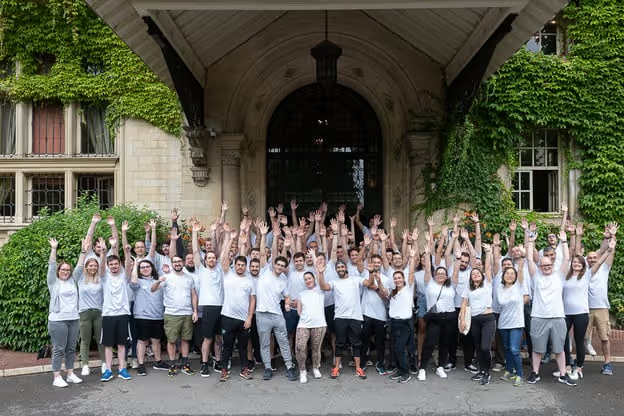
Paris, France, September 2022: Many of the 100+ SESAMmers gathered for a company retreat.
Thank you for being a part of our journey, and see you at SESAMm’s next milestone. Cheers!
Globally, ethics and sustainability are important, but the retail industry faces intense scrutiny over supply chain integrity. This spotlight shines on SHEIN and TEMU, two giants in the fast fashion and e-commerce sectors, known for their vast reach yet marred by controversies around labor practices and environmental impacts. This article explores their supply chain strategies, examining how current and emerging legislation, like the CSDDD initiative, aims to tackle the ethical dilemmas plaguing global retail. Through a comparison of SHEIN and TEMU, we assess the effectiveness of regulatory frameworks in addressing these critical issues. By analyzing their ESG controversies and comparing their responses, we assess how well current and future legislation, particularly the CSDDD initiative, addresses ethical issues in global supply chains.
Specialized Retail: The Case of SHEIN and TEMU
SHEIN and TEMU are compelling use cases due to their past controversies and the focus on their supply chain practices. Both companies have come under scrutiny for their labor practices, environmental impacts, and ethical issues, making them ideal subjects for analysis. By studying their supply chain challenges, we aim to assess the effectiveness of current legislation and predict the potential impact of future regulatory frameworks, particularly in the context of the CSDDD initiative.
While both companies operate with a similar business model, SHEIN is an established player entangled in numerous supply chain controversies. On the other hand, TEMU, a newcomer since 2022, faces similar issues. Comparing them helps us evaluate the effectiveness of existing supply chain legislation and determine whether increased regulatory scrutiny has improved compliance or merely raised awareness of these controversies within the industry.
Note:
Size bias mitigation:
We normalized the data for both companies to ensure an equal basis of comparison, accommodating the difference in operational history—SHEIN since 2008 and TEMU since 2022— to eliminate discrepancies in web attention.
Risk analysis:
It’s worth noting that the figures presented here specifically relate to supply chain risks, as that is the primary focus of our analysis.
Examining Supply Chain Controversies
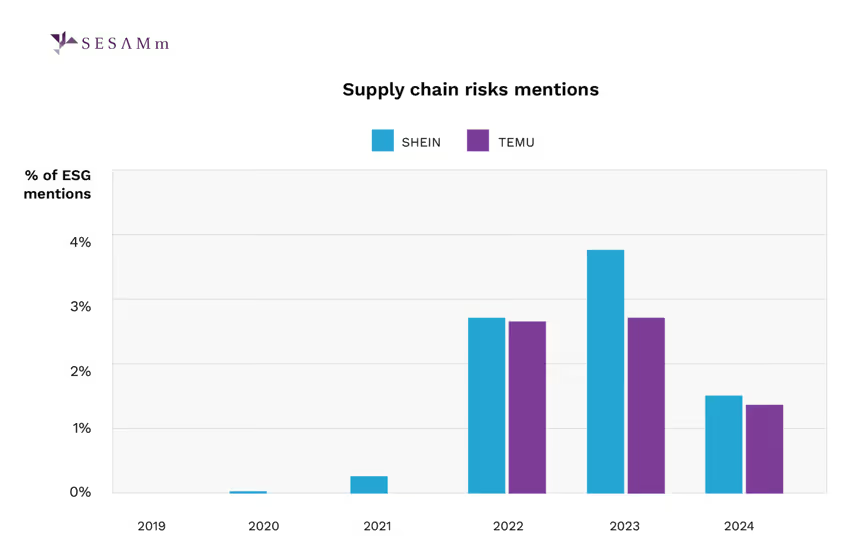
We analyzed ESG risks in the supply chains of SHEIN and TEMU over the past four years, adjusting data volumes for comparative analysis. SHEIN's supply chain risks have significantly increased since 2021, peaking in 2022 and continuing to rise in 2023, reflecting a growing online focus on its issues. Meanwhile, TEMU, despite only being established in 2022, has quickly come under intense scrutiny. The company faces frequent criticism for its supply chain practices, including condemnations for inaction and ongoing human rights violations.
Examining Social Sub-risks
In our analysis of social risks within the supply chains of TEMU and SHEIN, we discovered that fundamental human rights and labor rights are the most and second most prevalent issues, respectively. Notably, despite TEMU's more recent establishment compared to SHEIN, its supply chain has a relatively higher proportion of human rights controversies.
Both companies have faced serious allegations related to their supply chain practices. TEMU and SHEIN are scrutinized for using Chinese cotton potentially linked to slave labor, with insufficient efforts to mitigate forced labor risks. Allegations include child slavery, privacy issues related to sharing user data, and environmental neglect, including the use of carcinogens in products. Despite their efforts to boost their public image through aggressive marketing and influencer engagements, both companies have been criticized for their approach to environmental responsibility and labor practices.
Political calls for investigations into the use of Uyghur slave labor in both companies underscore their ethical challenges. Neither company has shown rigorous compliance with anti-forced labor laws, lacking stringent programs to audit supplier compliance. This highlights significant gaps in their corporate responsibility efforts.
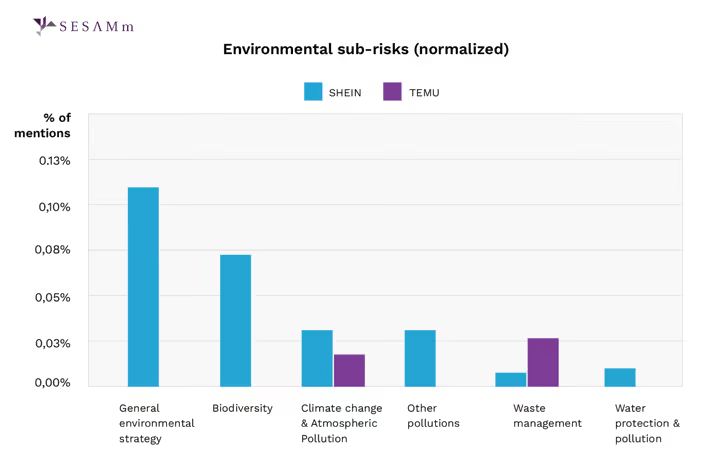
It's evident that social risks, particularly human rights breaches and labor rights controversies, have received significantly more attention than environmental risks. Despite the severity of environmental events, they represent a lower percentage in comparison. This highlights the prioritization of addressing social issues within these companies' operations.
SHEIN experiences extensive scrutiny, leading to a wealth of data on its practices. Conversely, TEMU, despite facing environmental controversies, has been less transparent about its environmental footprint, with Greenpeace reports highlighting this lack of clarity. This disparity underscores that SHEIN’s environmental impacts are more thoroughly documented than TEMU’s.
These environmental and health issues gained attention during SHEIN’s attempts to launch IPOs in the US and UK, spotlighting the company's ethical and environmental practices. Despite SHEIN's pledges to donate towards solving textile waste problems, critics label these actions as greenwashing, calling for significant alterations to its business model to address the underlying issues effectively.
Supply Chain Dynamics: SHEIN vs TEMU
While TEMU doesn't have its own brand like SHEIN, it operates under a comparable business model. It acts as an intermediary, managing shipments for products it doesn't manufacture. Despite their distinct approaches, both companies frequently engage in disputes, drawing attention to their supply chains. Additionally, policymakers often group them with similar firms, subjecting their fast fashion practices to heightened scrutiny.
These events highlight the growing scrutiny surrounding the supply chain practices of both SHEIN and TEMU. Senator Rubio's call for an investigation into allegations of Uyghur slave labor usage by both companies, additionally, mentions of Congressional attention has also focused on these companies, with reports exposing violations of U.S. tariff laws and evasion of human rights reviews on imports, shedding light on systemic issues within their operations.
Increasing Sustainability Awareness
We studied the mentions of both ESG initiatives associated with the brands and detected that over the analyzed time frame, SHEIN has been associated with significantly more initiatives than TEMU.
We analyzed the sustainability initiatives of these companies, finding that SHEIN's efforts outpace TEMU's significantly.
SHEIN focused on circular economy practices, exemplified by partnerships like that with Queen of Raw to reuse excess industry inventory and launches such as EvoluSHEIN and SHEIN Exchange, also boosting Product safety mentions, which promote recycled materials and resale of used products, respectively.
Throughout our analysis period, we noted that 2022 was a turning point for SHEIN's sustainability efforts, sparked by several mentions of breaches related to the Modern Slavery Act and child labor allegations in the previous year, which subsequently increased the company’s sustainability-related mentions. By 2023, as SHEIN prepared for potential IPOs in the US and UK and with the release of a controversial documentary, the company faced heightened scrutiny, with more allegations surfacing in its supply chain concerning various acts and legislations, such as the Modern Slavery Act, Uyghur Forced Labor Prevention Act, and others. Despite these challenges, mentions of SHEIN’s ESG initiatives also rose, although they remained less prominent than risk-related mentions due to controversies typically gaining more attention online. However, from 2024 to the present, we have observed more initiatives than risks, suggesting that, despite some acts and legislations being non-binding or not directly applicable to SHEIN, the potential reputational impacts drive the company toward positive change.
It's worth noting that we've observed discussions linking SHEIN with the recent EU Corporate Sustainability Due Diligence Directive, also referred to as CSDDD or CS3D. These discussions underscore the view that governments should refrain from incentivizing fast fashion companies like SHEIN. As the CSDDD is expected to bring about significant changes, forcing businesses to identify, prevent, or mitigate adverse impacts of their operations on human rights and the environment. Notably broader in scope compared to previous legislation, this directive will apply to all EU companies surpassing a certain revenue threshold. Consequently, fast-fashion retailers like SHEIN will face increased requirements to take action and ensure compliance.
The absence of enforceable regulations allows companies like TEMU to continue operating, but SHEIN's actions, particularly as it moves towards an IPO, raise questions about whether its efforts to improve practices are driven by the scrutiny associated with preparing for a public offering or by a sincere commitment to compliance with laws and regulations.
To conclude, our analysis underscores the dynamic landscape of supply chain regulations, ESG risks, and sustainability initiatives within the specialized retail sector, particularly in the fast-fashion industry. A focus on SHEIN and TEMU reveals a rise in both ESG initiatives and identified breaches. SHEIN's proactive initiatives suggest a response to regulatory pressures. Additionally, our findings suggest that even without binding legal requirements, companies may still choose to comply to enhance their reputation or respond to heightened scrutiny.
Reach out to SESAMm
TextReveal’s web data analysis of over five million public and private companies is essential for keeping tabs on ESG investment risks. To learn more about how you can analyze web data or to request a demo, reach out to one of our representatives.
Stay ahead with the latest in ESG and AI intelligence
Join our mailing list to receive new reports, event invites, and updates from SESAMm directly to your inbox.



.avif)

-01066.avif)
.avif)
.avif)
.avif)
.avif)




.png)