Introducing SESAMm’s New AI-Powered Secondaries & Credit Screening
July 22, 2025
•
5 mins read
Screen smarter. Act faster. Flag hidden risks at scale.
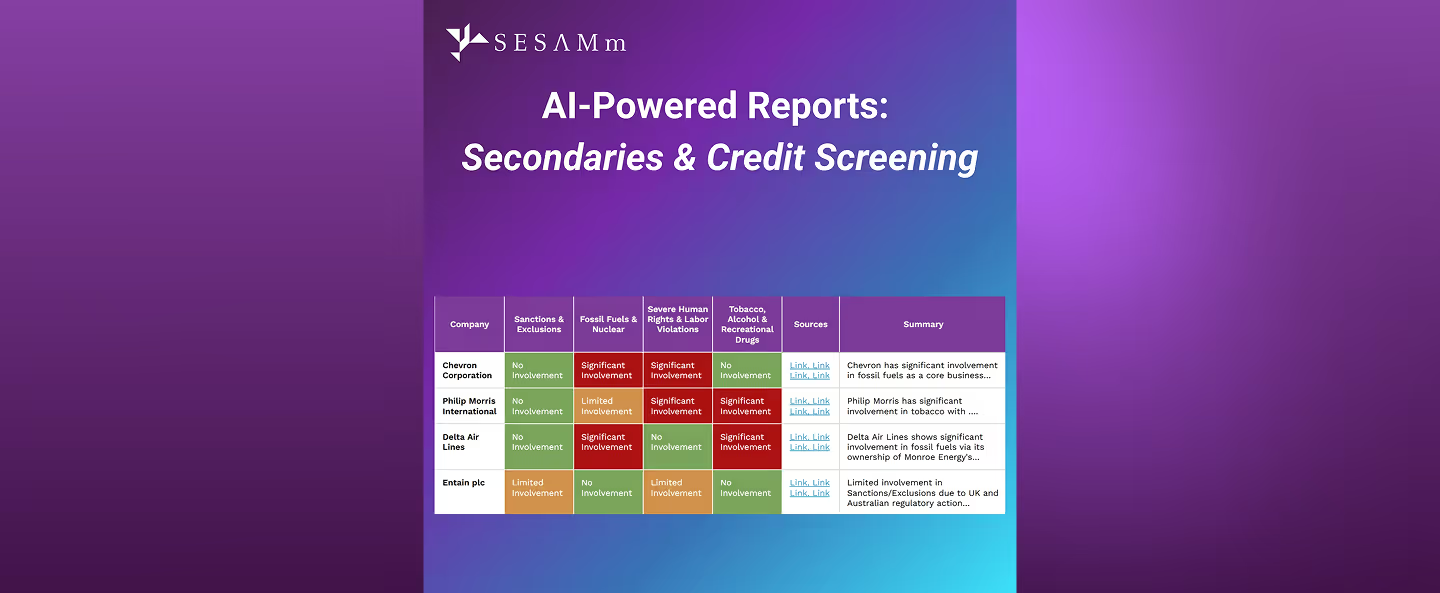
Speed and accuracy are critical in due diligence, especially when screening for reputational or compliance risks across large portfolios. That’s why we built SESAMm’s Secondaries & Credit Screening report: a faster, smarter way to assess exposure to restricted and controversial business activities.
How it works
Designed for investors, compliance teams, and financial institutions, this report uses SESAMm’s generative AI and large language models (LLMs) to analyze millions of documents and flag companies involved in sensitive sectors.
With just a list of company names, it highlights potential involvement in:
Fossil Fuels & Nuclear
Weapons & Military Equipment
Predatory Lending
Gambling & Betting
Adult & Violent Content
Severe Human Rights & Labor Violations
Tobacco, Alcohol & Recreational Drugs
Each result includes linked sources and a clear explanation, providing not just a flag but the context behind it.
Fast, Transparent, Scalable
Whether you're conducting secondary deal due diligence, reviewing a loanbook, or aligning portfolios with exclusion lists, this new report offers:
Scalable, fast batch screening: Upload a list of companies and get standardized, structured results in minutes.
Transparency: Each flag is backed by a justification and includes access to cited sources.
Faster decisions: Get standardized Excel outputs in minutes.
Deeper insight: Uncover risks that go beyond traditional industry classifications.
A New Standard for Risk Screening
Already in use by leading financial firms, the Secondaries & Credit Screening report brings clarity to complex decisions, helping teams flag risks earlier, faster, and more confidently.
Ready to Get Started?
Reach out to see a sample report or request a custom screening of your own list. With SESAMm’s Secondaries & Credit Screening, your next due diligence process just got faster and smarter.
By Magnus Billing, SESAMm advisor, with insights from Sylvain Forté, CEO of SESAMm
Investors have faced so-called “black swan” events throughout history: unexpected crises with severe consequences, often rationalized only in hindsight. Yet in an era defined by generative AI and vast, real-time data lakes, the question arises: could such events be understood and acted upon before they unfold?
The 2023 U.S. regional banking crisis offers a striking case study. The rapid collapses of Silicon Valley Bank and Signature Bank revealed how quickly stress can spread and how difficult it remains to connect early warning signs across sources.
While traditional financial analysis focuses on fundamentals such as capital ratios, liquidity positions, governance, and earnings, a new class of tools is expanding the lens. AI-driven controversy data aggregates and analyzes millions of public sources, from regulatory statements to media and industry discussions, to detect emerging issues as they surface. It does not replace quantitative and fundamental analysis; it complements it by tracking the visibility of risk as it enters public conversation.
This combination of approaches may offer investors a fuller picture: the structural risks visible in balance sheets, and the narrative risks revealed through public dialogue. To test this idea, we revisited the 2023 crisis through both perspectives, starting with what traditional analysis could have shown and what it missed.
Traditional Analysis and Its Blind Spots
In hindsight, the vulnerabilities of regional banks such as Silicon Valley Bank and Signature Bank were visible before the start of 2023. Unrealized losses on long-term securities, heavy reliance on uninsured deposits, and exposure to interest-rate risk pointed to potential liquidity stress. Yet these indicators were neither fully recognized nor connected in the market.
Traditional analysis has a tendency to evaluate banks based on their specific niches: Silicon Valley Bank focused on technology and venture financing, while Signature Bank served commercial real estate and digital asset clients. However, this approach risks overlooking the common and shared structural factors: concentrated depositor bases, high sensitivity to interest rate changes, rapid growth, and weaknesses in governance. Few, if any, observers recognized how rapidly these vulnerabilities could interact and escalate in a modern, digitalized banking environment.
While financial reports contained the data, there was little discussion connecting these risks in the public domain. But what about controversy data? Would it have caught the impending crisis? To find out, I asked Sylvain Forté, CEO of SESAMm, to provide an AI perspective.
What the Data Showed: Signature Bank
Signature Bank displayed a gradual pattern of emerging risk visible through public discussion. From mid-2022 onward, controversy data showed a rise in coverage related to governance practices, management oversight, and deposit concentration risks, often in the context of its ties to the digital-asset industry.
Importantly, it was not the crypto exposure itself that led to the bank’s collapse. The bank even announced in December 2022 that it would reduce its crypto-related business. Instead, the FDIC’s Supervision of Signature Bank report concluded that, “the root cause of SBNY’s failure was poor management. SBNY’s board of directors and management pursued rapid, unrestrained growth without developing and maintaining adequate risk management practices and controls.”
From a controversy perspective, those signals were publicly visible but fragmented. As shown in the chart above, AI-powered monitoring could have aggregated them into a clear view of a sustained drift in governance-related discussions, offering an early indication that oversight and internal controls were under pressure and risk was increasing.
What the Data Missed: Silicon Valley Bank
In contrast, Silicon Valley Bank presented a markedly different pattern. While controversy data registered some activity in late 2022, including investor reactions to financial forecasts and coverage of routine business operations, these signals were fundamentally different in character from Signature Bank's governance-related warnings.
The September 2022 increase reflected market disappointment with financial guidance rather than operational or governance concerns. The subsequent activity captured normal business news, such as arranging syndicated loans. Critically, there was minimal public discussion of the bank's balance-sheet structure, unrealized losses, or depositor concentration risk until the crisis was already unfolding in March 2023.
This example underscores a key distinction: AI controversy monitoring excels at capturing reputational, governance, and operational risks as they enter public dialogue, but may not surface structural financial risks that remain confined to regulatory filings and analyst reports.
Lessons from Both Cases
The contrast between these two banks illustrates the complementary roles of quantitative and fundamental financial analysis vs AI-driven controversy monitoring.
In Signature Bank’s case, controversy data captured a steady accumulation of governance-related warnings, a slow build-up of risk visible through public discussion.
In Silicon Valley Bank’s case, the risks were structural but not yet discussed, leaving little for AI-powered controversy data to detect.
As Sylvain explains, “AI controversy monitoring helps investors understand how and when risks start to emerge in public dialogue. It does not replace fundamental analysis. It complements it by showing when the conversation begins to shift.”
Conclusion
Black swan events are often rationalized only in hindsight, but the 2023 regional banking crisis suggests a more nuanced reality. Some signals existed. What remained difficult was connecting them across sources before stress became contagion.
AI-driven controversy monitoring proved effective at surfacing governance and operational risks as they entered public dialogue, as Signature Bank demonstrated. Yet structural financial vulnerabilities like those at Silicon Valley Bank may not generate discussion until crisis forces the conversation, underscoring that no single lens captures all risk.
The advantage lies not in prediction, but in preparation: combining the structural risks visible in balance sheets with the narrative risks revealed through public discourse. In an era of real-time data and generative AI, the question is no longer whether information exists, but whether investors can connect it before it becomes consensus.
Reach out to SESAMm
TextReveal’s web data analysis of over five million public and private companies is essential for keeping tabs on ESG investment risks. To learn more about how you can analyze web data or to request a demo, reach out to one of our representatives.
ESG frameworks are multiplying faster than organizations can comply with them. Supply chain visibility remains the weakest link, supplier self-disclosures are incomplete, ESG data is inconsistent, and regulatory requirements conflict across jurisdictions. Yet controversy events move fast. A reputational crisis, a forced labor allegation, or an environmental violation at a tier-two supplier can cascade through your entire supply chain in hours. Organizations that win today are those using AI to detect hidden ESG risk before the news breaks, turning fragmented data into actionable intelligence that protects brand, license to operate, and investor confidence.
Key Takeaways
Timely Response to ESG Controversy EventsCritical for maintaining corporate responsibility programs amid regulatory fluctuations.
AI-Powered Risk DetectionProactively detect and mitigate hidden ESG risk across supply chains.
Real-World Case StudiesUncover ESG risk that supplier questionnaires and internal data cannot expose.
In an era where global supply chains span continents and consumer goods can travel through dozens of hands before reaching store shelves, the challenge of ensuring ethical production has never been more complex. Against this backdrop, the recent warning from Parliament's Joint Committee on Human Rights should serve as a wake-up call for policymakers, businesses, and consumers alike.
The committee's stark assessment that the UK risks becoming a "dumping ground" for goods made using forced labor comes at a critical juncture. As other major economies implement increasingly stringent measures to block exploitative products from their markets, Britain's relatively lax approach threatens to make it an attractive destination for goods that can no longer find entry elsewhere.
The Hidden Reality of Modern Supply Chains
The scale of forced labor in global supply chains is both vast and largely invisible to end consumers. When we purchase everyday items, from clothing and electronics to food products, few consider the working conditions of those who produce them. Yet the uncomfortable truth is that forced labor affects virtually every industry and touches supply chains that ultimately reach consumers.
The British Joint Committee on Human Rights has identified a critical vulnerability: while other nations strengthen their regulatory frameworks to combat forced labor imports, the UK appears to be falling behind.¹ This regulatory gap creates a concerning dynamic where goods rejected by more stringent markets could increasingly find their way to British shores.
International Developments and Competitive Disadvantage
The committee's findings become particularly significant when viewed against recent international developments. Major economies have been implementing increasingly robust measures to prevent forced labor goods from entering their markets, creating higher barriers for ethically questionable products. This trend places the UK in a precarious position, potentially becoming the path of least resistance for exploitative goods seeking entry into Western markets.
The economic implications extend beyond moral considerations. British businesses operating in global markets face growing pressure to demonstrate ethical supply chain practices. Companies that cannot adequately address forced labor risks may find themselves at a competitive disadvantage as international standards continue to evolve.
The Committee's Clear Recommendations
The parliamentary committee's primary recommendation, implementing import bans on goods linked to forced labor, represents a significant departure from the UK's current approach. The existing framework, which relies heavily on voluntary corporate reporting and due diligence measures, has proven insufficient to address the scale and complexity of modern forced labor.
This recommendation aligns with best practices emerging globally. Governments are taking more direct action to prevent exploitative goods from entering their markets. The question is no longer whether such measures are necessary but how quickly they can be implemented effectively.
Practical Challenges and Solutions
Implementing comprehensive anti-forced labor measures presents genuine challenges, particularly for small and medium-sized enterprises that may lack the resources for extensive supply chain monitoring. However, these challenges should not deter action; they should inform the design of practical support systems.
Businesses need access to reliable tools and guidance for identifying forced labor risks in their supply chains. Government agencies, industry associations, and civil society organizations must collaborate to develop accessible resources that enable companies of all sizes to participate meaningfully in ethical sourcing practices.
The Path Forward
The parliamentary committee's warning represents more than a policy recommendation; it calls for Britain to reclaim its position as a leader in human rights protection. The government faces a clear choice: implement robust measures to prevent forced labor goods from entering UK markets, or risk Britain becoming known as a soft touch on fundamental human rights issues.
The urgency of this situation cannot be overstated. Each day of delay potentially allows more exploitative goods to enter British supply chains and undermines our credibility in international human rights discussions. The time for voluntary approaches and gentle encouragement has passed; decisive action is now required.
SESAMm’s AI Technology Reveals ESG Insights
Discover unparalleled insights into ESG controversies, risks, and opportunities across industries. Learn more about how SESAMm can help you analyze millions of private and public companies using AI-powered text analysis tools.

Stay ahead with the latest in ESG and AI intelligence
Join our mailing list to receive new reports, event invites, and updates from SESAMm directly to your inbox.