SESAMm is pleased to announce that Nathalie Wallace is joining our Advisory Board. Nathalie brings more than 20 years of experience at the intersection of investment management, sustainability strategy, and executive leadership. She has built a career helping global investment organizations integrate sustainability into investment decision-making and capital allocation.
Commenting on the appointment, Sylvain Forté, CEO of SESAMm, said, “Nathalie brings a rare combination of investment experience, strategic vision, and deep understanding of how sustainability considerations translate into real-world investment decisions. Her perspective will be invaluable as SESAMm continues to support financial institutions navigating increasingly complex risk and regulatory environments.”
She previously served as Chief Sustainability Officer at Edmond de Rothschild, where she contributed to the firm’s sustainability strategy across asset classes. Prior to that, Nathalie was Global Head of Sustainable Investment at Natixis Investment Managers, where she was a member of the executive, investment, and seed committees, chaired the CSR–Sustainable Investment committee, and served on the boards of Mirova and Ostrum Asset Management. Earlier in her career, she was Global Head of Strategy and Business Development at Mirova, supporting its growth and positioning as a leading sustainable investment platform.
As Senior Advisor to SESAMm, Nathalie will support the company’s strategic direction, bringing her perspective on sustainable finance, investor expectations, and the evolving role of data and AI in risk analysis and investment processes.
“SESAMm’s approach to risk and sustainability intelligence reflects how investment teams are evolving their processes,” said Nathalie Wallace. “I’m excited to contribute my perspective as the firm continues to support investors with timely, decision-relevant insights.”
We are delighted to welcome Nathalie to SESAMm and look forward to working together as we continue to support financial institutions with forward-looking risk and sustainability insights.
SESAMm’s AI Technology Reveals ESG Insights
Discover unparalleled insights into ESG controversies, risks, and opportunities across industries. Learn more about how SESAMm can help you analyze millions of private and public companies using AI-powered text analysis tools.
November 11, 2022, FTX, a $32 billion cryptocurrency exchange company that many believed would “change the world,” filed for bankruptcy. This news shook the crypto and financial communities, compelling many to debate the future of the crypto market and its platforms.
How did FTX collapse?
You could say that FTX’s collapse began before the news broke, but here’s a summary of events as The New York Times and ABC News details:
Breaking news
In early November, CoinDesk, a crypto publication, broke the news on a leaked document from FTX. The balance sheet showed that the hedge fund run by Sam Bankman-Fried (SBF), Alameda Research, held a substantial amount of FTT tokens. In short, SBF had set up Alameda (his trading firm) and FTX (his exchange firm) in such a way that if one unit experienced trouble, such as dropping cryptocurrency prices, the other experienced it, too.
First domino falls
By the way, FTT is used for various functions, including traders’ payment of operation fees. Also, by the way, Changpeng Zhao, Binance’s Chief Executive, sold his stake in FTX to SBF in 2021, partially with FTT. So, “due to recent revelations,” Binance (Zhao) announced on November 6, 2022, that it would sell its FTT tokens.
Other dominos follow
Traders responded; they hurried to pull funds out of FTX out of fear, and FTT’s price fell. Meanwhile, FTX processed withdrawal requests over three days, amounting to an estimated $6 billion. The liquidity crunch was upon it.
Then, on November 8, Binance said it would bail out FTX. But on November 9, Binance backtracked and announced in a Tweet that it would not “as a result of corporate due diligence,” while also citing regulatory investigations and reports of mishandled funds.
Things get worse
The next day, November 10, the Securities Commission of the Bahamas froze FTX’s assets, citing the public statement about potentially “mishandled” and “mismanaged” customer funds. On November 11, FTX filed for Chapter 11 bankruptcy protections, and SBF resigned as CEO. John J. Ray III—famously known as the CEO who headed the infamously known energy company, Enron, through its collapse in the 2000s—replaced SBF on November 17.
Fallout
Today, FTX faces federal investigation for securities laws violations based on a report by The Wall Street Journal regarding FTX lending customer deposits to Alameda Research for liabilities, of which the company’s top executives were aware. Investors have suffered loss, traders have suffered loss, and the greater crypto community and regulators are asking questions.
FTX and SBF web data analysis
News about FTX’s collapse generated tons of web data for us to scour. With this data, here’s what we aimed to find out:
How did the public web react to FTX’s collapse?
Could we have seen red flags before the news broke?
What was FTX’s collapse’s effect on the cryptocurrency market’s sentiment?
Is it possible to evaluate cryptocurrency exchange companies’ ESG risks and opportunities?
Was FTX’s collapse unprecedented? If not, what does web data tell us about that?
FTX and Sam Bankman-Fried mentions analysis
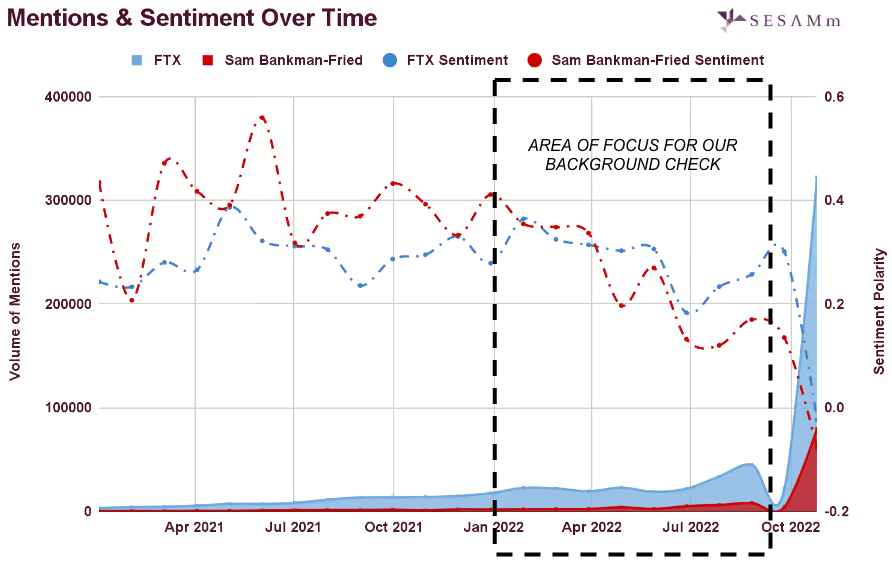
Web public sentiment for FTX and SBF was consistently positive until Q1 of 2022. As mentions volume increased, their sentiment polarity decreased (Figure 1). The mentions spike for both in November when CoinDesk broke the news. Likewise, polarity dips into the negative range for both.
Definition: Polarity represents the aggregate of positive and negative sentiments (opinions or reviews) on a company. A 0 score means there is as much positive as negative sentiment expressed. The dotted and dashed lines represent sentiment in the following charts.
Figure 1: FTX and SBF mentions and sentiment over time.
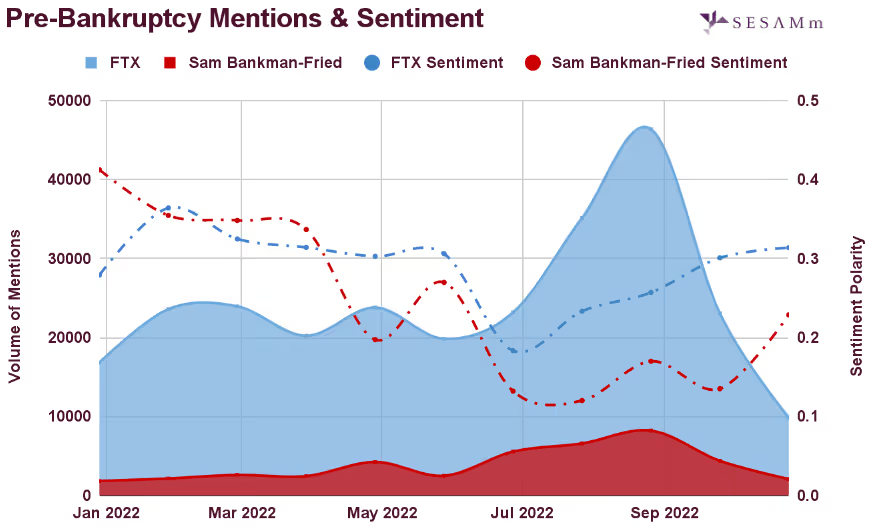
Looking closer at Q1 (Figure 2), we find that mentions affecting sentiment increased for FTX and SBF during this period. What are the mentions about, and why did they affect polarity negatively?
Figure 2: FTX and SBF pre-bankruptcy mentions and sentiment.
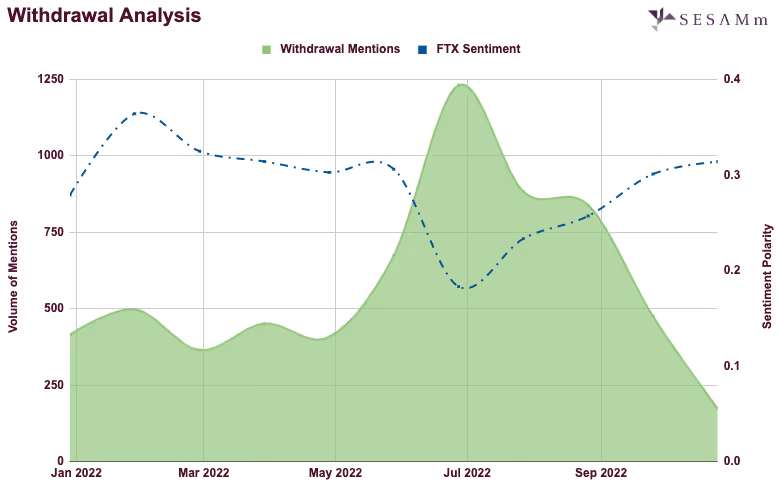
It turns out that SBF is linked to other keywords—we call these co-mentions—and between January 2022 and November 2022, SBF/withdrawal co-mentions (Figure 3) spiked in July when SBF defended Terra Luna’s founder, who was accused of peddling a Ponzi scheme.
Figure 3: FTX and SBF withdrawal co-mentions.
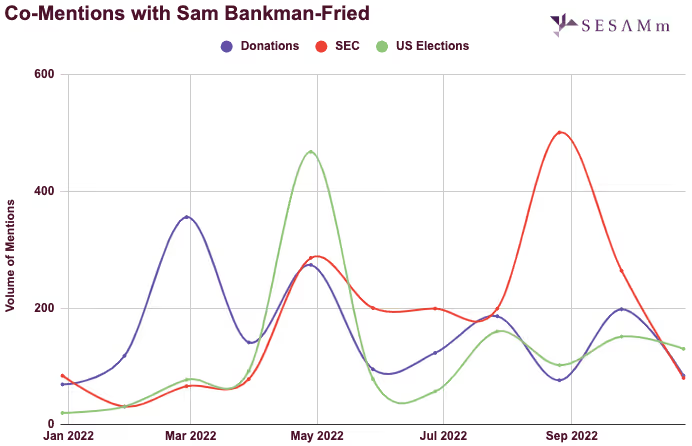
If withdrawal co-mentions brought up possible reasons why SBF and FTX experienced dips in sentiment, what other co-mentions could give us more insight? How about donations, SEC, and U.S. elections?
Figure 4: Donations, SEC, and U.S. elections co-mentions with SBF.
Corporate governance stands out when evaluating SBF’s ESG risks, but his social risks are nothing to ignore either.
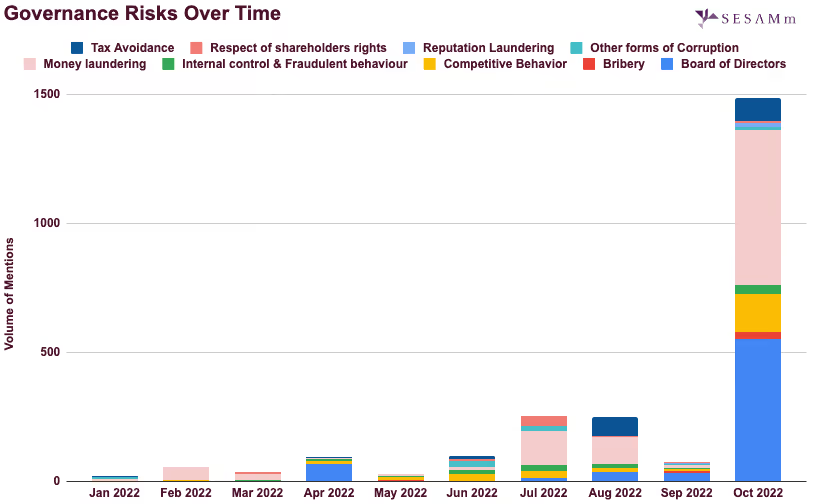
Figure 5: SBF governance risks over time.
Two areas of governance risks to note are money laundering and board of directors (Figure 5). Money laundering as a co-mention has been an issue as early as February 2022, but it became a bigger issue in October. These risks may be popping up due to allegations of manipulating the price of the APT token and a securities violations probe.
If you’ve read this far, you by now get an impression of FTX and SBF, from mention volume to sentiment analysis and ESG risk. But how did FTX’s collapse affect the overall cryptocurrency market? Let’s find out.
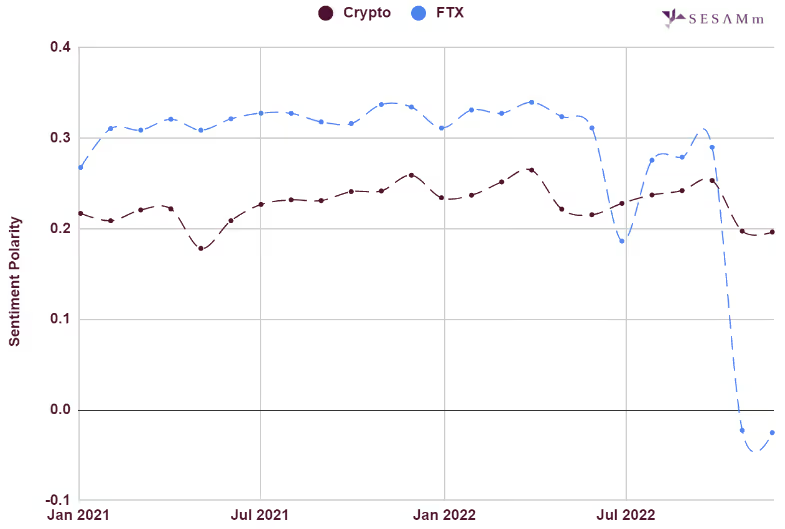
In comparing the sentiment polarities for FTX and the crypto market from January 2021 through November 2022 (Figure 6), the sentiment for crypto remains relatively steady despite FTX’s sentiment taking a hit.
Figure 6: Effect of FTX collapse on the crypto market.
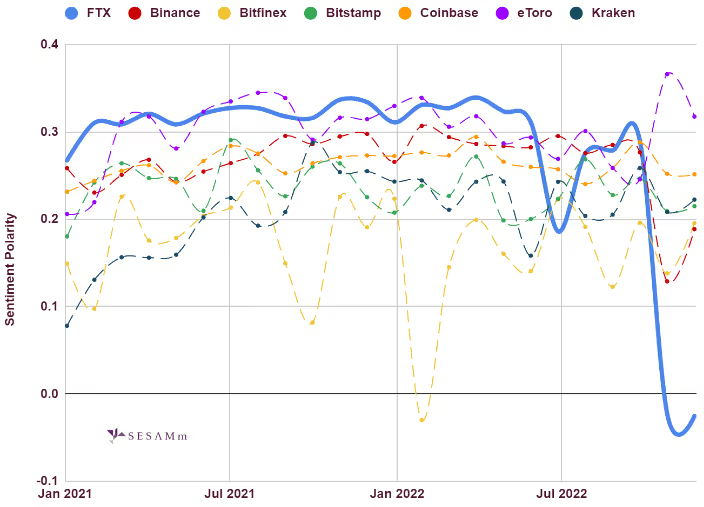
When comparing other cryptocurrency exchanges to FTX (Figure 7), sentiment polarity for them is hardly affected, except Binance, because of its connection with FTX. Oddly enough, eToro experienced a boost in sentiment, possibly because of its core values around openness and transparency, the fact that they’ve been around since 2007, its early compliance with regulations (i.e., AMF, FCA, ASIC, BaFin, and ACPR), and that it also proposes investing in stocks and ETFs, a contrast to most other crypto market exchanges. Bitfinex has its own issues, so its dip in sentiment might not be correlated.
Figure 7: FTX sentiment comparison across competitors.
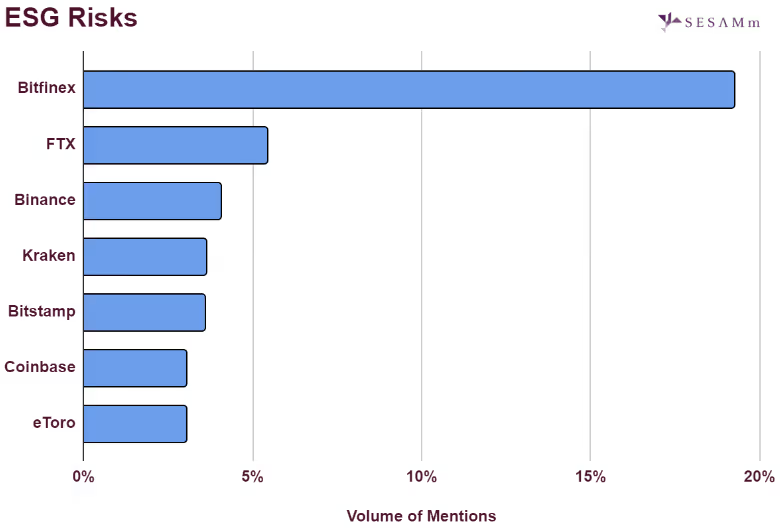
At this time, FTX’s ESG risks based on the mention volume are only surpassed by Bitfinex (Figure 8), which its risks are based on many other reasons we won’t get into in this article.
Figure 8: FTX and competitors ESG risks by mention volume.
Centralized vs. decentralized crypto exchange platforms
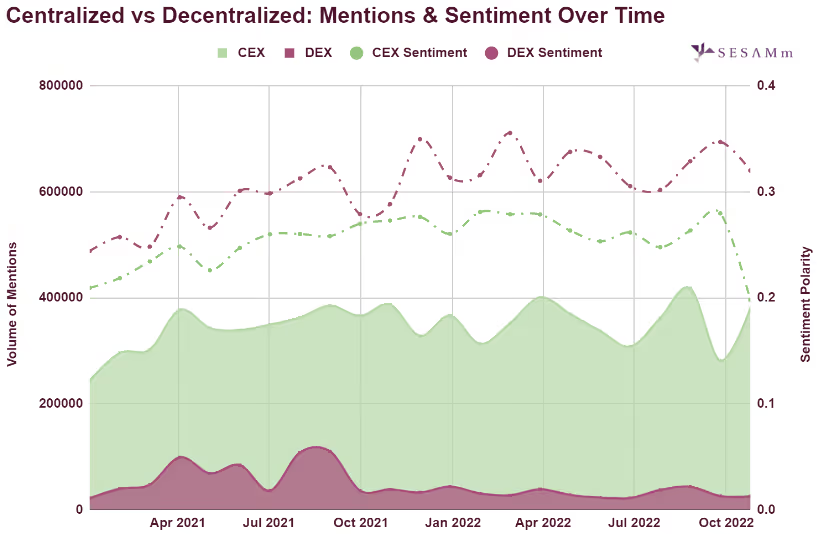
FTX’s collapse also affected sentiment around the centralized vs. decentralized debate. Since October 2022, sentiment for centralized exchange platforms, such as FTX and its competitors, has fallen (Figure 9).
Figure 9: Centralized vs. decentralized mentions and sentiment over time.
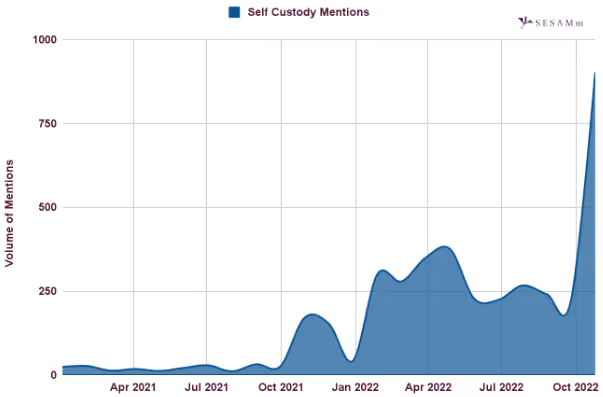
Likewise, the mention volume for self-custody has more than doubled in the last couple of months (Figure 10). Although centralized platforms offer quicker and easier access to crypto trading, traders are considering complex but more secure options such as crypto wallets and keys because, like banks, centralized exchanges can do what they will with cryptocurrency while it’s in their possession. With self-custody, owners are in control.
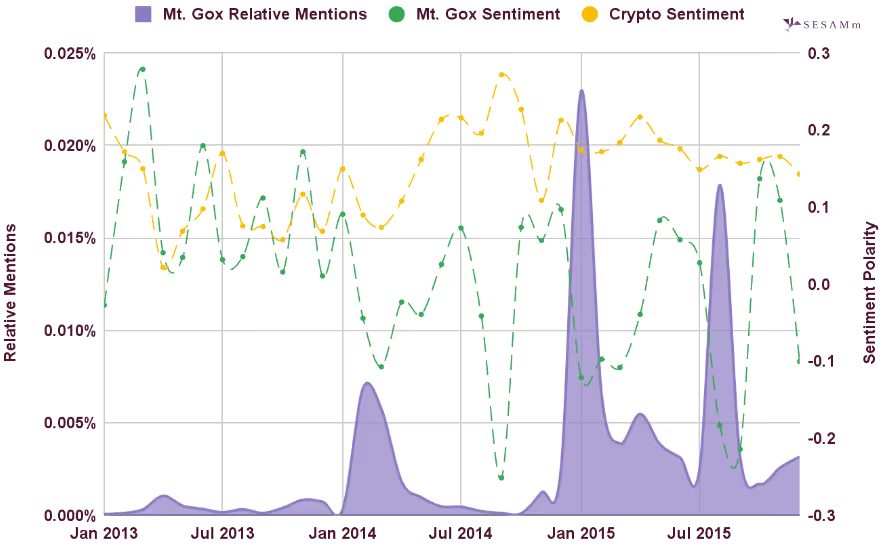
Believe it or not, FTX was not the first crypto exchange to collapse. In 2014, Mt. Gox—the biggest crypto exchange at the time—lost half a billion dollars worth of Bitcoin due to a hack. How did Mt. Gox’s collapse affect sentiment for the crypto market then? The short answer is: It didn’t.
Figure 11 shows that while Mt. Gox’s sentiment polarity fluctuated, even reaching negative territories, the sentiment for the crypto market remained relatively stable and positive.
Figure 11: Mt. Gox and crypto sentiment comparison.
Is FTX’s collapse a warning for investors?
Our analysis is that investors should treat cryptocurrency exchanges like any investment opportunity. Do your due diligence and monitor your portfolio with tools like SESAMm’s TextReveal®.
As for the cryptocurrency market, data shows that sentiment for it remains level and positive. We speculate that cryptocurrency and centralized exchanges are here to stay. However, based on historical data and current news, we suspect conversations about crypto regulations to increase.
Reach out to SESAMm
For a deeper analysis of FTX’s collapse and access to all charts and supportive-article links, reach out to a representative today.
SESAMm Incorporates Generative AI to Enhance ESG Risk Mitigation and Process Efficiency in the Finance Sector
FOR IMMEDIATE RELEASE
PARIS, France - July 12, 2023 - SESAMm, a leading player in financial technology, announces a transformative initiative to incorporate Generative AI solutions into its operations and product offerings. This strategic move is geared towards assisting financial firms in enhancing risk mitigation focused on ESG controversies and streamlining their processes.
The implementation of Generative AI follows a three-pronged strategic approach. This comprises the integration of large language models into their tech stack, the development of a client-facing conversational agent, and fostering a culture of AI utilization across all teams.
"With Generative AI, we are not only enhancing our internal processes but also focusing on the development of new features that redefine industry standards," stated Sylvain Forté, CEO & Co-founder of SESAMm. "These include intuitive dashboards, automated ESG/SDG event analysis tools, and a client interaction chatbot - all created to streamline data interaction and boost efficiency in risk management."
The integration of Generative AI has significantly enhanced SESAMm's product functionality already. This includes quicker and more intuitive interaction with data and introducing new features, such as ESG/SDG event summarization and automatic competitor searches for public and private companies.
SESAMm is also employing Generative AI for advanced risk mitigation. "Our innovative approach provides our clients a virtual team of ESG analysts and experts for detecting risk and ESG controversies, enhancing their risk mitigation strategies in a robust and comprehensive manner," Forté added.
SESAMm is preparing to launch a suite of AI-powered features later this year. "These new features, powered by Generative AI, reinforce our commitment to developing solutions that enhance risk mitigation and streamline processes for financial firms," Forté emphasized.
To explore more about SESAMm's Generative AI solutions and how they can boost your firm's operations, watch the video below:
Also, make sure you join our upcoming webinar, where Sylvain Forté will discuss live the future of fintech with Generative AI and how SESAMm is incorporating Generative AI into its processes and products. To register for the webinar, click here.
About SESAMm
SESAMm is a leading artificial intelligence and NLP (natural language processing) technology company serving global investment firms, corporations, and investors, such as asset managers, banks, private equity firms, hedge funds, and index providers. With over 100 employees and six offices worldwide, SESAMm celebrated its 9th anniversary in 2023.
In this issue of the "what investors ought to know about…" series, we'll cover natural language processing (NLP), a tool that draws from the computer science and computational linguistics disciplines. In the last topic, we discussed knowledge graphs as the core of text analysis. And if knowledge graphs are the core of the data’s context, NLP is the transition to understanding the data.
What is natural language processing?
Natural language processing is an artificial intelligence (AI) technology that automates the data analysis of mined textual, unstructured data to include natural language understanding and natural language generation to simulate a human's ability to create language. It combines computational linguistics with machine learning and deep learning models, performing a special linguistic analysis by algorithms so a machine can "read" text.
Where is natural language processing used?
Today, various industries use NLP, from email filters to virtual assistants and search engines to chatbots. Here's a list of common ways natural language processing is used:
Chatbots: Chatbots are computer programs that use NLP. They simulate human conversation by identifying a sentence's intent, determining suitable topics, keywords, and emotions, and calculating the best response based on the data's interpretation.
Email filters: Email filters apply machine learning using many data samples to sort emails into the right inbox.
Machine translation: Translation software like Google Translate or Microsoft Translator use NLP to translate text from one language to another, such as English to French.
Natural language generation (NLG): NLG, a subfield of NLP, builds applications or computer systems that can automatically produce natural language texts of various types by using a semantic representation as input. Applications of NLG include question answering and text summarization.
Predicting and autocorrecting text: Predictive text and autocorrect use NLP to recognize and recall commonly used words and names to make text suggestions and correct common errors.
Search engines: Search engines like Google search use NLP machine learning to interpret a searcher's intent and provide relevant results. It can even suggest subjects and topics related to the query the searcher might be interested in.
Virtual and voice assistants: Virtual assistants like Apple's Siri or Amazon's Alexa use NLP technology to understand and respond to voice requests. Speech-to-text can dictate messages and notes, and speech recognition can control everything from smartphone apps and smart speakers to thermostats and home security systems.
Web sentiment analysis: Sentiment analysis automates classifying opinions in a text as positive, negative, or neutral. It's a method companies like SESAMm use to monitor sentiments like a brand's sentiment on the web and social media.
Why natural language processing is important to uncover financial-related alternative data
NLP is important because it helps resolve human language ambiguity in big datasets (big data). Languages are complex, diverse, and expressed in unlimited ways, from speaking hundreds of languages and dialects to having a unique set of grammar and syntax rules, slang, and terms for each. In text form, these variables are unstructured text. But with NLP, we can transform unstructured data into structured data and make sense of it.
Because of NLP's power, investors can research and analyze unstructured data from the web to gain insights into financial and ESG data. You can use this wealth of information to focus on systematic data processing, risk management, and alpha discovery through contexts, such as:
Major global indices sentiment
Euronext exchange sentiment
Private company sentiment
ESG risks for public and private companies worldwide
A quick overview of how natural language processing works at SESAMm
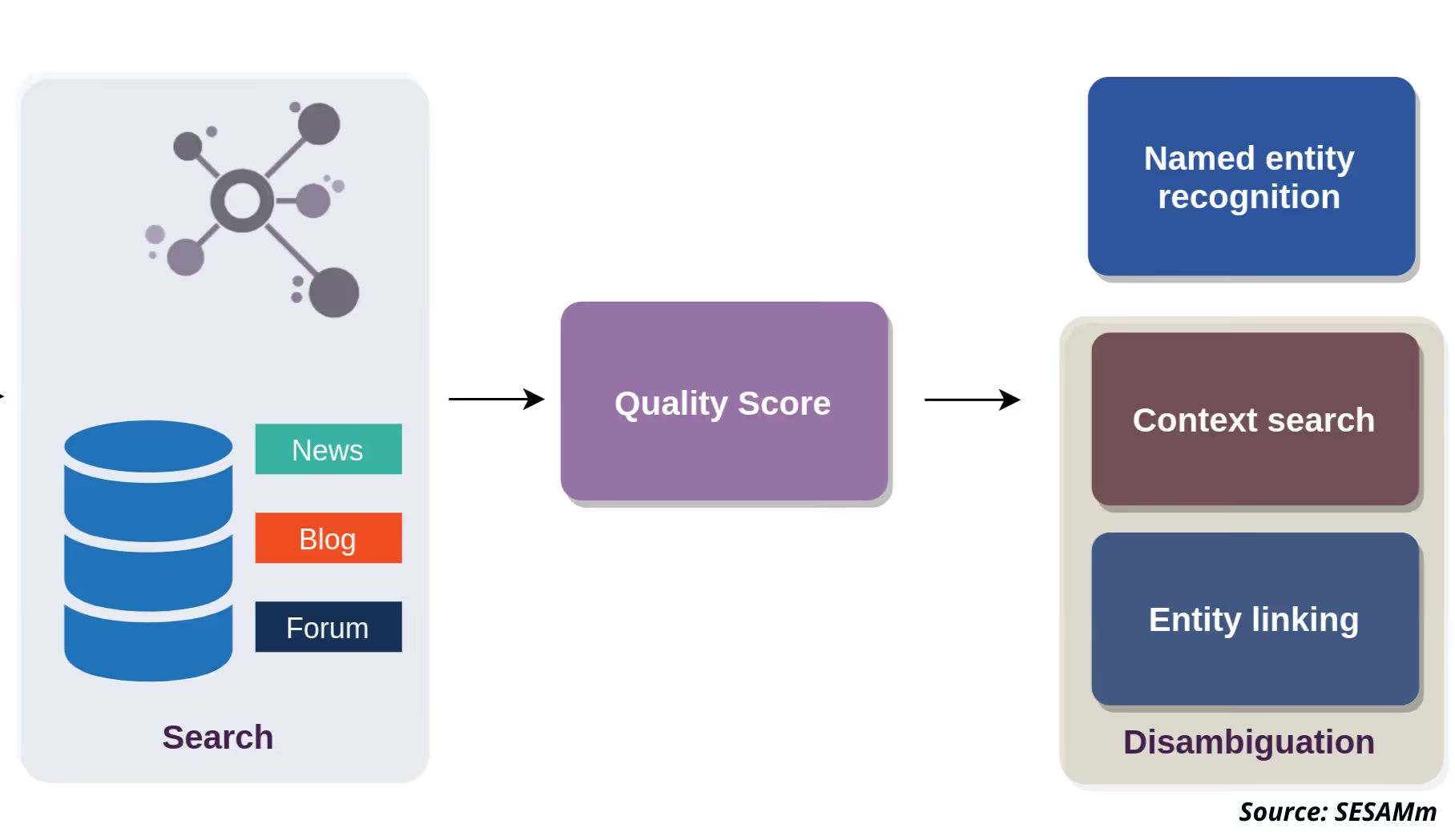
At SESAMm, we use named entity recognition (NER), which extracts the names of people, places, and other entities from text, and then named entity disambiguation (NED) to identify named entities based on their context and usage. For example, text referencing "Elon" could refer indirectly to Tesla through its CEO or a university in North Carolina. NED considers the context when classifying entities for an accurate match. Compared to simple pattern matching, which limits the number of possible matches, requires frequent manual adjustments, and can't distinguish homophones, NED is superior.
Process representation for NER and NED.
When identifying entities and creating actionable insights, SESAMm uses three other NLP tools: lemmatization and stemming, embeddings, and similarity. The lemmatization process normalizes a word into its base form (morphology) to help identify and aggregate entities. Embedding assigns the entity a numerical value to help analyze how words change meaning depending on context and understand the subtle differences between words that refer to the same concept—similarity measures whether two words, sentences, or objects are close to one another in meaning.
Representation of nodes in a knowledge graph.
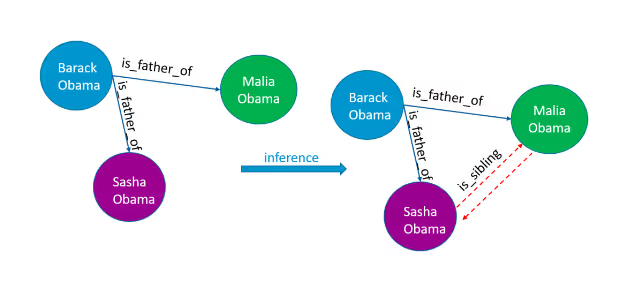
Of course, NLP couldn't function without the core of the text analytics process: knowledge graphs. A knowledge graph is a digital representation of a network of real-world entities, the foundation of a search engine or question-answering service. This structured data model puts the schema in context through semantic metadata and linking, providing a framework for analytics, data integration, sharing, and unification. In other words, it's like a map and legend, with the legend labeling the concepts, entities, and events and the map connecting and identifying their relationships. These details are stored in a graph database and visualized as a graph representation, hence the term knowledge graph.
SESAMm's natural language processing platform for investment research and analysis
SESAMm is the leading provider of natural language processing and machine learning solutions and analytics for investment firms and corporations.









.png)