

What Investors Ought to Know About Natural Language Processing: A Quick Guide
July 13, 2022
•
5 mins read
In this issue of the "what investors ought to know about…" series, we'll cover natural language processing (NLP), a tool that draws from the computer science and computational linguistics disciplines. In the last topic, we discussed knowledge graphs as the core of text analysis. And if knowledge graphs are the core of the data’s context, NLP is the transition to understanding the data.
What is natural language processing?
Natural language processing is an artificial intelligence (AI) technology that automates the data analysis of mined textual, unstructured data to include natural language understanding and natural language generation to simulate a human's ability to create language. It combines computational linguistics with machine learning and deep learning models, performing a special linguistic analysis by algorithms so a machine can "read" text.
Where is natural language processing used?
Today, various industries use NLP, from email filters to virtual assistants and search engines to chatbots. Here's a list of common ways natural language processing is used:
Chatbots: Chatbots are computer programs that use NLP. They simulate human conversation by identifying a sentence's intent, determining suitable topics, keywords, and emotions, and calculating the best response based on the data's interpretation.
Email filters: Email filters apply machine learning using many data samples to sort emails into the right inbox.
Machine translation: Translation software like Google Translate or Microsoft Translator use NLP to translate text from one language to another, such as English to French.
Natural language generation (NLG): NLG, a subfield of NLP, builds applications or computer systems that can automatically produce natural language texts of various types by using a semantic representation as input. Applications of NLG include question answering and text summarization.
Predicting and autocorrecting text: Predictive text and autocorrect use NLP to recognize and recall commonly used words and names to make text suggestions and correct common errors.
Search engines: Search engines like Google search use NLP machine learning to interpret a searcher's intent and provide relevant results. It can even suggest subjects and topics related to the query the searcher might be interested in.
Virtual and voice assistants: Virtual assistants like Apple's Siri or Amazon's Alexa use NLP technology to understand and respond to voice requests. Speech-to-text can dictate messages and notes, and speech recognition can control everything from smartphone apps and smart speakers to thermostats and home security systems.
Web sentiment analysis: Sentiment analysis automates classifying opinions in a text as positive, negative, or neutral. It's a method companies like SESAMm use to monitor sentiments like a brand's sentiment on the web and social media.
Why natural language processing is important to uncover financial-related alternative data
NLP is important because it helps resolve human language ambiguity in big datasets (big data). Languages are complex, diverse, and expressed in unlimited ways, from speaking hundreds of languages and dialects to having a unique set of grammar and syntax rules, slang, and terms for each. In text form, these variables are unstructured text. But with NLP, we can transform unstructured data into structured data and make sense of it.
Because of NLP's power, investors can research and analyze unstructured data from the web to gain insights into financial and ESG data. You can use this wealth of information to focus on systematic data processing, risk management, and alpha discovery through contexts, such as:
Major global indices sentiment
Euronext exchange sentiment
Private company sentiment
ESG risks for public and private companies worldwide
A quick overview of how natural language processing works at SESAMm
At SESAMm, we use named entity recognition (NER), which extracts the names of people, places, and other entities from text, and then named entity disambiguation (NED) to identify named entities based on their context and usage. For example, text referencing "Elon" could refer indirectly to Tesla through its CEO or a university in North Carolina. NED considers the context when classifying entities for an accurate match. Compared to simple pattern matching, which limits the number of possible matches, requires frequent manual adjustments, and can't distinguish homophones, NED is superior.
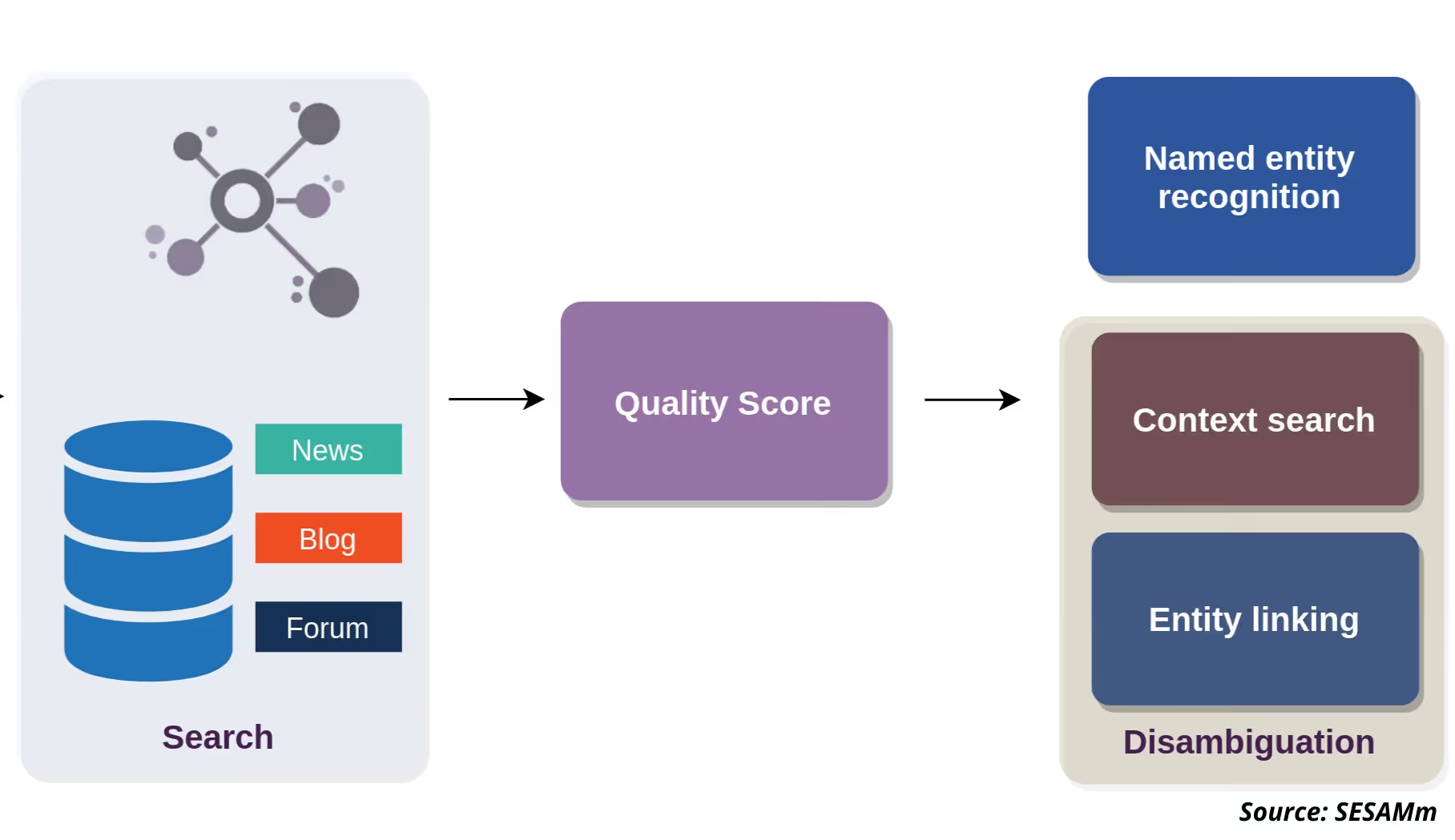
Process representation for NER and NED.
When identifying entities and creating actionable insights, SESAMm uses three other NLP tools: lemmatization and stemming, embeddings, and similarity. The lemmatization process normalizes a word into its base form (morphology) to help identify and aggregate entities. Embedding assigns the entity a numerical value to help analyze how words change meaning depending on context and understand the subtle differences between words that refer to the same concept—similarity measures whether two words, sentences, or objects are close to one another in meaning.
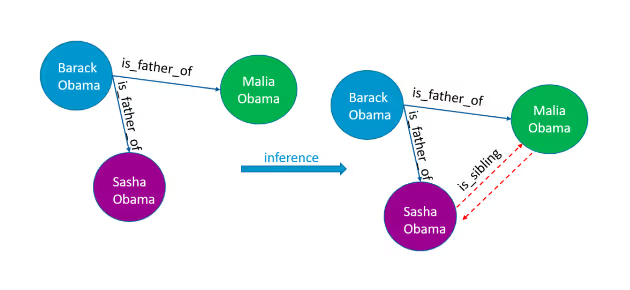
Representation of nodes in a knowledge graph.
Of course, NLP couldn't function without the core of the text analytics process: knowledge graphs. A knowledge graph is a digital representation of a network of real-world entities, the foundation of a search engine or question-answering service. This structured data model puts the schema in context through semantic metadata and linking, providing a framework for analytics, data integration, sharing, and unification. In other words, it's like a map and legend, with the legend labeling the concepts, entities, and events and the map connecting and identifying their relationships. These details are stored in a graph database and visualized as a graph representation, hence the term knowledge graph.
SESAMm's natural language processing platform for investment research and analysis
SESAMm is the leading provider of natural language processing and machine learning solutions and analytics for investment firms and corporations.
The aerospace and defense industry is essential to global technology and transportation, playing a crucial role in maintaining international security and connectivity. However, this sector faces intense scrutiny due to its significant impact on ESG factors. Amidst challenges like safety lapses and whistleblower revelations, stakeholders are increasingly relying on advanced AI technologies to gain insights into potential controversies. Such technologies have enabled a deeper understanding of the complex ESG issues that permeate the industry, revealing not only the specific challenges faced by companies like Boeing but also providing a broader view of the sector's commitment to corporate responsibility and sustainability.
This article explores the aerospace industry and its ESG challenges, backed up by a case study of industry giant Boeing. It also explains how we used SESAMm’s AI-powered tools to detect these controversies beforehand.
Aerospace and Defense Market Mentions
The top market players in the aerospace and defense industry command 8.3% of the overall market's online mentions. This sector is increasingly scrutinized for its ESG practices amidst technological advancements and global policy shifts.
Media Sentiment in the Aerospace Industry
In this study, we ran our AI tools through our data lake to extract the major market players: Northrop Grumman, Lockheed Martin, General Dynamics, Airbus, and Boeing, with the time frame starting from 2015 to date. The data reveals a notable peak in online mentions of the market trend, mainly following Boeing’s plane crash controversies. Post-2018, we noticed a general upward trend for Airbus and Boeing, indicating their increasing dominance or recovery in the market. This trend demonstrates the shifting landscape of the aerospace industry, where competition is intense, and the share of mentions can reflect broader market movements and company-specific developments.
(*): Polarity or sentiment polarity represents a company's aggregate of positive and negative sentiment (opinions, reviews), ranging from -1 to 1. A zero score means that there is as much positive as negative sentiment. High e-reputation brands can have polarity scores of more than 0.5.
The sentiment across the aerospace market reflects the industry’s highs and lows. On one hand, there are moments of significant achievements like new contracts and technological breakthroughs that drive companies like Lockheed Martin to positive media highlights. Between 2016 and 2018, Lockheed Martin experienced a surge in positive mentions due to key contract wins and proactive company initiatives, which have contributed to maintaining its reputation and market value.
Conversely, the industry faces intense scrutiny over various controversies, notably those surrounding Boeing. The company, a dominant figure in the market, has been at the center of numerous negative headlines, giving it the lowest sentiment polarity among its peers. Issues range from serious safety lapses, such as the tragic 737 MAX crashes throughout the years, to ongoing legal challenges and whistleblower claims that overshadow its governance practices. These incidents have not only affected Boeing’s sentiment negatively but have also influenced the overall perception of the aerospace and defense sector, highlighting the industry's susceptibility to reputational risks.
Macro Themes
The aerospace sector, while essential for global connectivity, has not been without its controversies, especially concerning safety and compliance issues. Among the major players, Boeing's significant share of media mentions is primarily driven by a series of high-profile accidents, including the 737 MAX crashes in 2019, killing all passengers and another serious incident in South China in 2022. These accidents triggered a cascade of lawsuits and fines, severely impacting Boeing’s public perception and operational standing. The aftermath of these incidents also precipitated broader discussions around leadership changes, management practices, safety protocols, and accountability measures within the company.
Similarly, Airbus has faced its own challenges, with notable accidents in 2015 in France and 2016 in the Mediterranean Sea, followed by another in 2020, resulting in 97 fatalities. These incidents underline the persistent safety risks inherent in aerospace operations and the critical need for stringent oversight. Accusations of ethical and legal violations also loom large across the industry. Boeing, for example, has been embroiled in numerous investigations and lawsuits related to various accusations. Meanwhile, other industry giants like Northrop Grumman and Lockheed Martin have faced legal actions over environmental and contracting practices, such as Northrop’s involvement in residential chemical contamination and Lockheed’s settlement over accusations of overcharging the Navy. General Dynamics has also encountered legal scrutiny over employment practices and allegations of human rights and privacy violations.
These controversies highlight a complex landscape of operational, legal, and ethical challenges in the aerospace industry. Each incident not only affects the involved company but also catalyzes shifts in regulatory practices and leadership strategies, underscoring the need for robust governance and proactive risk management to uphold safety and integrity in aerospace operations.
ESG Analysis
The influence of ESG factors on public perception and internal company policies within the aerospace industry is profound. Governance issues, in particular, continue to be a critical focus as aerospace companies confront challenges related to compliance, ethical practices, and transparency. Social factors are also prominent, with labor practices and safety standards critically influencing operational and strategic decision-making. Environmental considerations are escalating in importance as the industry progresses towards more sustainable practices, driven by increasing concerns over climate change and environmental sustainability.
Northrop Grumman illustrates an aspect of ESG concerns with specific environmental risks linked to its operations. Accusations have surfaced against Northrop Grumman for its role in environmental degradation, such as pollution from manufacturing plants and involvement in contamination incidents at residential sites. These issues not only affect the company’s environmental track record but also impact its social standing and governance integrity. The company also displays some governance risks related to its total mentions volume driven by accusations of fueling false ‘Revenge Porn’ allegations against CIA whistleblower John Kiriakou as well as legal investigations driven by Northrop Grumman investors over its claims to recover their losses and class action lawsuits over claims of a breach of fiduciary duty.
The aerospace sector’s engagement with these ESG factors indicates a shift towards addressing the critical issues facing the industry. Boeing ranks first in terms of risks, with social risks having the highest share, followed by Airbus, with risks coming from social issues such as customer relations, fundamental human rights, and governance risks mainly related to its fraud, bribery, and corruption charges. This shift is not just about mitigating risks but also about harnessing opportunities to enhance corporate responsibility and ensure long-term sustainability.
Deep Dive into Boeing: ESG Risks and Public Perception
The aerospace industry has faced increasing scrutiny over its ESG practices. Among the key players, the American aerospace company Boeing has been prominently featured in media discussions, not only due to its market distinction but also because of its ESG challenges that have sparked significant controversy.
Boeing Word Cloud
This word cloud visually represents the main online topics surrounding Boeing, particularly focusing on the issues and controversies related to the 737 Max aircraft. Key terms like "737 Max," "Boeing," "safety," "death," and "FAA" are prominently displayed, indicating these as central themes in the discussion. The size of each word in the cloud signifies its frequency and importance in related discussions, with larger words being more prevalent. This visualization encapsulates a range of associated topics such as "lawsuit," "Senate hearing," and "missed inspections," highlighting the broad spectrum of regulatory, safety, and ethical issues that have dominated public and media discourse regarding Boeing.
Boeing ESG Analysis
According to TextReveal’s findings, since 2019, Boeing's ESG risks have intensified, particularly in social and governance, leading to a substantial impact on its public image and stock performance. The company's struggles with governance issues are well-documented, encompassing major safety lapses that resulted in the tragic crashes of the 737 MAX aircraft in the span of six months in Indonesia and Ethiopia. These events have not only led to a loss of life but also raised serious questions about the company's commitment to safety protocols and ethical standards.
Social risks at Boeing are also prominent, with multiple incidents involving customer relations and human capital management. Notably, the company has faced significant scrutiny regarding its response to the 737 MAX crashes, highlighting deficiencies in transparency and accountability in dealing with the fallout. The handling of these incidents resulted in widespread public distrust, significantly damaging Boeing's relationships with airlines, regulatory bodies, and the flying public. Issues such as delays in disclosing software malfunctions and the initial reluctance to ground the fleet have led to accusations of prioritizing profit over passenger safety. Furthermore, Boeing's labor practices have also come under fire. There have been multiple instances of tension with labor unions over contract negotiations, job cuts, and factory conditions, which exacerbate the social risks by affecting employee morale and productivity. These labor disputes and the perceived erosion of safety standards contribute to a challenging environment, complicating Boeing's efforts to rebuild trust and ensure operational stability.
Early Signs: Whistleblowers
We used TextReveal's analytics capabilities to track the prevalence of whistleblower mentions within the aerospace industry, with data pointing back as far as 2019. This tool has effectively highlighted ongoing concerns and patterns related to corporate governance and safety issues.
Boeing has also been facing whistleblower retaliation. High-profile cases involving whistleblowers like John Barnett, who was found dead under mysterious circumstances, and Sam Salehpour, who reported safety shortcuts and received physical threats, illustrate the perilous environment for those who challenge the status quo. These whistleblowers' stories, while distressing, shed light on a culture that may prioritize expediency over thoroughness and safety.
One of the most significant cases involved John Barnett, a former quality manager at Boeing, who raised alarms about critical safety lapses in the production of the 787 Dreamliner. Barnett claimed that faulty parts were knowingly installed on planes, potentially endangering passengers. His revelations were met with hostility and retaliation, resulting in his tragic and suspicious death, which was officially ruled as a suicide. This case has fueled widespread media coverage and public outcry, questioning the integrity of Boeing’s internal safety practices and the treatment of employees who report such critical issues.
Another well-known whistleblower, Ed Pierson, reported concerns about the 737 MAX's manufacturing process, specifically pointing to the rushed production schedules that he believed compromised safety. His testimony before congressional hearings helped to expose a "profit over safety" mentality that appeared to saturate Boeing’s management practices. Pierson’s allegations were particularly damaging as they were directly linked to the two fatal crashes of the 737 MAX, which tragically resulted in 346 deaths.
Sam Salehpour, a Boeing engineer, also came forward with allegations of manufacturing shortcuts that compromised the structural integrity and safety of Boeing aircraft. Like others, Salehpour faced significant backlash from superiors and was reportedly blackballed within the industry for his outspokenness, highlighting the severe personal and professional risks faced by whistleblowers within the air travel giant.
The cumulative effect of these whistleblower cases has led to significant scrutiny from regulatory bodies, the media, and the public. The Federal Aviation Administration (FAA) has stepped up its oversight of Boeing, leading to fines, increased regulations, and a temporary grounding of the 737 MAX fleet. These incidents have sparked broader discussions about the need for systemic reforms within the aerospace industry to ensure that safety and ethical standards are not only upheld but prioritized over financial incentives.
How does SESAMm Detect ESG
Navigating the vast amounts of data available is a significant challenge when conducting this type of analysis. At SESAMm, our experts begin with a comprehensive sentiment analysis of the industry and its key players. By examining trends, particularly spikes in data volume or shifts in sentiment—both positive and negative—they can pinpoint the issues and controversies driving these changes. Following this, our team conducts a thematic deep dive into the topics most relevant to the industry, providing a nuanced understanding of the issues that are particularly sensitive for stakeholders. With these insights in hand, our team then moves to company-specific analyses and benchmarking to assess how individual companies perform relative to their peers.
SESAMm's TextReveal® platform plays a significant role in identifying and understanding the complex web of controversies within industries such as aerospace. Through its algorithms, the platform sifts through vast amounts of data from diverse sources like news outlets, social media, and corporate disclosures to detect subtle cues and patterns that might indicate emerging ESG controversies. This robust data collection and analysis enable SESAMm to pinpoint issues related to whistleblower activities, safety violations, and governance lapses well before they gain widespread attention. By integrating this intelligence, SESAMm facilitates a deeper understanding of the underlying factors contributing to these controversies, aiding stakeholders in navigating the intricate dynamics of corporate accountability and regulatory compliance.
SESAMm's TextReveal® platform provides a comprehensive suite of ESG analytics tools that leverage extensive data collection from news outlets, social media, corporate disclosures, and NGO reports, ensuring thorough coverage of emerging and underreported ESG issues. Utilizing advanced artificial intelligence, the platform analyzes sentiments and contextual nuances within this data to identify positive and negative ESG indicators, helps stakeholders measure public sentiment before issues escalate, and makes accurate business decisions. Additionally, its capability to identify and map relationships between entities such as companies, individuals, and products to various ESG issues is crucial for assessing how internal dynamics influence a company’s overall ESG profile.
TextReveal® also employs predictive analytics to foresee potentil ESG controversies, enabling proactive risk management and strategic planning. Moreover, it offers detailed ESG reporting and scoring, providing quantifiable insights into a company’s ESG performance, which is invaluable for investors and analysts. Lastly, the platform’s analysis of the influence of key individuals on ESG practices offers deeper insights into leadership effectiveness and ethical compliance, making SESAMm's tools essential for integrating ESG considerations into comprehensive corporate strategy and maintaining competitive advantage in a socially conscious market environment.
Conclusion
Navigating the complexities of ESG risk management requires a shift from traditional methods to more advanced, AI-driven approaches. AI's ability to analyze vast amounts of unstructured data enables early detection of hidden risks, as demonstrated in our case study on Boeing. Using AI, we identified emerging controversies around Boeing's safety practices, quality control, and governance issues before they escalated, showcasing the technology's potential for proactive risk management.
Incorporating AI into ESG assessments allows private equity firms and other stakeholders to move beyond reactive strategies. By detecting potential risks early, firms can safeguard their investments, protect their reputations, and align with a growing emphasis on responsible investing. Embracing AI-driven tools is not just about keeping pace with market demands—it's about ensuring a more secure, transparent, and sustainable approach to investment in an ESG-focused world.
Reach out to SESAMm
TextReveal’s web data analysis of over five million public and private companies is essential for keeping tabs on ESG investment risks. To learn more about how you can analyze web data or to request a demo, reach out to one of our representatives.
It’s been an action-packed year at SESAMm, and being the data lovers that we are, we ran the numbers and found that we:
Added 9 million documents to our data lake...every day!
Identified 600,000 ESG controversies
Enriched and added 4 new languages (Albanian, Serbian, Croatian, and Hungarian) to the data lake, which already includes Chinese, Russian, French, and more.
Check out this infographic below for more stats.
SESAMm’s AI Technology Reveals ESG Insights
Discover unparalleled insights into ESG controversies, risks, and opportunities across industries. Learn more about how SESAMm can help you analyze millions of private and public companies using AI-powered text analysis tools.
Held from June 21–29, London Climate Action Week (LCAW) 2025 brought together over 45,000 participants across 700+ events, emphasizing London’s role as a global hub for climate finance and leadership. As geopolitical uncertainty clouds climate ambitions, this year’s event signaled a broader market pivot: investors are now prioritizing regions with regulatory clarity and policy momentum, namely Europe and Asia.
He also outlined plans for new corporate sustainability reporting standards, a move intended to improve transparency, build investor confidence, and ensure alignment with the UK's net-zero targets. These commitments were part of the UK’s post-Brexit green industrial strategy, distinguishing it from recent ESG policy slowdowns in Brussels and Washington.
Climate Finance and Market Confidence
One of the most prominent themes throughout the week was capital mobilization. At the “Finance Live” forum, asset managers, banks, and insurers debated how to align their portfolios with net-zero goals while navigating geopolitical instability and rising greenwashing scrutiny. Key discussions included scaling blended finance vehicles, investing in transition technologies, and strengthening ESG data governance.
Meanwhile, sessions like the Nature Hub spotlighted biodiversity and natural capital, moving beyond carbon to more holistic definitions of environmental value. This reflects a growing consensus that an effective climate strategy must include nature-based solutions and ecosystem restoration.
The Broader Message: A Shift in Global Climate Leadership
While the U.S. backtracks on core climate regulations, London and Europe are entering a leadership void. For global investors, that means that developing a climate strategy now includes not only where to invest but also where to trust. In that context, LCAW 2025 offered both policy and finance updates and a credibility reset.
The takeaway is clear: in an age of fragmented regulation and climate politicization, market trust flows towards stability. London Climate Action Week didn’t just reflect that shift; it helped define it.
SESAMm’s AI Technology Reveals ESG Insights
Discover unparalleled insights into ESG controversies, risks, and opportunities across industries. Learn more about how SESAMm can help you analyze millions of private and public companies using AI-powered text analysis tools.
Stay ahead with the latest in ESG and AI intelligence
Join our mailing list to receive new reports, event invites, and updates from SESAMm directly to your inbox.