Webinar Replay: How AI is Transforming ESG Ratings Amid Regulatory Challenges
October 22, 2024
•
5 mins read
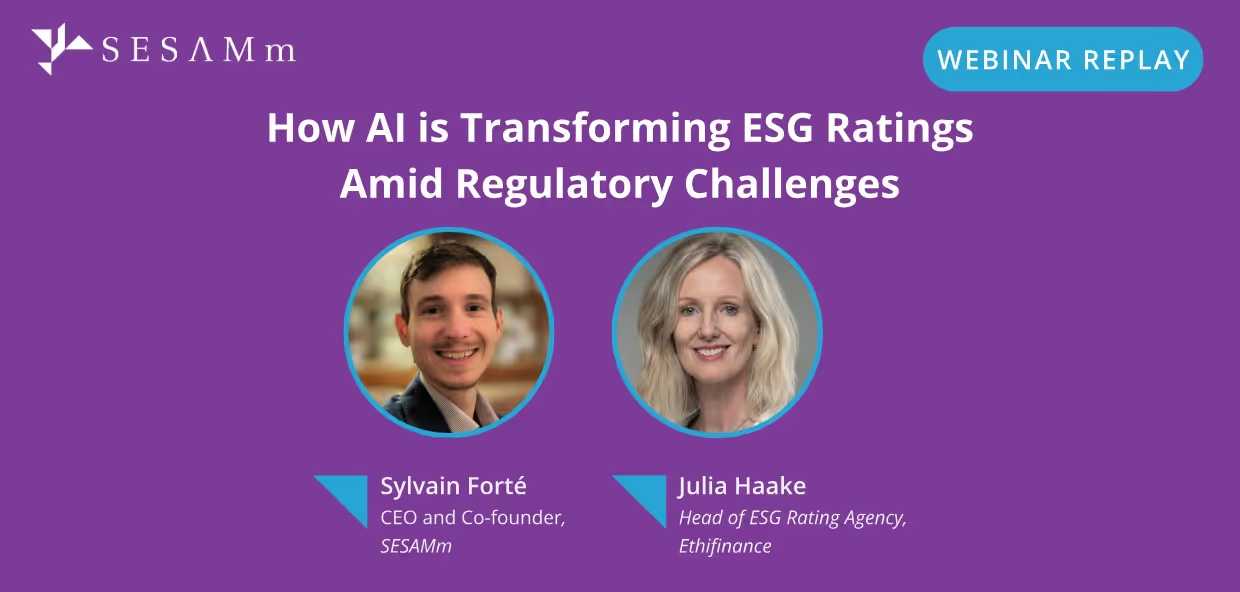
In our latest webinar, "How AI is Transforming ESG Ratings Amid Regulatory Challenges," SESAMm’s CEO and Co-founder Sylvain Forté and Julia Haake, Head of ESG Rating Agency at EthiFinance explored how artificial intelligence is reshaping the way ESG ratings are developed in the face of increasing regulatory pressures. The session focused on AI's transformative role in improving the accuracy, transparency, and efficiency of ESG ratings while navigating the complex regulatory environment in the EU and UK.
Key Takeaways
Upcoming ESG Regulations: New EU and UK rules emphasize transparency in ESG rating methodologies and conflict of interest management, impacting how rating providers operate.
AI’s Role in ESG Ratings: AI is transforming ESG ratings by analyzing vast amounts of unstructured data, improving coverage, and enhancing accuracy for small and mid-sized companies.
Addressing ESG Data Gaps: AI enables more comprehensive data collection and helps fill gaps, especially in regions and industries with limited reporting.
CSRD and ISSB Frameworks: These new standards are driving data standardization in Europe, with AI helping organizations adapt to evolving regulatory requirements.
The NZBA's announcement comes after a series of high-profle departures that began in late 2024. What started as a coalition of 43 banks at its 2021 launch had grown to over 140 institutions representing $74 trillion in assets by 2024. However, political pressure, particularly from Republican politicians in the US, warning of potential legal violations, triggered a mass exodus.
The departures followed a predictable pattern: Goldman Sachs led the way in December 2024, followed rapidly by all major Wall Street peers within weeks. Canadian banks soon followed, and the bleeding continued through 2025 with HSBC, UBS, and Barclays all exiting. Barclays' departure statement was particularly telling, noting that "with the departure of most of the global banks, the organisation no longer has the membership to support our transition."
Proposed Restructuring
The NZBA has now proposed transitioning from a membership-based alliance to what it calls a "framework initiative." This fundamental change would essentially transform the organization from an active coalition with binding commitments to a more passive guidance provider. The steering group believes this approach would be "the most appropriate model to continue supporting banks across the globe to remain resilient and accelerate the real economy transition in line with the Paris Agreement."
A member vote on this restructuring is currently underway, with results expected at the end of September. However, given the exodus of major institutions, the outcome seems predetermined.
Broader Climate Coalition Collapse
The NZBA's troubles reflect a wider crisis affecting climate-focused financial coalitions:
A member vote on this restructuring is currently underway, with results expected at the end of September. However, given the exodus of major institutions, the outcome seems predetermined.
Recent developments include a 23-state coalition warning the Science Based Targets initiative (SBTi) about potential antitrust risks, demonstrating that the pressure extends beyond banking to other ESG frameworks.
Market Implications
The NZBA's effective dissolution has several implications:
Fragmented Approach
Without coordinated frameworks, banks will likely develop individual approaches to climate commitments, potentially leading to:
Inconsistent standards and methodologies
Reduced transparency and comparability
Weakened collective bargaining power with policymakers
Regulatory Response
The vacuum left by voluntary coalitions may accelerate regulatory intervention:
Mandatory climate disclosure requirements
Government-imposed transition standards
Regional divergence in approaches
Investment Impact
For investors, this development signals:
Increased difficulty in assessing bank climate commitments
Greater need for individual due diligence
Potential opportunities in banks with strong standalone commitments
Looking Forward
The NZBA's pause represents more than just one organization's troubles; it symbolizes a broader retreat from coordinated climate finance at precisely the moment when such coordination is most needed. With climate risks accelerating and the urgent need for massive capital deployment, the financial sector's inability to maintain collective action represents a significant setback.
However, this may also create opportunities for more resilient, legally defensible approaches to climate finance. Banks that remain committed to transition goals may find competitive advantages in developing robust standalone frameworks, while regulatory bodies may step in to fill the coordination gap.
SESAMm’s AI Technology Reveals ESG Insights
Discover unparalleled insights into ESG controversies, risks, and opportunities across industries. Learn more about how SESAMm can help you analyze millions of private and public companies using AI-powered text analysis tools.
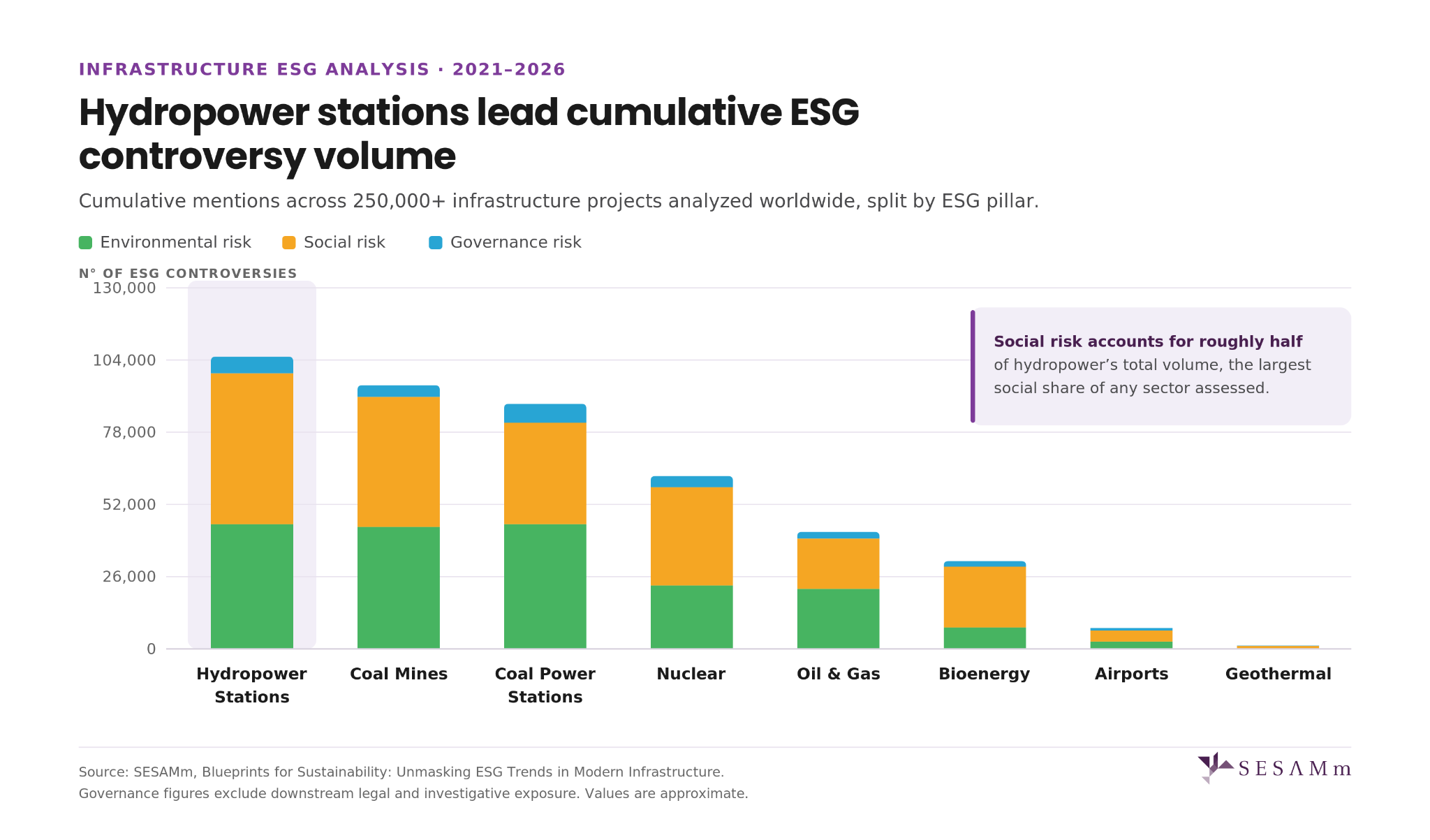
An analysis of over 250,000 infrastructure projects reveals that the sector most often filed under "clean energy" carries the heaviest environmental and social controversy footprint of any asset type assessed.
In the taxonomy of energy infrastructure, hydropower occupies a comfortable position. It is renewable, dispatchable, and long-lived, and it enters transition frameworks, green bond eligibility criteria, and net-zero roadmaps with minimal friction. Where coal is a legacy liability to be managed down and nuclear invites a specialized debate, hydropower is largely treated as settled. What these projects have actually done does not support that treatment.
Belo Monte, an 11,233 MW complex on the Xingu River in Pará, Brazil, is the sharpest test of the point, because it was built to answer this exact objection. Approved after decades of opposition to a far larger design, it was engineered as a run-of-river plant to minimize flooding, and its reservoirs cover 478 km², of which 274 km² was already river channel at high water, a 61% reduction compared with the 1980s proposal, according to the operator's own regulatory filing. The mitigation was designed from the start, and everything that follows happened regardless.
Biodiversity: the cost of a physical footprint
Environmental controversy across infrastructure concentrates on industrial accidents, water pollution, and biodiversity, and hydropower leads the third, outright, because dams require the permanent conversion of river systems and the land around them. Mexico's Federal Electricity Commission won environmental approval in September 2014 for the Las Cruces dam on the San Pedro Mezquital, upstream of Marismas Nacionales, a Ramsar-protected wetland, even though the project's own impact statement conceded that the damage to Indigenous ceremonial sites could not be mitigated. Along the Mekong River, river health and fish populations fell as dam construction spread through the basin. In Brazil, the Doce River carried a mass release of toxic material after an upstream failure. Elsewhere, the record includes violations of the Endangered Species Act and documented disruption to rainfall patterns.
At Belo Monte, the consequences have been measured rather than projected. The plant diverts water into a canal that bypasses a 130-kilometer stretch of the Xingu known as the Volta Grande, which has received less than 30% of its natural annual discharge since 2019, and some 86% of the stretch's seasonally flooded vegetation, 30,748 of 35,600 hectares, can no longer be inundated at all. The gap lies in the regulator's own file: IBAMA's technical staff called for 10,900 cubic meters per second in February, the historic peak month, compared with the 1,600 that the operating regime actually releases. Seven years of underwater video survey data published in Scientific Reports recorded total fish species richness falling from 62 to a post-operation average of 51, with the steepest losses near the dam and in the rocky rapids, which hold roughly 2.6 times as many species as sandy reaches. The zebra pleco, whose entire known range lies inside the dewatered stretch, now sits on Brazil's national list of threatened species as critically endangered.
None of this is an accident or a failure of operation. It is a structural consequence of the asset. A well-run dam still floods a valley, and a dam engineered specifically not to flood one still dewater the river below it.
When engineering fails: hydropower's physical risk profile
Coal mining leads infrastructure on industrial accidents, where the record is dominated by human tragedy and safety negligence: explosions, collapses, fires, and repeated, incremental failures. Hydropower ranks second, but its accidents take a different form, because in this sector, industrial failure means catastrophic engineering failure at scale. The record includes pipe ruptures causing severe land erosion, oil leaks, and dam collapses that killed and displaced people across whole regions, while PG&E's settlement over damages to the Middle Fork American River Hydroelectric Project and the litigation still running in Brazil after dam collapses give a sense of the exposure a single event can generate. For anyone underwriting these assets, the distinction is financial as much as physical: a coal mine's safety record is a rising cost curve, while a dam's structural integrity is a low-probability, near-unbounded loss.
At Belo Monte, that exposure has so far been financial. The project was budgeted at R$28.9 billion when Brazil's development bank approved a then-record R$22.5 billion loan in November 2012, and by late 2017, actual investment had reached R$38.6 billion, roughly 34% over. The operator owed R$28.3 billion to lenders and debenture holders at the end of 2024. Aliança Norte Energia Participações, the Vale and Cemig vehicle holding a stake in the project, discloses a possible loss of R$3.05 billion from a single construction-delay claim and describes the operator's liquidity as its principal point of attention and a source of investor alert. Neoenergia wrote off its own 10% holding by R$482 million in the fourth quarter of 2021.
The physical risk has been closer than the absence of a collapse suggests. In October 2019, the operator wrote to the national water regulator declaring an emergency, because reservoir levels had fallen far enough to expose an unprotected section of the Pimental dam's earthfill base to wind-driven wave erosion and, in the company's own words, structural damage. It cut outflow below the level agreed with the environmental regulator to protect the structure, and the letter surfaced only through investigative reporting.
Beyond the environment: displacement, water, and chronic corruption
Right to property
Hydropower ranks first among infrastructure sectors for property disputes, a direct function of the footprint a dam and reservoir require. The record shows land seizures, forced displacement, compensation that arrives short or not at all, communities never consulted before ground was broken, and blasting that cracked the foundations of nearby homes. Those affected are frequently the least equipped to hold an operator to account.
Fifteen years after Belo Monte broke ground there is still no audited count of who lost their homes. Estimates run from 20,000 to 40,000 depending on the definition used, against the operator's account of rehousing some 6,000 urban families. Landowners say expropriations are priced at unadjusted 2013 values while the project's own construction boom inflated the market, and as of 2025 none of the land required for the riverine resettlement program had been bought. A petition filed with the Inter-American Commission in 2011 still has no ruling.
Community health and safety
Hydropower sits alongside coal and nuclear as a leading source of community health disputes, but it arrives by a different route. Coal delivers PM2.5, nuclear delivers radioactive anxiety, and hydropower delivers water mismanagement: overconsumption that strips farmers of a livelihood, contaminated water reaching local crops. The grievance is agricultural rather than industrial, which widens the affected population considerably.
On the Volta Grande, catch per fisher fell from 11.1 kilograms a day between 2001 and 2008 to 4.53 kilograms between 2020 and 2023. A randomized household survey found 38.5% of residents in Belo Monte's resettlement neighborhoods living with moderate or severe food insecurity, against 28.3% across the surrounding city. In June 2026, federal prosecutors sought as interim relief for 635 families along the reduced-flow stretch the emergency delivery of three and a half to five liters of drinking water per person per day.
Corruption and bribery
Corruption and bribery accounts for close to 30% of governance controversy across infrastructure. What separates hydropower is the pattern. In airports, nuclear, and coal, corruption surfaces as discrete scandals: a probe opens, executives are charged, attention fades. In hydropower it keeps returning, tied repeatedly to falsified records and payments to local officials to secure land and water rights. Isolated scandals point to isolated actors. A pattern that recurs points to how these projects get permitted.
Brazilian prosecutors alleged that Belo Monte's construction contracts carried bribes worth 1% of their value, and three contractors admitted cartel conduct and kickbacks under leniency agreements that carried immunity. Everything after that was procedural closure rather than a finding of liability: the principal defendants were acquitted and the acquittal upheld on appeal in 2024, the competition authority archived its bid-rigging case in 2025, and no individual has been convicted in connection with the project. An investor screening for enforcement outcomes would have found a closed file. The costs landed elsewhere, in permitting delay, financing conditions, and a minority stake that has been for sale since 2022 without a buyer.
Hydropower's risk concentration: what this means
Hydropower's classification as clean energy is accurate on the metric it was designed to measure, because generation is low-carbon. But carbon intensity is one dimension of sustainability, and it is not the dimension that produces operational friction, legal exposure, or the loss of a social license.
What drew sustained opposition to these projects was water rights, displaced communities, cracked foundations, converted wetlands, and permits secured through local payments. None of it appears in a carbon accounting framework.
For investors, insurers, and lenders seeking transition-aligned infrastructure exposure, that is a material blind spot: an asset class that screens well on the primary criterion while carrying the heaviest social burden in the dataset, and carrying it on behalf of people who have no employment relationship with it. Belo Monte was engineered to avoid precisely that outcome and produced it regardless, which suggests the exposure is not a function of how a dam is built but of what a dam is.
The label is not wrong. It is simply measuring something other than risk.
Researching and analyzing investment opportunities can be challenging for asset management—private equity and hedge fund portfolio managers, researchers, and analysts—because, of course, you want to make sure that you're a good steward of your client's investments.
And when you find and source data, such as traditional or alternative data, you also want to make sure it's reliable and that the methods used to gather it are tried and true.
This article aims to give you an inside look into SESAMm's knowledge graph—one of the key reasons SESAMm's NLP-derived alternative data is reliable and trusted. We'll explain what a knowledge graph is, why it's important, how it works, and what makes SESAMm's knowledge graph unique.
What is a knowledge graph?
A knowledge graph is a digital representation of a network of real-world entities, the foundation of a search engine or question-answering service. This structured data model puts the schema in context through linking and semantic metadata, providing a framework for data integration, analytics, unification, and sharing. In other words, it's like a map and legend, with the legend labeling the concepts, entities, and events and the map connecting and identifying their relationships. These details are stored in a graph database and visualized as a graph representation, hence the term knowledge graph.
Fun fact: The expression, knowledge graph, gained popularity after Google used it in 2012 to name their semantic network.
Two types of knowledge graphs
There are two general types of knowledge graphs: open and private. Open knowledge graphs are open to the public. They're created and made available by organizations such as Wikidata, DBpedia, and Yago. Private knowledge graphs are often only used by organizations that create them, like Google, WolframAlpha, Facebook, and SESAMm (of course). Some offer them up for a fee or subscription, such as Crunchbase and OpenCorporates.
Why a knowledge graph is important
Knowledge graphs are important because they equip us with a model to see how everything relates from a big-picture view, creating new knowledge. Its benefits include:
Incorporating disparate data sources, avoiding data silos
From a data science and artificial intelligence (AI) perspective, knowledge graphs provide machine-readable details, adding context and depth to data-driven AI techniques such as machine learning. Using knowledge graphs and machine learning models together improves system accuracy and extends the range of machine learning capabilities for better explainability and trustworthiness.
How a knowledge graph works
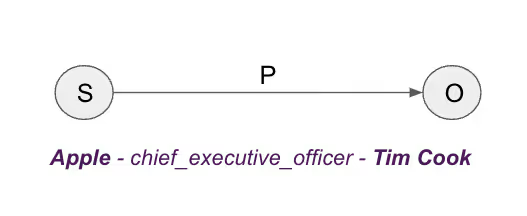
The core of a knowledge graph is its knowledge model, a collection of interconnected descriptions of concepts, entities, events, and relationships known as an ontology. This model provides a framework for statements or taxonomy. Each statement consists of a subject, predicate, and object (Figure 1)—known as a triple model—and each subject or object is represented only once in the context of the other subjects and their relationships. For example, in this simple sentence, "The boy kicks the ball," The boy is the subject, and kicker is the predicate because he kicks the ball, the object.
Figure1: Apple is the subject, chief executive officer is the predicate, and Tim Cook is the object.
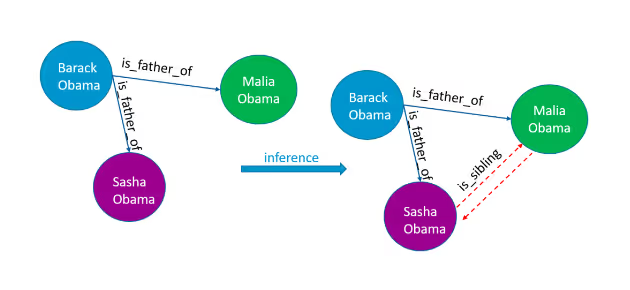
Likewise, each statement consists of three components: nodes, edges, and labels. A node, or vertice, represents an entity, which can be anything existing in the real world, such as a person, company, or object. For instance, in this example (Figure 2), Barack Obama is the subject node, Malia and Sasha are object nodes, and the edges, or relationships, are labeled as father or sibling, respectively.
Figure 2: How the relationships between nodes can be labeled.
What makes SESAMm's knowledge graph unique?
SESAMm uses open and private datasets with custom, curated information to create our proprietary knowledge graph. As a result, the knowledge graph is a vast map connecting and integrating over 70 million related entities and their keywords, relating each organization to its brands, products, associated executives, names, nicknames, and exchange identifiers in the case of public companies from a data repository made up of more than 18 billion articles and messages and growing.
The knowledge graph is updated regularly
Entities within the knowledge graph are updated weekly and tagged to ensure we correctly track their changes. For instance, the CEO of a company today might not be its CEO tomorrow. And brands might be bought and sold, changing the parent company with each sale. So, weekly updates within the knowledge graph ensure the system is aware of these changes.
NLP-driven accuracy
At SESAMm, named entity disambiguation (NED), a natural language processing (NLP) technique, identifies named entities based on their context and usage. Text referencing "Elon," for example, could refer indirectly to Tesla through its CEO or to a university in North Carolina. Only the context allows us to differentiate, and NED considers that context when classifying entities. This method is superior to simple pattern matching, which limits the number of possible matches, requires frequent manual adjustments, and can't distinguish homophones.
SESAMm uses three other NLP tools to identify entities and create actionable insights: lemmatization, embeddings, and similarity. The lemmatization process normalizes a word into its base form (morphology) to help identify and aggregate entities. Embedding assigns the entity a numerical value to help analyze how words change meaning depending on context and understand the subtle differences between words that refer to the same concept. Similarity measures whether two words, sentences, or objects are close to one another in meaning.
SESAMm tailored its knowledge graph to find, extract, and analyze data about public or private entities, which isn't readily available from the web or standard rating firms. This unique implementation of a knowledge graph provides insights to give you an edge when researching, analyzing, and submitting recommendations to the portfolio manager or clients.
SESAMm's premiere platform, TextReveal®, allows you to leverage NLP-driven insights fully and receive high-quality results through data streams, modular API and dashboard visualization, and signals and alerts. It's perfect for many quantitative, quantamental, and ESG investment use cases.
Learn how SESAMm can support you in your investment decision-making and request a demo today.
Stay ahead with the latest in ESG and AI intelligence
Join our mailing list to receive new reports, event invites, and updates from SESAMm directly to your inbox.






.png)