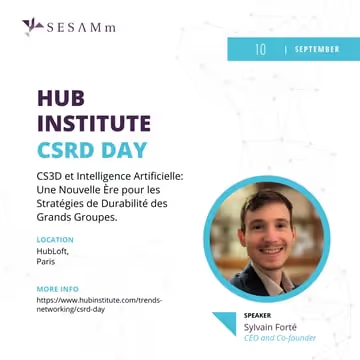
Find us in Paris on September 10 for Hub Institute’s CSRD Day, where CEO Sylvain Forté will give a short presentation on CSDDD and Artificial Intelligence. The session is titled “CS3D et Intelligence Artificielle: Une Nouvelle Ère pour les Stratégies de Durabilité des Grands Groupes.” Our Regional Corporate Sales Director, Kevin Ozadanir, will also attend the conference. For more information, feel free to chat with him at our booth.
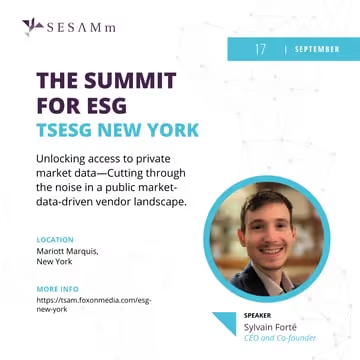
We’ll be in New York for The Summit for ESG on September 17. Sylvain Forté, SESAMm’s CEO, will join a panel discussion about accessing private and public market data in the vendor landscape. You can also stop by our booth and chat with our conference representatives, Dave Anspach, Jorge Alvarez, and Loic De Cupper.
Join us on September 17 for the AI for Finance and the AI for Industry summits in Paris. Leo Shamash and Juliette Fafa will gladly answer your questions on how we leverage AI to generate timely and accurate ESG insights.
Controversial business involvement screening is moving beyond its origins as a compliance exercise.
Under frameworks like SFDR and the EU Taxonomy, investors must prove that their portfolios not only promote sustainability but also exclude activities fundamentally at odds with environmental, social, or ethical principles. This marks a shift from static disclosure toward dynamic accountability, and it has broadened both the scope and ambition of ESG screening.
Historically, exclusions focused on a narrow range of activities - weapons, tobacco, or fossil fuels - and primarily applied to public equities. Today, that universe has expanded dramatically. Private markets, secondaries portfolios, and private credit exposures are now expected to undergo the same scrutiny as listed assets. This reflects not only regulatory alignment but also diversifying investor expectations, as institutions incorporate reputational, cultural, and mission-based constraints into their investment frameworks.
Modern exclusion policies increasingly include areas not yet covered by regulation but relevant to ethics, faith, or social impact. Examples range from pork-related activities in Sharia-compliant portfolios to emerging debates over cryptocurrency mining and trading, and even biotechnology topics such as human cloning or genetic manipulation that raise profound ethical questions. These additions illustrate how business involvement screening is evolving from a rule-based checklist into a reflection of each investor’s worldview and stakeholder commitments.
This evolution, however, brings complexity. Private assets and novel sectors often lack standardized data or public disclosures. ESG, compliance, and deal teams must process incomplete information, document decisions, and adapt quickly to new mandates - all without expanding headcount. The result is a growing need for automation that can adapt to human nuance.
SESAMm’s AI-powered business involvement screening meets that need. By allowing investors to screen based on their own exclusion categories and thresholds, it translates varied mandates - from regulatory to reputational - into a single, automated process.
Automating Controversial Business Involvement Screening in Public and Private Assets
SESAMm’s platform uses a new AI agent approach that scans and analyzes vast amounts of information. Below, we provide an overview of SESAMm’s business involvement screening capabilities and how they address investors’ needs for automation, thresholding, and flexible outputs.
Comprehensive Coverage through Big Data
SESAMm utilizes its AI engine to monitor over 30 billion articles and 10 million new documents daily from various sources, including news sites and NGOs. This extensive data collection spans multiple languages and local outlets, enabling it to detect obscure references to companies and raise alerts for issues such as misconduct. SESAMm's coverage encompasses millions of public and private companies, enabling users to conduct thorough screenings of any entity, including private companies and subsidiaries.
Customizable Exclusion Frameworks
SESAMm’s business involvement screening gives investors control over what to screen and how to classify it. Users can request customization of exclusion categories to mirror their own policy, whether based on regulation (e.g., SFDR, EU Taxonomy) or internal mandates (e.g., faith-based or reputational constraints). In addition to standard ESG categories like fossil fuels or weapons, investors can add custom topics. This flexibility allows ESG, compliance, and secondaries teams to tailor the tool to their precise needs,.
Threshold-Based Classification
SESAMm’s business involvement screening module is built around the concept of threshold-based flags. The AI utilizes structured data and unstructured signals to determine involvement levels. The output for each company is a clear classification: No Involvement, Limited Involvement, or Significant Involvement for each category. These classifications correspond to thresholds – limited might mean some involvement but below the exclusion threshold, significant means above the threshold or its a core business. By encoding the thresholds in the system, SESAMm ensures consistency with the investor’s policy. This is crucial for automation: rather than an analyst manually checking revenue percentages and news, the system does it automatically and provides clear justification.
Rapid Portfolio Screening Process
The system is designed for fast, self-contained screening. A user simply uploads a list or portfolio, and within hours receives a complete file summarizing involvement across all exclusion categories. The output includes company-level classifications, summaries of supporting evidence, and references to sources. This enables investors to integrate the results directly into due diligence workflows, risk committees, or regulatory reporting, with no ongoing manual data maintenance required.
Cost and Resource Efficiency
Automating this process saves substantial analyst time, particularly for rating agencies and secondaries investors managing high volumes of entities. Rating agencies can use the pre-classified results as a baseline input for their own ESG or credit assessments, reducing the manual data-gathering burden. LPs and GPs can run large private company universes in-house without additional research teams. In secondaries, where a full portfolio review can take days of analyst effort, SESAMm’s workflow compresses that timeline to just a few hours, enabling ESG validation to fit seamlessly into transaction schedules.
Auditability and Verification
Each classification is fully transparent. Analysts can drill down into the evidence behind a flag, including links to original articles, filings, or corporate statements, and verify the AI’s reasoning. Automatic translation ensures accessibility across languages. This transparency builds trust in the results and provides auditable documentation for LP reporting or regulator reviews.
As ESG investing matures, the leaders will be those who can implement exclusions transparently, efficiently, and in alignment with evolving norms. The next frontier is no longer just regulatory compliance - it is the ability to anticipate what clients and society will expect tomorrow, and to operationalize those expectations across all asset classes. SESAMm’s technology makes that possible: a platform that keeps pace with both policy evolution and moral expectations, bringing consistency and clarity to an increasingly complex ESG landscape.
Rejoignez SESAMm pour son événement annuel, le SESAMm Day, au Palais Brongniart à Paris, le 6 octobre, de 8h30 à 10h30.
Cette année, nous organisons le SESAMm Day sous la forme d'un petit-déjeuner : assistez à une table ronde où nos clients partagent leurs bonnes pratiques et posez-leur vos questions, découvrez les nouveautés de la plateforme et les prochaines évolutions, puis échangez autour d'un café avec l'équipe SESAMm et d'autres professionnels de l'ESG, du risque et de la conformité.
La table ronde
CDC Croissance, société de gestion dédiée aux PME cotées, et Archimed, investisseur spécialisé dans la santé, abordent la réalité opérationnelle de l'analyse ESG depuis deux angles différents : comment couvrir des actifs peu suivis par la donnée standard, petites et moyennes valeurs cotées d'un côté, actifs privés de l'autre, comment recouper des sources qui ne s'accordent pas, et l'utilisation concrète d'un signal lorsqu'il arrive.
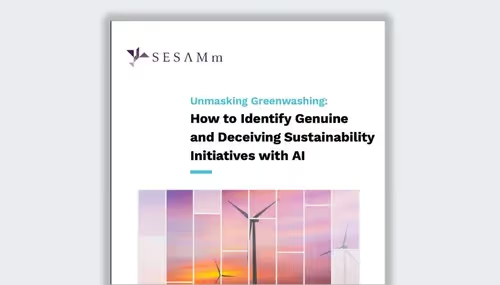
In our latest research, “Unmasking Greenwashing with AI” our ESG and Research & Analytics teams provide a comprehensive analysis of greenwashing trends using AI-powered text analysis.
Notable increase in mentions of greenwashing, with a 3.3x rise since 2021.
This increase suggests both a real growth in deceptive sustainability practices and a rise in public awareness.
Greenwashing represents 55% of all reputational laundering, underscoring a major shift towards environmental deception.
Surge in climate lawsuits with over 3x increase in climate change lawsuits since 2020, highlighting legal risks for misleading practices
It underscores the financial sector’s dual role in both contributing to and fighting against greenwashing through its investment practices
Submit this form to download your ebook now
Stay ahead with the latest in ESG and AI intelligence
Join our mailing list to receive new reports, event invites, and updates from SESAMm directly to your inbox.