Rejoignez SESAMm pour son événement annuel, le SESAMm Day, au Palais Brongniart à Paris, le 6 octobre, de 8h30 à 10h30.
Cette année, nous organisons le SESAMm Day sous la forme d'un petit-déjeuner : assistez à une table ronde où nos clients partagent leurs bonnes pratiques et posez-leur vos questions, découvrez les nouveautés de la plateforme et les prochaines évolutions, puis échangez autour d'un café avec l'équipe SESAMm et d'autres professionnels de l'ESG, du risque et de la conformité.
La table ronde
CDC Croissance, société de gestion dédiée aux PME cotées, et Archimed, investisseur spécialisé dans la santé, abordent la réalité opérationnelle de l'analyse ESG depuis deux angles différents : comment couvrir des actifs peu suivis par la donnée standard, petites et moyennes valeurs cotées d'un côté, actifs privés de l'autre, comment recouper des sources qui ne s'accordent pas, et l'utilisation concrète d'un signal lorsqu'il arrive.
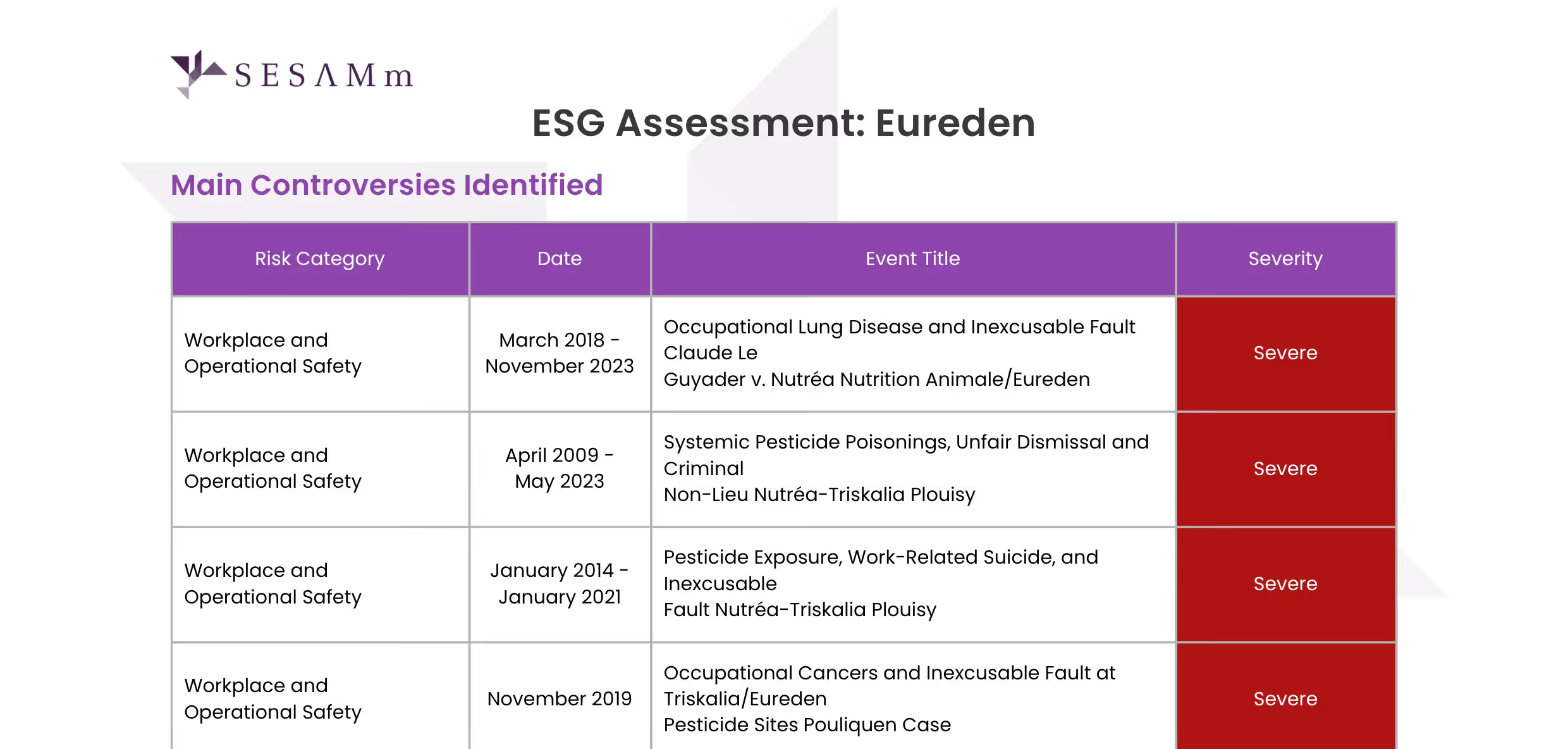
Eureden is a large farmer‑owned French agri‑food co‑operative headquartered in Brittany, combining upstream agricultural inputs and advice with downstream vegetables, eggs, meat/charcuterie, dairy, retail chains and labs across roughly 40 industrial sites in France, Germany, Spain and Hungary and generating about €3.7–3.8bn in annual revenue, according to its website and latest integrated report.
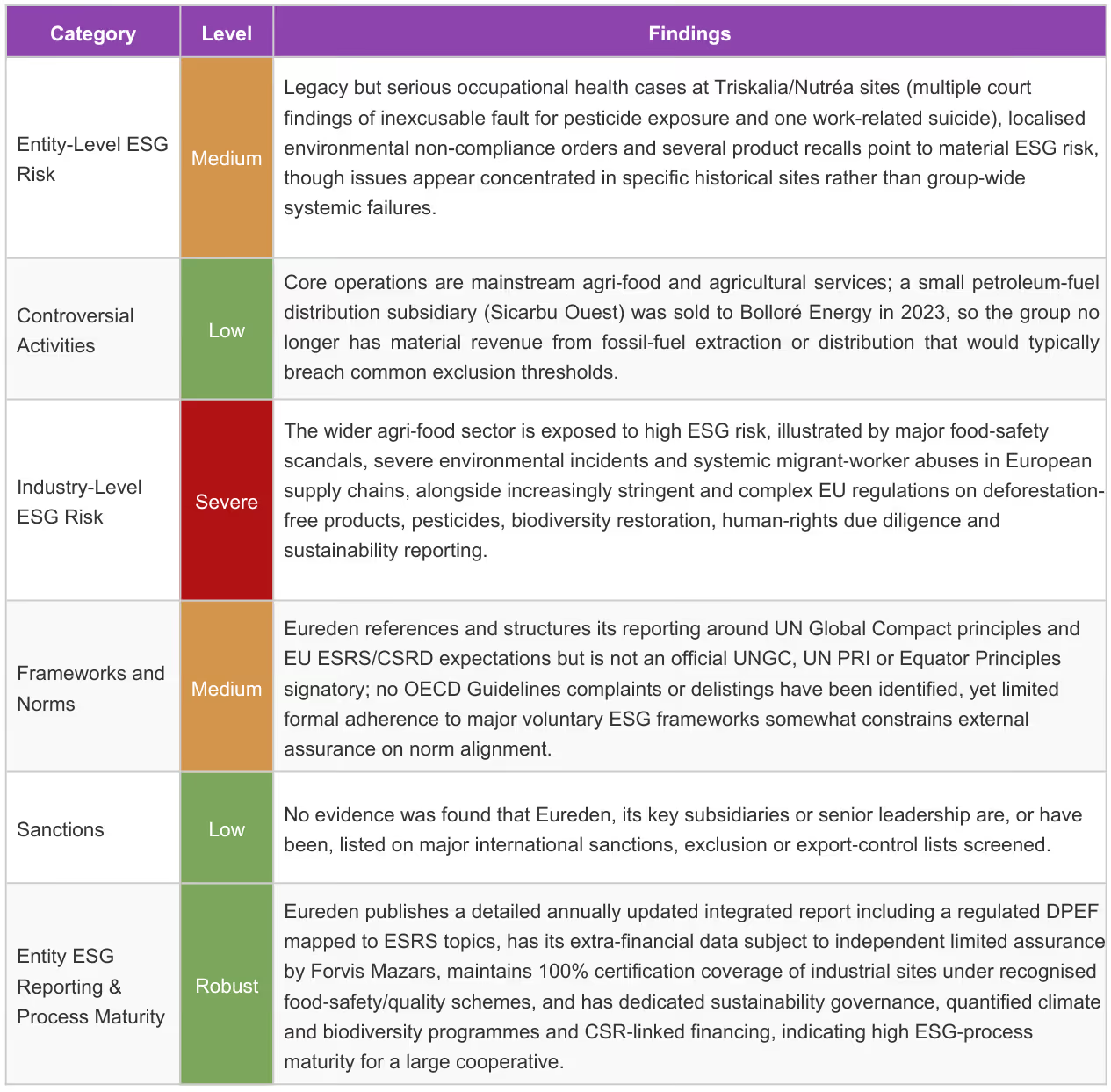
Eureden’s main ESG risks stem from legacy health‑and‑safety failings at Triskalia/Nutréa pesticide and feed sites, where French courts repeatedly recognised work accidents and occupational diseases as due to the employer’s “inexcusable fault” in pesticide‑exposure cases, including a worker suicide linked to workplace conditions, alongside other labour tensions, recurring though mostly precautionary food and allergen recalls, an environmental enforcement order against an ICPE site, and structural exposure to climate, biodiversity, animal‑welfare and chemical‑use risks from intensive livestock, pesticides and Seveso‑classified storage. At the same time, the company reports a relatively advanced CSR framework, high levels of external certifications (100% of industrial sites under at least one food‑safety/quality standard), externally assured integrated reporting with group‑wide ESG KPIs, CSR‑linked financing and programmes on pesticide reduction, non‑deforestation soy, climate, water and waste, while stating alignment with UN Global Compact principles without being a listed signatory; no international sanctions listings or OECD complaints involving Eureden were identified in public sources.
Reach out to SESAMm
SESAMm's web data analysis of over five million public and private companies is essential for keeping tabs on ESG investment risks. To learn more about how you can analyze web data or to request a demo, reach out to one of our representatives.
The secondaries market has tripled in size since 2019, now representing roughly $240 billion in annual volume. LP expectations around diligence - on exclusions, sanctions, mandate compliance, and reputational risk - have risen in lockstep. The window to screen a 300-company portfolio has not. For deal teams operating in an auction environment, the question is no longer how much to screen, but how to do it without becoming the reason a deal slips.
It covers how screening requirements differ by transaction type, what investors are actually screening for, why private market data makes this hard, and what a workflow looks like that can realistically fit inside a 48-hour timeline.
Held from June 21–29, London Climate Action Week (LCAW) 2025 brought together over 45,000 participants across 700+ events, emphasizing London’s role as a global hub for climate finance and leadership. As geopolitical uncertainty clouds climate ambitions, this year’s event signaled a broader market pivot: investors are now prioritizing regions with regulatory clarity and policy momentum, namely Europe and Asia.
He also outlined plans for new corporate sustainability reporting standards, a move intended to improve transparency, build investor confidence, and ensure alignment with the UK's net-zero targets. These commitments were part of the UK’s post-Brexit green industrial strategy, distinguishing it from recent ESG policy slowdowns in Brussels and Washington.
Climate Finance and Market Confidence
One of the most prominent themes throughout the week was capital mobilization. At the “Finance Live” forum, asset managers, banks, and insurers debated how to align their portfolios with net-zero goals while navigating geopolitical instability and rising greenwashing scrutiny. Key discussions included scaling blended finance vehicles, investing in transition technologies, and strengthening ESG data governance.
Meanwhile, sessions like the Nature Hub spotlighted biodiversity and natural capital, moving beyond carbon to more holistic definitions of environmental value. This reflects a growing consensus that an effective climate strategy must include nature-based solutions and ecosystem restoration.
The Broader Message: A Shift in Global Climate Leadership
While the U.S. backtracks on core climate regulations, London and Europe are entering a leadership void. For global investors, that means that developing a climate strategy now includes not only where to invest but also where to trust. In that context, LCAW 2025 offered both policy and finance updates and a credibility reset.
The takeaway is clear: in an age of fragmented regulation and climate politicization, market trust flows towards stability. London Climate Action Week didn’t just reflect that shift; it helped define it.
Stay ahead with the latest in ESG and AI intelligence
Join our mailing list to receive new reports, event invites, and updates from SESAMm directly to your inbox.