Ebook: Navigating AI in ESG & Risk Management: Unveiling the Mechanics
September 18, 2024
•
5 mins read
With all the buzz around Generative AI, it’s easy to forget that artificial intelligence (AI) has been driving innovation across industries for years. Environmental, Social, and Governance (ESG) and risk management are no different. However, at the rate AI is advancing and as the amount of raw data available for analysis continues to expand, the need to understand AI is more pressing than ever.
AI is transforming ESG, turning complex data into predictive insights and reshaping our approach to risk. But what does this mean for the industry, and how can professionals leverage this technology to maintain a competitive edge? The future of AI in ESG and risk management is not just a matter of technological advancement but a narrative of how we evolve with it.
This ebook dives into how AI works when applied to ESG, shares a few practical examples of what it looks like in real life, and offers a few predictions for what comes next.
Dive deeper into the mechanics of how AI works in ESG and equip your organization with the insights needed to enhance your ESG practices. Fill out the form below to access your copy.
Housing and construction fees have skyrocketed over the past few years. This increase goes back to multiple factors: economic unrest, raw materials disruption, and labor shortage, to name a few. What does web data have to say about all this?
In this week’s “Alternative Data Trends” issue, we’ll talk about commercial real estate, unveiling the industry’s ESG and SDG conformity and the effects of COVID-19 on the supply chain and labor.
Commercial real estate volume of mentions
While analyzing web data dealing with commercial real estate, we detected an evident increase in the industry’s volume of mentions. This trend spiked in April 2020 and was initially hindered by the COVID pandemic, which resulted in a drop in sentiment polarity. Still, it witnessed a rapid recovery leveraging digitalization and e-solutions (Figure 1).
Figure 1: Commercial real estate market mentions Feb 2015 to Mar 2022.
Case study: Unibail-Rodmaco-Westfield
To further understand the commercial real estate industry, we studied Unibail-Rodamco-Westfield and its competitors. Unibail-Rodmaco, a French commercial real estate company, acquired Westfield, a U.S. company, in December 2017. This acquisition accentuated its market share and grew its web voice share compared to its competitors (Figure 2).
Figure 2: Unibail volume of mentions compared to the market.
The chart in Figure 3 shows that the company’s volume of mentions has been increasing ever since the acquisition occurred. However, a negative sentiment polarity has been steadily increasing due to social ESG risks related to collective health crises during COVID and security-disrupting threats. In addition, the company faced difficulties collecting rent from retailers leading to lawsuits.
The arrows in this chart indicate Unibail ESG risks in time. The first arrow points to the social risks generated by security threats, in 2016, and the second arrow points to the issue of unpaid rent and lawsuits filed regarding the matter, in 2020.
Figure 3: Unibail ESG risks.
According to web data, Unibail has the second highest volume of sustainability mentions among analyzed groups. The company was notably related to sustainable development goals number 8* and number 12**. This volume is manifested in their initiatives to help unemployed people and maintain sustainable ethics and practices when launching their malls and shopping centers (Figure 4).
* Social development goal for decent work and economic growth.
** Social development goal for responsible consumption and production.
Figure 4: Unibail SDG volume of mentions compared to the market.
The impact of COVID on the emerging commercial real estate market
As previously mentioned, COVID had several effects on the industry, both negative and positive. Furthermore, it reshaped the market and its work policies. Some companies, as well, chose to switch to remote work and digitalization. In Figure 5, we can see that sentiment related to remote work policies has steadily improved since the pandemic started. However, in the last few months, we’ve seen a sharp decline, potentially signaling a negative reaction to some companies requiring employees back to their offices.
Figure 5: Remote work policies’ volume of mentions.
In addition, the pandemic has resulted in labor shortage and supply chain disruption, eventually leading to tremendous inflationary pressure. Raw materials prices, including oil, gas, iron, and wood, have witnessed a drastic increase and a disequilibrium between the volume of demand and the quantity available (Figure 6).
Figure 6: Labor shortage and supply chain disruption Feb 2015 - Dec 2021.
Data source
To produce this analysis, we combined natural language processing with billions of textual web data related to the real estate market, commercial real estate in particular. Using NLP-powered models gives us an edge as we can extract ESG, SDG, and financial insights that aren’t necessarily obvious or easy to detect. These insights help investors make better investment decisions.
SESAMm leverages artificial intelligence and machine learning to help you decipher and understand timely sentiments, trends, and ESG metrics on a wide range of public and private companies.
Stay in touch with SESAMm
Thanks for reading this issue of Alternative Data Trends. Be sure to catch the next issue by subscribing to our blog. And if you'd like a TextReveal® demo, send us a message via the form.
Paris, France – 24 février 2026 – SESAMm, leader mondial des données de controverses ESG et réputationnelles, annonce le renouvellement de son partenariat avec le Crédit Mutuel Arkéa, initié en janvier 2023, pour le renforcement de l’évaluation et du suivi des risques ESG au sein de ses activités d’achats et d’investissement.
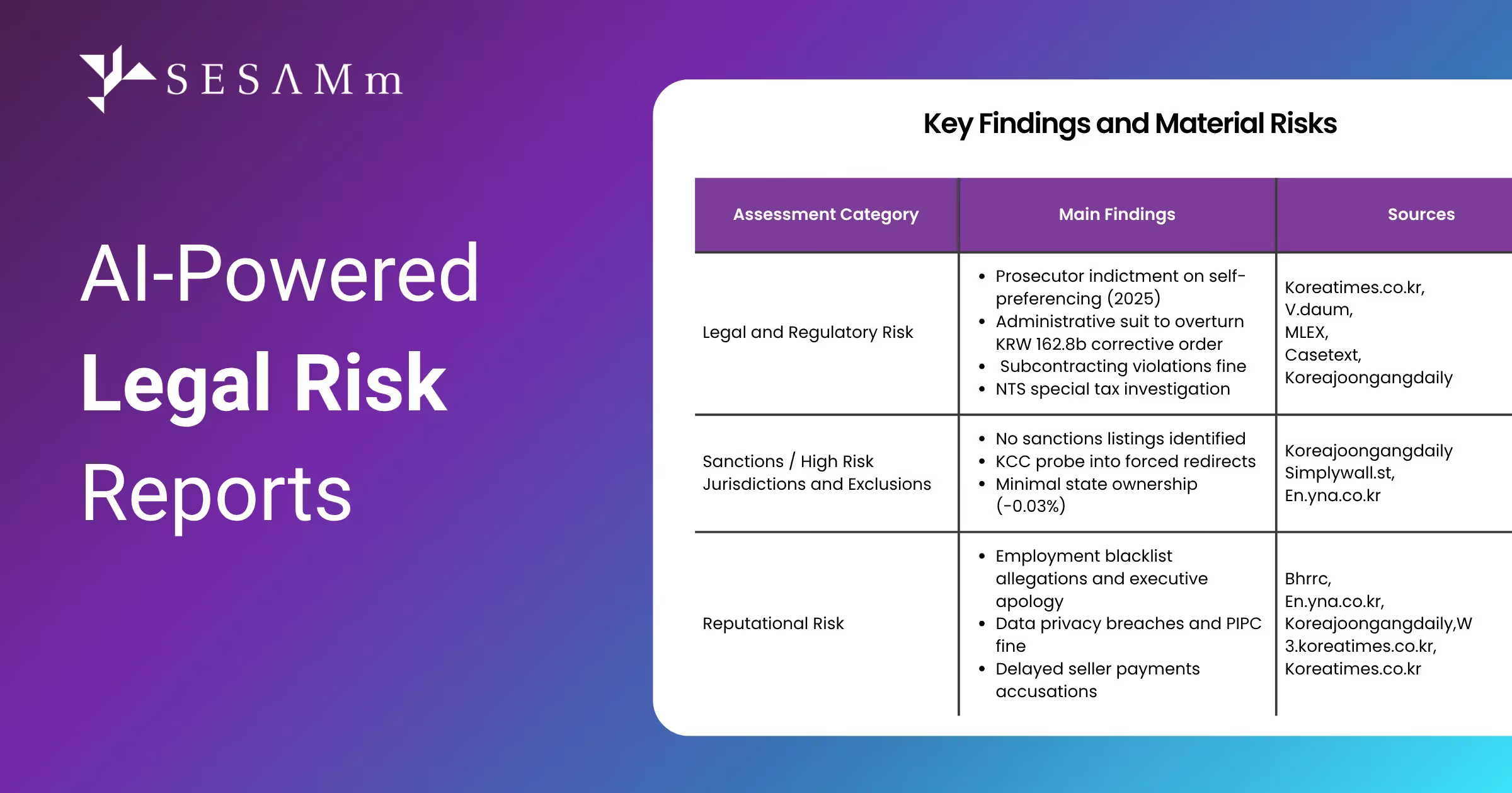
Depuis le début de cette collaboration, Crédit Mutuel Arkéa s’appuie sur la plateforme SESAMm pour analyser les risques environnementaux, sociaux et de gouvernance liés à ses fournisseurs, partenaires et participations. Grâce à des données de controverses ESG fondées sur l’intelligence artificielle, il est possible d’identifier notamment les manquements réglementaires, incidents environnementaux, risques sociaux, atteintes aux droits humains, cas de corruption et autres risques réputationnels.
Dans le cadre de ce partenariat renouvelé, SESAMm poursuit cet accompagnement, à la fois lors des appels d’offres et dans le suivi continu des tiers, ainsi que pour l’analyse des dossiers d’investissement et la surveillance quotidienne du portefeuille, complétées par des synthèses hebdomadaires des controverses ESG.
Ce renouvellement de confiance confirme la valeur ajoutée des analyses de SESAMm pour renforcer la cohérence, la réactivité et la robustesse des processus de due diligence et de gestion des risques ESG du Crédit Mutuel Arkéa.
SESAMm, the leading provider of controversy data, is pleased to announce that ENGIE has chosen SESAMm to strengthen its ESG risks monitoring of subsidiaries, including positive impact news.
SESAMm delivers real-time controversy data on millions of private and public companies, leveraging multilingual large language models to analyze content from more than 4 million sources in 100+ languages. This enables SESAMm to surface potential red flags such as human rights violations, corruption, and environmental breaches, even in hard-to-assess, non-listed firms, while also highlighting positive impact events.
With SESAMm’s AI-powered platform, ENGIE will supplement its ESG analysis tools for its global operations. This includes early detection of controversies, benchmarking against industry peers, and surfacing positive achievements that reinforce ENGIE’s role in the energy transition.
“We’re proud to support ENGIE in monitoring both risks and opportunities,” said Sylvain Forté, CEO and co-founder of SESAMm. “Our AI-driven insights will help their teams anticipate challenges, benchmark effectively, and showcase progress in building a more sustainable future.”
About ENGIE
ENGIE is a major player in the energy transition, whose purpose is to accelerate the transition towards a carbon-neutral economy. With 98,000 employees in 30 countries, the Group covers the entire energy value chain, from production to infrastructure and sales. ENGIE combines complementary activities: renewable electricity and green gas production, flexibility assets (notably batteries), gas and electricity transmission and distribution networks, local energy infrastructures (heating and cooling networks), and the supply of energy to individuals, local authorities, and businesses. Every year, ENGIE invests more than €10 billion to drive forward the energy transition and achieve its net-zero carbon goal by 2045. Learn more at www.engie.com.
About SESAMm
SESAMm is a global leader in controversy data, leveraging advanced large language models and generative AI to uncover ESG, reputational, and supplier risks in seconds. Our AI-powered platform surfaces real-time insights, even in low-disclosure markets, on millions of companies and infrastructure projects, supporting more informed decisions, enhanced due diligence, and regulatory alignment at scale. We work with leading firms, including Carlyle, Warburg, Natixis, RBI, Sustainable Fitch, Oddo, and others. SESAMm has raised $50M from renowned investors and operates across four continents. Learn more at www.sesamm.com.
SESAMm’s AI Technology Reveals ESG Insights
Discover unparalleled insights into ESG controversies, risks, and opportunities across industries. Learn more about how SESAMm can help you analyze millions of private and public companies using AI-powered text analysis tools.

Stay ahead with the latest in ESG and AI intelligence
Join our mailing list to receive new reports, event invites, and updates from SESAMm directly to your inbox.