Inrate Enhances ESG Ratings Through Strategic Data Partnership with SESAMm
May 5, 2025
•
5 mins read
Inrate’s Controversies assessment and ESG Ratings will now be enhanced by SESAMm’s extensive AI-driven controversy data, deepening visibility into real-time corporate risks.
Zurich & Paris — 5th May 2025 — Inrate, the leading ESG data and ratings specialist that pioneered impact ratings built on science-based sustainability analysis, and SESAMm, a global leader in AI-powered ESG and reputational risk data, have announced a new partnership. This collaboration will enrich Inrate’s ESG Ratings with SESAMm’s real-time controversy insights, which cover millions of companies across over 4 million global sources.
Through this partnership, Inrate will integrate SESAMm’s large-scale controversy event data into its controversies analysis, ESG assessments, and ratings. This enhances Inrate’s insights into ESG controversies and strengthens its rigorous approach to evaluating corporate sustainability performance. All of Inrate’s research and ratings extend beyond reported data, incorporating the sustainability impact of business activities and ESG controversies for a holistic picture of a company’s sustainability performance.
“Our ESG Ratings are built on a robust foundation—assessing companies based on the impact of their activities, not just on what they choose to disclose,” said Saurabh Srivastava, Head of Sustainability Data and Ratings at Inrate. “By integrating SESAMm’s extensive data set, we further enhance our ability to uncover relevant ESG events quickly and with greater global coverage, capturing a more complete and objective view.”
“Inrate’s ESG Ratings offer a powerful lens on real ESG impact. By adding SESAMm’s expansive, multilingual controversy data, users gain faster and broader visibility into the ESG events that matter,” said Sylvain Forté, CEO & Co-founder of SESAMm. “We’re proud to partner with a company that shares our values of providing unbiased, transparent data.”
About Inrate
Inrate, a Sustainability Data & ESG Ratings firm, helps financial institutions view sustainable finance through an impact lens. We offer high-quality, granular analyses across a broad range of datasets used by investment teams from due diligence, portfolio analysis, and reporting, to exit.
About SESAMm
SESAMm is a global leader in ESG controversy data, using advanced Generative AI. We automate monitoring and due diligence on public and private assets, providing coverage of more than 5 million companies. We work with Carlyle, Warburg, Natixis, RBI, Fitch, Oddo, and many more. SESAMm has raised $50M from renowned investors and operates across four continents. Learn more at www.sesamm.com.
SESAMm’s AI Technology Reveals ESG Insights
Discover unparalleled insights into ESG controversies, risks, and opportunities across industries. Learn more about how SESAMm can help you analyze millions of private and public companies using AI-powered text analysis tools.
The Securities and Exchange Commission (SEC) has voted to cease defending its climate disclosure regulations in court, marking a significant shift in U.S. corporate sustainability reporting requirements. This decision, announced on March 27, 2025, under Acting Chairman Mark Uyeda's leadership, has substantial implications for the ESG landscape.
The Decision
The SEC’s withdrawal from defending its climate disclosure rules comes amidst ongoing litigation before the U.S. Court of Appeals for the Eighth Circuit. Originally adopted in 2024, the rules were intended to provide investors with standardized information about companies' climate-related risks, emissions, and the financial impact of those risks. Uyeda justified the withdrawal by stating, “The goal of today’s Commission action is to cease the Commission’s involvement in the defense of the costly and unnecessarily intrusive climate change disclosure rules.” The regulations faced swift opposition from industry trade groups and Republican state attorneys general, who argued the SEC had overstepped its authority. The legal challenge quickly gained momentum, and with the change in SEC leadership, the agency opted not to continue defending the rules. Caroline Crenshaw, the lone Democratic commissioner, sharply criticized the move. She described it as an attempt to “unlawfully undo valid regulations” and accused her colleagues of “watching the rule’s demise while eating popcorn on the sidelines.”
Market Implications
The decision reintroduces regulatory uncertainty for companies. Many had already begun preparing internal systems and compliance structures based on the 2024 rules. Now, in the absence of a federal standard, they may be forced to rely on voluntary reporting frameworks or navigate a fragmented set of expectations from investors, states, and international markets. This lack of uniformity is likely to lead to inconsistent reporting practices and difficulties in cross-company comparisons. Investors, meanwhile, will face greater challenges in accessing reliable and comparable data on climate-related risks. Without SEC-mandated disclosures, much of the burden of transparency shifts to individual companies and third-party ESG data providers. Investors will likely need to increase due diligence efforts, adopt varied methodologies, and potentially absorb higher costs to obtain the data needed to manage climate risk effectively.
The Broader Context
This decision does not exist in isolation—it aligns with a broader trend of regulatory rollback on climate issues in the U.S. and signals a widening divergence between American and international disclosure approaches.
The divergence creates complexity for multinational corporations that must now navigate different expectations in different jurisdictions. This fragmentation may also create competitive disadvantages for U.S.-listed firms, especially those competing for capital in more disclosure-forward markets.
SEC Leaves the ISSB
In a related move that further isolates the U.S. from international sustainability efforts, the SEC recently withdrew from two key ISSB governance groups: the IFRS Sustainability Jurisdictional Working Group and the Sustainability Standards Advisory Forum. These groups are central to building alignment on global ESG disclosure standards.
The SEC’s exit from these forums signals a significant retreat from coordinated climate disclosure initiatives and weakens the U.S. role in shaping global ESG norms.
Market Response
Despite the rollback, some companies may continue voluntary climate-related disclosures. Those that have already invested in reporting infrastructure may opt to maintain transparency to meet investor expectations, mitigate reputational risk, and support long-term sustainability goals.
Simultaneously, ESG data providers and rating agencies are expected to play a more prominent role in filling the information gap. Financial institutions may also develop their own internal frameworks to evaluate climate risks, further privatizing what was once a public regulatory function.
Looking Forward
The path ahead remains uncertain. State-level legislation may introduce a patchwork of new rules. Global investors—particularly those with mandates in the EU or UK—may continue demanding robust disclosures from U.S. firms. And future federal administrations could choose to reintroduce or reshape mandatory disclosure regimes. In the interim, companies and investors will need to adapt by maintaining flexible reporting systems, monitoring evolving voluntary frameworks, and diversifying their sources of ESG data. While federal requirements may have receded, the underlying investor interest in climate-related financial risk is not going away. Climate disclosure, in one form or another, remains firmly on the radar.
SESAMm’s AI Technology Reveals ESG Insights
Discover unparalleled insights into ESG controversies, risks, and opportunities across industries. Learn more about how SESAMm can help you analyze millions of private and public companies using AI-powered text analysis tools.
Paris, France – November 21, 2024 – SESAMm, a leading artificial intelligence company, has been prominently featured in the latest edition of Datos Insights' Capital Markets Fintech Spotlight for Q3. This recognition underscores SESAMm's pivotal role in transforming the landscape of ESG and sentiment analysis through innovative AI technologies.
SESAMm's technological prowess allows clients to conduct in-depth due diligence and risk assessments, monitor investments, and make informed decisions. The platform’s strength lies in its ability to detect ESG controversies and identify positive impact events related to the UN Sustainable Development Goals (SDGs).
The report by Datos Insights highlights the challenges investment firms face regarding timely and transparent ESG risk information, particularly with small to mid-sized companies and in diverse geographic locations. SESAMm addresses these issues by providing a robust alternative to more traditional, often costlier, solutions. Its capacity to offer detailed ESG monitoring and analysis positions SESAMm as a valuable asset to its clients, which include some of Europe's largest financial institutions and notable names like Carlyle and Raiffeisen Bank International.
The Capital Markets Fintech Spotlight is a quarterly report that evaluates innovative companies shaping the future of finance through technology. Featuring SESAMm in this report highlights its impact on integrating ESG considerations into the investment process globally. This recognition is a testament to SESAMm’s commitment to excellence and innovation in the rapidly evolving fintech landscape.
Discover unparalleled insights into ESG controversies, risks, and opportunities across industries. Learn more about how SESAMm can help you analyze millions of private and public companies using AI-powered text analysis tools.
As the 2022 United Nations Climate Change Conference wraps up, governments and, by proxy, companies are charged with fulfilling new recommendations, especially for non-State entities to commit with integrity to Net-Zero. COP27, as the conference is also called, is the time and place where we claim as a united society at the world's center to make change for the better.
But COP27 is over. Now what? Do we go back to business as usual? Do we wait and see if we stick to any of these new agreements? Or worse, do we say we'll make changes but fall short of making those changes?
I say no. We can do better, and here's why…
We need to talk about climate change
Climate change effects are more than global warming. Global warming consequences include:
Rising sea levels
Stronger and more intense hurricanes
More droughts and heat waves
Longer wildfire seasons
And more
Why do I bring these up? Because all of these effects will impact your business in one way or another.
For example, did you know that the Rhine River, one of Europe's major rivers, is suffering from drought? Water levels are so low that barges are limited, and it's disrupted river cruises because levels are currently 38 centimeters below the minimum required.
The same goes for the Mississippi River in the U.S. The Mississippi River has dropped to the lowest levels they've ever been in 34 years, driving up shipping costs. This challenge is also a big deal because the river carries 92% of agricultural exports.
Also, in the past year, damaging hurricanes and typhoons have damaged infrastructure in South Korea, South Africa, China, Japan, and the U.S., to name a few countries, affecting crops, manufacturing operations, supply chains, and much more across the globe.
I could go on about how each effect influences enterprise, but the bottom line is climate change is bad for business. And supporting companies that enable climate change is also bad for business, which brings us to the topic of environmental, social, and governance (ESG) measures.
We need to talk about ESG
ESG has become mainstream since the UN shared a report in 2006, a joint initiative by a group of financial institutions to develop policies and guidance on how to better incorporate ESG issues in securities brokerage services, asset management, and associated research functions. This introduction has helped industries establish goals through:
Managing ESG risks
Anticipating regulatory action or accessing new markets
Contributing to the sustainable development of their societies
However, with ESG policies come ESG data challenges. For example, ESG measuring, its data, and how companies report them are inconsistent. ESG data providers deal with "data gaps" differently, so their approaches can lead to discrepancies. And as ESG data becomes available publicly, how ESG data providers interpret the data varies, too.
We need to talk about greenwashing
In simplest terms, greenwashing occurs when a company misleads its stakeholders, investors, and consumers about its environmental practices, specifically by communicating positive environmental performance contrary to its actual, less flattering execution.
On the surface, you might think, "What's the big deal? We all exaggerate, right?" But as sustainability awareness among investors and eco-conscious customers grows, so has their scrutiny over business conduct to disclose information about a company's performance and its "environmental-friendly" products. Their scrutiny, coupled with the growing number of companies reporting their environmental footprints, reveals that many companies misreport and publish information about their ecological impacts, which regulators consider misleading or deceptive.
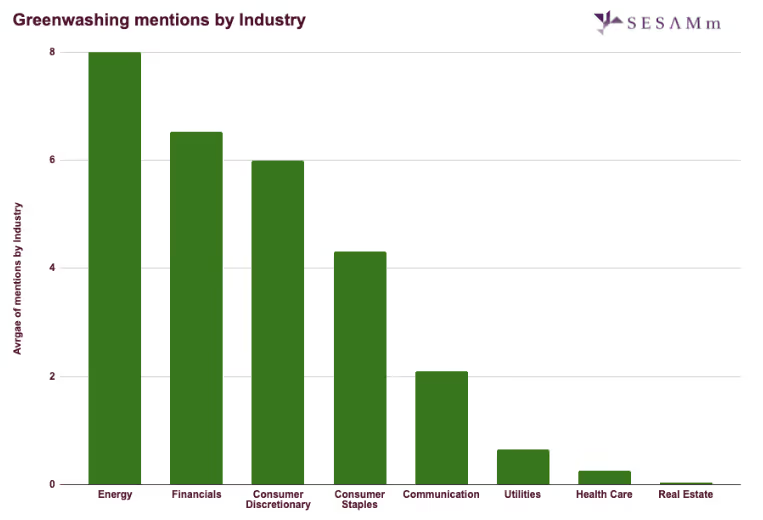
How do we know? Let's take a look at greenwashing mentions by industry.
We analyzed greenwashing mentions in web data. On the X-axis, we list the industries. The Y-axis measures the ratio of greenwashing mentions by N° of companies per industry (N=1166 companies) since 2015; this extraction method corrects sampling bias. Each industry is defined by a significant sample of large- and mid-capitalization-sized companies in developed countries.
This greenwashing mention chart clearly shows that the Energy industry has the highest ratio of greenwashing allegations. While many fossil fuel companies claim to be transitioning into clean energy, most mentions link these companies to advertisements and campaigns that don't align with the Paris Agreement goals. In contrast, fossil fuel companies are growing their carbon-intensive operations and products. It's a concerning trend because according to The Intergovernmental Panel on Climate Change (IPCC) report, "Climate Change 2021: The Physical Science Basis.", the data shows that emissions from fossil fuels are the primary cause of global warming, contributing up to 91% of global carbon dioxide emissions in 2018 as an example.
Second, on this chart is the Financial industry. It has fallen short of its commitments to climate action while continuing to finance fossil fuels. According to eMarketer, financial institutions have allocated $4.6 trillion for fossil fuels while promoting sustainable finance and supporting global energy transition.
Further, the mentions volume has grown year over year since 2015—when it was almost zero—to more than 1500 present day.
Clearly, this greenwashing problem is getting worse. So what can we do about it?
We need to talk about a solution
We don't have any control over what companies will do to fulfill their agreements, but we can understand their ESG data better and make better investment and portfolio decisions.
How? With AI.
AI, specifically natural language processing (NLP) algorithms, help us read billions of news articles, forums, and web text and extract unstructured data for analysis. With SESAMm's TextReveal®, we can see an entity's ESG controversies or events in near real time, providing a unique perspective to ESG data and details, filling the data gaps more accurately.
So when Company A reports on its ESG goals, we can help verify if the results are accurate and find any potential controversies that didn't make the report. We also don't need to wait until ESG reports come out; we can extract this data from the web on an as-needed basis. Moreover, we can look at all types of companies across the globe, public or private. As long as web data exists for an entity (or concept), we can analyze it.
My final thoughts
COP27 might be over, but our agreements and commitments carry on. We have an opportunity today to make a positive difference toward climate change while still maintaining profits. In fact, I think we can be even more profitable if we support green and sustainable initiatives.
I'd like to hear your thoughts; feel free to reach out on LinkedIn and share them with me.
About Alexandre Tiesset
Alexandre Tiesset is the Head of ESG at SESAMm. He's worked in finance for seven years in various ESG-related roles, such as Credit Analyst, Sustainable Investing Specialist, Index Product Specialist, and more. He holds a Master of Science degree in Finance and Financial Analysis. His passion lies in the intersection of finance and general knowledge and making new connections.
Reach out to SESAMm
SESAMm is a leading NLP technology company serving global investment firms, corporations, and investors, such as private equity firms, hedge funds, and other asset management firms, by providing datasets or NLP capabilities to generate their own alternative data for use cases, such as ESG and SDG, sentiment, private equity due diligence, corporation studies, and more.
To learn how you can generate NLP-enhanced ESG data for your firm, or to request a demo, reach out today.
Stay ahead with the latest in ESG and AI intelligence
Join our mailing list to receive new reports, event invites, and updates from SESAMm directly to your inbox.




.avif)



.png)