The Future of ESG: Technology, Data, and Regulatory Compliance
November 14, 2024
•
5 mins read
Recently, SESAMm sat down with ClimateAction to discuss the evoloving ESG regularlatory landscape and its impact on businesses and investors alike. Below we’ve gathered key takeawyas from that discussion.
Addressing ESG Challenges
Organizations are facing the challenge of managing a broad range of ESG-related risks while adapting to new legal requirements. These include tracking greenhouse gas emissions, monitoring labor practices, and ensuring board diversity, all while meeting the expectations of multiple stakeholders, including shareholders, employees, governments, and communities.
Frameworks like the Organisation for Economic Co-operation and Development (OECD) guidelines, the UN Global Compact, and the International Labour Organization conventions provide a foundation for best practices in these areas. However, implementing these standards effectively requires companies to go beyond compliance and actively engage with stakeholder feedback.
The Role of ESG Data and Stakeholder Insights
Companies and investors are increasingly shifting to robust data sources to craft effective ESG strategies. ESG data collection now includes not only internal metrics, such as workplace safety statistics and environmental performance indicators but also external stakeholder perspectives. These insights, drawn from media coverage, social media sentiment, and reports from non-governmental organizations, provide a more comprehensive understanding of a company's impact and reputation. For investors, this information is necessary for assessing risks and opportunities in their portfolios. By integrating external feedback into their analyses, investors can better align their strategies with regulatory demands and societal expectations.
Leveraging Advanced Technologies in ESG Monitoring
Artificial intelligence (AI) and natural language processing (NLP) technologies have emerged as effective tools for ESG monitoring and reporting. These technologies can analyze vast amounts of data from diverse sources, including news articles, social media posts, and corporate reports, to identify potential ESG controversies and risks.
The benefits of AI-driven ESG analysis are particularly evident in sectors with limited traditional data, such as private equity. By expanding coverage to include smaller or less transparent companies, AI enables investors to gain deeper insights into their portfolios.
Furthermore, advances in AI, particularly large language models, have enhanced the ability to detect and analyze a wider range of events that might impact a company's ESG performance. This capability helps address one of the primary limitations of ESG reporting—reliance on self-reported data, which may not fully capture a company's real-world impact.
Preparing for the Future
As ESG regulations become more stringent and stakeholder expectations rise, businesses and investors must adopt proactive strategies. By leveraging advanced technologies and comprehensive data sources, they can better manage ESG risks and align with regulatory requirements. This approach not only ensures compliance but also enhances reputation and long-term sustainability, positioning organizations to thrive in an increasingly ESG-focused world.
The integration of stakeholder feedback into ESG assessments represents a significant shift in how organizations view their responsibilities. By combining traditional metrics with innovative technologies, companies, and investors can build strategies that reflect both regulatory priorities and societal values. This holistic approach is essential for navigating the complex and rapidly changing ESG landscape.
TextReveal’s web data analysis of over five million public and private companies is essential for keeping tabs on ESG investment risks. To learn more about how you can analyze web data or to request a demo, reach out to one of our representatives.
SESAMm recently hosted a webinar led by Lead Solutions Engineer Leo Shamash. The session focused on the critical role of Artificial Intelligence in identifying and managing ESG (Environmental, Social, Governance) risks and controversies, especially in private companies.
During the webinar, Leo Shamash shared insights on how SESAMm’s advanced AI technologies analyze millions of daily articles to provide accurate ESG risk assessments.
Why is this important for private equity firms? Because traditional methods of risk assessment are often labor-intensive and limited in scope. SESAMm’s AI-driven approach offers a scalable, efficient solution. The webinar also touched on SESAMm's extensive data lake comprising over 20 billion documents, making it one of the largest repositories for tracking ESG risks and controversies.
Watch the webinar replay now:
Join us for our next webinar on November 15 at 4 PM Paris time/10 AM New York time, and watch Sylvain Forté share his insights into how artificial intelligence can help distinguish between genuine sustainability efforts and greenwashing. Book your spot.
Reach out to SESAMm
TextReveal's web data analysis of over five million public and private companies is essential for keeping tabs on ESG investment risks. To learn more about how you can analyze web data or request a demo, contact one of our representatives.
Below is an approximation of this video’s audio content. Watch the video for a better view of graphs, charts, graphics, images, and quotes the presenter might be referring to in context.
Introductions
Sylvain: Thank you very much for joining this webinar. We are talking today about three practical techniques to monitor ESG on private companies. So we're going to talk a lot about private equity, private debt, but also high yield even supplies, and client monitoring on the corporate side. And, of course, we're gonna talk about ESG and sustainability, including a bit about positive impact with qualitative and quantitative.
So this webinar is 45 minutes, and we'll have 15 minutes allotted for Q&A. And without further ado, I'll let you introduce yourself, Navin, and I'll do the same afterward.
Navin: Thank you so much, and thank you to SESAMm, and SuperReturn for putting this together as well. And good morning, good afternoon, good evening, wherever you are in the world.
And I hope you look forward to the next one hour of, may I say, excitement with ESG. So call me Navin, call me Nav, whatever you are comfortable with. I basically sit as a partner running our sustainability practice in Tata, very specifically in Tata’s technology practice. And what we see and what we cover is a number of clients across financial services across corporates, and we also advise our Tata group of companies as well. So we are a huge industrial conglomerate in high-carbon, low-carbon, carbon-renewable energy, and good ESG practices as well. Oil, gas, hotels, retail call, manufacturing, you name it. But a day will not go by when you do not touch a Tata product as well.
Just to add, you know, I've been at Tata Consultancy Services for the past three years now. Prior to that, I worked a number of leadership roles in places such as EY, Credit Suisse, Commerce Bank, across risk and trading. So I look forward to speaking with you, and thank you so much for having me today, Sylvain.
Sylvain: Thank you very much, Navin. And we really appreciate you joining the webinar. A few words on my side, too. I'm Sylvain, CEO of SESAMm. I'm based in Paris, France. And I'm managing a team of around a hundred people at SESAMm that basically extract billions of documents from the web—articles, messages, news, social media—and leverage AI to identify ESG controversies monitor the positive impact on companies.
And specifically, and that's really the goal of this with our assets that no one else can cover. So private equity, private debt, supplier clients, a lot of assets that traditional ESG rating agencies would have difficulties covering. So at SESAMm, we serve a lot of private equity firms: asset managers, corporates, such as the Carlyle Group or Warburg Pincus for example, in the investment management side. Or on the corporate side, helping them monitor ESG topics on clients across Eastern Europe. And we’re really interested in private equity, but also private debt in how intricate the complexity can be in terms of ESG monitoring in that sector. So that’s it about me, and I think we are ready to start.
So the first thing that we want to discuss is the high-level topic of industry challenges with regard to ESG monitoring, especially on private assets and sustainability in general. So Navin, very happy to have your opinion and your thoughts on this.
Navin: Thank you so much. So I think when we think about this high level, let's take a step back from what do we mean by sustainability, right?
Someone in the organization can tap the word sustainability, but what specifically are they asking about in sustainability? Is it ESG? Is it climate change? Climate risks? Are we talking about carbon markets? Are we talking around sustainable financing? Are we talking around net zero? Are we talking about concepts such as circular economy, and the EU Green Deal as well? So when we talk sustainability and we try to think about what a sustainability mean, one of the challenges that you see is that you need to join all of the, that wording up together. And that's why it becomes crucially important, especially in an industry [00:05:00] such as private equity, where data is not widely open or not widely shared. Because when we look at companies, rival companies on listed stock exchanges as well, just the sheer amount of data disclosures that need to be done for ESG, climate risks, amount of sustainable financing, the firm has done their usage of carbon markets. And not last but not least, how are they going to get to net zero is very, you know, is extremely widely available.
Now, take a step back again. How do you take those words and those keywords, and what are we trying to measure? What is relevant to the PE company in scope? What is going to be most important for their strategy as well?
Sylvain: That makes sense. And you're right, actually, Nevin, it’s one of the primary, like the biggest problem is simply that private companies don't disclose as much information and that there is a lack of data globally in the industry. And to find that this is a problem because people have put costly processes in place to connect the data or because it poses a problem from a standardization perspective.
Navin: Of course.
And I think, “how do you standardize, right? Do you, for example, if we go into the crux of it, do we go and proxy, let's say, we've got a PE, oil and gas company? Do we just go and proxy to BP because that oil and gas PE company is based in the UK and has a similar decarbonization pathway? Or is managing its climate risks in a similar way to BP, for example? Or do we have to proxy that company because their investment is not primarily in the UK but maybe in emerging markets? And we might have to find a proxy, such as maybe Reliance Oil and Gas, which is an Indian oil and gas company. Or do we basically proxy against a shell, for example? And proxying can be great, and it's been used by quants for a very, very long time. But if we don't really understand how the listed company is going, is it gonna make sense for the PE company that you're trying to proxy?
Sylvain: Yeah, you're right. And we are actually seeing that a lot in ESG rating agencies that has that kind of human costs, that limits the scale that they can have in terms of rating new companies, including small caps in private markets and where that kind of proxy rating is used more and more. But it still means that you're lacking data on the companies themselves. Everything is more industry based, which also creates some issues sometimes.
Navin: And another thing. Yeah, yeah. Sorry. Go on. Keep going, Sylvain.
Sylvain: No, and I dunno what your opinion is on that, but one of the two key things that we observe from an industry perspective and issues that PE firms are facing is one, regulatory pressure is coming. It's been in asset management for quite some time. The SEC right now is scrutinizing private equity from a tax perspective in particular, and by doing this, it also puts the focus on ESG regulations and how SFR EU, taxonomy, et cetera, could apply to private equity. And I think there's also pressure from the LPs.
So kind of the first question is, what is your ESG strategy? That's something that we see a lot with GP that we work with. Is that something that you see also in the industry?
Navin: Very much so. So, I think that the issue is the strategy keeps on changing. And with economic headwinds, we are facing globally with higher rates, higher inflation, and the terrible war initiated by Russia on Ukraine as well.
Very volatile commodity prices that we are seeing as well. Sometimes ESG is taking a back step. Sometimes ESG is taking a front step. Now how do we navigate those global headwinds and factor that into ESG strategy? And one of the points that sometimes tend to get missed is that, you know, some governments are putting the environment on the back foot. And the good examples are the new UK government that we currently have in the UK, which is talking a lot about deregulation. Some governments, such as the EU and their taxonomy, are upping the standards and trying to push those standards.
So what does that mean again for your ESG strategy? And does that mean that country by country, I need to have an individual sovereign ESG view so I can understand the impact on the…if I'm a PE company and I'm invested in certain sectors as well, what does it mean? And that is the issue that you cannot have a generic ESG strategy and apply that globally.
Sylvain: You're very right. So yeah, regulatory pressures specificities across the different countries.
Industry challenges and technology overview
Sylvain: I think we're touching on a lot of high-level topics on industry issues. One of the things that we see a lot more as a data provider and AI solution is there is really a data issue beyond the regulatory pressure beyond the need. Once that need is expressed, there is actually a huge issue in the whole industry is the lack of coverage.
So there are like more than 20 million firms worldwide that private equity could access as financial assets, and they are less than 50,000 that are actually rated by rating agencies. And so I think the entire industry is really seeing that data gap that is costing in terms of standardization in the whole industry.
Because if the data is not there, it's very difficult to get together and find a standard process. [00:12:00] And what that means is that there is a lot of reliance on manual processes, questionnaires, which sometimes also lack objectivity, so we are seeing right now that contrary to asset management, most of the information is disclosed on an active basis instead of firms being observed by external parties. And I think that could create some issues in the industry, especially with greenwashing involved, et cetera. This could actually create a few issues for investors in the next few years.
Navin: And I think one of the examples to take there is, how do you say to, let's say, an asset manager or a bunch of investors who are, say, investing in PE companies or creating PE funds or funds of funds, and they are being asked, “Can you tell me what the climate risks are for those companies?” Can you tell me the underlying sector that the company sits in? What is their strategy, for biodiversity, for example? What is their strategy for social and governance metrics as well? Really, really super challenging questions, especially because the PE company does not has to disclose currently, right? Now, that’s where, you know, it goes back to the word, how can you use proxy, but how can you get other types of data that are mandated by sovereign legislation as well? Because remember, let's go back to the example of oil and gas, for example. So if you talk about oil and gas, you know, there are certain regulations around oil and gas where disclosure has to happen, whether you are listed or whether you are unlisted as well. And that can go right [00:14:00] down to carbon emissions. So the hunt for the data needs to take place, but mapping of the sector, and the sovereign legislation in the country, which will determine how do I get those, determine those data points are very, very critical. So, as they say, data is gold.
Sylvain: Yeah, it is. And what we found also is that even when you have the data, the journey is not over. So a lot of the issues are in a lot of private equity firms, there's gonna be a lot of data collection.
But then that data is not gonna be regularly updated. So it's gonna be stale pretty quickly, and after a year, the process will start over. It's tough to have that point-in-time history. So public markets are very aware of this because every event has, could have a high-intensity impact very rapidly.
But this is actually the case also for private equity. So still lack of frequent data is a bit problematic. And similar to equity markets and public markets, I think black box scores are also a bit of an issue. A bit less so because a lot of the processes rely on manual data collection. But at the end of the day, you still end up in a lot of cases with the sort of score that may not be entirely transparent.
Neither for portfolio companies nor for LPs, and sometimes they don't really understand the ranks and the scores. I think transparency is a bit of an issue also that people are trying to solve in the industry, progressing.
Navin: And I think that's where we are seeing these issues of greenwashing and social washing going out there in the industry. And in some cases, it's deliberate. In some cases, it's not deliberate, right? You know, there are certain companies which have just had, unfortunately, very, very poor data points or not understood the data, and relied on the validity and office, if I can pronounce that word, let's say the validity of the data correctly. And they've taken that to their board, and they've used that in pricing or to raise financing as well, and then basically found out that the media or research companies have then gone and challenged the assumptions that have been used in the data as well. And would you say that it's the industry's problem or challenge? You could maybe say yes and maybe no, but at the same time, we remember we've got a plethora of ESG standards out there.
So for PE, who are they going to choose? Right? Where will they lean towards? So the UN SDGs is a framework that's used very often in asset management, but there have also been certain criticisms about the methodologies that are used for UN SDGs as well. But then you could maybe go to the other side of the equation and look at what are the metrics being used by SASB, which is already folded into the ISSP now as well, starting from next year.
And SASB is an investor's point of view in ESG metrics. Or you could go to the holy grail, may I say, and not to be blasphemous, but the holy grail of ESG frameworks and metrics such as the GRI initiative and the GRI, which was one of the first frameworks to basically release their a framework to measure E and S and G issues, right?
So I think it goes back to, “Well, which framework do I use and which will be accepted and which will I not be put on the hook for?
Sylvain: Yeah, you're right. And there's UN global complex UN SDGs and the EU taxonomy and emerging frameworks, to be honest, in a lot of cases when the data is available, we find that investors are kind of happy to adapt. If it's SASB, it's SASB. If it's UN global compact, it's UN global compact. But the biggest issue that we see usually day to day is actually the coverage. So if you have to choose the framework, it's likely because the data is not there and it's not standardized. And we found that this puts kind of mounting pressure both on ESG teams, deal teams, even corporates because they have to make all of the choices. They have to actively collect the data, and they don't have that kind of passive approach that ESG rating agencies are providing to the public market where they can just say, “Okay, I'm, I'm gonna go to a big provider, buy that data off the shelf, and I'm just gonna use that framework, that exact taxonomy, and that specific focus.”
And to the extent that some of our clients in private equity ESG teams have even to be the ones due diligence from an ESG perspective on any new deal coming to the pipeline. So that burden can be pretty high, actually. It can be a very difficult task. And I see a lot of ESG teams that are significantly understaffed actually in private equity and where it's a bit difficult to really handle all these tasks without the passive data approach.
ESG monitoring on private companies
Sylvain: Right. So let's move to the core of our presentation and discussion for today. So as you understand, our perspective on the market is that with a lot of these difficulties to track private assets and the lack of that standardized data, AI and natural language processing, so algorithms to extract information from text, are one of the only solutions that can provide that level of standardized off-the-shelf data, and that can help complement questionnaires and other active approaches. So the goal for today is to start diving into specificities, a high-level review of NLP technologies, leverage for that context. And also, Navin, I would love to have your view on how you see NLP leverage in general in financing private equity for these types of use cases.
Navin: So NLP is very, very important and a very powerful technology competency that can be used, especially when we are thinking about where is [00:21:00] data sitting, right? You know, so when we think about, and let's go back to what I was saying when we opened and open our sustainability and what type of sustainability data, a lot of the data could be at a geospatial level. Some of the data could be location-based. Some of the data could be unstructured and structured, right? So let's say you wanted to basically pick up the flood risk data for where the PE has taken a position. And let's say, a social housing project, right?
Now, can I use NLP to basically go and read certain documents which describe climate conditions? Or can I use NLP, including AI and ML, to go and read, let's say, climate models? How do I look at, for example, let's say, let's go back to oil and gas, right? Because [00:22:00] everybody likes to hammer the oil and gas industry, right?
You know, how would you go and use technology to go and identify what's the methane plume or the methane leakage rate, or the CO2 leakage rate, you know, for a very specific location? And again, that data might be sitting in certain documents, regulatory documents, for example, where maybe the EPC in the U.S. has replied back, or the environmental agency in the UK has replied back.
So again, understanding, and this goes back to, you know, understanding the sector where the data is sitting and how can I go and then use NLP on those, you know, sector regulators and sector regulations?
Sylvain: Yeah, that makes sense. That makes sense. And by the way, you're right to point out that there are things beyond NLP. Geospatial data is also something that is really interesting in that space.
Our focus is really NLP, basically extracting insights from text. That's basically that branch of AI. And usually, we see that the main use cases are identifying context related to ESG and sustainable development goals. For example, at SESAMm, we track 90 different risk categories off the shelf. And the algorithms are detecting like a human being, “Okay. This is actually related to biodiversity. This specific article is mentioning a lawsuit, and this one is about a strike.” We're discussing train strikes right before, during the preparation, so all of these E, S, and G contexts. And without going too deep into the technology, a lot of this is transformers, language models, deep learning for those of you that are more on the tech-savvy side. And the technology has really drastically evolved in the past three years. So it's getting really, really good.
The advantage of NLP is that it's pretty universal, so any assets and company are gonna be mentioned on the web, it's gonna have a website. There are some very rare cases that are not the case. I can think of one oil company in Texas in which one of our clients was doing a due diligence that didn't have a website at all. But that's really, NLP, in general, is very universal. And whether it's in finding information in news content, including local content, so when you can parse local languages in Holland or Ukraine, like we're doing right now for some of our clients, and analyzing potentially controversial context.
Social media is also interesting. A lot of the big controversies, for example, fiscal tax evasion, Panama Papers, Pandora papers, and Whistleblower alerts. All of this is actually revealed on Reddit in many cases, so lots of relevant information there. And then you have NGO websites and sustainability reports. So yeah, whether you want to identify information coming from NGOs, for example, or you want to find out about the latest news controversy, NLP is really powerful to help you do that at scale on a large number of different sectors and companies. I think that's one of the very powerful aspects of the technology.
Navin: And I think just to add as well, what is the perception of a PE investing in a company or holding a certain proportion of a company and, you know, the branding? And that's where we're seeing more investment in sentimental scoring.
So how would you do NLP, take those outputs, and create a sentimental score? So then how can you basically see what is the perception of the public or the perception of the media in terms of what is society saying, and then how would you then go and benchmark that too, does this conform to my ESG strategy, for example, especially the S and the G, which tend to get overlooked because we all seem very hung up about the E, which is also important as well. But let's not forget the correlation between E and S and G.
Sylvain: Yeah, you're very right, and actually, you're, it's interesting to mention sentiment because in the algorithm that I used, sentiment analysis is very common. And for me, from an NLP perspective, ESG is a bit of an extension of adverse media monitoring.
So you're trying to identify a specific risk that an algorithm is going to classify as, okay, highly negative sentiment on an article. And then you're gonna associate a context extraction algorithm around specific ESG and SDG context that you then need to map to a specific regulatory framework. So there is an additional layer, but in a lot of cases, it starts either from reputational insight sentiment or information extraction. I'm looking for a specific number inside report carbon emissions specifically or something similar. So yeah, from technology-wise, it's really an extension of sentiment analysis, and a lot of companies come from that sector initially. And so does SESAMm. We started with reputational insight and, a few years ago, starting to really build that ESG expertise along with a partner ESG rating agency in France.
Navin: And I'm pretty sure let's take a case study such as Tesla. You know, Tesla was thrown out of the MSCI ESG index and replaced with who? Exxon. Mr. Musk, aka Iron Man, was not happy. But what did Mr. Musk not think about? The S and the G in the overall ESG context, but also, what is the sentimental [00:28:00] scoring analysis? Especially that, well, he's decided to buy Twitter now, but he likes to blast off on Twitter as well. So maybe not very great for the sentimental scoring side. Just a sense of humor there, you know, to keep everybody awake.
Sylvain: You're right. And not to advertise or anything, but actually, since I'm published on this, so you'll find that there is a study on Tesla, our blog, because we were interested in understanding whether from a reputational basis that could be justified. And from a web perspective and media perspective, their level of scandals that Tesla is generating on the social and governance side is pretty intense, actually. And even when you look at things like how viral is the information and how relevant it is to traditional ESG metrics. It's not always looking good for them.
Navin: Of course. I think this is where NLP plays its part, right? Because by understanding where you are now, you want to look at your future. You want to be thinking about how am I going do regression or an extrapolation out to look at where are carbon emissions going to be for my company or what amount of CapEx do I need to put in to basically either address or make better my ESG metric that I'm trying to measure as well. Because at the end of the day, if corporations do that, then financial services will say, “Well, you know, I'd like to take a slightly picker position, or I'd like to invest in this PE company because they're doing the right thing.” That will make my metrics look good. And also, I will minimize my reputational riskbecause the last thing a financial services firm wants is to be investing in a PE company that's invested in, let's say, unethical companies with very bad ESG scores and very bad ESG data. And I think that's where SESAMm comes in, Sylvain.
Sylvain: Yeah, exactly. And sometimes, these controversies are tough to track. We have cases where even the portfolio companies themselves are not aware that one of their subsidiaries is involved in a huge scandal in a specific Asian country for which they'd actually don't control the information. And that's actually a good segue into kind of the practical use cases. The main ones that we encounter for NLP ESG indicators right now are monitoring of private equity companies, private debt supply clients, and due diligence.
And due diligence is actually also important because, in a lot of cases, someone at the private equity firm has to check a box saying, “This company is not exposed to adverse ESG controversies.” And checking that box is not a neutral thing, and there's a lot of responsibility. It's gonna be either an ESG team doing that and being flooded with a lot of work, or it's gonna be the deal team who sometimes doesn't have the basically the knowledge of the regulatory framework or on ESG, or sometimes it's a bit more systematic. And so we also work with the data team or data science team. They're looking to embed more systematic data sets. So I think we can discuss these a bit more and in the context of specific examples. So on monitoring in due diligence. I’d be happy to have your view on this, Navin, and see [00:32:00] what you've seen on use cases such as supply chain due diligence, ESG and credit alerts, or ESG controversy monitoring, for example.
Deep dive: how technology assists private equity firms from an ESG perspective (3 examples)
Navin: Definitely. I mean, look, with a number of our clients that we work with on ESG, a lot of the focus has been on, is this company going to be creditworthy in five years’ time, in three years’ time? Because when we look at climate risks. It's been proven that there is a correlation between your credit rating and how you manage your climate risks. It's very also clear that how does consumer sentiment and consumer perception impact revenues of a product port if you have poor SMG and poor E scores as well.
And companies that we work with on the financial side and the corporate side are investing a lot of money in trying to understand, if I don't do X, Y, Z, what does that mean for the valuation of my assets on the balance sheet in five years time, 10 years time, 50 years time, and the savvy ones out to 50 years as well. Because we gotta remember climate change is a long-term subject that needs to be addressed, and climate change is becoming more frequent and more severe as well. And we can see that, you know, with numerous weather-related disasters that are reported around the world. But how about the supply chain? And a great example is especially when we came to sort of the end of the Covid Pandemic last year and how materials weren't readily available as well. Again, the types of data insights in terms of building dashboards to help our clients understand, you know, where in the supply chain do I have issues and where do I start flagging those issues, and how is it going to hold up production of my component, my product, sorry, as well.
And at the, you know, last but not least, again, controversy. Right? We've worked with a number of companies which have had certain issues that have come out in the press as well. Sometimes these companies have happened because of bad data or mismanagement of data, and we help our clients try to understand okay.
If you're gonna be invested in XYZ company, you really need to understand what does this mean from your S and your G. You need to put enhanced [00:35:00] diligence on the S and the G. So, for example, if you're producing electric batteries and you're supplying electric batteries to, hey a bunch of companies, Well, what about child labor? What about human rights? What about how people are being looked after in terms of a social element?
And again, a lot of this is done by, how do you do that? NLP. You need to basically be reading and understanding what is being reported out there via so many different sources of information. So not just the media and doing sentimental scoring, but also how do you do NLP, unlike, let's say, a human rights report or a UN report that is issued out. So technology is very key and critical to help us do that. But how do you standardize is the point, right? And how do you compare? And that's the probably number one challenge at the moment.
Sylvain: You're very right. And I think what you were saying about analyzing controversy, for example, on child labor, and like there's really a data aspect to that is how do I do that in the local language? That's actually a big issue, even for people doing it manually. It's actually an issue. You have to have international teams, et cetera.
At SESAMm, we cover around 20 different languages, and one of the use cases I wanted to mention today on supply chain detection, SDGs, et cetera is, for example, we worked with a large private equity firm in Japan on helping them evaluate the sustainability of a green tech investment that they were going into.
And so they wanted to make sure that the company was actually really well perceived from a UN SDG perspective in Japanese media and in Japanese consumer discussion. And in addition to that, they wanted internationally, in almost every country worldwide, to make sure that there was an appetite for, in that case, sustainable material that the company was producing, which would have taken multiple surveys and pretty difficult work to actually do this. And so that's a typical use case: early-stage due diligences, assessing the impact thesis around a specific company, and having to do that on an international basis is super difficult, and NLP is a good enabler for that specific topic that's applicable to impact fund, but also in the context of risk identification.
And…
Navin: I think also… Sorry, can I just add something there? You know, like you talking about the Japanese firm, right? That this could be any emerging market company or, let's say comp a non-English based country, right? You know, where English is another [00:38:00] primary language, but you might be a Western company, but you need to really understand, you know, what actually is going on.
So what is the media writing about? You know, right down to, you know, that local language, you might be a dialect of the country, sovereign language as well. And then just that's the sheer amount of people you need to get to go and work backwards to understand your E, S, and G. Sorry, Sylvain. I thought I would add that in there.
Sylvain: Yeah, that's a good point. And actually, it relates also I found on the credit side. So in a lot of cases where our clients want to do on the ESG side of credit like you said, is assess how, basically assess their, the relevance of ESG in terms of potential default. That's the key focus of a lot of private credit investing, and it's expressed most of the time in terms of early warming.
So that means that your goal is not just to have information that everyone else has, but really to dive into these local sources, social sources, et cetera, to make sure that you can detect potential, great risk in advance. And a good use case that we had a few years ago was on WeWork, for example. So yeah, you all know WeWork global company, et cetera.
But what's interesting is that at SESAMm, we're able to get inside local sources and more social information and local forums. To identify that there was a pretty significant default risk on WeWork at the top of that controversy, right before Fitch announced it, and then Fitch issued a report and said there is actual default risk on WeWork.
You guys should be careful. And the credit rating of the firm was significantly downgraded. So early warning is pretty critical in credit. And what's interesting is that it's not just private debt; it also applies to high yield. We see a lot of asset management firms they're looking also to get access to these types of early warnings from local news.
Navin: No. Yeah, I can't fault WeWork because I do enjoy the free beers that they provide as well. Maybe that could be part of an early warning system, the amount of beer being drunk, you know, and leading to a default.
Sylvain: I will not comment on that.
Navin: But look, you make a very good point, and on a serious note, Sylvain, and it is very, very key that we get on top of this correlation between how ESG performance is, what metric should be tracked, and what's the correlation to credit ratings, right? You know. And I think the biggest issue at the moment is that we have slightly different methodologies from different rating providers on looking at, let's say, an ESG rating that how do we basically close the disparity so then we can understand the correlation of, let's say, an early warning system that basically triggers you, that says, okay, ESG metric deterioration, what does that mean for credit risk, right?
Also, let's not forget ESG risks. So when we look at our 99 percentile, how do we capture those black swan events? And can black-swan events arise from ESG as well? Right. You know, and there have been many, there have been certain examples in the past where the environmental aspect of managing or mismanagement of climate risks has not been done correctly.
And companies have actually ended up, you know, see the prices spiking, default eventually happens, the company goes into bankruptcy, especially in the U.S. as well. So again, how do you use the power of technology to start flagging and start bringing that up, right? You know, and I think this is how the role of a risk manager as well is going to change, Sylvain.
You know, the role of a trader or the role of an investor, the role of an asset manager who is investing, and let's say PE is going to change, you know. What are the metrics or early warning metrics that they need to be monitoring? What type of reporting does a risk department need to do?
Sylvain: You're right. And actually, if we were like just talking about trading, some of our clients are doing CVS forecasts basically based on the data. In the PE space, what it looks like, and we promise practical use case also. And in the private equity space, in private credits, what we see is, for example, we have a large client in the U.S. that is tracking in a private credit portfolio of around 5,000 assets. And so they're not attempting to predict CD spread, et cetera. What they're doing is they're receiving daily alerts for both ESG and SDGs on the entire 5,000 assets. And private debt has a lot more assets than private equity, so it's particularly tough on the team to track these day to day, and so that helps them centralize monitoring.
They receive all of the alerts. They have access to the dashboard, etc. That makes this process really independent from deal teams, so they don't have to take that information from each deal team individually, and they receive email deliveries and files integrated into their own tools. And so with that, they're kind of safe in knowing that all of the information from all of those sources are already there.
They don't need to wait on anyone. They don't need to ask the company to report on [00:44:00] these topics. From a reputational ESG perspective, they are well covered, and they will not miss any ESG controversies. So that's one of the really practical use cases on private credit.
Navin: And I think it goes to show that I think when we look back at the past 45 minutes, what we've been talking about, right, that in private equity, ESG risks, climate risks, sustainability-related risks are now truly correlated, and truly part of financial risks now as well.
I think we had this historical perception that we would see carbon emissions as a non-financial risk. Okay. You know, we could say it has non-financial data, you know, maybe it's more scientific data, but we're now really bringing in that data and looking at what is the impact of financial risk and financial metrics.
Something that we, you know, that wasn't done extensively 10 years ago. So very exciting times.
Sylvain: It is, right? And that's very much one point with topics such as double materiality. How is ESG actually impacting financials? And yeah. One last use case I wanted to mention. We promised three, so we're gonna honor that promise, is actually controversies and ratings. Something that is done a lot in the financial market space and in public. There's one example that we recently had in France a few months ago. There's a nursing home company called Orpea that has been exposed to massive controversies, in particular coming from local journals, mistreatments of patients, which is, really, yeah, problematic on the social side.
And what's interesting is that rating agencies, public rating agencies at the time we’re [00:46:00] seeing, allocating the best ratings to the company because it has some social impact factors, et cetera, and they were missing on that local news information and on everything happening. And NLP is very powerful in helping make these ratings a bit less dependent on the company's reporting information, identifying the local information. And for us, Orpea was one of the companies we identified a lot of critical controversy risk and where the rating from an NLP perspective was really poor, simply because we had a bit more information. And in some cases, it's a way to complement the data that exists. So a lot of our clients are doing this, is leveraging these scores and leveraging the controversy alerts in order to do monitoring, like we discussed, in order to do due diligence.
We have a large private equity firm that does that, around 200 companies. And all of that data then gets integrated internal systems, CRMs, like dCloud, et cetera. And then people can then rank companies, which is something that people do in public markets every day. So as to say, okay, I'm gonna invest in the best-ranked companies, or I'm going to exclude the worst-ranked.
And this is, I think, something that is gonna continue to emerge in private equities, not just events controversies, but also ratings, actual scores that are useful to have a statistical view on the portfolio.
Navin: I think, you know, it's very sad to hear a company executing those types of actions. And I think this is where it shows technology can basically save lives and prevent further controversies.
Now, I think, taking a step back, how would you take an assessment framework? Will the health and social assessment framework from the French authorities? [00:48:00] And how would you map that into an ESG framework, right? Because as I said, when we opened 45 minutes ago, each sector has a different ESG problem. Each sector is measured in a different way.
So how do you go and take those regulations or sovereign regulations, sector, sub-sector, and then how do you do that sub-mapping to what the issues are from an E and S and G perspective? And I think that's where the government as well need to be clear about what are the E and S and G factors that are important to them.
That will give a lot of clarity to the financial sector and especially, you know, private equity firms.
Sylvain: Thanks. I think that's actually a good conclusion, and it's also important to know that not everything is easy in that sector. So we understand here that there is definitely a data issue. There are definitely a lot of problems still to solve, especially in the private equity space, around which framework do we use for that specific type of application.
I hope that we provided some answers and, as promised, three concrete use cases, which you can take back to your team and which you can discuss as practical applications. So I think we're gonna close this session here and go to Q&A and take some questions from the audience and see what people are asking about.
Q&A
Sylvain: So let's move to the Q&A part.
Great. Okay. So maybe as the first question for you and Navin, how is everything here related to SFDR and other regulations in particular [00:50:00] Europe, and how have tools evolved with new practices, standards, and market expectations? I think that's something that you touched on with the different regulations.
Navin: Yeah. Why? Well, why don't I take that one? So, look, SFDR, it's driving the baseline for the asset management industry, right? The SFDR is also telling you your classification of is your fund green or is it not green? Is it ESG compliant? Or if it's not compliant, right? But the issue with SFDR is that it's connected to the taxonomy, right?
And that's the EU taxonomy. And the taxonomy is obviously like a political football, given the current energy crisis that we are going through as well. And how would that be relevant to, say, private equity or, you know, companies? Now we've got to basically be very clear. Where does funding come from?
A lot of funding into these PE companies comes through certain areas from the asset management industry. So when you have such a substantial baseline regulation, such as the SFDR, such as the EU taxonomy, which is actually being used as a baseline standard around the world and being globally accepted, right?
It is going to find, its say, it's going to find its way in to basically assess, do assessment on PE companies. Very, very, very simple. But that answers the question.
Sylvain: I think it does. And so we have a couple others. Finding data on small firms can be challenging, whereas the coverage of private companies for these types of solutions.
[00:52:00] That's, yeah, I think I'll take that one. This one is a key data question. So yeah, there are millions of companies to track, and NLP is a good enabler for this. At SESAMm, we track around five million companies. So it covers every company, almost every company worldwide, beyond growth, so it's very applicable to private equity firms.
And that coverage is pretty high compared to traditional solutions in the market that are gonna cover on 50,000 firms or so. So this is where we see a big, big edge right now, [?] covering everything that no one else can cover because the companies are too small because they are too local because they don't disclose information.
So I think that's actually one of the key topics and discussions.
Navin: I think we have another question as well. Number three?
Sylvain: Yes. And…
Navin: what is the main benefit, or what is the main benefit of using AI in ESG? Can it also be applied to local websites, or why didn't I start and hand it over to you, Sylvain?
ESG continues to expand. There are thousands and thousands of metrics out there, right? Are you going to go and basically put a human being to basically look at every single metric in the E, and the S, and the G area?
Very challenging. And how are you going to find the data? I think AI, including ML, including NLP, is the way forward and something that we substantially use with our clients.
Sylvain?
Sylvain: I think you summarize it well. So coverage is a key topic. And local information is very critical. Actually, I think there's one for you, Navin. How much of an effect will ESG have on valuations? And how can a company attribute a quantifiable value to this?
Navin: Hugely. With… When we look at millennials and how they want to invest as well, they are taking more and more environmentally conscious decisions. And if they feel that they do not like a company, you know, they can get together, and they can actually cause a company just by public perception to be impacted. The other thing, you know, away from the millennial issue, which is not hugely, but it's important, we have to remember millennial mindset is changing and which kits they purchase and how they invest, but also the valuation of companies is very much driven by intangibility.
When we look at accountants, and they're looking at the balance sheet, when we looked at, and let's take listed companies, you know, 20 years ago, 20% of a balance sheet used to be intangible. Now 80% of a balance sheet is intangible. And where does intangibility come from? A lot of intangible tangibility is measured by ESG as well.
Carbon emissions, social-led governance issues, child labor, mental health employment rights, gender equality. These are all being looked at using techniques such as AI and NLP on the impact of a company on its balance sheet. And as accountants and especially high SSP get better at quantifying what the intangibility is, it’s gonna be even more and [00:56:00] vitally important to the valuation of a company, which will then be taken as a proxy for private equity companies.
Sylvain: Yeah. You’re very right. Then these three resonate with what we mentioned before, like double naturality, ESG events now just don't have an impact on the environment or on the different stakeholders. They actually have a financial impact, and it resonates. Also, we work with an ESG rating and credit agency in France called EthiFinance, which helps us put together some of the frameworks that we use for monitoring assets from the ESG perspective. And that's really their model of double materiality, taking to account the financial side of ESG.
And a lot of people have realized that in public markets, equities have been heavily impacted by ESG controversy, and the impact is growing bigger and bigger for every new event. So I think that's also a good thing or interesting thing to take from this, [00:57:00] is that ESG is having a real impact on a company's financial. And this is a growing trend over time.
Navin: And I think, just to wrap it up, that if we want to prove it, look at delivery. Which listed on markets look at boohoo, which is listed on the markets. And last but not least, Mr. Musk and Tesla. So some very fascinating movements in the valuation of companies because of ESG.
Sylvain: Thank you. That makes total sense. Thank you very much, Navin. Thank you, everyone, for listening in and for joining this webinar. We were super happy to tell you a bit more about these three use cases and ESG and natural language processing. And happy to have a follow-up conversation. Please feel to reach out to Navin and to myself, and have a great day.
Thank you very much.
Navin: Thank you so much, everybody. Have a great day.
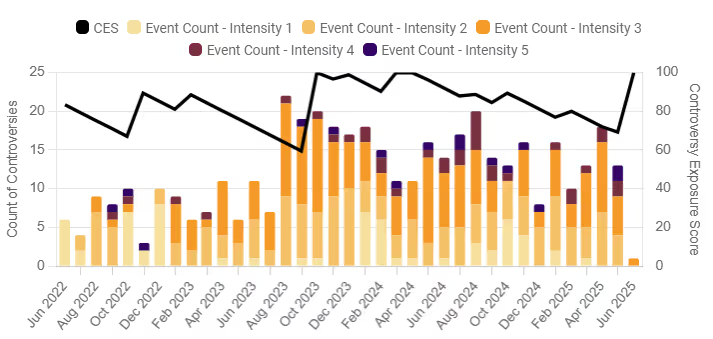
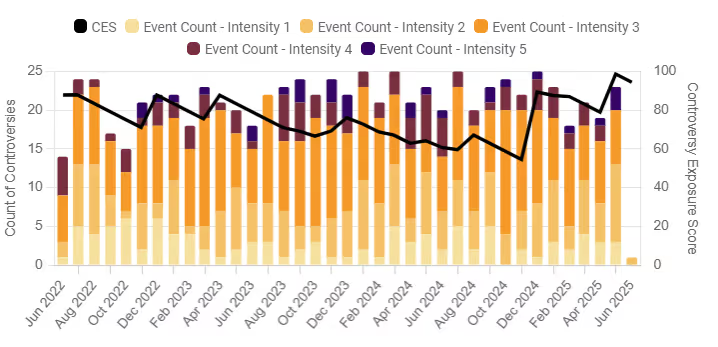
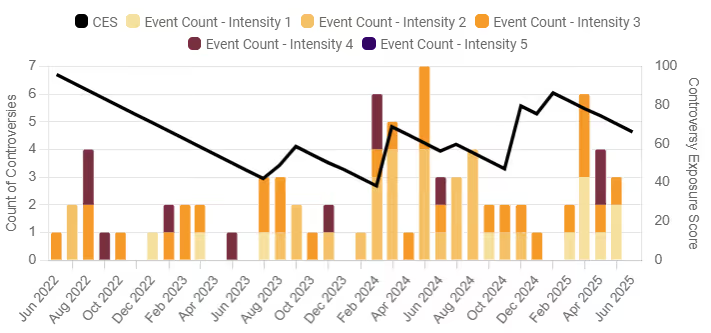
With summer here, travelers are turning to vacation rental platforms more than ever to plan their getaways. As these platforms grow, it’s important to understand the ESG controversies they face, impacting users, hosts, and local communities worldwide.
Vacation rental platforms like Airbnb, Booking.com, Expedia, and Tripadvisor have faced several ESG challenges recently, including regulatory issues, safety and privacy concerns, and social controversies related to housing affordability and community displacement. Different companies face varied risks: Airbnb deals with global restrictions and legal issues, Booking.com faces antitrust fines and tax disputes, Expedia contends with operational challenges, and Tripadvisor grapples with reputational concerns. All, however, must balance growth with ethical practices.
What are the most pressing ESG challenges currently facing the vacation rental sector? Read to find out.
Booking.com: Legal Storms and Mounting Fines
Booking.com has encountered various ESG risks due to regulatory scrutiny and legal issues. The company faced a €413 million fine in Spain for abusing market dominance with price parity clauses and a €94 million tax settlement in Italy for VAT compliance. Additionally, Russia penalized it for antitrust violations, while hotel operators in Japan filed lawsuits over unpaid fees. Legal scrutiny also surrounds its listings in the occupied West Bank, with investigations by Dutch prosecutors. In the U.S., a court ruled that Booking.com illegally scraped Ryanair’s website. Finally, a significant data breach exposed millions of guests’ sensitive information, raising cybersecurity concerns, and planned workforce reductions highlight ongoing operational risks for stakeholders globally.
Airbnb is facing significant regulatory and legal challenges globally, including Spain's order to remove over 65,000 listings, Italy's €576 million tax settlement, and stricter rental rules in Greece and France. In the US, cities like New York have imposed tight short-term rental limits, while Airbnb is dealing with class-action lawsuits in Canada and pricing accusations in Australia. Safety and privacy issues also plague the platform, including lawsuits related to guest deaths. Furthermore, Airbnb has been criticized for its listings on occupied Palestinian land and its impact on housing affordability. In 2023, the company cut 1,900 jobs, or about 25% of its workforce, increasing its ESG risks amidst evolving pressures.
Expedia Group faces several ESG risks, though generally less severe than its larger peers. Key challenges include a $33 million penalty in Australia for misleading hotel rates, 1,500 job cuts, antitrust investigations in Europe, and a $29.8 million payment under the Helms-Burton Act. Legal issues also involve unpaid commissions, tax avoidance claims, and COVID-19 flight refund disputes. Governance problems include executive departures and a reverse racism lawsuit, along with data breaches affecting millions. Overall, these risks are significant but less severe than those of competitors.
In conclusion, the vacation rentals sector faces significant ESG challenges that threaten its growth and credibility. Major players like Booking.com, Airbnb, and Expedia must address regulatory scrutiny, safety concerns, and social issues to meet the evolving expectations of travelers. By prioritizing transparency, community engagement, and compliance, these platforms can rebuild trust and promote responsible tourism. Embracing these changes not only mitigates risks but also positions them to lead in sustainable travel and reshape the future of vacation rentals.
Reach out to SESAMm
TextReveal’s web data analysis of over five million public and private companies is essential for keeping tabs on ESG investment risks. To learn more about how you can analyze web data or to request a demo, reach out to one of our representatives.
Stay ahead with the latest in ESG and AI intelligence
Join our mailing list to receive new reports, event invites, and updates from SESAMm directly to your inbox.




-1.avif)
.avif)



.png)