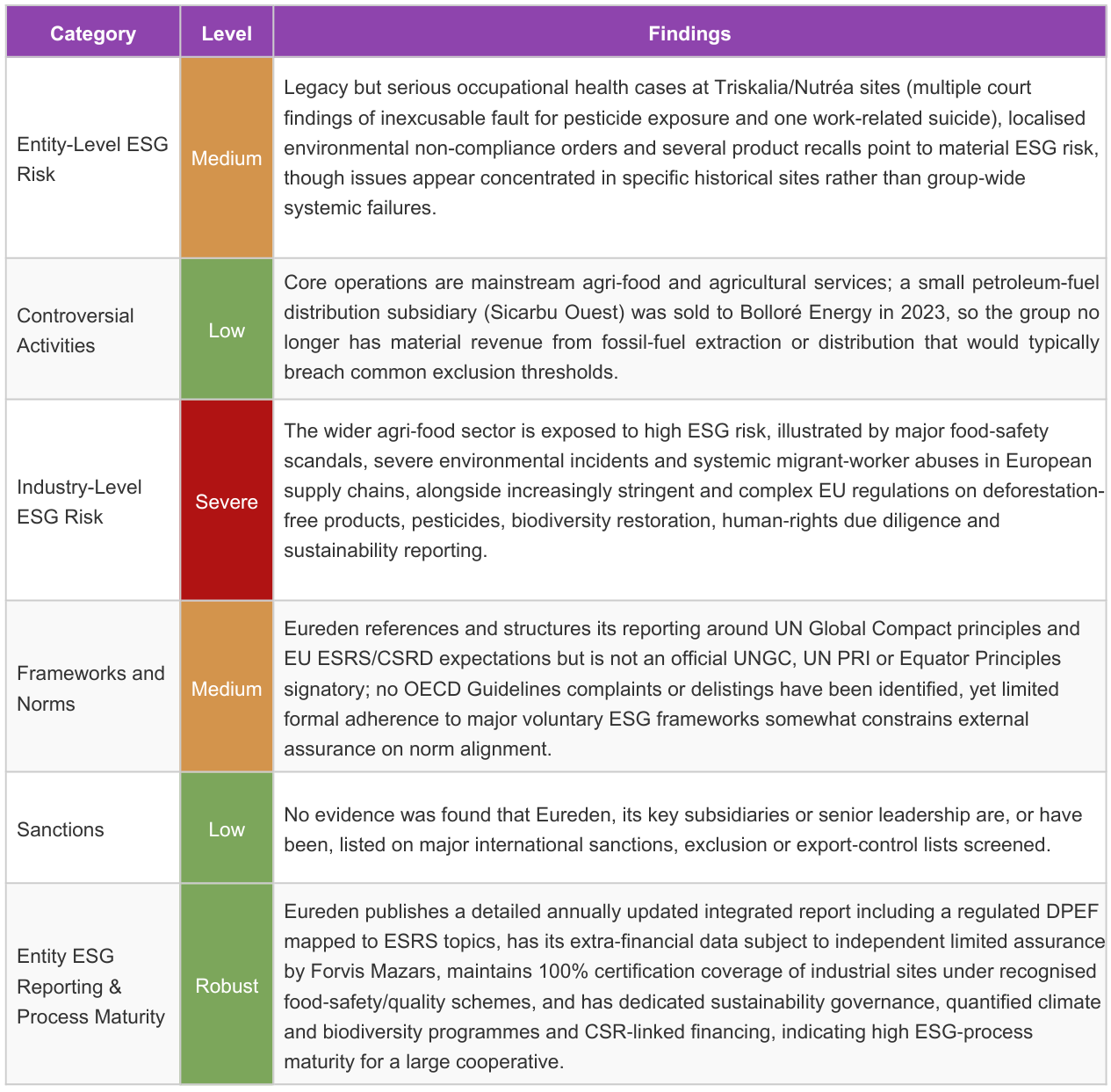
Eureden is a large farmer‑owned French agri‑food co‑operative headquartered in Brittany, combining upstream agricultural inputs and advice with downstream vegetables, eggs, meat/charcuterie, dairy, retail chains and labs across roughly 40 industrial sites in France, Germany, Spain and Hungary and generating about €3.7–3.8bn in annual revenue, according to its website and latest integrated report.
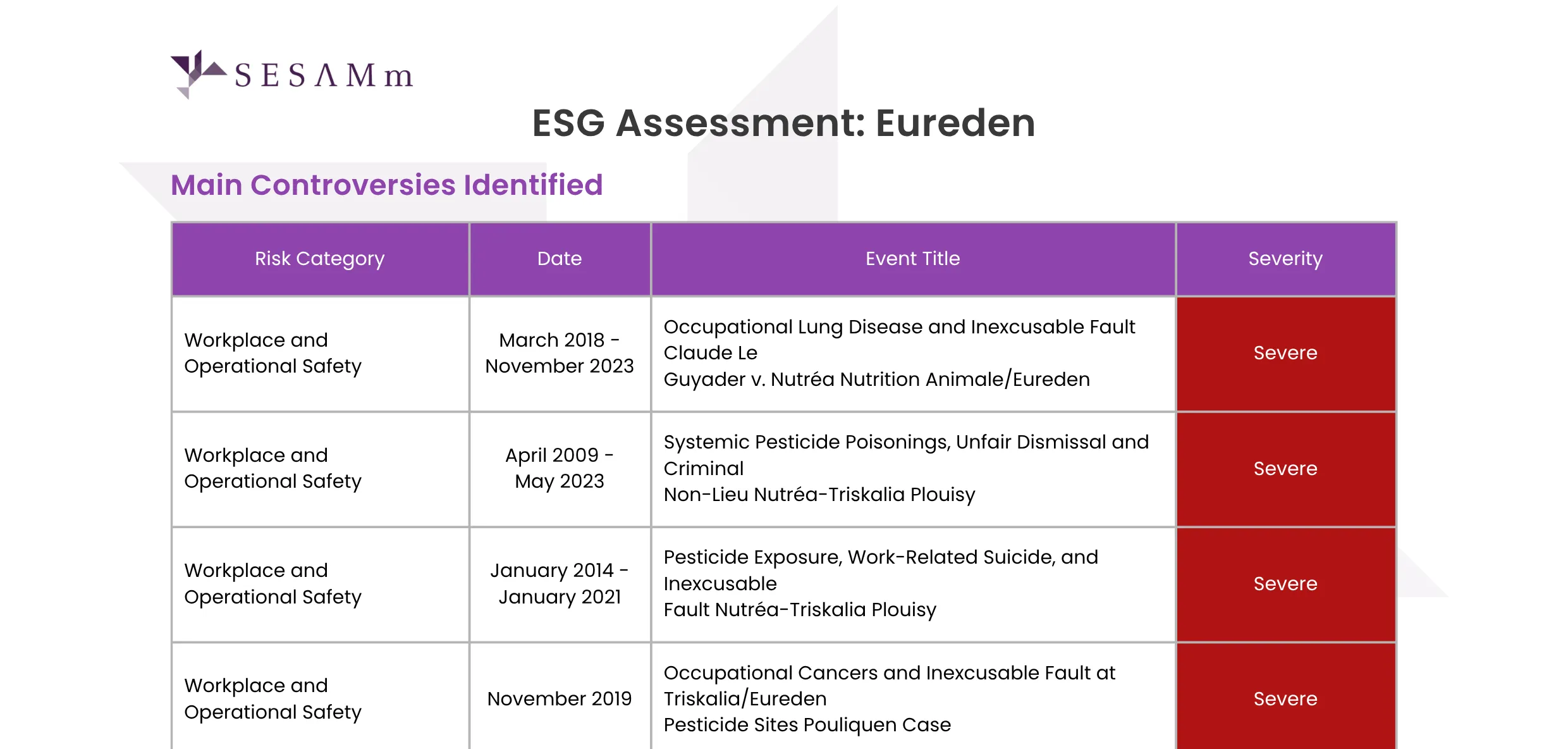
Eureden’s main ESG risks stem from legacy health‑and‑safety failings at Triskalia/Nutréa pesticide and feed sites, where French courts repeatedly recognised work accidents and occupational diseases as due to the employer’s “inexcusable fault” in pesticide‑exposure cases, including a worker suicide linked to workplace conditions, alongside other labour tensions, recurring though mostly precautionary food and allergen recalls, an environmental enforcement order against an ICPE site, and structural exposure to climate, biodiversity, animal‑welfare and chemical‑use risks from intensive livestock, pesticides and Seveso‑classified storage. At the same time, the company reports a relatively advanced CSR framework, high levels of external certifications (100% of industrial sites under at least one food‑safety/quality standard), externally assured integrated reporting with group‑wide ESG KPIs, CSR‑linked financing and programmes on pesticide reduction, non‑deforestation soy, climate, water and waste, while stating alignment with UN Global Compact principles without being a listed signatory; no international sanctions listings or OECD complaints involving Eureden were identified in public sources.
Reach out to SESAMm
SESAMm's web data analysis of over five million public and private companies is essential for keeping tabs on ESG investment risks. To learn more about how you can analyze web data or to request a demo, reach out to one of our representatives.
With all the buzz around Generative AI, it’s easy to forget that artificial intelligence (AI) has been driving innovation across industries for years. Environmental, Social, and Governance (ESG) and risk management are no different. However, at the rate AI is advancing and as the amount of raw data available for analysis continues to expand, the need to understand AI is more pressing than ever.
AI is transforming ESG, turning complex data into predictive insights and reshaping our approach to risk. But what does this mean for the industry, and how can professionals leverage this technology to maintain a competitive edge? The future of AI in ESG and risk management is not just a matter of technological advancement but a narrative of how we evolve with it.
This ebook dives into how AI works when applied to ESG, shares a few practical examples of what it looks like in real life, and offers a few predictions for what comes next.
Dive deeper into the mechanics of how AI works in ESG and equip your organization with the insights needed to enhance your ESG practices. Fill out the form below to access your copy.
In this issue of the "what investors ought to know about…" series, we'll cover natural language processing (NLP), a tool that draws from the computer science and computational linguistics disciplines. In the last topic, we discussed knowledge graphs as the core of text analysis. And if knowledge graphs are the core of the data’s context, NLP is the transition to understanding the data.
What is natural language processing?
Natural language processing is an artificial intelligence (AI) technology that automates the data analysis of mined textual, unstructured data to include natural language understanding and natural language generation to simulate a human's ability to create language. It combines computational linguistics with machine learning and deep learning models, performing a special linguistic analysis by algorithms so a machine can "read" text.
Where is natural language processing used?
Today, various industries use NLP, from email filters to virtual assistants and search engines to chatbots. Here's a list of common ways natural language processing is used:
Chatbots: Chatbots are computer programs that use NLP. They simulate human conversation by identifying a sentence's intent, determining suitable topics, keywords, and emotions, and calculating the best response based on the data's interpretation.
Email filters: Email filters apply machine learning using many data samples to sort emails into the right inbox.
Machine translation: Translation software like Google Translate or Microsoft Translator use NLP to translate text from one language to another, such as English to French.
Natural language generation (NLG): NLG, a subfield of NLP, builds applications or computer systems that can automatically produce natural language texts of various types by using a semantic representation as input. Applications of NLG include question answering and text summarization.
Predicting and autocorrecting text: Predictive text and autocorrect use NLP to recognize and recall commonly used words and names to make text suggestions and correct common errors.
Search engines: Search engines like Google search use NLP machine learning to interpret a searcher's intent and provide relevant results. It can even suggest subjects and topics related to the query the searcher might be interested in.
Virtual and voice assistants: Virtual assistants like Apple's Siri or Amazon's Alexa use NLP technology to understand and respond to voice requests. Speech-to-text can dictate messages and notes, and speech recognition can control everything from smartphone apps and smart speakers to thermostats and home security systems.
Web sentiment analysis: Sentiment analysis automates classifying opinions in a text as positive, negative, or neutral. It's a method companies like SESAMm use to monitor sentiments like a brand's sentiment on the web and social media.
Why natural language processing is important to uncover financial-related alternative data
NLP is important because it helps resolve human language ambiguity in big datasets (big data). Languages are complex, diverse, and expressed in unlimited ways, from speaking hundreds of languages and dialects to having a unique set of grammar and syntax rules, slang, and terms for each. In text form, these variables are unstructured text. But with NLP, we can transform unstructured data into structured data and make sense of it.
Because of NLP's power, investors can research and analyze unstructured data from the web to gain insights into financial and ESG data. You can use this wealth of information to focus on systematic data processing, risk management, and alpha discovery through contexts, such as:
Major global indices sentiment
Euronext exchange sentiment
Private company sentiment
ESG risks for public and private companies worldwide
A quick overview of how natural language processing works at SESAMm
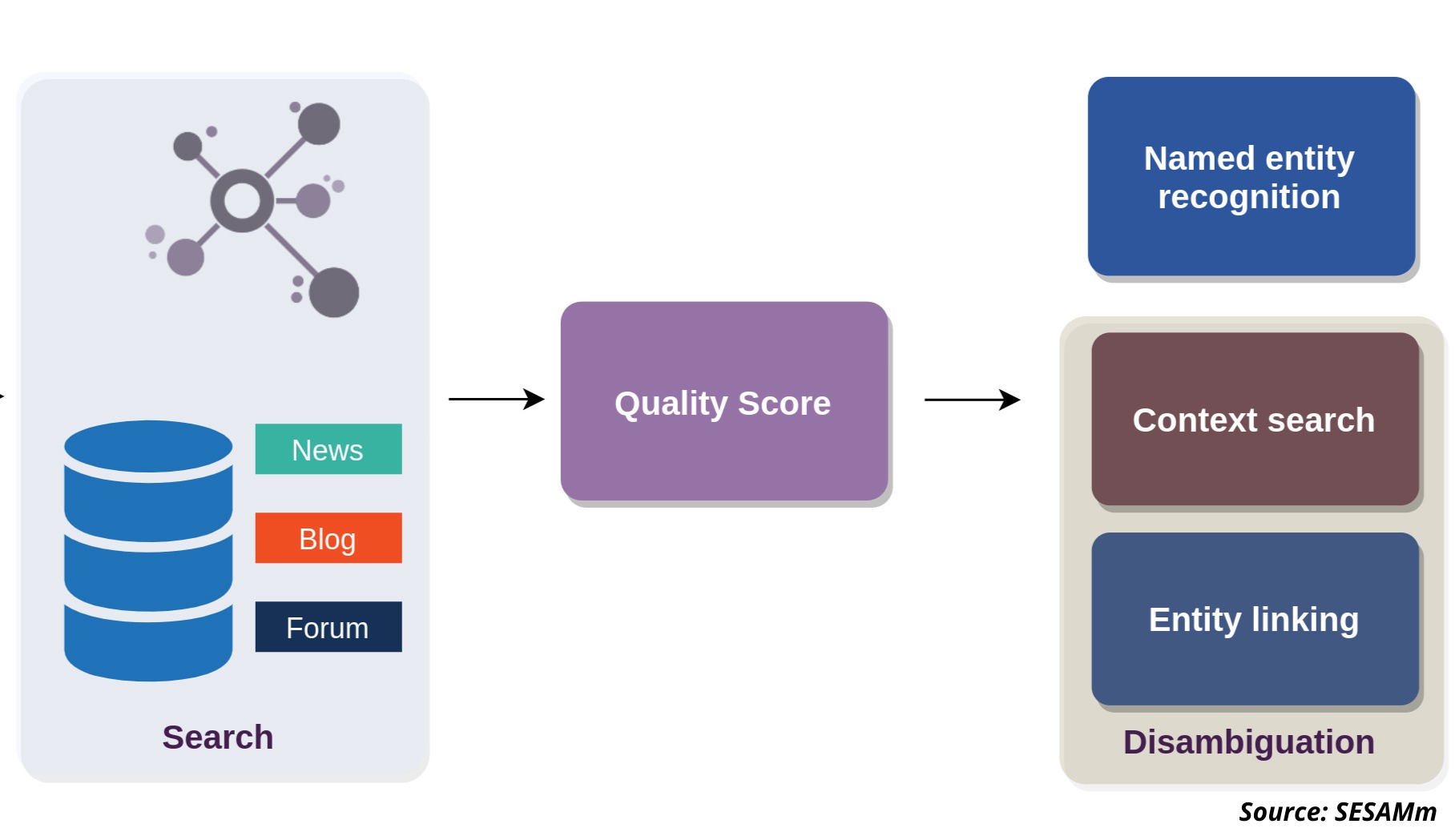
At SESAMm, we use named entity recognition (NER), which extracts the names of people, places, and other entities from text, and then named entity disambiguation (NED) to identify named entities based on their context and usage. For example, text referencing "Elon" could refer indirectly to Tesla through its CEO or a university in North Carolina. NED considers the context when classifying entities for an accurate match. Compared to simple pattern matching, which limits the number of possible matches, requires frequent manual adjustments, and can't distinguish homophones, NED is superior.
Process representation for NER and NED.
When identifying entities and creating actionable insights, SESAMm uses three other NLP tools: lemmatization and stemming, embeddings, and similarity. The lemmatization process normalizes a word into its base form (morphology) to help identify and aggregate entities. Embedding assigns the entity a numerical value to help analyze how words change meaning depending on context and understand the subtle differences between words that refer to the same concept—similarity measures whether two words, sentences, or objects are close to one another in meaning.
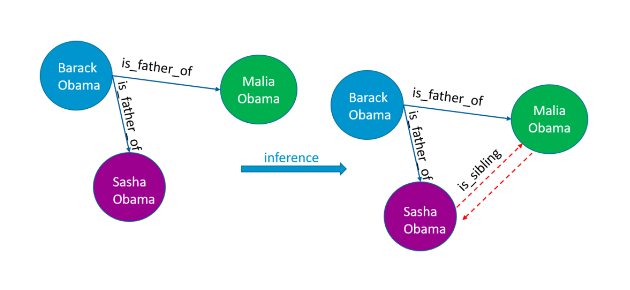
Representation of nodes in a knowledge graph.
Of course, NLP couldn't function without the core of the text analytics process: knowledge graphs. A knowledge graph is a digital representation of a network of real-world entities, the foundation of a search engine or question-answering service. This structured data model puts the schema in context through semantic metadata and linking, providing a framework for analytics, data integration, sharing, and unification. In other words, it's like a map and legend, with the legend labeling the concepts, entities, and events and the map connecting and identifying their relationships. These details are stored in a graph database and visualized as a graph representation, hence the term knowledge graph.
SESAMm's natural language processing platform for investment research and analysis
SESAMm is the leading provider of natural language processing and machine learning solutions and analytics for investment firms and corporations.
As 2024 comes to a close, I’m proud to reflect on SESAMm’s achievements and energized by the opportunities that lie ahead. This year has been a milestone for our growth, partnerships, and technological advancements, setting a strong foundation to tackle the challenges and embrace the possibilities of 2025.
Looking Back on 2024: Key Achievements
Strengthening Client Partnerships and Expanding Our Reach
This year, SESAMm welcomed an impressive roster of new clients, in particular working more closely with LPs such as Swen Capital, banks, and asset managers such as Natixis, alongside numerous mid-market asset managers and private equity funds. These organizations are turning to SESAMm for more control over their ESG data and access to granular controversy insights, reaffirming our role as a trusted partner in sustainable finance. We also launched impactful partnerships with Ramboll, ARX, FinGreen, and CybelAngel, among others, broadening our reach and capabilities.
Building a Stronger Team and Advancing Our Technology
Internally, we strengthened our team with strategic hires, including our first team member in Canada, to better support our clients locally. On the technology front, we achieved significant milestones: introducing new platform features, launching a comprehensive product documentation help page, and reaching the capacity to process nearly 30 billion documents—our largest scale yet.
Adapting to a Dynamic ESG Landscape
Globally, the ESG landscape was marked by notable developments. Europe focused heavily on CSRD compliance, while Asia advanced new ESG mandates and regulations in South Korea, Japan, and Singapore. Despite regulatory shifts in the U.S., SESAMm experienced strong growth in North America, demonstrating our ability to adapt and thrive globally.
Innovating with Generative AI
This year also saw the integration of generative AI into our solutions, reshaping how we deliver value to clients. Risk Reveal, for example, enables automated controversy report generation and real-time insights.
Looking Ahead to 2025: Rising to ESG Challenges
Embracing ESG Challenges
As we close out 2024, the momentum in ESG shows no signs of slowing down. With new regulations like CS3D and evolving global frameworks, companies face mounting demands to monitor not only their investments but also their supply chains while improving transparency across the board. SESAMm remains committed to enhancing its tools to meet these challenges, delivering faster, more actionable insights to corporate and investment clients alike.
Harnessing the Potential of AI
The evolution of AI presents a major opportunity. Advances in generative models will enable us to further increase the scale and quality of our data processing. Our focus will remain on refining interpretation and reporting capabilities, empowering clients to make smarter, data-driven decisions on millions of companies with minimal friction.
The year ahead will undoubtedly bring its share of challenges, but it also holds incredible potential for progress. SESAMm is committed to remaining at the forefront of ESG and AI innovation, helping businesses not only adapt to change but lead it. None of this progress would be possible without the trust and collaboration of our clients, partners, and team members. Thank you for making this year a success. Together, we are shaping the future of finance and sustainability. Here’s to another year of growth, innovation, and positive impact in 2025!
Reach out to SESAMm
TextReveal’s web data analysis of over five million public and private companies is essential for keeping tabs on ESG investment risks. To learn more about how you can analyze web data or to request a demo, reach out to one of our representatives.
Stay ahead with the latest in ESG and AI intelligence
Join our mailing list to receive new reports, event invites, and updates from SESAMm directly to your inbox.






.png)