Executive Breakfast: Double Materiality in a World of AI
09/30/2026
•
5 mins read
Swiss institutions are being asked to measure exposures that were never disclosed in the first place. FINMA Circular 2026/1, in force since January 2026, moves banks and insurers from climate disclosure to nature-related risk management, and the measurement problem lands well before the 2028 deadline.An asset owner and a private bank open the discussion: where they actually struggle to measure, what they built internally, and what they chose not to build. Inrate and SESAMm answer from the data side. One question runs through the session: does sustainable investing have a data problem, or a classification problem? Our panellists do not agree, which is the point.
Agenda
8:30
Breakfast and networking
9:00
Opening remarks
SESAMm and Inrate
9:20
Panel — Double Materiality in a World of AI
Moderated by Romain Leroy-Castillo, Swiss
Sustainable Finance
10:00
Audience Q&A
10:15
Closing remarks and networking
Speakers
Nicolas Barben
Group Head of Sustainable Investment UBP
Sasha Cisar
Specialist for Sustainable Investments Nest
Saurabh Srivastava
Managing Director Inrate
Sylvain Forté
CEO SESAMm
Romain Leroy-Castillo (Moderator)
Director Artificial Intelligence and Education Swiss Sustainable Finance
With 2023 drawing to an end, we wanted to share the most relevant ESG controversies during the year. In this article, we provide a comprehensive overview of the year's top ESG controversies, breaking them down into the three pillars of ESG: Environmental, Social, and Governance. Through our research, we will explore each of these areas in detail, shedding light on the most talked-about controversies and the companies involved.
Methodology
To gain a comprehensive understanding of the ESG risks in 2023, we conducted a thorough analysis of web mentions related to SESAMm’s ESG taxonomy across our expansive data lake with 20B+ articles. This allowed us to evaluate the overall volume of mentions related to each risk category: Environmental (E), Social (S), and Governance (G).
ESG Risks Over Time
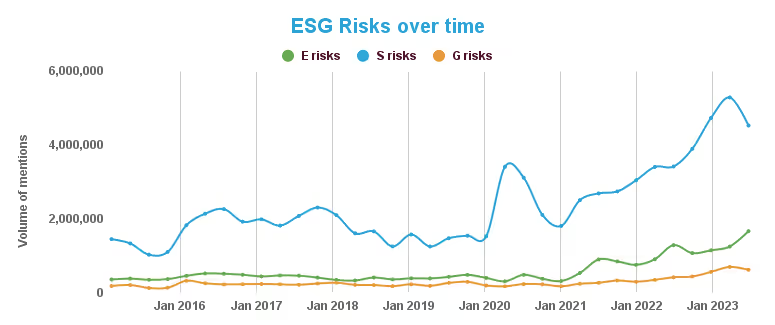
Before diving into the details, we looked into the main trends over the last few years in ESG trends. We found a detectable increase in the volume of ESG-related web mentions, with an emphasis on social risks. Especially since the start of 2020, social risks have been on a consistent upward trajectory. Notably, there was a significant spike in mentions around mid-2020 following mass protests amid the COVID-19 lockdown, in addition to reports of cyberattacks and allegations of sexual assault. Furthermore, 2021 saw an uptick in mentions related to issues of racism (Black Lives Matter movement) and homophobia.
Figure 1: ESG risks over time.
ESG Risks: Focus 2023
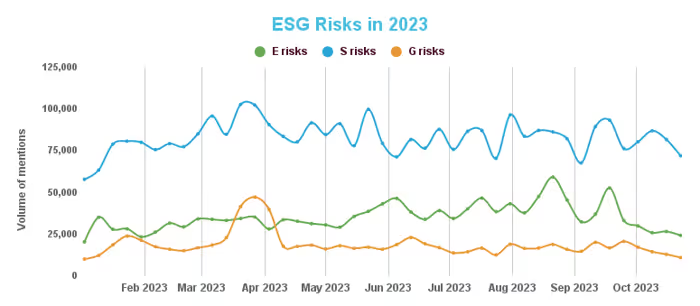
We outlined the prominent risks in 2023: social risks, with layoffs and strikes gaining attention; environmental risks, marked by wildfires and oil spills; and governance risks, where tax evasion and ethical violations like bribery were in focus. Each risk category underscores the urgent issues facing society and the need for accountability and action.
Figure 2: ESG risks in 2023.
Environmental Controversies of 2023
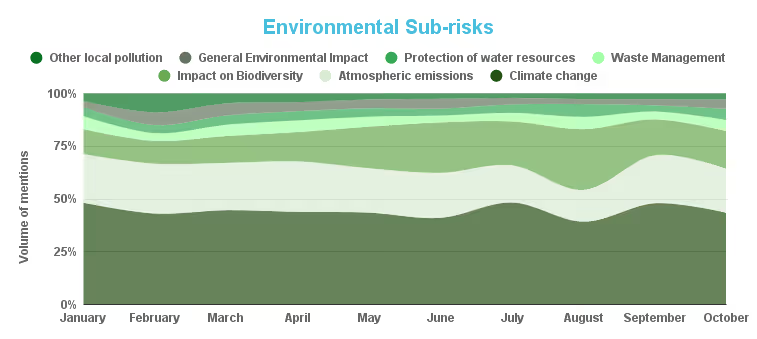
Environmental risks may not match the sheer number of mentions that social risks receive, but their presence in discussions has steadily grown over the year, particularly in the third quarter. Let's explore the most common controversies that have emerged.
Climate Change and Policy
Climate change dominated environmental discussions in 2023. A noticeable peak in mentions arose in the latter half of the year, particularly around heatwaves and debates surrounding climate policies.
Atmospheric Emissions
September saw increased discussions about atmospheric emissions, notably due to the emissions from volcanic eruptions, hybrid cars, and the discovery of toxic metals in food products.
Impact on Biodiversity
The wildfires that spread in June sparked significant debates around their impact on biodiversity, leading to increased mentions and concerns related to environmental preservation.
Figure 3: Top environmental sub-risks in 2023.
Top 5 Environmental Controversies
These controversies are ranked by relative volume*.
Marathon Petroleum
Volume of mentions: 62
Relative volume: 69%
A significant portion of environmental risk discussions surrounding Marathon Petroleum was due to its chemical leak in Garyville. This incident led to massive fires, so large they could be observed from space. (source)
Nestlé
Volume of mentions: 30
Relative volume: 54%
Nestlé faced scrutiny in 2023, with over half of its environmental risk mentions associated with drought controversies. The company was urged to cease its water mining activities following severe droughts in France. (source)
Coca-Cola
Volume of mentions: 178
Relative volume: 53%
Coca-Cola garnered attention due to a hydrochloric acid leak in January 2023, leading to significant environmental concerns. (source)
ExxonMobil
Volume of mentions: 571
Relative volume: 31%
Exxon, along with Guyana’s environmental agency, was implicated in breaches of oil spill insurance policies. (source)
Shell
Volume of mentions: 872
Relative volume: 23%
An oil spill from a Shell pipeline adversely affected farms and a river in a region of Nigeria already grappling with pollution. (source)
Social Controversies of 2023
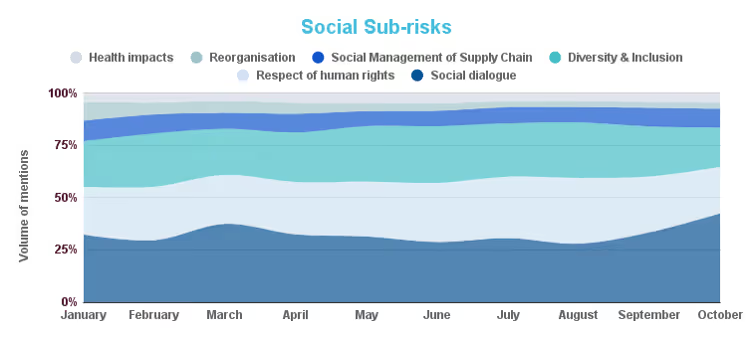
Social risks have taken the forefront in 2023, with notable web mentions increasing significantly. Here are the most relevant controversial topics:
Social Dialogue
Social discourse intensified at the start of the year, with news of widespread strikes in various sectors, including aviation and education, primarily driven by pay disputes. The wave of layoffs in several tech companies was the talk of the town, especially during the first quarter of the year.
Discrimination against minority groups, including the LGBTQ community and people of color, and age-based discrimination became a significant topic of discussion in 2023.
Figure 4: Top social sub-risks in 2023.
Top 5 Social Controversies
These controversies are ranked by relative volume*.
McDonald's
Volume of mentions: 8,903
Relative volume: 87%
McDonald's faced substantial social risks in 2023 due to significant layoffs of its corporate staff in April. The move led to public concern and discussions around the company's employment practices and stability. (source)
Google
Volume of mentions: 13,504
Relative volume: 43%
Google found itself in the spotlight as it faced challenges related to major layoffs in January and October of 2023. These layoffs contributed to almost half of the social risk mentions associated with the tech giant. (source)
Meta
Volume of mentions: 10,965
Relative volume: 38%
Meta, formerly known as Facebook, also faced scrutiny as 38% of the company's social risk mentions revolved around layoffs that took place in March and October 2023. (source)
Microsoft
Volume of mentions: 6,060
Relative volume: 28%
Microsoft faced challenges due to disruptions caused by cyberattacks in early June. In addition, the company had to navigate through controversies related to layoffs, contributing to its social risks. (source)
X (formerly Twitter)
Volume of mentions: 7,246
Relative volume: 8%
X/Twitter experienced a global outage, which was followed by significant layoffs. These events led to considerable public discussions and social risks for the company. (source)
Governance Controversies of 2023
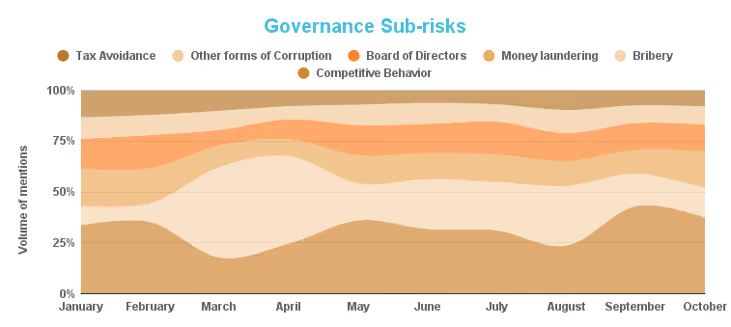
Governance risks, though often overlooked, play a pivotal role in shaping corporate responsibility and ethical conduct. In 2023, several governance controversy trends emerged:
Money Laundering
Tax evasion was a major topic of discussion in the first quarter, highlighting the need for greater transparency and accountability within corporations.
Bribery
There was a significant increase in mentions related to bribery cases, underscoring the challenges in maintaining ethical governance standards.
These controversies are ranked by relative volume*.
FTX
Volume of mentions: 8,085
Relative volume: 40%
FTX, a notable entity in the financial sector, found itself at the center of governance controversies. A significant portion of the discussions surrounding FTX's governance risks in 2023 pertained to allegations of its founder's involvement in bribery schemes. (source)
Apple
Volume of mentions: 3,162
Relative volume: 28%
Apple, a tech giant, faced scrutiny as a third of its governance risk mentions revolved around antitrust violations reported in October 2023. (source)
Microsoft
Volume of mentions: 4,429
Relative volume: 25%
Microsoft encountered legal challenges with its deal with Activision. The company had to approach the court to reject the FTC's request to halt the deal. (source)
X (formerly Twitter)
Volume of mentions: 2,251
Relative volume: 18%
X/Twitter, another major player in the tech industry, faced legal challenges when a judge dismissed a shareholder lawsuit against Elon Musk concerning a Twitter buyout. (source)
Google
Volume of mentions: 3,920
Relative volume: 13%
Google faced judicial sanctions for allegedly destroying evidence in an antitrust case, further emphasizing the critical governance challenges even major tech giants face. (source)
Conclusion
In conclusion, the year 2023 proved to be eventful in the ESG landscape. From environmental concerns sparked by significant events like chemical leaks and wildfires to social challenges such as widespread layoffs and discrimination and governance risks underscored by bribery and antitrust violations, the year offered a comprehensive view of the myriad challenges companies face in the modern era.
Understanding these controversies and the companies involved provides invaluable insights for stakeholders, especially in the private equity and asset management sectors. AI-driven ESG insights, like those provided by SESAMm, can be pivotal in navigating the ever-evolving ESG landscape, ensuring informed decision-making and proactive risk management.
Relative volume*: Relative to the total volume of E, S, or G risks for the company during the same period.
SESAMm’s AI Technology Reveals ESG Insights
Discover unparalleled insights into ESG controversies, risks, and opportunities across industries. Learn more about how SESAMm can help you analyze millions of private and public companies using AI-powered text analysis tools.
In the digital age, data proliferates at an astonishing rate. From news articles to social media posts, the information explosion presents unique challenges in processing and understanding content accurately. One significant challenge is distinguishing between entities with similar or identical names in different contexts. named entity disambiguation (NED) is a sophisticated technology within natural language processing (NLP) aimed at tackling this issue. This technology ensures that when you search for "Orange," the results accurately reflect whether you meant the color, the fruit, or the multinational corporation. This article explores the concept of NED, underscores its importance, and elaborates on how SESAMm employs this technology to stand out from other companies in the artificial intelligence (AI) landscape.
What Is Named Entity Disambiguation?
Named Entities: Defining the Basics
In data science and text processing, a named entity is defined as any real-world object that can be denoted with a proper name. This includes people like "Elon Musk," companies like "Google," and landmarks like "Mount Everest." These entities are distinct because they refer to unique individuals, organizations, or locations, unlike common nouns such as "manager" or "river," which are non-specific and can refer to many different entities globally.
Named Entities: Defining the Basics
Named Entity Disambiguation, also known as entity linking, involves identifying which specific entity is referred to in an unstructured text when there are multiple candidates with similar names. This process utilizes a blend of machine learning, knowledge graphs, and other sophisticated NLP algorithms to analyze the text and determine which entity type is relevant in the given context. This determination is important because it affects the interpretation and subsequent processing of the information.
The Importance of Named Entity Disambiguation
The role of NED in text analysis and information processing cannot be overstated, particularly when dealing with large and complex datasets. It enables:
Refined text analytics: For tasks like sentiment analysis, precise entity recognition ensures that emotions or sentiments are accurately associated with the right entities. This is crucial for businesses to understand public perceptions of their products or services accurately.
Efficient construction of knowledge graphs: Knowledge graphs that organize and link real-world information rely heavily on NED to accurately populate and update their data. This accuracy is essential for applications like digital assistants, which use these graphs to provide informed responses to user inquiries.
The Importance of Named Entity Disambiguation
NED is a complex process that involves multiple steps and methodologies to accurately identify and link named entities in a given text to their correct real-world counterparts.
1. Identifying Named Entities
Before disambiguation can occur, named entities must first be identified within a text. This is typically done using named entity recognition (NER), a preliminary step that involves scanning text data to locate and classify entities into predefined categories such as person names, organizations, locations, dates, and other specific information.
Techniques Used in NER
Rule-based systems: These utilize patterns and linguistic rules, such as capitalization or context indicators (e.g., titles like Mr. or corporate designators like Inc.), to identify entities.
Statistical methods: Techniques like Hidden Markov Models (HMMs) or Conditional Random Fields (CRFs) learn from large datasets of annotated text to recognize entities based on probabilistic models.
Deep learning approaches: More recently, models based on neural networks, particularly those using architectures like LSTM (Long Short-Term Memory) or transformers, have become prevalent. These models benefit from large amounts of training data and have shown superior ability to capture context for more accurate entity recognition.
2. Categorizing Named Entities
Once entities are identified, they need to be categorized accurately. This involves classifying each entity according to its type, which helps in narrowing down the possible meanings in the subsequent disambiguation step.
Methods for categorization
Fine-grained classification: Beyond basic categories, entities can be classified into more specific classes, such as distinguishing between types of organizations (e.g., non-profit vs. corporate) or public figures (e.g., politician vs. artist).
Contextual classification: It involves analyzing the surrounding text to understand an entity's role and relevance, using both the immediate context and broader discourse.
3. Disambiguating Named Entities
The core of NED lies in its ability to distinguish between entities that share the same name. This step is critical because it determines the accuracy of information extraction, search engines, knowledge graph construction, and other NLP applications.
Core Techniques in Disambiguation
Rule-based disambiguation: Applies heuristic rules based on linguistic cues and patterns, such as geographical proximity or typical associations (e.g., Apple might be linked to "technology" if the context involves words like "iPhone" or "MacBook").
Machine learning models: Supervised learning models are trained on datasets where each entity is annotated with its correct reference. These models learn to predict the correct entity based on features extracted from the context.
Unsupervised and semi-supervised methods: These involve clustering similar entities and using algorithms to predict the most likely meaning based on the densities of clusters and the contextual similarity.
Knowledge-based approaches: Utilize large external databases or knowledge graphs that contain information about entities and their relationships. By querying these resources, NED systems can pull contextual information and metadata to resolve ambiguities. For example, linking to a specific Wikipedia page can clarify whether "Jordan" refers to the country, the river, or the basketball player, based on the context.
4. Linking Entities to External Databases or Knowledge Graphs
The final step in NED is often linking the disambiguated entity to a unique identifier in an external database or a node in a knowledge graph. This linkage not only confirms the entity’s identity but also enriches the text with semantic information that can be used for further processing and analysis.
Linkage methods
URI Assignment: Each entity is assigned a unique resource identifier (URI) that points to a specific location in a database or a knowledge graph.
Semantic tagging: Entities are tagged with semantic labels that provide additional metadata, enhancing the richness of the data for subsequent analytical tasks.
The combination of these techniques ensures that NED systems can operate with high accuracy and efficiency, making them indispensable in the field of NLP. By understanding and implementing these processes, SESAMm enhances its analytical capabilities, offering precise and context-aware solutions that stand out in the competitive AI landscape.
SESAMm's Innovative Approach to NED
SESAMm has carved a niche in the NLP field by incorporating advanced, proprietary technologies that refine and enhance the NED process:
Cutting-edge algorithms: SESAMm develops and deploys state-of-the-art machine learning approaches and deep learning algorithms designed to increase the precision and reliability of entity disambiguation.
Scalable data processing: SESAMm's platforms are engineered to handle extensive data volumes, making them well-suited for large-scale industrial applications that require robust data analysis capabilities.
Customizable APIs: SESAMm offers adaptable APIs that clients can tailor to fit specific project requirements, whether for financial analysis, marketing research, or other specialized areas.
Seamless knowledge graph integration: By integrating its NED processes with dynamic knowledge graphs, SESAMm enhances its semantic analysis capabilities, enabling deeper insights and more accurate data interpretations.
Conclusion
Named Entity Disambiguation is a fundamental component of modern NLP applications, essential for interpreting the enormous volumes of data generated daily. By accurately identifying and categorizing named entities, NED not only deepens the understanding of text but also improves the efficiency of information processing. SESAMm's approach to NED sets it apart in the AI analytics field, pushing the boundaries of what's possible with smart, context-aware technology solutions. To learn more about SESAMm’s innovative technology and how it is used to identify ESG controversies, request a demo.
Reach out to SESAMm
TextReveal’s web data analysis of over five million public and private companies is essential for keeping tabs on ESG investment risks. To learn more about how you can analyze web data or to request a demo, reach out to one of our representatives.
Luxury brand Loro Piana, owned by LVMH, has been placed under a one-year judicial administration by an Italian court after a labor exploitation investigation uncovered serious abuses within its supply chain. According to Reuters, workers at a subcontracted factory were paid as little as €4 per hour and subjected to 90-hour workweeks, often living inside the premises. One worker was reportedly attacked after requesting unpaid wages, requiring 45 days of medical treatment. The case highlights the growing scrutiny of labor conditions in Italy’s fashion manufacturing sector, especially among high-end labels. Loro Piana is now the fifth luxury brand, joining Dior, Armani, Valentino, and Alviero Martini, under court supervision due to supplier-related violations.
A Complicated Web of Subcontracting
What sets this case apart is the complexity of the supply chain. Loro Piana did not contract directly with the workshop where the violations occurred. Instead, it worked through two front companies, both of which lacked actual manufacturing capacity. These intermediaries then subcontracted the work to a network of unregistered or poorly monitored producers. All the firms involved in this chain have been swept up in the investigation.
This multi-tier outsourcing structure made it difficult to detect violations and raises questions about accountability. The Milan court noted that Loro Piana "culpably failed" to supervise its partners, prioritizing cost and output over due diligence.
Why It Matters
Luxury brands trade on trust and exclusivity. Consumers expect not just quality, but integrity, especially regarding sourcing. When serious labor violations are revealed, the reputational risks extend far beyond one product or supplier. They affect brand credibility, investor confidence, and long-term consumer loyalty.
This incident also reinforces a trend: regulators are increasingly willing to intervene when voluntary monitoring fails. Judicial administration isn’t just symbolic; it’s a legally binding oversight mechanism aimed at forcing systemic change.
The Path Forward
For fashion brands, this is a clear signal that supply chain governance must go deeper. That includes mapping indirect suppliers, improving transparency around subcontracting, and enforcing ethical standards at every level. Simply trusting the next link in the chain is no longer enough.
In a sector built on craftsmanship and heritage, safeguarding those values behind the scenes is just as important as what ends up on the runway.
SESAMm’s AI Technology Reveals ESG Insights
Discover unparalleled insights into ESG controversies, risks, and opportunities across industries. Learn more about how SESAMm can help you analyze millions of private and public companies using AI-powered text analysis tools.
Stay ahead with the latest in ESG and AI intelligence
Join our mailing list to receive new reports, event invites, and updates from SESAMm directly to your inbox.

%20(1240%20x%20592%20px)%20(1).jpg)











.png)