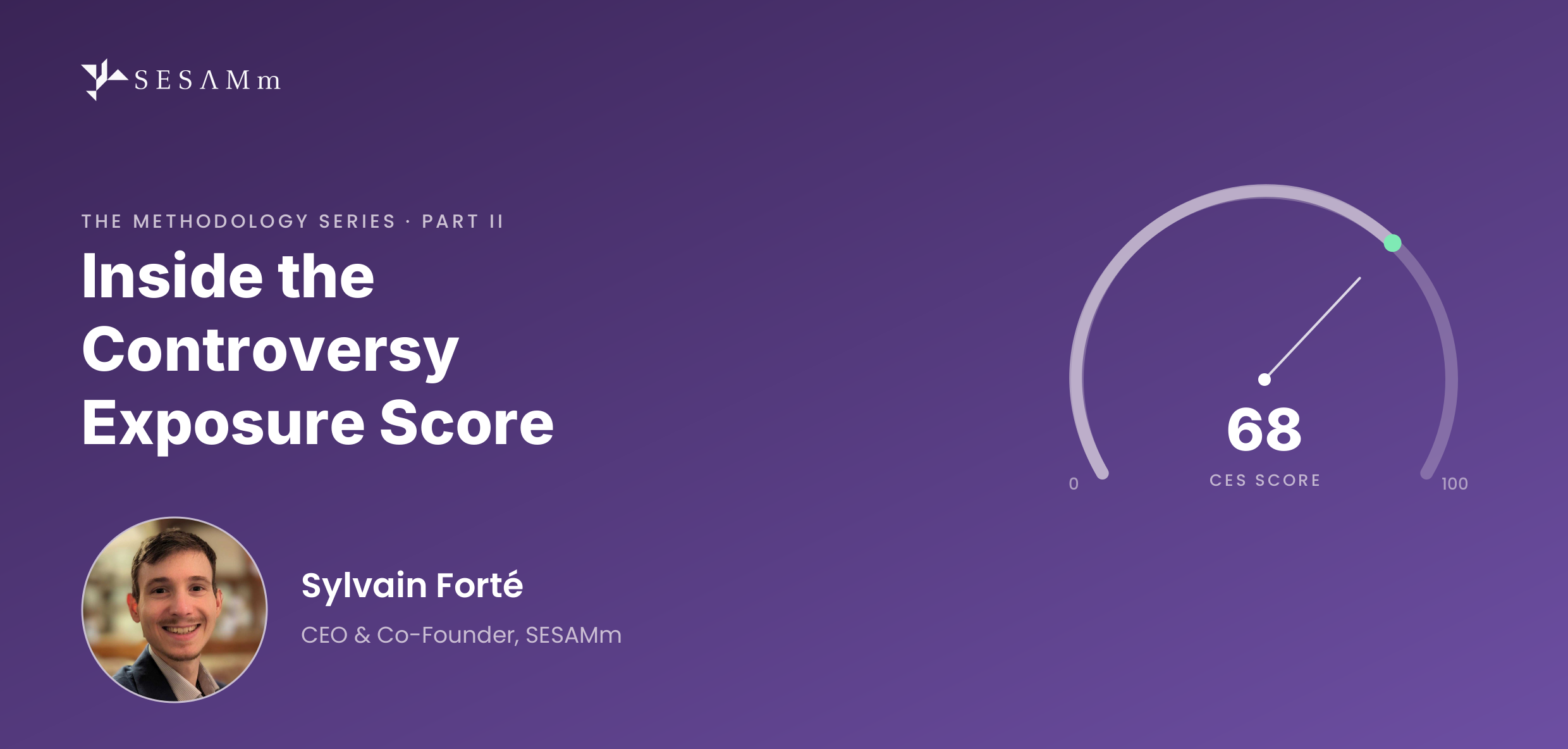
Inside the Controversy Exposure Score: How SESAMm Turns Controversies into a 0 to 100 Rating
07/15/2026
•
5 mins read
A single number is a powerful thing. It can summarise months of reporting across dozens of sources into something a risk team can act on in seconds. It can also hide more than it reveals, if no one explains how it was built. When the same company receives very different ESG scores from different providers, the usual reason is not bad data. It is undisclosed method.
SESAMm has published the full methodology behind its Controversy Exposure Score, free to access, following the entry into force of the EU ESG Rating Regulation on 2 July 2026. This article walks through what the score measures, how it is constructed, and the two design choices that most distinguish it.
What the Score Measures
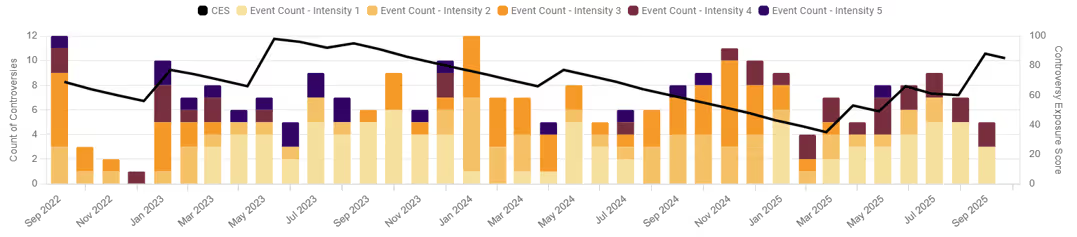
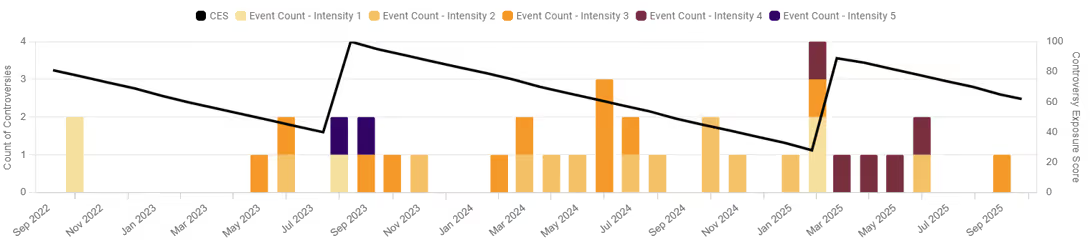
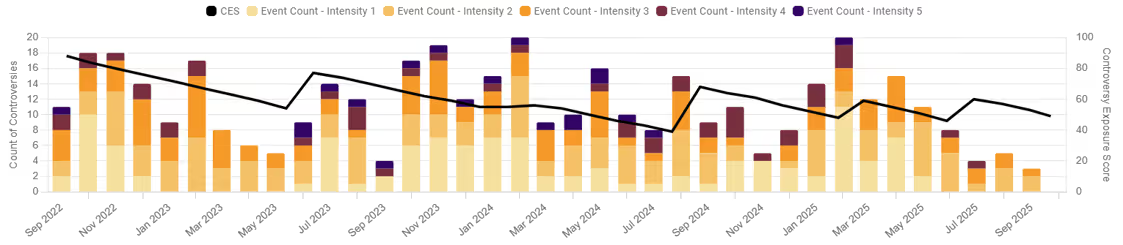
The Controversy Exposure Score, or CES, runs on an absolute scale from 0 to 100 and is grouped into five risk bands, from Very Low to Very High. It has a single, deliberately narrow objective: to measure an entity's exposure to ESG controversies, meaning adverse events and conduct attributed to that entity as reported in public sources.
Three points define its scope from the outset. The CES is an impact-materiality measure. It looks at the negative footprint of an entity's activities on people and the environment, not the financial effect of ESG issues on the company itself. It is backward-looking. It reflects controversies that have already been reported, over a rolling 24-month window, rather than forecasts or transition pathways. And it is built only from public and licensed public-domain information, never from private, confidential or self-reported data.
From Millions of Articles to a Single Case
Before any score can exist, raw coverage has to become structured information. This is where most of the engineering sits.
SESAMm's pipeline first attributes each document to the right entity and screens it for genuine ESG relevance against a multilingual taxonomy, removing low-quality, duplicate or non-editorial content. It then addresses a problem familiar to anyone who monitors the news: media echo. A single real-world incident can generate dozens of near-identical articles. To prevent that from inflating the picture, related documents are grouped into Events, and related Events into Cases, so that a controversy unfolding over time is tracked as one continuous case rather than many separate items.
A validation step then confirms that each candidate event is a genuine ESG controversy concerning the entity, acting as a control against false positives before anything enters the score. Only after this sequence does scoring begin.
Design Choice One: Severity Before Volume
The most important question about any controversy is not how many articles it generated. It is how serious it is. SESAMm assesses severity first, through a feature called Event Intensity, scored on a 1 to 5 scale.
Severity is judged on two axes. The first is reversibility, the permanence of the harm, from a procedural or technical breach at the low end to irreversible damage such as fatalities or permanent ecosystem destruction at the high end. The second is reach, the scale of the impact, from an effect confined to a single facility up to systemic or national-level harm.
Two principles govern how these combine, drawn from the UN Guiding Principles approach to identifying severe impacts. Permanence takes priority over breadth, so an irreversible harm weighs more than a widespread but remediable one. And grave, irreversible events are designed not to slip into low-severity tiers simply because their reach was limited, so that isolated but serious events stay visible. The structured severity is then adjusted for the entity's actual responsibility, from direct involvement through its own operations to indirect involvement through its value chain.
Media coverage does play a role, but a disciplined one. The level of coverage contributes to the score as a signal of salience, and it is rebased against each entity's own historical media baseline rather than counted in absolute terms. This stops high-profile companies from looking riskier simply because they attract more press, and it keeps the engine sensitive to genuine spikes at less-covered entities.
Design Choice Two: Worst-Of, Not Average
The second defining choice is how the pillars combine. Most ESG scores apply percentage weights to Environmental, Social and Governance factors and blend them into a weighted average. SESAMm deliberately does not.
The reason is a structural flaw the company calls dilution bias, or data masking. When pillars are averaged, strong administrative compliance in one area can mathematically conceal a catastrophic breach in another. A company with excellent governance disclosures could see a severe environmental controversy diluted into a comfortable middle score.
Instead, the CES uses a rule-based maximum-severity, or worst-of, logic. The entity's most serious controversy drives the score, regardless of which pillar it sits in, and it cannot be watered down by stable metrics or an absence of alerts elsewhere. The five bands that result are fixed in absolute terms rather than calculated relative to a peer group, so a company's score is not flattered or punished by the behaviour of its sector. A score above 80 reflects critical, often irreversible breaches. A score of 20 or below reflects negligible or minor isolated issues.
A Number You Can Interrogate
Taken together, these choices produce a score with a clear logic behind every point on the scale. Severity is assessed before volume. The gravest event leads. Coverage is normalised so it informs rather than distorts. And the bands mean the same thing for every entity, in every sector, anywhere in the world.
None of this requires a user to take the result on faith. The objective, the taxonomy of 44 sub-risks, the severity model, the aggregation rule and the interpretation of each band are all set out in the public methodology. A score is only as useful as the method that produced it, and that method is now open to read.
To see exactly how the Controversy Exposure Score is constructed, visit sesamm.com/methodology.
On June 17, SESAMm joined WeeFin and EthiFinance to co-host ESG Version Française, a morning of discussion held at Caisse des Dépôts in Paris. The event brought together investors, asset managers, and ESG leaders from across the French and European financial sector to address a question with real consequences for how ESG risk gets measured: how do you support European sovereignty in ESG evaluation, ratings, and analysis?
The starting point for the morning was a striking figure: roughly 60% of the global ESG data market is controlled by US-based providers. For European investors, that concentration creates a structural dependency that shapes methodologies, tooling, and ultimately investment decisions. ESG Version Française set out to move that conversation from diagnosis to action.
Opening: Why ESG Sovereignty Is a Competitiveness Issue
The morning opened with a conversation between Grégoire Hug, co-founder and CEO of WeeFin, and Josselin Kalifa, Director of the Investment Management Department at Caisse des Dépôts. Their discussion framed ESG sovereignty not as an abstract policy goal but as a competitiveness issue for European financial institutions, one that touches data access, methodological independence, and the ability to set standards rather than simply follow them.
Methodology: French ESG Expertise as an Asset
The first panel, moderated by Carol Sirou, CEO of EthiFinance, examined what makes French ESG expertise distinctive and how those strengths can serve European sustainable finance more broadly. Panelists discussed the specific methodological rigor that French providers and analysts bring to ESG assessment, and why that expertise is a genuine asset rather than a niche approach, at a moment when European institutions are being asked to justify their ESG frameworks with more scrutiny than ever.
Private Assets and Technology: New Frontiers for ESG Analysis and Risk Management
The second panel, titled "Actifs privés et technologie : quelles nouvelles frontières pour l'analyse ESG et la gestion des risques ?" (Private Assets and Technology: What New Frontiers for ESG Analysis and Risk Management?), was moderated by Sylvain Forté, CEO of SESAMm. The discussion focused on private assets specifically, the segment of the market where ESG data has traditionally been hardest to access, and on how AI driven technology is opening new frontiers for covering, analyzing, and monitoring risk on private companies at scale. Panelists discussed what these tools make possible today, from broader coverage of private assets to faster, more transparent risk analysis, and why technological capability is now central to the sovereignty conversation, not separate from it.
The morning closed with a final round of questions over coffee, giving attendees a chance to continue theconversation informally with speakers and fellow investors.
Speakers
Josselin Kalifa
Director of the Investment Management Department Caisse des Dépôts
Pascale Forde Maurice
Head of Corporate Europe, Sustainable Banking Crédit Agricole CIB
Marie-Pierre Peillon
Director of Research and ESG Strategy Groupama Asset Management
Maud Colin Livet
Head of SRI Fonds de Garantie des Victimes
Cécile Goubet
Managing Director Institut de la Finance Durable
Gaëlle Achdjian
Principal ESG & Sustainability Access Capital Partners
Abigail Arellano
Sustainability Project Manager & Data Specialist Natixis Investment Managers
Over the past decade, many organizations have improved their carbon footprints, from recyclable and biodegradable packaging and single-use plastic to planting trees and reducing their greenhouse gas emissions. However, some businesses and companies looking to boost their eco-friendly image without committing to serious changes and addressing environmental issues have been associated with false green marketing. We call this "Greenwashing."
What is Greenwashing?
Greenpeace and the Environmental Protection Agency define greenwashing as making false and misleading claims about a product's environmental benefits or practices, services, technology, or company practices. Greenwashing typically involves companies spending more money on advertising and marketing than on implementing sustainable business practices that minimize environmental impact. These false green claims can deceive consumers into believing that a product or company is more environmentally friendly than it is, leading to increased sales and profits. As a result, false advertising, misleading initiatives, and groundless claims have increased green investors' exposure to risks emerging from potential lawsuits from activist groups, image deterioration, and some heavy loss in assets invested.
Why is Spotting Greenwashing Important?
Greenwashing is a growing concern for investors as they look to make sustainable and responsible investments. Therefore, spotting greenwashing practices is important for these firms. Here's why.
The deceptive practices used by greenwashers can have significant implications for the integrity of investments made in what investors believe to be sustainably operated companies or sustainable funds. In other words, greenwashing makes it difficult for investors to distinguish between genuinely committed to sustainability companies and those merely making false claims about their environmental practices. As a result, investors may unknowingly invest in companies that are not as sustainable as they claim to be, which can harm their financial returns and the environment. Therefore, it's essential for investors to be aware of greenwashing tactics and to carefully research companies before investing in them to ensure that their investments align with their values and contribute to a more sustainable future.
What Are the Challenges to Detecting Greenwashing?
It's challenging to produce an accurate assessment of environmental, social, and governance (ESG) factors, which gives companies the opportunity to cover or hide ineffective and fake green initiatives. According to Regtank, some of the main challenges to detecting greenwashing practices are the following:
Lack of reporting standards: some investors believe that we haven’t universally agreed upon a set of standards to determine whether a product is ESG compliant.
Lack of transparency: greenwashing companies don’t disclose the specificities of their “green campaigns,” which makes it difficult for investors and consumers to fact-check and evaluate their sustainability claims.
Limited consumer awareness: false marketing strategies could be based on a combination of the consumer’s eco-consciousness and brand loyalty. As a result, consumers become less aware of the misleading strategies greenwashing companies use to sell their products.
Ultimately, these factors may contribute to the inaccuracy and limitations of ESG data and scores, which makes it easier for greenwashers to get away with their false marketing campaigns. Consequently, detecting greenwashing requires scrutiny of environmental claims made by companies and an understanding of the complex supply chains and manufacturing processes involved in producing products and services.
To learn more about greenwashing and have access to real-life case studies, download this comprehensive report:
How Does Artificial Intelligence Detect Greenwashing?
As greenwashing practices increase, activist investors, experts, journalists, and even the general public are spreading awareness of the issue using social media, news outlets, forums, and blogs, among other means. Recently, artificial intelligence (AI), particularly natural language processing (NLP), has proven to be effective in the early detection of greenwashing by analyzing vast amounts of qualitative data publicly available on the web. At SESAMm, for example, we apply our NLP capabilities to identify companies likely to engage in greenwashing practices by analyzing text in billions of web-based articles. Our data lake contains over 25 billion web–sourced articles, sourced from four million news, blogs, social media, and forum discussions on five million public and private companies in more than 100 languages. We run these articles through our AI platform tool, TextReveal®, and systematically craft reliable, timely, and comprehensive insights to detect greenwashing, generate ESG alerts, and identify related risks.
The Rise of Greenwashing
Greenwashing, the deceptive practice where companies claim to be more environmentally friendly than they actually are, has become a growing concern in recent years. By analyzing the frequency of web mentions of greenwashing over time, we can observe important trends and understand the factors contributing to this phenomenon.
Recent analyses indicate a significant increase in greenwashing mentions since late 2019. This rise aligns with a growing public awareness of the climate emergency and the increase in media outlets and social media accounts dedicated to exposing greenwashing. The number of mentions escalated from fewer than 200 to over 23,000 in the last quarter of 2023, highlighting the increasing scrutiny of corporate environmental claims.
A noteworthy pattern is the regular occurrence of spikes in greenwashing mentions during the third quarter over the past three years. This timing corresponds with the "pre-COP" periods, leading to critical international climate change management conferences. These periods see heightened discussions around sustainability, with increased attention on companies' environmental practices.
Figure 1: Greenwashing mentions over time.
Greenwashing in the Energy Sector
The energy sector, particularly the oil industry, has faced significant scrutiny regarding greenwashing. In this context, companies like Shell and ENI have been prominent due to the frequency of greenwashing mentions associated with them.
Figure 2: Examples of greenwashing mentions in the energy sector over time.
For Shell and ENI, the volume of greenwashing mentions has fluctuated, with notable increases in specific quarters. For example, Shell saw spikes in mentions during the second quarter of both 2021 and 2022 while experiencing a drop in the third quarter of 2022. ENI has faced similar fluctuations, often linked to legal actions and publicized environmental issues.
Shell's Greenwashing Mentions, ESG Risks, and Initiatives
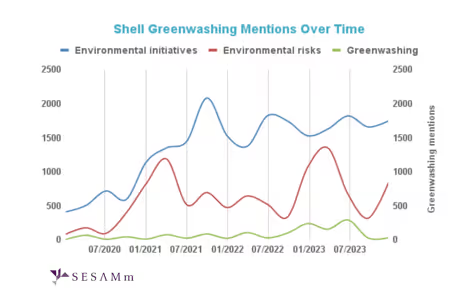
Shell, a British multinational and prominent player in this sector, has faced considerable scrutiny for such practices. The company has experienced notable spikes in greenwashing mentions and has been involved in several ESG-related risks.
Figure 3: Shell greenwashing and ESG mentions over time.
Greenwashing Mentions
We can see an increase in greenwashing mentions in the first half of 2023. Around that period, Shell faced allegations and lawsuits concerning its environmental claims. The company was criticized for misleading U.S. authorities and investors about its energy transition efforts. Additionally, Shell faced public backlash for labeling fossil gas as 'renewable' while reporting record profits. A notable incident involved a shareholder suing Shell's executives over climate risks.
ESG Risks
Shell has faced several ESG-related risks, including legal challenges and pollution issues. In 2021, the company was sued by New York City over climate change-related advertising and filed an arbitration claim against Nigeria concerning a spill dispute. In March 2023, Shell faced another oil spill, this time in another region in Nigeria, Rivers State, and also saw institutional investors backing a lawsuit against its board over climate risks. The mid-2023 period saw Shell agreeing to pay $10 million for air pollution violations at a Pennsylvania petrochemical plant. Despite its net-zero pledge, the company announced plans to increase fossil fuel production.
ESG Initiatives
Despite its challenges, Shell has also engaged in various sustainability initiatives. In late 2021, the company announced plans to purchase power from the world's largest offshore wind farm. Mid-2022 saw a leadership change with the company's CEO stepping down as Shell aimed to align with its climate goals. The company also planned to deploy 10,000 EV chargers across India as part of its global strategy. In mid-2023, Shell committed to investing $10–15 billion in developing low-carbon energy solutions. Although the company abandoned its lower oil production target, it maintained its commitment to reducing emissions.
Shell's journey underscores the challenges of aligning environmental claims with real actions, emphasizing the importance of transparency and genuine sustainability efforts.
ENI's Greenwashing Mentions, ESG Risks, and Initiatives
ENI, an Italian multinational oil and gas company, has faced scrutiny for such practices. The company has experienced fluctuations in greenwashing mentions and has been involved in a number of ESG-related risks.
Figure 4: ENI greenwashing and ESG mentions over time.
Greenwashing Mentions
ENI's greenwashing mentions are fairly low. However, the company has been featured in discussions about greenwashing, especially with recent developments. In early 2022, the company faced criticism for inconsistencies in emissions data and greenwashing activities, as highlighted by the Sereno Regis Study Center. Greenpeace also criticized ENI for using the Sanremo Music Festival as a platform for greenwashing. In May 2023, ENI faced a lawsuit for allegedly lobbying and greenwashing to promote fossil fuels despite being aware of their environmental risks. Greenpeace sued the company, accusing it of knowingly contributing to climate change.
ESG Risks
Over the past 4 years, the oil giant's ESG risks have been few but not inexistent. ENI has encountered several risks, including legal challenges and pollution issues. In 2022, ENI's environmental strategy was deemed a failure, and concerns arose about a pipeline spill into the East Irish Sea. The company also faced legal actions in 2021, including an appeal against a court ruling in an illegal waste case and warnings from the Legality Network to reduce greenhouse gas emissions or face prosecution.
The company faced a lawsuit in early 2023 for allegedly having prior knowledge of the climate crisis. In another incident, a report found that ENI and Shell were responsible for significant pollution in Bayelsa, requiring a $12 billion cleanup.
Shell and ENI both face the challenge of balancing economic interests with environmental responsibility. Despite allegations of greenwashing and environmental risks, both companies have taken steps towards sustainability, such as investing in low-carbon solutions and renewable energy projects. Their experiences highlight the importance of transparency, genuine commitment to environmental responsibility, and the role of public scrutiny in holding companies accountable.
Greenwashing and ESG Investing
In sum, certain companies advertise their sustainability and green initiatives, while in reality, they are making false claims and practicing greenwashing, as evidenced by our analysis using SESAMm's AI and ESG reports. We use AI through TextReveal to generate alternative data for use cases, such as ESG and SDG, sentiment, private equity due diligence, corporate studies, and more. Our technologies can reliably ensure the credibility of ecological initiatives and serve global investment firms, corporations, and investors, such as private equity firms, hedge funds, and other asset management firms, to enhance their investment strategies.
Conclusion
In conclusion, the issue of greenwashing represents a substantial obstacle in the journey towards genuine environmental sustainability, misleading consumers and investors and diluting the efforts of genuine sustainable enterprises. Nevertheless, the emergence of advanced technologies such as Artificial Intelligence (AI) and Natural Language Processing (NLP) indicated a new era of accountability. Innovators like SESAMm are at the forefront, deploying these technologies to effectively unravel and counteract greenwashing practices. This empowers investors, asset, and portfolio managers to discern and align their resources with legitimately sustainable entities. The call to action is clear: a collective demand for transparency and responsibility is crucial.
Reach out to SESAMm
TextReveal’s web data analysis of over five million public and private companies is essential for keeping tabs on ESG investment risks. To learn more about how you can analyze web data or to request a demo, reach out to one of our representatives.
Despite its promises, the clean energy sector, featuring companies like NextEra Energy, First Solar, and Siemens Energy, faces significant challenges across ESG fronts. Governance issues include lawsuits over misleading financial practices and greenwashing accusations. Environmentally, the sector struggles with defective technology and product performance failures, eroding trust in renewable energy solutions. Social and labor challenges are also prevalent, including discrimination lawsuits, unsafe working conditions, and customer dissatisfaction stemming from product failures and poor service. Furthermore, the growing threat of cybersecurity vulnerabilities within clean energy infrastructure poses risks to both operational systems and consumer data.
What are the most pressing ESG challenges currently facing the clean energy sector? Read on to find out.
NextEra Energy: ESG Challenges and Legal Disputes
NextEra Energy faces several ESG controversies despite being less exposed than its peers. Governance issues include a $1.2 billion impairment related to the Mountain Valley Pipeline and a $350 million antitrust lawsuit for allegedly obstructing a competitor’s clean energy project. It has also faced legal challenges, notably investigations into its political donations connected to its bid for Jacksonville’s public utility. Environmental concerns involve growing opposition to its solar and battery projects and lobbying against rooftop solar policies, along with protests over its wind and drilling operations in Florida, which are subject to a class-action lawsuit for environmental risks. Additionally, the company is investigating wind turbine collapses and is engaged in legal disputes regarding employee rights, including a retaliation lawsuit and a $500,000 settlement over debt collection practices.
First Solar has been dealing with a mix of ESG challenges. The solar manufacturer is locked in patent litigation with JinkoSolar while struggling with broader industry headwinds like polysilicon oversupply, hurting bookings, and creating manufacturing problems. CEO Mark Widmar has pointed to policy uncertainty as a major roadblock, saying failed climate legislation is hampering domestic solar production. The company is also cleaning house with its Malaysian contractors over unethical labor practices. Despite proposed subsidy cuts dragging down the stock, RBC analysts still see nearly 40% upside potential as First Solar works through these operational and regulatory pressures.
Siemens Energy: ESG Controversies and Operational Challenges
Siemens Energy is facing multiple ESG controversies, including criticism for its reliance on fossil fuels and accusations of greenwashing. Its Siemens Gamesa unit struggles with turbine quality issues, resulting in financial losses, employee layoffs, and legal disputes, including a blocked asset sale in India and corruption allegations. The company is also under legal scrutiny for delays in the Akkuyu nuclear project and past sanctions violations. Additionally, Siemens Energy has been criticized for a data breach involving MOVEit software and vulnerabilities in its products. Socially, it has faced backlash for abolishing its women’s quota in the U.S. and labor unrest at Siemens Gamesa facilities, including strikes over working conditions.
In conclusion, the clean energy sector faces critical ESG challenges that threaten its potential for sustainable growth. Companies like Tesla, Siemens Energy, and NextEra Energy must prioritize transparency, improve governance, and address environmental and social issues to regain stakeholder trust. By proactively tackling these concerns, the sector can strengthen its credibility and better contribute to global sustainability efforts. The path forward is challenging, but addressing these challenges is essential for the clean energy industry's success in combating climate change.
Reach out to SESAMm
TextReveal’s web data analysis of over five million public and private companies is essential for keeping tabs on ESG investment risks. To learn more about how you can analyze web data or to request a demo, reach out to one of our representatives.
Stay ahead with the latest in ESG and AI intelligence
Join our mailing list to receive new reports, event invites, and updates from SESAMm directly to your inbox.



.jpg)
















.png)