TextReveal ESG Alerts, a better way to research and monitor your investment portfolio
September 13, 2022
•
5 mins read
SESAMm is proud to announce the launch of our latest solution: TextReveal® ESG Alerts. TextReveal ESG Alerts identifies ESG risks1 and positive impact coverage2 in over 100 languages by tracking mentions of your entire portfolio across 20 billion historical articles with millions of new ones added daily in near real-time.
1 Inspired by SASB and other major standards. 2 Based on UN SDGs.
Why use TextReveal ESG Alerts for your portfolio
Environmental, social, and governance (ESG) ratings have become a conventional measure of a company’s risk against those business areas. They are also increasingly critical as legislation and stakeholders focus on sustainability, positive impact initiatives, and corporate social responsibility (CSR). So with the practice of ESG rating, investors have been able to use those scores to make decisions about their portfolios. Of course, investors are committed to a greener future, too.
Unfortunately, traditional ESG ratings come with challenges. For example, according to Andrew McLaughlin, a contributor to The Globe and Mail, many ESG rating providers are “popping up like dandelions,” and “each uses its own methodologies to rank and score publicly traded companies based on their purported environmental, social and governance risk and performance.” Further, you might have access to ratings, but they’re only updated once per quarter or once yearly.
With SESAMm’s TextReveal ESG Alerts, you can access consistent, timely daily data on five million public and private companies to better assess risks and receive early warnings.
Figure 1: In 2020, U.S. news sentiment falls ahead of the stock market in response to COVID-19 concerns.
The model can calculate sentiment for each company by analyzing the news of individual companies. It’s also possible to create a composite to measure the sentiment related to a stock index. The sentiment data also helps management and investor relations because it provides a quantitative means of understanding the extent to which investors are concerned about certain news about their company.
Verifying the results
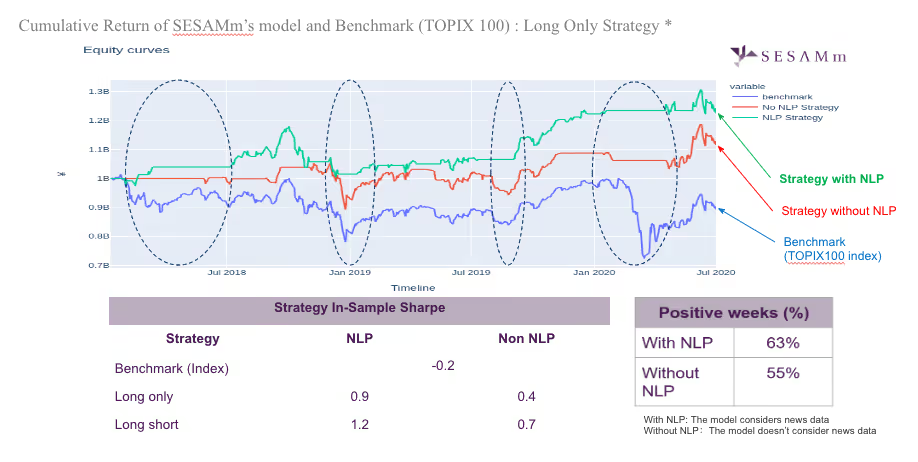
Verification using Japanese has revealed that the timing of bottoming and ceiling of text sentiment precedes those of stock prices. The collaborating team compared the performance of:
A model that uses only orthodox financial and economic data as inputs
A model that considers NLP and financial and economic data, confirming that the latter could generate higher alpha
ESG controversy monitoring can alert you to potential risks before market-moving events occur. Illustrated: Tesla ESG scores for pollutants, ethical standards, discrimination, and environmental impact.
The TextReveal ESG Alerts edge
Broad coverage
Access five million private and public companies of all sizes, including micro-caps, to identify risks in over 100 languages.
Expertise
Leverage ninety pre-built yet taxonomy-adaptable ESG risk categories such as SASB standards, UN Global Compact, and UN SDG-based positive impact statistics coverage.
Transparency
Gain insights with deeper analysis, seeing specific articles driving your alerts.
Timeliness
View live web data for forward-looking scores and insights.
TextReveal ESG Alerts features
Because we trained them on a representative corpus selected from billions of articles from prestigious news organizations, local news, and discussion forums, our NLP tools can understand finance and interpret slang, misspellings, and textspeak.
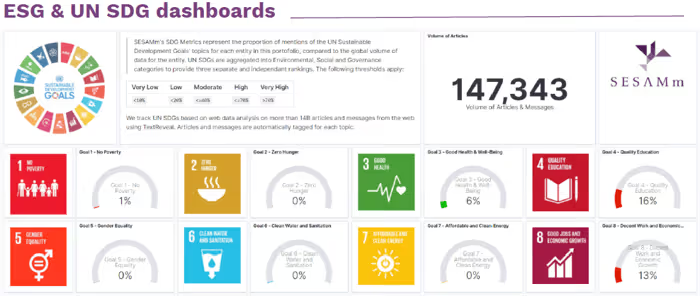
Get an ESG and UN SDG dashboard view of your portfolio.
The best part is that you can receive alerts and monitor scores in the way that works best for you. ESG and UN SDG‐based positive impact statistics can be accessed and delivered via:
Email Alerts
CRM and cloud based integration
Live dashboards
API and data files
ESG studies
Get the SESAMm edge from TextReveal ESG Alerts
Save time vetting your current investments and evaluating new ones while providing higher quality, objective results compared with manual monitoring, black-box ratings, or self-reported questionnaires.
Reach out to a SESAMm representative for a personal demo today.
SESAMm is delighted to welcome Magnus Billing to its Advisory Board. With more than 30 years of experience at the intersection of finance, technology, and sustainability, Magnus brings a wealth of knowledge and global perspective to support SESAMm’s mission of advancing AI-powered ESG and reputational risk analysis.
“Magnus has been a driving force in the evolution of sustainable finance, combining deep regulatory insight with a strong understanding of how data and technology can accelerate change,” said Sylvain Forté, CEO and Co-Founder of SESAMm. “His experience and perspective will be invaluable as we continue to scale globally and strengthen our partnerships with leading financial institutions in the Nordics and beyond.”
Magnus has held several senior leadership roles throughout his career, including CEO of Alecta, Sweden’s largest pension fund with approximately USD 100 billion in assets under management, and CEO of Nasdaq Nordics and Baltic Markets. Earlier in his career, he served as Chief Legal Counsel for Nasdaq Europe, overseeing market regulation and governance across multiple jurisdictions.
Beyond his corporate leadership, Magnus has played an influential role in shaping the global sustainable finance agenda. As a member of the EU High-Level Expert Group (HLEG) on Sustainable Finance, he contributed to the development of the EU Sustainable Finance Action Plan, which continues to guide regulatory frameworks across Europe.
Today, Magnus serves as a non-executive director and senior advisor to organizations advancing sustainability and development finance. He was recently appointed Independent Chair of the Future of Sustainable Data Alliance (FoSDA), further expanding his contribution to advancing sustainability data and analytics worldwide.
“SESAMm’s work at the intersection of AI and sustainable finance is both innovative and impactful. I look forward to supporting the company’s mission to help financial institutions better understand and act on ESG and reputational risks,” Magnus stated.
We’re thrilled to welcome Magnus to SESAMm’s Advisory Board and look forward to working together as we continue to advance AI-powered ESG and reputational risk analysis worldwide.
SESAMm’s AI Technology Reveals ESG Insights
Discover unparalleled insights into ESG controversies, risks, and opportunities across industries. Learn more about how SESAMm can help you analyze millions of private and public companies using AI-powered text analysis tools.
At SESAMm, we’re committed to helping our clients navigate the complexities of ESG risk management and compliance. Our Partner Network, set to launch in 2025, is a new initiative designed to provide clients with seamless access to expert remediation services—something that is especially important in light of new regulations like CSDDD. Whether conducting on-site audits, providing grievance mechanisms, or offering cybersecurity due diligence, our partners are carefully selected to address diverse client needs.
Why the Partner Network?
Identifying risks is only part of the battle—effectively mitigating them is just as crucial. The SESAMm Partner Network bridges this gap by connecting clients with top-tier partners offering important mitigation services.
Key Features of the Partner Network
Remediation Options: Comprehensive services for CS3D compliance and financial regulations.
Streamlined Processes: Pre-negotiated agreements ensure fast access to expert teams.
Seamless Integration: Automated recommendations and real-time results tracking via SESAMm’s platform.
The Partner Network
Discover our partners below - and keep an eye out for new additions; the Partner Network is growing fast.
Proactive M&A Cyber Due Diligence with CybelAngel
CybelAngel offers a cutting-edge external risk protection platform that proactively identifies and mitigates external threats before they can be exploited. Recognized for its excellence by Gartner, CybelAngel has become a trusted partner for organizations globally.
CybelAngel's M&A Cyber Due Diligence reports provide a comprehensive external assessment of a third party's cybersecurity posture. By combining advanced threat intelligence with expert human analysis, these reports offer crucial context and actionable insights into potential cyber exposures. This approach enables organizations to make informed decisions about mergers, acquisitions, or partnerships by revealing vulnerabilities that may not be apparent through traditional due diligence methods.
The reports include:
Exposure scores and detailed metrics
Benchmark of cyber exposure to industry standards
Detailed analysis, technical findings, and data samples
ESG & Sustainability Assessments, Due Diligence, and more with Indefi
Indefi are strategy consultants dedicated to serving investment managers and financial investors globally. They partner with business leaders on growth strategy, market entry, product development and enhancement, sustainability, M&A and transaction support.
Through this collaboration, SESAMm clients can now access Indefi’s industry-leading services, including ESG and sustainability assessments, buy- and sell-side commercial due diligence, sustainable investment strategies, and sustainability reporting (SFDR, Article 29, and CSRD). This partnership ensures an efficient and effective response to identified risks while supporting clients in meeting regulatory and sustainability goals.
The SESAMm Partner Network will officially launch in Q1 2025. Stay tuned for updates as we welcome new partners to the network and continue to develop innovative solutions for risk and ESG management.
SESAMm’s AI Technology Reveals ESG Insights
Discover unparalleled insights into ESG controversies, risks, and opportunities across industries. Learn more about how SESAMm can help you analyze millions of private and public companies using AI-powered text analysis tools.
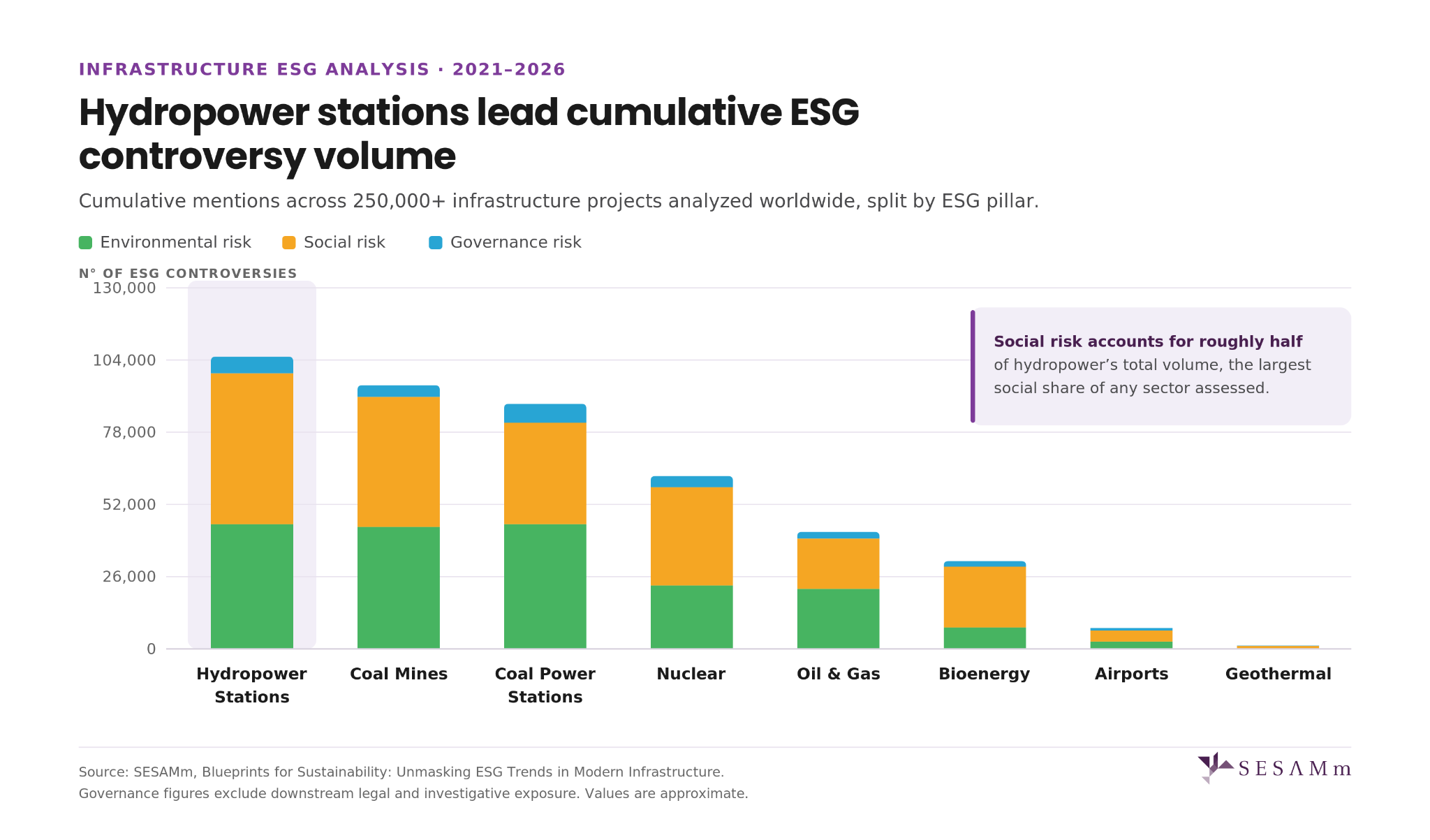
An analysis of over 250,000 infrastructure projects reveals that the sector most often filed under "clean energy" carries the heaviest environmental and social controversy footprint of any asset type assessed.
In the taxonomy of energy infrastructure, hydropower occupies a comfortable position. It is renewable, dispatchable, and long-lived, and it enters transition frameworks, green bond eligibility criteria, and net-zero roadmaps with minimal friction. Where coal is a legacy liability to be managed down and nuclear invites a specialized debate, hydropower is largely treated as settled. What these projects have actually done does not support that treatment.
Belo Monte, an 11,233 MW complex on the Xingu River in Pará, Brazil, is the sharpest test of the point, because it was built to answer this exact objection. Approved after decades of opposition to a far larger design, it was engineered as a run-of-river plant to minimize flooding, and its reservoirs cover 478 km², of which 274 km² was already river channel at high water, a 61% reduction compared with the 1980s proposal, according to the operator's own regulatory filing. The mitigation was designed from the start, and everything that follows happened regardless.
Biodiversity: the cost of a physical footprint
Environmental controversy across infrastructure concentrates on industrial accidents, water pollution, and biodiversity, and hydropower leads the third, outright, because dams require the permanent conversion of river systems and the land around them. Mexico's Federal Electricity Commission won environmental approval in September 2014 for the Las Cruces dam on the San Pedro Mezquital, upstream of Marismas Nacionales, a Ramsar-protected wetland, even though the project's own impact statement conceded that the damage to Indigenous ceremonial sites could not be mitigated. Along the Mekong River, river health and fish populations fell as dam construction spread through the basin. In Brazil, the Doce River carried a mass release of toxic material after an upstream failure. Elsewhere, the record includes violations of the Endangered Species Act and documented disruption to rainfall patterns.
At Belo Monte, the consequences have been measured rather than projected. The plant diverts water into a canal that bypasses a 130-kilometer stretch of the Xingu known as the Volta Grande, which has received less than 30% of its natural annual discharge since 2019, and some 86% of the stretch's seasonally flooded vegetation, 30,748 of 35,600 hectares, can no longer be inundated at all. The gap lies in the regulator's own file: IBAMA's technical staff called for 10,900 cubic meters per second in February, the historic peak month, compared with the 1,600 that the operating regime actually releases. Seven years of underwater video survey data published in Scientific Reports recorded total fish species richness falling from 62 to a post-operation average of 51, with the steepest losses near the dam and in the rocky rapids, which hold roughly 2.6 times as many species as sandy reaches. The zebra pleco, whose entire known range lies inside the dewatered stretch, now sits on Brazil's national list of threatened species as critically endangered.
None of this is an accident or a failure of operation. It is a structural consequence of the asset. A well-run dam still floods a valley, and a dam engineered specifically not to flood one still dewater the river below it.
When engineering fails: hydropower's physical risk profile
Coal mining leads infrastructure on industrial accidents, where the record is dominated by human tragedy and safety negligence: explosions, collapses, fires, and repeated, incremental failures. Hydropower ranks second, but its accidents take a different form, because in this sector, industrial failure means catastrophic engineering failure at scale. The record includes pipe ruptures causing severe land erosion, oil leaks, and dam collapses that killed and displaced people across whole regions, while PG&E's settlement over damages to the Middle Fork American River Hydroelectric Project and the litigation still running in Brazil after dam collapses give a sense of the exposure a single event can generate. For anyone underwriting these assets, the distinction is financial as much as physical: a coal mine's safety record is a rising cost curve, while a dam's structural integrity is a low-probability, near-unbounded loss.
At Belo Monte, that exposure has so far been financial. The project was budgeted at R$28.9 billion when Brazil's development bank approved a then-record R$22.5 billion loan in November 2012, and by late 2017, actual investment had reached R$38.6 billion, roughly 34% over. The operator owed R$28.3 billion to lenders and debenture holders at the end of 2024. Aliança Norte Energia Participações, the Vale and Cemig vehicle holding a stake in the project, discloses a possible loss of R$3.05 billion from a single construction-delay claim and describes the operator's liquidity as its principal point of attention and a source of investor alert. Neoenergia wrote off its own 10% holding by R$482 million in the fourth quarter of 2021.
The physical risk has been closer than the absence of a collapse suggests. In October 2019, the operator wrote to the national water regulator declaring an emergency, because reservoir levels had fallen far enough to expose an unprotected section of the Pimental dam's earthfill base to wind-driven wave erosion and, in the company's own words, structural damage. It cut outflow below the level agreed with the environmental regulator to protect the structure, and the letter surfaced only through investigative reporting.
Beyond the environment: displacement, water, and chronic corruption
Right to property
Hydropower ranks first among infrastructure sectors for property disputes, a direct function of the footprint a dam and reservoir require. The record shows land seizures, forced displacement, compensation that arrives short or not at all, communities never consulted before ground was broken, and blasting that cracked the foundations of nearby homes. Those affected are frequently the least equipped to hold an operator to account.
Fifteen years after Belo Monte broke ground there is still no audited count of who lost their homes. Estimates run from 20,000 to 40,000 depending on the definition used, against the operator's account of rehousing some 6,000 urban families. Landowners say expropriations are priced at unadjusted 2013 values while the project's own construction boom inflated the market, and as of 2025 none of the land required for the riverine resettlement program had been bought. A petition filed with the Inter-American Commission in 2011 still has no ruling.
Community health and safety
Hydropower sits alongside coal and nuclear as a leading source of community health disputes, but it arrives by a different route. Coal delivers PM2.5, nuclear delivers radioactive anxiety, and hydropower delivers water mismanagement: overconsumption that strips farmers of a livelihood, contaminated water reaching local crops. The grievance is agricultural rather than industrial, which widens the affected population considerably.
On the Volta Grande, catch per fisher fell from 11.1 kilograms a day between 2001 and 2008 to 4.53 kilograms between 2020 and 2023. A randomized household survey found 38.5% of residents in Belo Monte's resettlement neighborhoods living with moderate or severe food insecurity, against 28.3% across the surrounding city. In June 2026, federal prosecutors sought as interim relief for 635 families along the reduced-flow stretch the emergency delivery of three and a half to five liters of drinking water per person per day.
Corruption and bribery
Corruption and bribery accounts for close to 30% of governance controversy across infrastructure. What separates hydropower is the pattern. In airports, nuclear, and coal, corruption surfaces as discrete scandals: a probe opens, executives are charged, attention fades. In hydropower it keeps returning, tied repeatedly to falsified records and payments to local officials to secure land and water rights. Isolated scandals point to isolated actors. A pattern that recurs points to how these projects get permitted.
Brazilian prosecutors alleged that Belo Monte's construction contracts carried bribes worth 1% of their value, and three contractors admitted cartel conduct and kickbacks under leniency agreements that carried immunity. Everything after that was procedural closure rather than a finding of liability: the principal defendants were acquitted and the acquittal upheld on appeal in 2024, the competition authority archived its bid-rigging case in 2025, and no individual has been convicted in connection with the project. An investor screening for enforcement outcomes would have found a closed file. The costs landed elsewhere, in permitting delay, financing conditions, and a minority stake that has been for sale since 2022 without a buyer.
Hydropower's risk concentration: what this means
Hydropower's classification as clean energy is accurate on the metric it was designed to measure, because generation is low-carbon. But carbon intensity is one dimension of sustainability, and it is not the dimension that produces operational friction, legal exposure, or the loss of a social license.
What drew sustained opposition to these projects was water rights, displaced communities, cracked foundations, converted wetlands, and permits secured through local payments. None of it appears in a carbon accounting framework.
For investors, insurers, and lenders seeking transition-aligned infrastructure exposure, that is a material blind spot: an asset class that screens well on the primary criterion while carrying the heaviest social burden in the dataset, and carrying it on behalf of people who have no employment relationship with it. Belo Monte was engineered to avoid precisely that outcome and produced it regardless, which suggests the exposure is not a function of how a dam is built but of what a dam is.
The label is not wrong. It is simply measuring something other than risk.
Stay ahead with the latest in ESG and AI intelligence
Join our mailing list to receive new reports, event invites, and updates from SESAMm directly to your inbox.












.png)