We have exciting news to share! The HFM US Services Awards 2022 judging panel—a diverse panel of leading hedge fund COOs, CFOs, CCOs, GCs, and CTOs—selected SESAMm as the best information and data provider!
Here's a little about why and how we earned this prestigious award.
“With Intelligence HFM US Services Awards recognize and reward hedge fund service providers who have demonstrated exceptional client service, innovative product development, and strong and sustainable business growth over the past 12 months.
The rigorous judging process, based on the views of a panel of leading hedge fund COOs, CFOs, CCOs, GCs, and CTOs, ensures that the Awards recognize those driving up service standards across the sector and stand out from the crowd as the ones the big providers really want to win.”
A big thanks to SESAMm's investors, partners, and clients
We thank our clients, investors, and partners for your support and patronage. Thank you for being such a big part of SESAMm; you're why we do what we do, and many of you have been involved since day one. And your generous and encouraging attitude has helped get us here today.
One of seven shortlisted in this category
After winning best use of artificial intelligence or blockchain at the 2022 HFM US Technology Awards earlier this year, we were encouraged to apply for best information and data provider. As a result, the judging panel selected SESSAMm as one of seven providers shortlisted for this award.
To be eligible for this award, we had to apply and provide details about our client service initiatives, the innovative product development we conducted, the growth we experienced over the past 12 months, and more. For the best information and data provider category, the criteria the judges look at are:
Commercial success and business growth
Demonstration of product or service innovation
Description of future product or service development possibilities
Positive customer feedback via submitted testimonials
Honored and excited
Of course, we're honored to earn best information and data provider at 2022 HFM US Services Awards. We're also excited for our clients and partners because our products and services are game-changers for hedge fund services. And while we have more work to do and clients to serve, we think the future looks bright for us, our partners, and our clients.
About SESAMm and TextReveal
SESAMm is a leading NLP technology company serving global investment firms, corporations, and investors, such as private equity firms, hedge funds, and other asset management firms. Through TextReveal®, we give you NLP capabilities to generate your own alternative data for use cases, such as ESG and SDG, sentiment, private equity due diligence, corporation studies, and more. And with access to SESAMm’s massive data lake, made up of 20 billion articles and messages and growing, you can make better investment decisions.
Reach out to SESAMm
For a personal demonstration of our award-winning platform, reach out to a representative
Denmark's Danske Bank has announced a sweeping divestment from fossil fuel investments, cutting its portfolio from 2,000 companies to just 270, representing an over 85% reduction in the number of companies in its fossil fuel investment universe. However, its overall exposure to the fossil fuel industry remains stable, thanks to increased investments in some fossil fuel companies. This move, implemented through its Danske Invest fund management unit and Danica pension and insurance business, marks one of the most significant climate-related portfolio adjustments by a major European financial institution.
Assessment Framework
The bank's new methodology centers on a dual evaluation approach. First, it examines management quality, analyzing how companies handle emissions and assess transition risks. Second, it evaluates carbon performance, scrutinizing emissions reduction targets and their alignment with Paris Agreement goals. This comprehensive framework ensures a thorough assessment of companies' climate commitments and actions.
Strategic Approach
Rather than implementing a complete divestment strategy, Danske Bank has adopted a more nuanced approach. While significantly reducing the number of investee companies, the bank has maintained its overall sector exposure by increasing investments in selected companies demonstrating strong transition plans. This strategy focuses particularly on businesses actively working to future-proof their operations against climate-related challenges.
Leadership Perspective
Erik Eliasson, Head of Responsible Investment at Danske Bank, emphasizes the customer-centric approach: "Our new fossil fuels investment approach aligns with the preferences of the majority of our customers while underscoring our commitment to achieving competitive returns on a responsible basis.” Thomas Otbo, CIO at Danske Bank Asset Management, reinforces this position, noting their commitment to maintaining investments in fossil fuel companies that reflect global economic realities while becoming more selective in their choices.
Implementation Flexibility
The bank has designed its strategy to accommodate diverse customer preferences. Some funds remain exempt from the new methodology, while others offer complete fossil fuel exclusion. This flexible approach allows Danske Bank to serve varying client needs while maintaining its broader commitment to sustainable finance. "We firmly believe this to be in the best long-term interest of our investment customers," adds Otbo.
Market Implications
This development signals a sophisticated evolution in how financial institutions approach fossil fuel investments. Rather than implementing blanket exclusions, Danske Bank's approach demonstrates how major financial institutions can balance climate responsibilities with financial returns. The strategy could set a new standard for the industry, showing how banks can significantly reduce fossil fuel exposure while maintaining strategic investments in energy transition leaders.
Looking Forward
As financial institutions face mounting pressure to address climate change, Danske Bank's approach offers a practical template for others in the industry. It demonstrates that major banks can significantly reduce fossil fuel exposure while maintaining their role in financing the global energy transition. This balanced strategy could become a model for other institutions seeking to align their portfolios with climate goals while ensuring continued financial performance.
The bank's innovative approach to fossil fuel investment suggests a new phase in sustainable finance, where sophisticated evaluation methods and flexible implementation strategies replace simple exclusion policies. This development may well shape the future of institutional investment in the energy sector.
SESAMm’s AI Technology Reveals ESG Insights
Discover unparalleled insights into ESG controversies, risks, and opportunities across industries. Learn more about how SESAMm can help you analyze millions of private and public companies using AI-powered text analysis tools.
Forced labor remains among the most pressing human rights challenges for companies worldwide. Despite stronger regulations and corporate pledges, millions remain trapped in exploitative conditions, often deep within complex global supply chains.
As new laws increase scrutiny and liability, the cost of blind spots is rising. Investors, corporates, and private equity firms alike must now demonstrate active due diligence or face legal, financial, and reputational consequences.
In this whitepaper, SESAMm explores:
The tightening global regulatory landscape on forced labor
Exclusive data-driven insights from SESAMm’s AI platform on labor-related controversies
Real-world case studies revealing how risks can remain hidden despite compliance efforts
Download the report to learn how data and AI are transforming the fight against forced labor - and how organizations can move from reactive to proactive risk management.
As the 2022 United Nations Climate Change Conference wraps up, governments and, by proxy, companies are charged with fulfilling new recommendations, especially for non-State entities to commit with integrity to Net-Zero. COP27, as the conference is also called, is the time and place where we claim as a united society at the world's center to make change for the better.
But COP27 is over. Now what? Do we go back to business as usual? Do we wait and see if we stick to any of these new agreements? Or worse, do we say we'll make changes but fall short of making those changes?
I say no. We can do better, and here's why…
We need to talk about climate change
Climate change effects are more than global warming. Global warming consequences include:
Rising sea levels
Stronger and more intense hurricanes
More droughts and heat waves
Longer wildfire seasons
And more
Why do I bring these up? Because all of these effects will impact your business in one way or another.
For example, did you know that the Rhine River, one of Europe's major rivers, is suffering from drought? Water levels are so low that barges are limited, and it's disrupted river cruises because levels are currently 38 centimeters below the minimum required.
The same goes for the Mississippi River in the U.S. The Mississippi River has dropped to the lowest levels they've ever been in 34 years, driving up shipping costs. This challenge is also a big deal because the river carries 92% of agricultural exports.
Also, in the past year, damaging hurricanes and typhoons have damaged infrastructure in South Korea, South Africa, China, Japan, and the U.S., to name a few countries, affecting crops, manufacturing operations, supply chains, and much more across the globe.
I could go on about how each effect influences enterprise, but the bottom line is climate change is bad for business. And supporting companies that enable climate change is also bad for business, which brings us to the topic of environmental, social, and governance (ESG) measures.
We need to talk about ESG
ESG has become mainstream since the UN shared a report in 2006, a joint initiative by a group of financial institutions to develop policies and guidance on how to better incorporate ESG issues in securities brokerage services, asset management, and associated research functions. This introduction has helped industries establish goals through:
Managing ESG risks
Anticipating regulatory action or accessing new markets
Contributing to the sustainable development of their societies
However, with ESG policies come ESG data challenges. For example, ESG measuring, its data, and how companies report them are inconsistent. ESG data providers deal with "data gaps" differently, so their approaches can lead to discrepancies. And as ESG data becomes available publicly, how ESG data providers interpret the data varies, too.
We need to talk about greenwashing
In simplest terms, greenwashing occurs when a company misleads its stakeholders, investors, and consumers about its environmental practices, specifically by communicating positive environmental performance contrary to its actual, less flattering execution.
On the surface, you might think, "What's the big deal? We all exaggerate, right?" But as sustainability awareness among investors and eco-conscious customers grows, so has their scrutiny over business conduct to disclose information about a company's performance and its "environmental-friendly" products. Their scrutiny, coupled with the growing number of companies reporting their environmental footprints, reveals that many companies misreport and publish information about their ecological impacts, which regulators consider misleading or deceptive.
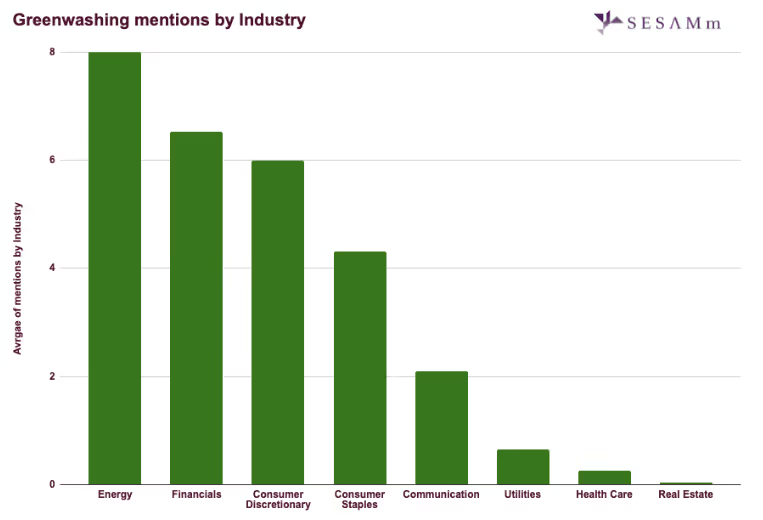
How do we know? Let's take a look at greenwashing mentions by industry.
We analyzed greenwashing mentions in web data. On the X-axis, we list the industries. The Y-axis measures the ratio of greenwashing mentions by N° of companies per industry (N=1166 companies) since 2015; this extraction method corrects sampling bias. Each industry is defined by a significant sample of large- and mid-capitalization-sized companies in developed countries.
This greenwashing mention chart clearly shows that the Energy industry has the highest ratio of greenwashing allegations. While many fossil fuel companies claim to be transitioning into clean energy, most mentions link these companies to advertisements and campaigns that don't align with the Paris Agreement goals. In contrast, fossil fuel companies are growing their carbon-intensive operations and products. It's a concerning trend because according to The Intergovernmental Panel on Climate Change (IPCC) report, "Climate Change 2021: The Physical Science Basis.", the data shows that emissions from fossil fuels are the primary cause of global warming, contributing up to 91% of global carbon dioxide emissions in 2018 as an example.
Second, on this chart is the Financial industry. It has fallen short of its commitments to climate action while continuing to finance fossil fuels. According to eMarketer, financial institutions have allocated $4.6 trillion for fossil fuels while promoting sustainable finance and supporting global energy transition.
Further, the mentions volume has grown year over year since 2015—when it was almost zero—to more than 1500 present day.
Clearly, this greenwashing problem is getting worse. So what can we do about it?
We need to talk about a solution
We don't have any control over what companies will do to fulfill their agreements, but we can understand their ESG data better and make better investment and portfolio decisions.
How? With AI.
AI, specifically natural language processing (NLP) algorithms, help us read billions of news articles, forums, and web text and extract unstructured data for analysis. With SESAMm's TextReveal®, we can see an entity's ESG controversies or events in near real time, providing a unique perspective to ESG data and details, filling the data gaps more accurately.
So when Company A reports on its ESG goals, we can help verify if the results are accurate and find any potential controversies that didn't make the report. We also don't need to wait until ESG reports come out; we can extract this data from the web on an as-needed basis. Moreover, we can look at all types of companies across the globe, public or private. As long as web data exists for an entity (or concept), we can analyze it.
My final thoughts
COP27 might be over, but our agreements and commitments carry on. We have an opportunity today to make a positive difference toward climate change while still maintaining profits. In fact, I think we can be even more profitable if we support green and sustainable initiatives.
I'd like to hear your thoughts; feel free to reach out on LinkedIn and share them with me.
About Alexandre Tiesset
Alexandre Tiesset is the Head of ESG at SESAMm. He's worked in finance for seven years in various ESG-related roles, such as Credit Analyst, Sustainable Investing Specialist, Index Product Specialist, and more. He holds a Master of Science degree in Finance and Financial Analysis. His passion lies in the intersection of finance and general knowledge and making new connections.
Reach out to SESAMm
SESAMm is a leading NLP technology company serving global investment firms, corporations, and investors, such as private equity firms, hedge funds, and other asset management firms, by providing datasets or NLP capabilities to generate their own alternative data for use cases, such as ESG and SDG, sentiment, private equity due diligence, corporation studies, and more.
To learn how you can generate NLP-enhanced ESG data for your firm, or to request a demo, reach out today.
Stay ahead with the latest in ESG and AI intelligence
Join our mailing list to receive new reports, event invites, and updates from SESAMm directly to your inbox.








.png)