Paine Schwartz Partners Selects SESAMm to Strengthen ESG Screening and Controversy Monitoring
05/05/2026
•
5 mins read
SESAMm, a leading provider of AI-powered ESG and reputational risk insights, is pleased to announce that Paine Schwartz Partners, the largest private equity firm dedicated to sustainable food chain investing, has selected SESAMm’s platform to enhance its ESG due diligence and portfolio monitoring processes.
Paine Schwartz Partners manages over $6 billion in assets and invests globally across the food and agribusiness value chain, pursuing predominantly buyout investments, with a smaller allocation to growth companies. With a strong, long-standing commitment to sustainable investing in the food chain, Paine Schwartz integrates environmental, social, and governance (ESG) considerations at every stage of its investment process, from initial screening to active portfolio management.
As part of its investment process, Paine Schwartz Partners will leverage SESAMm’s platform to enhance its ESG risk screening, due diligence, and supplier and portfolio monitoring.
SESAMm’s platform provides real-time visibility into ESG and reputational risks across millions of public and private companies worldwide. The platform leverages multilingual large language models to analyze content from over 4 million sources in 100+ languages, enabling rapid first-gate screening, continuous monitoring of portfolio companies and their supply chains, and early detection of potential red flags, all while providing fully auditable data.
Among the platform’s capabilities, Paine Schwartz Partners will make use of SESAMm’s AI Reports, a suite of AI-generated reports covering ESG Assessment, Legal, and Governance Screening, available directly within the platform. These reports make it possible to rapidly screen companies for ESG and reputational risks even where direct access to company data is limited, for example, when evaluating whether to pursue a smaller or minority investment, or before launching a full due diligence process. The reports will also help the firm efficiently screen key suppliers across its portfolio, a particularly valuable capability given the firm’s focus on the food and agribusiness value chain.
About Paine Schwartz Partners
Paine Schwartz Partners is the largest private equity firm dedicated to sustainable food chain investing, with ~$6.5 billion of AUM and over 20 years of experience. The firm invests across specific segments of the food and agribusiness value chain, with a focus on two core investment themes: productivity and sustainability and health and wellness. Through its proactive, thesis-driven approach, the firm targets value-added and differentiated companies and makes primarily control buyout investments, with a smaller allocation to growth companies. Learn more at www.paineschwartz.com.
About SESAMm
SESAMm is a global leader in controversy data, leveraging advanced large language models and generative AI to uncover ESG, reputational, and supplier risks in seconds. Our AI-powered platform surfaces real-time insights, even in low-disclosure markets, on millions of companies and infrastructure projects, supporting more informed decisions, enhanced due diligence, and regulatory alignment at scale. We work with leading firms, including Carlyle, Warburg, Natixis, RBI, Sustainable Fitch, Oddo, and others. SESAMm has raised $50M from renowned investors and operates across four continents. Learn more at sesamm.com
As we mark Earth Day 2025, it’s clear we’re at a defining moment. Despite decades of activism and innovation, the ecological crisis continues to accelerate, driven by climate change, biodiversity loss, and unsustainable resource use. But alongside this growing threat is a growing opportunity: the ability to harness artificial intelligence (AI) and data to drive more responsible business practices and environmental stewardship.
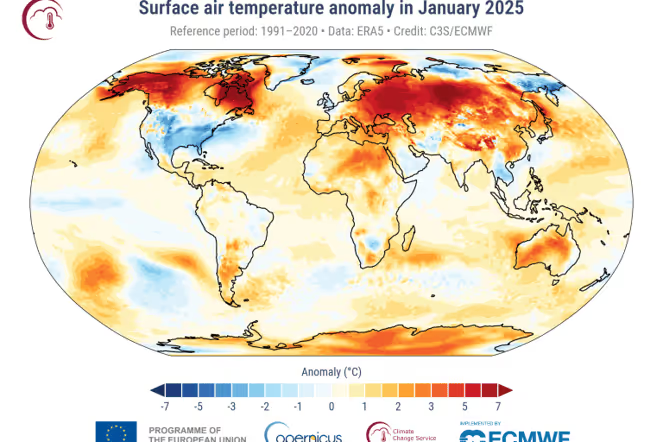
The warning signs are everywhere. By early 2025, Earth’s average surface temperature reached 13.0°C (55.4°F)—pushing us closer to climate tipping points. The first three months of this year were among the hottest on record, with unprecedented temperature anomalies in both the Arctic and Antarctic regions.
Global greenhouse gas emissions reached 37.8 billion metric tons in 2024, driven largely by fossil fuel use, agriculture, and industrial output. Meanwhile, biodiversity is in sharp decline, with over 46,000 species threatened with extinction due to climate-related stressors like habitat loss, pollution, and extreme weather.
Plastic waste continues to acidify oceans, while urban sprawl and overconsumption accelerate deforestation. From fast fashion to factory farming, human activity is pushing planetary boundaries—and the consequences are becoming harder to ignore.
The Human Toll: Environmental Anxiety on the Rise
This crisis isn’t just environmental—it’s deeply personal. Younger generations are increasingly affected by eco-anxiety, a psychological response to fears of environmental collapse. Studies warn that by 2050, billions could face water scarcity, food system disruption, and mass migration from climate-affected regions. Overheated ecosystems, wildfires, and resource scarcity are not abstract threats—they’re the lived reality of millions.
The Role of AI and ESG in the Fight for a Livable Planet
Fortunately, powerful tools are emerging. Artificial intelligence is transforming how we track and respond to environmental, social, and governance (ESG) risks. Natural language processing (NLP) can detect greenwashing, monitor corporate behavior, and surface early warning signals of environmental harm. AI is also helping companies reduce emissions, optimize energy use, and act on regulatory and reputational risks in real time.
By integrating ESG strategy with AI-powered insights, businesses are no longer passive observers but active players in shaping a sustainable future.
Hope for Change
Despite the scale of the crisis, momentum is building. From robotic wildlife conservation to AI-enabled recycling innovations, new technologies offer hope. Companies are aligning with the UN Sustainable Development Goals (SDGs), and governments are responding with new ESG regulations and global climate pledges. But regulation and innovation are not enough—collective action is still key.
Conclusion
There’s no better time than Earth Day to commit to change. Whether it’s supporting environmental nonprofits, reducing your consumption, investing in sustainable products, or advocating for better policies, every action counts. Our window to act is narrowing, but it’s still open.
Sylvain Forté, SESAMm's co-founder and CEO, discusses ESG data and its challenges. Further, he describes how to generate insights and reports on millions of companies, including micro-companies, using artificial intelligence and natural language processing.
Below is an approximation of this video’s audio content. Watch the video for a better view of graphs, charts, graphics, images, and quotes the presenter might be referring to in context.
About SESAMm
To give you a bit of context, I’m CEO of SESAMm, a French company of around 100 people that has been in business for eight years and that specializes in artificial intelligence for finance, especially with a focus on ESG.
So we work with some of the largest insurance companies in Japan, such as Tokio Marine, Asset Management One, or Japan Post Insurance. And we have seen the rise of ESG investing in the past few years, especially in the past four years in Europe and in the U.S. And we see now this trend also in Asia and in Japan, more specifically.
Primary uses of ESG data
The primary uses of ESG that we see are first complying with regulation. That is the key priority for most asset managers, but also improving performance. Many quantitative teams are seeing ESG also as a way to have new factors integrated that could qualify to generate alpha in investment funds. ESG is also used a lot in order to better manage risk in portfolio and, finally, to better analyze sustainable investment opportunities.
ESG use cases
So a couple of the main use cases are detecting ESC controversies. So purely from the perspective of generating risk alerts, excluding assets that are not well rated in portfolios, or creating portfolios that contain best-in-class assets, meaning most sustainable assets.
And finally, I want to mention that this trend is really global. So it's across both public assets, equities, and bonds, and also across private equity. And we see private equity reacting very quickly to the ESG trend.
Traditional ESG data challenges
So now, let's discuss in more detail some of the key challenges of ESG data. Traditionally, ESG data is created by teams of analysts that are looking at individual companies that are gathering data from each of the companies, and that are then reading the press in order to complement that information. This approach is relevant, but it is hard to scale, and it presents some difficulty. Traditional ESG ratings agencies are, for example, MSCI or system analytics.
The problem with a lot of traditional ratings is that they don't cover small companies very well. And this is one of the key challenges currently in ESG is the lack of coverage. So it is very difficult to cover small caps, microcaps, and also private companies. In particular, in Asia, the coverage is very poor right now for ESG, and that means that many portfolio companies may not be covered by ESG rating. In Japan specifically, even large companies are sometimes not covered by traditional ESG providers. So that creates a lot of data inefficiency in the industry.
Another key challenge that we see in ESG right now is the frequency of ESG ratings. So oftentimes, ESG ratings are updated only one time per year or just a few times per year. And when ESG ratings are used for risk management, obviously, the market is moving much more quickly than one time or a few times per year.
In addition to that, we see that ESG ratings mostly takes into account information that is reported by management and does not take as much into account information that is from outside of the company. For example, in the case of government scandals, such as fraud scandals, it is actually better to have information that is not reported by the company but that also has an external point of view.
Lastly, the last key challenge I want to mention in ESG data specifically, and one challenge that I'm sure you are aware of in market data and fundamental data is that ESG data is oftentime, not point-in-time. So that means that you don't have a continuous dataset that has not been modified over time. ESG agencies tend to modify their ratings after the fact, and so that means that the rating that you will receive now for a data point in 2020 will not be the same that the rating that you would actually have received in 2020 point-in-time. That creates a lot of problems when you want to back-test data because you cannot reproduce actual historical results.
So these are all of the key challenges that we have identified in ESG data currently, and there are challenges in order to address the needs that we described. But there are actually some solutions that exist.
The solution to ESG data challenges
And one of the key solutions right now that is merging in ESG is the use of artificial intelligence, in particular, what is called natural language processing, meaning text analysis.
What we do at SESAMm and what some other providers do is detecting ESG risks and positive impact with regards to sustainability by analyzing automatically billions of articles and messages in real time. So as an example, we have 18 billion articles and messages from common news websites, from social media, from blogs and forums, and from company reports. And we automatically detect ESG themes and risk and perform sentiment analysis in order to understand whether a company may be exposed to an ESG controversy or whether a company may have positive impact with regards to sustainability.
Advantages of AI for ESG data challenges
And the advantage of AI in that context is that it solves a lot of the challenges that we discussed before. So it helps access higher frequency data, it helps cover small companies, private companies, it helps also find information that is independent, that is public, and that is not necessarily just reported by management, and it also is point-in-time information that can easily be backlisted.
How SESAMm tackles ESG data challenges
So I'll mention a couple of use cases to illustrate that in more detail. But basically, at SESAMm, we create an ESG datasets in order to track more than 90 different ESG risks and also the 17 sustainable development goals in order to precisely identify positive impact. And we do that on millions of companies, not just large public companies but also small caps and also private companies.
SESAMm ESG data use cases
Some of the use cases that I wanted to illustrate for that is using artificial intelligence in order to perform ESG monitoring using alerts. What that means is that we automatically generate ESG alerts on portfolios, for example, of equities or bonds on a daily basis, including portfolios of Japanese equities. And this data is then used by quantitative analysts and also fundamental managers to systematically exclude companies that are exposed to controversies in a portfolio. And this is a very efficient approach to systematically exclude companies that are not sustainable that are exposed to them.
Secondly, we have companies generate ESG signals by combining market data and ESG AI data to generate alpha. So basically, we create long-only and long-term portfolios, and we incorporate these ESG signals in order to improve the alpha of these portfolios.
The two last examples I wanted to mention, one is positive impact. So there is a specific framework called the UNSDGs for sustainable development goals, which is well suited to automatically detecting positive impact actions by a company, such as implementing, for example, a new net zero carbon policy. And we automatically track these announcements and these positive actions that companies perform in order, again, to share this information in the form of alerts to help fundamental managers track the sustainability actions of their portfolio companies and automatically report on them without having to do manual research.
The last use case I wanted to illustrate, and it's going to be my last point, is due diligence in private equity. So this is not only applicable to public assets but also to private assets. As an example, we have the Carlyle Group, a very large private equity company in particular with the Japanese team, and we have them generate various kinds of analytics at the stage when they evaluate the company. And in particular, we help them monitor and track potential ESG risk and sustainability factors which are very important to assess potential private assets opportunities. So this is the last use case that I want to mention. And as you can see, there are many opportunities in a growing field in ESG that started in Europe and came out to Asia. But there are also a lot of the challenges which artificial intelligence can help solve in some cases and which are illustrated with some examples.
SESAMm is proud to announce the launch of our latest solution: TextReveal® ESG Alerts. TextReveal ESG Alerts identifies ESG risks1 and positive impact coverage2 in over 100 languages by tracking mentions of your entire portfolio across 20 billion historical articles with millions of new ones added daily in near real-time.
1 Inspired by SASB and other major standards. 2 Based on UN SDGs.
Why use TextReveal ESG Alerts for your portfolio
Environmental, social, and governance (ESG) ratings have become a conventional measure of a company’s risk against those business areas. They are also increasingly critical as legislation and stakeholders focus on sustainability, positive impact initiatives, and corporate social responsibility (CSR). So with the practice of ESG rating, investors have been able to use those scores to make decisions about their portfolios. Of course, investors are committed to a greener future, too.
Unfortunately, traditional ESG ratings come with challenges. For example, according to Andrew McLaughlin, a contributor to The Globe and Mail, many ESG rating providers are “popping up like dandelions,” and “each uses its own methodologies to rank and score publicly traded companies based on their purported environmental, social and governance risk and performance.” Further, you might have access to ratings, but they’re only updated once per quarter or once yearly.
With SESAMm’s TextReveal ESG Alerts, you can access consistent, timely daily data on five million public and private companies to better assess risks and receive early warnings.
Figure 1: In 2020, U.S. news sentiment falls ahead of the stock market in response to COVID-19 concerns.
The model can calculate sentiment for each company by analyzing the news of individual companies. It’s also possible to create a composite to measure the sentiment related to a stock index. The sentiment data also helps management and investor relations because it provides a quantitative means of understanding the extent to which investors are concerned about certain news about their company.
Verifying the results
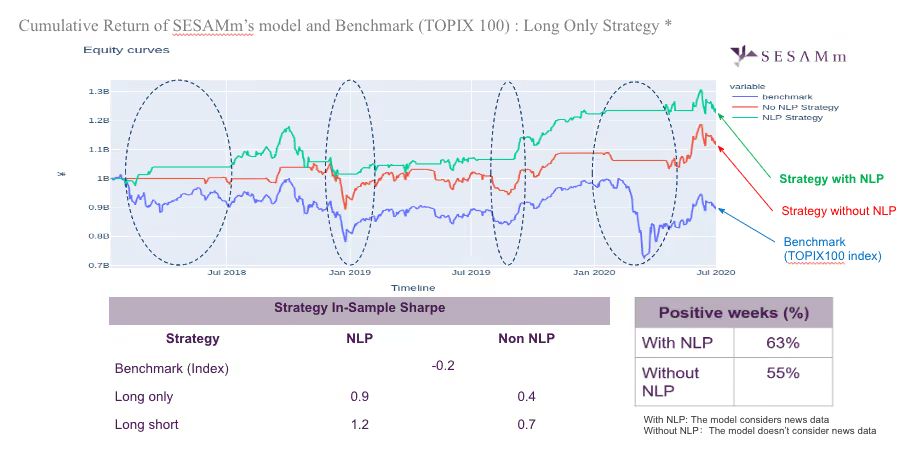
Verification using Japanese has revealed that the timing of bottoming and ceiling of text sentiment precedes those of stock prices. The collaborating team compared the performance of:
A model that uses only orthodox financial and economic data as inputs
A model that considers NLP and financial and economic data, confirming that the latter could generate higher alpha
ESG controversy monitoring can alert you to potential risks before market-moving events occur. Illustrated: Tesla ESG scores for pollutants, ethical standards, discrimination, and environmental impact.
The TextReveal ESG Alerts edge
Broad coverage
Access five million private and public companies of all sizes, including micro-caps, to identify risks in over 100 languages.
Expertise
Leverage ninety pre-built yet taxonomy-adaptable ESG risk categories such as SASB standards, UN Global Compact, and UN SDG-based positive impact statistics coverage.
Transparency
Gain insights with deeper analysis, seeing specific articles driving your alerts.
Timeliness
View live web data for forward-looking scores and insights.
TextReveal ESG Alerts features
Because we trained them on a representative corpus selected from billions of articles from prestigious news organizations, local news, and discussion forums, our NLP tools can understand finance and interpret slang, misspellings, and textspeak.
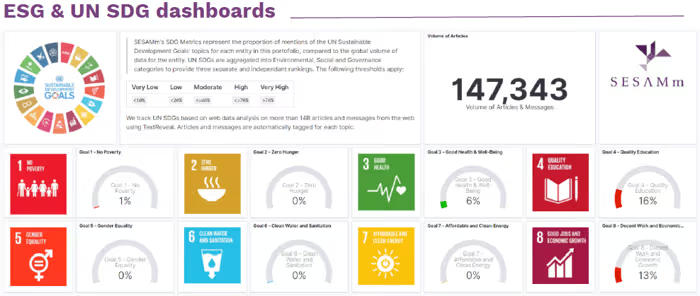
Get an ESG and UN SDG dashboard view of your portfolio.
The best part is that you can receive alerts and monitor scores in the way that works best for you. ESG and UN SDG‐based positive impact statistics can be accessed and delivered via:
Email Alerts
CRM and cloud based integration
Live dashboards
API and data files
ESG studies
Get the SESAMm edge from TextReveal ESG Alerts
Save time vetting your current investments and evaluating new ones while providing higher quality, objective results compared with manual monitoring, black-box ratings, or self-reported questionnaires.
Reach out to a SESAMm representative for a personal demo today.
Stay ahead with the latest in ESG and AI intelligence
Join our mailing list to receive new reports, event invites, and updates from SESAMm directly to your inbox.












.png)