Supporting M&A Screening with AI-Powered Risk Insights
10/29/2026
•
5 mins read
Overview
Acentra Health is a healthcare technology and services company working with public and commercial partners to modernize healthcare delivery. Its solutions span claims and encounter management, provider services, care management, and quality oversight.
As Acentra Health expands its platform and capabilities, mergers and acquisitions play an important role in strengthening the solutions it provides to healthcare partners and the populations they serve.
The Challenge
As part of its growth strategy, Acentra Health evaluates companies that may complement its technology, services, or market reach.
During early-stage evaluation, access to timely external information can help provide additional context about a potential target, including potential risks, market considerations, and areas that may warrant further diligence.
The team sought an efficient way to organize and assess relevant external information to supplement its broader evaluation and diligence processes
The Solution
To support early-stage deal evaluation, Acentra Health uses SESAMm’s AI Deal Screening Reports as one input in its screening process.
Generated quickly, the reports provide a structured overview of publicly available information related to a company, including potential risk considerations, competitive landscape insights, and market context.
By consolidating external information into a concise report, the tool helps the team develop an initial view of the broader environment surrounding a potential target and identify areas that may warrant additional investigation.
The Impact
By incorporating AI-powered screening into its workflow, Acentra Health supplements its broader evaluation and diligence processes with additional external intelligence.
SESAMm’s reports provide an efficient way to organize and review relevant external information during early-stage evaluation, helping the team identify topics for further consideration and supporting informed decision-making as Acentra Health evaluates strategic growth opportunities.
There’s no denying that ESG risk exposure in the pharmaceutical industry is high. This stems from the intense regulatory oversight, complex global operations, and the sector’s direct impact on public health. Governance issues represent the most persistent challenge, with leading companies repeatedly facing bribery and corruption cases, antitrust and excessive pricing investigations, misleading marketing practices, patent disputes, and data integrity concerns, often resulting in significant fines, large settlements, and prolonged legal scrutiny across jurisdictions.
Social risks are closely tied to product safety and workforce management, as evidenced by recurring drug recalls, regulatory suspensions, and litigations linked to adverse patient outcomes, alongside layoffs, labor disputes, and workplace safety concerns. Environmental risks, while comparatively less frequent, increasingly center on credibility and compliance, including sustainability reporting weaknesses, greenwashing allegations, and operational environmental violations.
What are the most persistent ESG challenges in the pharmaceutical industry? Read on to find out.
GlaxoSmithKline: Legal Battles and Social Accountability
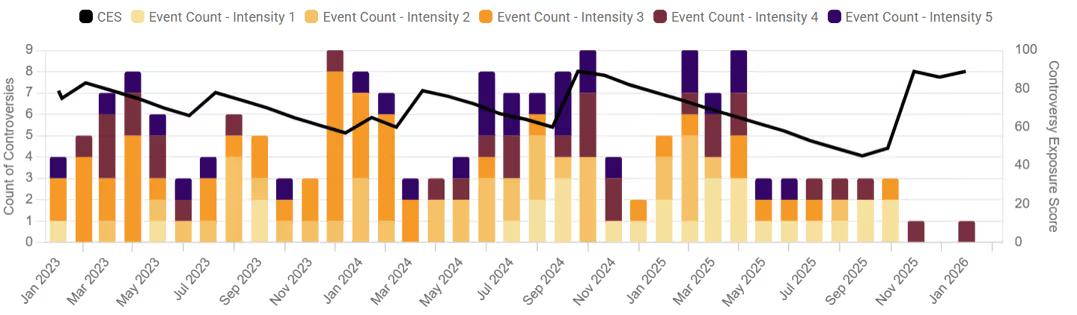
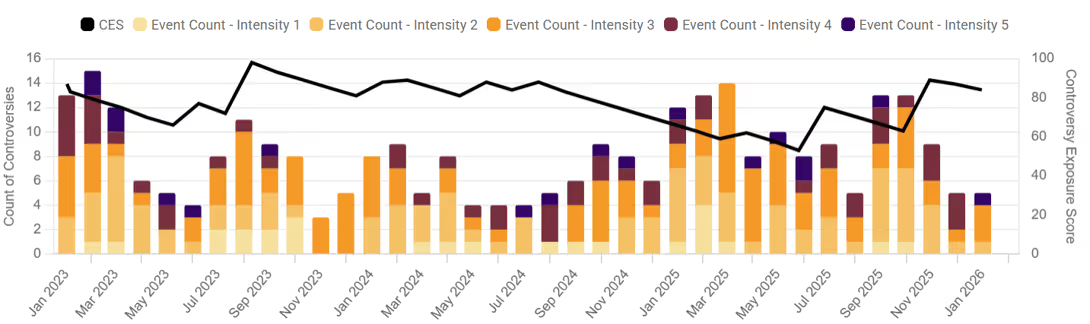
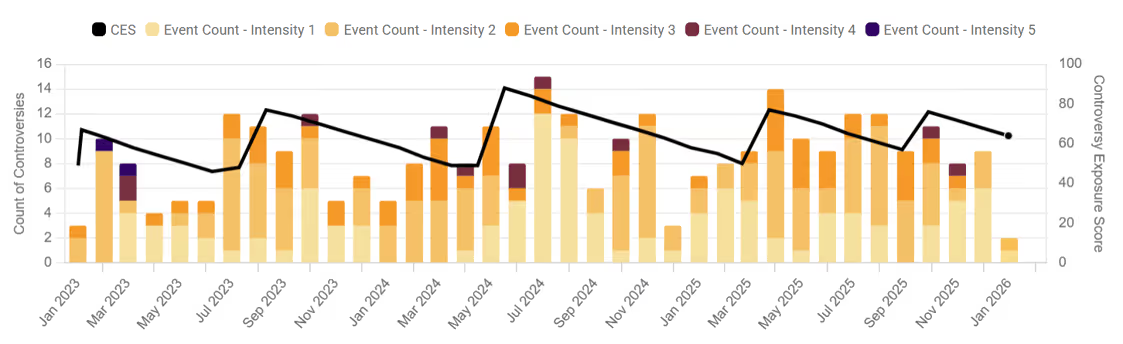
While taking a deeper look at GlaxoSmithKline (GSK), we found that the company has a very high Controversy Exposure Score (CES) of 88/100. This elevated score reflects a sustained pattern of governance and social controversies rather than isolated incidents. On the governance side, GSK has repeatedly faced major legal and regulatory actions, including a $2.2 billion settlement linked to Zantac, a $235 million patent award upheld by the U.S. Supreme Court, and multiple fines for misleading marketing, anticompetitive behavior, and bribery. Several of these events are flagged as UN Global Compact (UNGC) violations, particularly under principles related to anti-corruption, labor rights, and ethical business conduct, while others remain under UNGC watchlist classification.
Social risks further expose GSK, including recurring product recalls and regulatory suspensions tied to contamination, dosing, and packaging defects, as well as labor disputes, strikes, and large-scale layoffs across Europe and the United States. Together, the CES score and UNGC screening highlight persistent governance weaknesses and social risk drivers that continue to shape GSK’s overall risk profile.
Similar to GSK, Novartis shows very high controversy exposure, with a CES of 84/100, reflecting sustained ESG headwinds rather than isolated events. Governance risks are the primary driver of this elevated score, with Novartis facing repeated fraud and bribery allegations, competition and price-fixing investigations, patent disputes, and data integrity concerns across multiple jurisdictions. These issues have resulted in significant financial consequences, including nearly $1 billion in U.S. settlements related to improper physician incentives, $345 million to resolve foreign corruption cases, a €444 million antitrust fine in Europe, and several high-value patent dispute settlements.
A number of these controversies are flagged under UNGC screening, primarily classified as Watchlist events, particularly in relation to anti-corruption, ethical conduct, and legal compliance. Environmental risks also contribute to Novartis’ exposure, following greenwashing allegations and scrutiny over the credibility of its net-zero commitments. On the social front, large-scale workforce reductions, protests, strikes, and voluntary product recalls linked to safety oversight have further intensified the company’s overall risk profile.
Roche: Facing the Spotlight on Governance and Ethics
While lower than some of its peers, Roche shows a high level of controversy exposure, with a CES of 64/100. This score still reflects recurring ESG controversies across governance, social, and operational dimensions. Governance-related risks are the main contributors, with Roche involved in multiple lawsuits linked to bribery allegations, antitrust and excessive pricing practices, patent disputes, and marketing misconduct, including a €444 million antitrust fine in Europe.
Several of these events are captured under the UNGC screening, predominantly classified as Watchlist cases, particularly in relation to anti-corruption, competition practices, and governance standards. Environmental risks have also emerged, with the Ethos Foundation publicly challenging Roche’s sustainability reporting and executive remuneration practices, and its subsidiary Genentech was fined $158k for hazardous materials violations. On the social front, Roche has faced drug recalls tied to safety deficiencies, large-scale global layoffs, reported employee exposure to hazardous substances, and legal rulings related to workplace discrimination, all contributing to its overall ESG risk profile.
Across GlaxoSmithKline, Novartis, and Roche, ESG risk in the pharmaceutical sector is clearly structural. Governance controversies remain the most persistent and financially material, while social risks tied to product safety and workforce practices continue to drive litigation and reputational pressure. Environmental issues, though less frequent, increasingly raise questions around credibility and compliance.
Together, these cases highlight the need for continuous, forward-looking risk monitoring in a sector where regulatory scrutiny, public trust, and long-term value are tightly connected.
Reach out to SESAMm
TextReveal’s web data analysis of over five million public and private companies is essential for keeping tabs on ESG investment risks. To learn more about how you can analyze web data or to request a demo, reach out to one of our representatives.
In December 2021, Carlyle led a $475 million Series E funding round for YipitData. As part of its diligence process, Carlyle used SESAMm’s Natural Language Processing (NLP) models to help inform this investment decision.
Results
YipitData is an alternative data firm that extracts billions of data points from the web and other alternative data sources to generate proprietary data and KPIs on industries and individual companies.
SESAMm’s TextReveal® platform enabled Carlyle to extract valuable insights on the alternative data market to assess the global market opportunity based on the analysis of more than 17 billion web articles and messages. Using NLP in its due diligence process, Carlyle’s deal team was able to confirm YipitData’s leading market position and growth prospects across multiple industries and geographies. Furthermore, a risk analysis drawn from social discussions, anonymous forums and dark web content concluded there was very low risk associated with the company.
SESAMm provided valuable insights based on the analysis of billions of documents for this specific deal and helped translate unstructured contents into industry-level trends, competitive insights and risk analytics. These types of analytics can add value to the entire investment lifecycle, from sourcing to due diligence and portfolio monitoring — providing investment teams with key insights to assess investment opportunities and build a competitive edge.
“SESAMm provided us with valuable and timely insights for our investment process through its NLP alternative data. They helped us gain even more confidence in YipitData’s strong potential by confirming the company’s leading position. We are very happy with the insights provided by SESAMm and look forward to further collaborations.” Senior Associate – Technology Private Equity, The Carlyle Group
Barcelona, QuantMinds International, November 2022
CEO Sylvain Forté joins QuantMinds correspondent Joanna Simpson in an interview highlighting the use of AI in ESG Investing and how we use it to detect greenwashing practices.
Below is an approximation of this video’s audio content. Watch the video for a clearer understanding of the topics discussed during the interview.
Joanna: I'm Joanna Simpson here at QuantMinds International in Barcelona. Joining me now is Sylvain Forté, CEO of SESAMm. Thank you very much for being here.
Sylvain:Thank you.
Joanna: Tell me, how does it feel to be here at QuantMinds International?
Sylvain:It feels very good, actually. We've been to the conference a couple of times already, so it's not our first year, and this time we brought several people from our team. We're all here together, presenting our technology and discussing some of the novelties in the space. It's very exciting and personalized.
Joanna: Great. And what role does artificial intelligence have to play in the future of ESG and ESG investing, in particular?
Sylvain:ESG is a massive trend in the industry right now, not just in asset management and the quant space but also in private equity, in corporate space like tracking suppliers, clients, etc. And one of the key problematic themes that we see is data gaps. There's a lack of data in terms of coverage; small caps, mid caps, or even private firms are not well covered. The frequency of information tends to be lagging. There's a very low frequency, like quarterly updates or so. There's also a lack of transparency and the like.
So, I believe that AI is primarily a tool that can help build that information gap and, for example, cover millions of companies instead of just a few tens of thousands of companies manually. What we do at SESAMm is leverage a technology called natural language processing (NLP), where we screen text automatically to understand potential ESG controversies or positive impact events. This leads us to have a coverage of around 5 million companies, meaning every publicly listed company out there and private firms that no one else would cover otherwise. This enables many use cases.
There's also frequency; you can generate indicators every single day, more like a quantitative time series that people are used to, and this enables clients to get access to information even locally, like Raiffeisen, one of our clients, is tracking clients in Poland, in Austria, in Germany, or in Ukraine using NLP which would not be possible with traditional ESG metrics. I think that the key topic of AI is expanding the use, expanding the coverage in terms of ESG data, and making sure that data is systematic, follows a good process, and is transparent.
Joanna: What examples are there of ESG investing being enhanced by AI?
Sylvain:We see two primary use cases.
The first one is more quantitative, where people are looking to leverage ESG NLP data in their systematic trading process. It's either for alpha generation; for example, we work with LFIS, an asset manager in France that created a fund based on ESG NLP data. Their primary goal is to enhance their strategy to generate outperformance, which is really a good use case in that space. This is the quantitative use case where you can use higher frequency data like daily data to leverage ESG like any other kind of alternative dataset and derive superior returns.
Then we have more discretionary use cases where we see large asset managers or private equity shops which are looking to perform risk management tasks or help their team prioritize the scoring of assets. Say they have a team that does their own proprietary scoring on assets with regards to ESG, but how do I prioritize? I have 3000 assets to follow, I need some kind of alert on that whole universe to make sure that I focus on the assets that could be most controversial today. That's one of the things that we provide; daily alerts using natural language processing where people can say okay, there is a massive shift right now; as an ESG analyst, I'm going to make a decision to look at this asset specifically to help cover it and update the score.
Joanna:Can AI help with greenwashing in ESG investing, and if so, how?
Sylvain:Yes, it's one of the other kinds of problems that you have in ESG is the lack of transparency on the methodology creates some anomalies in some cases. And one of the big anomalies is that there's this averaging effect where a firm that has both positive actions and negative topics is going to be, on average, neutral, which is really problematic.
We had a big example like this in France recently with Orpea, a listed company of nursing homes exposed to a massive scandal with regards to mistreating patients—so more like social washing than greenwashing. And the problem is their scores were pretty high because, at the same time, they had some positive impact. They were implementing new diversity policies and the like, so it was averaging up.
At SESAMm, we leverage NLP to completely differentiate positive and negative topics. So if a firm is doing good stuff that is aligned with SFDR, and they have positive actions, etc., great! That's going to be one score. But if, at the same time, they have very negative topics, there are a lot of risks we're going to still detect that's not going to be averaged. It's going to be very specifically focused on.
Joanna: Sylvain Forté, thank you for your time.
Sylvain: Thank you very much.
To learn more about how SESAMm uses Text Reveal to find ESG data, contact a representative today.
Stay ahead with the latest in ESG and AI intelligence
Join our mailing list to receive new reports, event invites, and updates from SESAMm directly to your inbox.