Unlock the Future of Risk Mitigation with AI-Driven Insights
November 3, 2023
•
5 mins read
SESAMm recently hosted a webinar led by Lead Solutions Engineer Leo Shamash. The session focused on the critical role of Artificial Intelligence in identifying and managing ESG (Environmental, Social, Governance) risks and controversies, especially in private companies.
During the webinar, Leo Shamash shared insights on how SESAMm’s advanced AI technologies analyze millions of daily articles to provide accurate ESG risk assessments.
Why is this important for private equity firms? Because traditional methods of risk assessment are often labor-intensive and limited in scope. SESAMm’s AI-driven approach offers a scalable, efficient solution. The webinar also touched on SESAMm's extensive data lake comprising over 20 billion documents, making it one of the largest repositories for tracking ESG risks and controversies.
Watch the webinar replay now:
Join us for our next webinar on November 15 at 4 PM Paris time/10 AM New York time, and watch Sylvain Forté share his insights into how artificial intelligence can help distinguish between genuine sustainability efforts and greenwashing. Book your spot.
Reach out to SESAMm
TextReveal's web data analysis of over five million public and private companies is essential for keeping tabs on ESG investment risks. To learn more about how you can analyze web data or request a demo, contact one of our representatives.
SpaceX has spent the past three years in the news for reasons that have little to do with rockets. The company has been in court with a neighboring company in Texas, is at odds with the FAA, and has been quietly dropped by more than one European pension fund. In June 2026, shortly before its record 75 billion dollar public listing, MSCI gave the company its lowest corporate responsibility rating, a CCC.
We took a look at SESAMm’s data on SpaceX’s and pulled its record to see what three years of coverage actually holds. Between September 2023 and September 2026, we detected 139 distinct controversy cases involving the company, assembled from news reporting and other public sources. Four of them sit in the most severe tier, and between them they carry most of the story.
SpaceX and FAA in Regulatory Turmoil
UNGC: WatchlistSeverity 5 · Very High
CategoryEnvironmentalGovernanceSocial
17 events | February 2023 to June 2026
The first case in the record is a disagreement with the regulator. Conflict between SpaceX and the Federal Aviation Administration (FAA) intensified over time, with multiple proposed fines and significant penalties for data submission failures and safety oversight. Elon Musk publicly criticized the agency's management and called for reforms. What the case also notes is that none of this severed the relationship: through the same years, SpaceX continued to unveil ambitious plans for Mars and to collaborate with the FAA.
SpaceX's Environmental Challenges and Legal Battles
UNGC: WatchlistSeverity 5 · Very High
CategoryEnvironmentalGovernanceSocial
123 events | August 2019 to August 2026
SpaceX faces increasing scrutiny over its expansion and launch activities, with numerous environmental lawsuits and regulatory challenges emerging. The concerns range from habitat destruction and pollution to safety violations, and have prompted protests and legal action from environmental groups and local communities. As the company pushes forward with its plans, the balance between innovation and environmental responsibility remains contentious.
SpaceX Faces Scrutiny Over Workplace Safety Violations
Severity 5 · Very High
CategoryEnvironmentalGovernanceSocial
13 events | November 2023 to June 2026
SpaceX is under scrutiny following a series of workplace safety incidents, including a death and multiple injuries at its facilities. OSHA has imposed significant fines and opened investigations, citing trends in injury rates and unreported incidents, raising questions about the company's safety practices.
SpaceX's Starship Program: A Journey of Triumphs and Setbacks
Severity 5 · Very High
CategoryEnvironmentalGovernanceSocial
59 events | May 2020 to July 2026
The FAA has navigated a complex relationship with the Starship program, closing multiple investigations while mandating corrective actions after a series of explosive test failures. Set against those failures are significant milestones, including successful test flights and the development of new prototypes. Regulatory scrutiny and environmental concerns have continued through both.
What Investors are doing about it
Beyond these four, the record runs heavily to labor and employment litigation, as well as to Starlink's military use and security exposure.
Investors have already acted on it. Danish fund Akademiker Pension blacklisted SpaceX in March 2025. In August 2026 the Swedish state pension fund AP7, which manages savings for roughly six million people, ruled out investing at all, citing corporate governance and human rights risk management. Both decided on evidence that had been public for years. After the listing, the stock fell 27 percent.
Takeaways
The record does not point to one isolated controversy, or even to one particular part of the business. It points to a pattern. SpaceX’s exposure sits at the intersection of the risks that come with operating at extraordinary speed and scale: safety, environmental impact, labor practices, regulatory compliance and the governance of increasingly consequential technology.
That pattern matters more than any single headline. These cases are different in substance, but they share a common feature: the underlying disputes have persisted.
The exposure is not just something of the pastl. SESAMm’s Controversy Exposure Score* for SpaceXis currently 82 (considered “Very High Risk”) f, in its “Very High Risk” band, compared with an average of 67 (HIgh Risk) over the preceding year.
This ongoing exposure shows that controversy has become a recurring feature of SpaceX’s expansion story. For investors, regulators and other stakeholders, the question is increasingly whether the company’s governance and risk controls can scale as quickly as its rockets, satellites and ambitions.
*The Controversy Exposure Score (CES) is a continuous score from 0 to 100 measuring a company's exposure to ESG controversies over time, based on the severity of incidents and their media volume.
This is an unsolicited rating: it is not commissioned by the rated company. The company is notified before its score is first issued, does not take part in the rating, and SESAMm has no access to its management or non-public documents. Ratings are produced only from public and licensed sources. Methodology: https://www.sesamm.com/methodology
SESAMm has a large data lake of more than 20 billion articles (growing by 5–10 million a day) and 14 years of data in 100 languages. But its size alone is not what makes it good; it’s a refined process to find the exact data you want that makes it better.
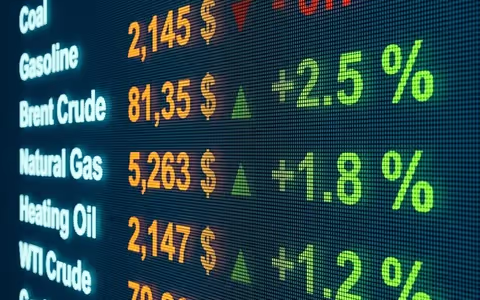
Here’s an example to help explain the point. We’re sometimes asked for help researching data to forecast and monitor the commodities market, even by large companies with their own commodities desk of traders and quant researchers. Why would they seek help from outside their firm?
Simply put, traders want an edge. They want information advantages that others are likely to miss, so they look to alternative data from various sources, anything that adds value and is from different angles. And, as it turns out, commodities are a more challenging segment to analyze when it comes to alternative text data. Unlike for companies, commodity texts are scarcer and need more domain knowledge to unravel their implications. A simple sentiment analysis doesn’t bring enough relevant information.
For a more in-depth view, join us as we discuss NLP-derived alternative data, its benefits, challenges for researchers, and why bigger isn’t always better in the world of data.
In theory, a portfolio with no ESG controversies signals low risk. In practice, experienced analysts treat it as a warning sign. The absence of alerts often reflects not resilience, but limited coverage, fragmented data, or incomplete aggregation. What looks like reassurance may instead point to a gap in visibility.
This dynamic matters more than ever as private market due diligence intensifies. With fewer deals, longer holding periods, and higher selectivity, investors are spending more time scrutinizing assets before acquisition and monitoring them for longer after entry. Yet the informational foundation behind many ESG assessments has not caught up with these expectations.
When "No Data" Becomes "No Risk"
Private assets operate under persistent disclosure constraints. Unlike public companies, most private firms do not produce standardized, recurring ESG disclosures, nor do they benefit from consistent analyst coverage. These gaps are structural and unlikely to disappear in the near term.
In this context, silence is ambiguous. A clean ESG screen may indicate the absence of material issues, but it may just as easily signal that no relevant information was captured. Language limitations, fragmented sources, and uneven coverage across geographies and asset types all contribute to this uncertainty.
This dynamic is particularly visible in secondary transactions. Deal teams often need to assess large portfolios under tight time pressure, with limited access to management and incomplete identifiers. In such cases, relying on the absence of signals can create false confidence rather than reduce risk.
How Weak Coverage and Duplicated Signals Create Blind Spots
Even when information exists, it is not always immediately actionable. Adverse media has become a valuable substitute where structured ESG data is limited, offering outside-in visibility into private assets. However, it is not without challenges. Without robust aggregation and cross-language consolidation, the same issue can appear repeatedly across multiple articles, jurisdictions, and languages, creating duplication rather than clarity. At the same time, gaps in coverage or weak filtering can allow other material risks to go undetected.
At the same time, some portfolios appear unusually quiet simply because the underlying assets fall outside the scope of traditional datasets. ESG and reputational expectations in private markets remain fragmented, with bespoke workflows driven by LP-specific requirements. This lack of convergence makes it difficult to distinguish between genuinely low exposure and analytical gaps.
More data does not automatically resolve this problem. Without traceability, source quality, and a way to assess financial, legal, or operational materiality, increased volume can add noise without improving decisions. In that environment, silence can be just as misleading as signal overload.
What Meaningful ESG Visibility Looks Like Under Disclosure Constraints
A core takeaway from the webinar was that point-in-time ESG assessments are no longer fit for purpose in private markets. A single diligence exercise conducted at entry cannot capture emerging governance failures, litigation, reputational issues, or supply chain risks over multi-year holding periods.
Instead, meaningful ESG visibility combines three elements:
Broad coverage, to avoid portfolios appearing "low risk" simply because assets are not captured.
Aggregation and severity assessment, to separate isolated news from controversies with real financial or operational implications.
Continuous monitoring, so the original risk thesis evolves as new information emerges rather than remaining static.
This approach reframes ESG from a compliance exercise into a source of informational advantage. Rather than concluding that no alerts mean no risk, investors use ESG signals to guide follow-up questions, prioritize deeper diligence, and identify issues that were not visible at entry.
Replacing False Comfort with Informed Uncertainty
Private markets will continue to operate with imperfect information. Disclosure gaps, opaque supply chains, and bespoke reporting demands are inherent to the asset class.
Treating “no issues detected” as a conclusion creates false comfort. Treating it as a hypothesis, contingent on coverage quality and monitoring depth, aligns ESG analysis with how risk actually emerges in private assets.
SESAMm’s AI Technology Reveals ESG Insights
Discover unparalleled insights into ESG controversies, risks, and opportunities across industries. Learn more about how SESAMm can help you analyze millions of private and public companies using AI-powered text analysis tools.
Stay ahead with the latest in ESG and AI intelligence
Join our mailing list to receive new reports, event invites, and updates from SESAMm directly to your inbox.






.png)