Unmasking Greenwashing: How to Identify Genuine and Deceiving Sustainability Initiatives with AI
November 23, 2023
•
5 mins read
In our most recent webinar, "Unmasking Greenwashing: How to Identify Genuine and Deceiving Sustainability Initiatives with AI," Sylvain Forté, SESAMm’s CEO and Co-founder, discussed our recent ebook entitled with the same name focusing on the vital role of AI in identifying and understanding ESG controversies, focusing on greenwashing and reputational laundering.
Greenwashing, the act of misleadingly portraying products or services as environmentally friendly, and reputational laundering, where companies create a facade of ethical behavior, are increasingly prevalent challenges. These practices mislead investors and consumers, obscuring the reality of a company's environmental impact. Our webinar highlighted the complexity of these issues and their relevance across various industries.
We discussed how AI technology is revolutionizing the detection of greenwashing and reputational laundering. By analyzing vast amounts of web data, including news articles, social media, and public records, AI uncovers patterns and red flags that might indicate deceptive practices. This is particularly pertinent for stakeholders in the financial sector, such as private equity firms, who must navigate the intricate landscape of ESG compliance and sustainability.
Our recent research study underscored the importance of this technology. We found that mentions of greenwashing and related controversies have grown exponentially over the years. This increase aligns with a rising global awareness of environmental issues and the demand for corporate transparency. AI's ability to sift through and analyze this growing body of data is invaluable in providing accurate, timely insights into potential ESG risks.
We also noted an interesting trend: while greenwashing mentions are increasing, their growth rate is slowing down. This suggests that as regulatory frameworks around ESG become more formalized and the market becomes more educated, instances of unintentional greenwashing decrease. It's a sign that clearer rules are helping companies avoid these pitfalls.
Our analysis also revealed that different industries experience varying levels of exposure to greenwashing claims. Sectors like food, drug retail, and oil and gas have seen significant increases in accusations of reputational laundering. However, we also observed a positive trend in the fashion industry, where regulatory frameworks have led to a decrease in greenwashing mentions.
Lastly, we highlighted the importance of distinguishing between negative and positive ESG mentions. While it's crucial to identify and monitor greenwashing allegations, it's equally important to recognize and support genuine sustainability initiatives. Our analysis showed that positive ESG initiatives often have a more significant impact on public perception than negative ones.
Watch the webinar replay now:
Reach out to SESAMm
TextReveal's web data analysis of over five million public and private companies is essential for keeping tabs on ESG investment risks. To learn more about how you can analyze web data or request a demo, contact one of our representatives.
Corporate responsibility and sustainability are not just buzzwords anymore but integral aspects of business strategy. The importance of Environmental, Social, and Governance (ESG) compliance cannot be overstated. With the introduction of stringent and complex regulations like the CS3D, corporations face an unprecedented challenge in aligning their operations with these evolving standards. This is where Artificial Intelligence (AI) steps in, offering not just a solution but a transformative approach to staying ahead in the ESG compliance game.
The New ESG Compliance Challenge: CS3D Regulation and Beyond
The CS3D regulation marks a pivotal change in the corporate world, demanding greater diligence and transparency in sustainability practices. This regulation encompasses a broad spectrum of ESG aspects, from environmental impact to social responsibility and governance standards. It necessitates a comprehensive approach to due diligence, extending beyond the corporation to its entire supply chain. This means every partner, supplier, and stakeholder must align with these stringent standards, complicating compliance efforts.
However, CS3D is just the tip of the iceberg. Other regulations like the EU Green Taxonomy and the German Supply Chain Law further add layers to this complex regulatory tapestry. Each of these regulations brings its own set of challenges and nuances, making it increasingly difficult for corporations to keep pace using traditional compliance methods.
Understanding CS3D in Depth
Delving deeper into the CS3D regulation, it's clear that its impact is far-reaching. Corporations are now required to ensure their practices are sustainable and ethical and verify that their suppliers and partners adhere to similar standards. This means conducting thorough audits, maintaining a high level of transparency, and being accountable for the entire supply chain's ESG impact. The regulation also demands regular reporting and public disclosure of these practices, adding another layer of complexity to compliance.
Broader ESG Regulatory Landscape
While focusing on CS3D, it's essential to understand its place within the broader ESG regulatory landscape. Regulations like the EU Green Taxonomy, which classifies sustainable activities and investments, and the German Supply Chain Law, which focuses on human rights and environmental standards in supply chains, complement CS3D's objectives. Together, they create a comprehensive framework that guides corporations toward more ethical, sustainable, and socially responsible business practices.
AI: A Game-Changer in ESG Compliance
The advent of AI technologies has opened new avenues for corporations to manage their ESG compliance needs effectively. AI's capability to process vast amounts of data, identify patterns, and predict outcomes is invaluable in navigating the complexities of ESG regulations.
Real-Time Controversy and Reputational Risk Monitoring
One of the most significant advantages of AI in ESG compliance is its ability to monitor and analyze textual data in real-time. This is crucial in the context of regulations like CS3D, where ongoing vigilance is necessary. AI algorithms can sift through vast amounts of text data from various sources – news, reports, social media, etc., to identify potential controversies and non-compliance issues. This proactive approach enables corporations to address issues before they escalate, ensuring continuous alignment with regulatory standards.
Enhanced Supply Chain Management
Another critical area where AI makes a significant impact is in supply chain management. Under regulations like CS3D, corporations must ensure that their entire supply chain complies with ESG standards. AI-driven tools can analyze supplier data, audit reports, and other relevant information to provide a comprehensive view of the supply chain's compliance status. This helps identify potential risks, assess supplier performance, and make informed decisions about partnerships and procurement strategies.
Case Studies and Success Stories
Illustrating the power of AI in ESG compliance, several corporations have successfully leveraged these technologies to meet regulatory requirements. For instance, a leading multinational company used AI-driven analytics to monitor its global supply chain, ensuring compliance with CS3D and other ESG regulations. The AI system provided real-time insights into supplier practices, flagged potential risks, and enabled the company to take proactive measures to maintain compliance.
SESAMm: Pioneering AI-Driven ESG Compliance
At SESAMm, we specialize in providing AI-powered solutions tailored to the unique challenges of ESG compliance. Our flagship product, TextReveal, is a testament to our commitment to innovation in this field.
SESAMm utilizes advanced natural language processing and machine learning algorithms to analyze unstructured data from multiple sources. It provides actionable insights that help corporations monitor ESG risks, understand regulatory changes, and maintain compliance. By leveraging TextReveal, corporations can:
Continuously monitor global news, social media, and other data sources for ESG-related risks and opportunities.
Conduct thorough sentiment analysis and trend forecasting to anticipate potential compliance issues.
Gain a deeper understanding of the ESG landscape and the evolving regulatory requirements.
Partnering for Success
Our partnership with leading corporations and financial institutions exemplifies the effectiveness of our AI-driven approach. By collaborating with SESAMm, these organizations have enhanced their ESG compliance strategies, effectively navigated the regulatory landscape, and made more informed decisions.
Staying ahead of the curve in the rapidly evolving world of ESG compliance is not just about meeting regulatory requirements – it's about leading the way in corporate responsibility and sustainability. AI technologies, with their unparalleled capabilities in data analysis and predictive insights, are the key to this leadership.
As pioneers in AI-driven ESG compliance solutions, SESAMm is committed to helping corporations navigate these challenges. Our innovative tools and expertise are designed to empower you to meet and exceed regulatory standards confidently. We invite you to explore the potential of AI in transforming your ESG compliance strategy and join us in shaping a more sustainable, ethical, and compliant corporate future.
SESAMm’s AI Technology Reveals ESG Insights
Discover unparalleled insights into ESG controversies, risks, and opportunities across industries. Learn more about how SESAMm can help you analyze millions of private and public companies using AI-powered text analysis tools.
SESAMm recently announced its successful Series B2 fundraising round. The news was covered by TechCrunch, a popular technology news website known for its comprehensive coverage of the latest developments in the tech industry.
SESAMm, a French startup that helps financial firms and corporates adhere to their ESG goals by using natural language processing (NLP) to generate insights from digital content, has raised €35 million ($37 million) in a round of funding to expand internationally.
Despite a growing backlash against ESG efforts from some politicians and vocal executives, companies are still cognizant of the reputational and commercial risks of ignoring their environmental, social, and corporate governance (ESG) responsibilities — this applies both to their internal practices and those of third-parties they do business with.
With that in mind, SESAMm enables businesses to track textual data from across the web — including news portals, NGO reports, and social networks — and convert this into actionable insights.
SESAMm has amassed a fairly impressive roster of clients from across the financial realm specifically, including U.S. investment giant Carlyle Group, French corporate and investment bank Natixis, Japanese multinational insurance holding company Tokio Marine, and U.K.-based asset management firm Unigestion.
Companies can access SESAMm’s flagship product, TextReveal, via several conduits, including an API that brings SESAMm’s NLP engine into their own systems. But on top of that, SESAMm also offers a web-based dashboard where companies can access data analysis, visualizations, and push notifications for various due diligence, compliance, and ESG scenarios.
For example, a company that wants to keep tabs on its supply chain partners can use SESAMm to track anything related to those partners that hits the public domain, such as emerging fraud litigation or other lawsuits. This allows them to proactively respond the instant they receive an alert via SESAMm — these ESG alerts, which SESAMm launched a few months back, can be delivered by email or system integrations, for example a customer relationship management (CRM) application.
Elsewhere, private equity firms can use SESAMm for due diligence on potential acquisition or investment targets. Indeed, SESAMm boasts a “20 billion article data lake” which it applies its NLP algorithms to to identify mentions on any type of company, with the data sliced, diced, and categorized into user-friendly dashboards.
“Private equity firms usually engage with consulting firms to perform due diligence on target companies,” SESAMm co-founder and CEO Sylvain Forté explained to TechCrunch. “The cost of doing this is very high, and the result is suboptimal as the amount of data on the web is enormous for individuals to go through it. Therefore frequently, the results are not comprehensive enough, leading to inaccuracies.”
However, the SESAMm platform can be configured for any number of use-cases, such as “share of voice” competitor analysis, or any other theme that might be relevant to a company.
“With the current attention on ESG in the industry, many of our use-cases are focused on that — however, we provide insights into several types of information,” Forté said. “This includes sentiment on brands, thematic stock baskets and indices, company leadership reputation, and web insights on macro-economic indicators such as inflation, among others.”
According to Forté, SESAMm pre-trains large language models, similar to that of ChatGPT, the generative AI poster child of the moment — on all the data it hoovers up, and fine-tunes the algorithms on its own datasets, which are annotated across the 100-plus languages it supports.
“SESAMm integrates a variety of data — over 20 billion articles in 100 languages with 14 years of history,” Forté said. “Data sources include highly-vetted news organizations, expert blogs, and social media. SESAMm also manages licenses for proprietary data sources from premium news channels.”
“Raising a significant amount during challenging market conditions highlights the relevancy of SESAMms focus on two key trends — AI and sustainability,” Forté said. “In turn, these tools enable organizations to make better decisions and fill the data gaps, particularly in ESG, on both public and private companies.”
Over the past decade, many organizations have improved their carbon footprints, from recyclable and biodegradable packaging and single-use plastic to planting trees and reducing their greenhouse gas emissions. However, some businesses and companies looking to boost their eco-friendly image without committing to serious changes and addressing environmental issues have been associated with false green marketing. We call this "Greenwashing."
What is Greenwashing?
Greenpeace and the Environmental Protection Agency define greenwashing as making false and misleading claims about a product's environmental benefits or practices, services, technology, or company practices. Greenwashing typically involves companies spending more money on advertising and marketing than on implementing sustainable business practices that minimize environmental impact. These false green claims can deceive consumers into believing that a product or company is more environmentally friendly than it is, leading to increased sales and profits. As a result, false advertising, misleading initiatives, and groundless claims have increased green investors' exposure to risks emerging from potential lawsuits from activist groups, image deterioration, and some heavy loss in assets invested.
Why is Spotting Greenwashing Important?
Greenwashing is a growing concern for investors as they look to make sustainable and responsible investments. Therefore, spotting greenwashing practices is important for these firms. Here's why.
The deceptive practices used by greenwashers can have significant implications for the integrity of investments made in what investors believe to be sustainably operated companies or sustainable funds. In other words, greenwashing makes it difficult for investors to distinguish between genuinely committed to sustainability companies and those merely making false claims about their environmental practices. As a result, investors may unknowingly invest in companies that are not as sustainable as they claim to be, which can harm their financial returns and the environment. Therefore, it's essential for investors to be aware of greenwashing tactics and to carefully research companies before investing in them to ensure that their investments align with their values and contribute to a more sustainable future.
What Are the Challenges to Detecting Greenwashing?
It's challenging to produce an accurate assessment of environmental, social, and governance (ESG) factors, which gives companies the opportunity to cover or hide ineffective and fake green initiatives. According to Regtank, some of the main challenges to detecting greenwashing practices are the following:
Lack of reporting standards: some investors believe that we haven’t universally agreed upon a set of standards to determine whether a product is ESG compliant.
Lack of transparency: greenwashing companies don’t disclose the specificities of their “green campaigns,” which makes it difficult for investors and consumers to fact-check and evaluate their sustainability claims.
Limited consumer awareness: false marketing strategies could be based on a combination of the consumer’s eco-consciousness and brand loyalty. As a result, consumers become less aware of the misleading strategies greenwashing companies use to sell their products.
Ultimately, these factors may contribute to the inaccuracy and limitations of ESG data and scores, which makes it easier for greenwashers to get away with their false marketing campaigns. Consequently, detecting greenwashing requires scrutiny of environmental claims made by companies and an understanding of the complex supply chains and manufacturing processes involved in producing products and services.
To learn more about greenwashing and have access to real-life case studies, download this comprehensive report:
How Does Artificial Intelligence Detect Greenwashing?
As greenwashing practices increase, activist investors, experts, journalists, and even the general public are spreading awareness of the issue using social media, news outlets, forums, and blogs, among other means. Recently, artificial intelligence (AI), particularly natural language processing (NLP), has proven to be effective in the early detection of greenwashing by analyzing vast amounts of qualitative data publicly available on the web. At SESAMm, for example, we apply our NLP capabilities to identify companies likely to engage in greenwashing practices by analyzing text in billions of web-based articles. Our data lake contains over 25 billion web–sourced articles, sourced from four million news, blogs, social media, and forum discussions on five million public and private companies in more than 100 languages. We run these articles through our AI platform tool, TextReveal®, and systematically craft reliable, timely, and comprehensive insights to detect greenwashing, generate ESG alerts, and identify related risks.
The Rise of Greenwashing
Greenwashing, the deceptive practice where companies claim to be more environmentally friendly than they actually are, has become a growing concern in recent years. By analyzing the frequency of web mentions of greenwashing over time, we can observe important trends and understand the factors contributing to this phenomenon.
Recent analyses indicate a significant increase in greenwashing mentions since late 2019. This rise aligns with a growing public awareness of the climate emergency and the increase in media outlets and social media accounts dedicated to exposing greenwashing. The number of mentions escalated from fewer than 200 to over 23,000 in the last quarter of 2023, highlighting the increasing scrutiny of corporate environmental claims.
A noteworthy pattern is the regular occurrence of spikes in greenwashing mentions during the third quarter over the past three years. This timing corresponds with the "pre-COP" periods, leading to critical international climate change management conferences. These periods see heightened discussions around sustainability, with increased attention on companies' environmental practices.
Figure 1: Greenwashing mentions over time.
Greenwashing in the Energy Sector
The energy sector, particularly the oil industry, has faced significant scrutiny regarding greenwashing. In this context, companies like Shell and ENI have been prominent due to the frequency of greenwashing mentions associated with them.
Figure 2: Examples of greenwashing mentions in the energy sector over time.
For Shell and ENI, the volume of greenwashing mentions has fluctuated, with notable increases in specific quarters. For example, Shell saw spikes in mentions during the second quarter of both 2021 and 2022 while experiencing a drop in the third quarter of 2022. ENI has faced similar fluctuations, often linked to legal actions and publicized environmental issues.
Shell's Greenwashing Mentions, ESG Risks, and Initiatives
Shell, a British multinational and prominent player in this sector, has faced considerable scrutiny for such practices. The company has experienced notable spikes in greenwashing mentions and has been involved in several ESG-related risks.
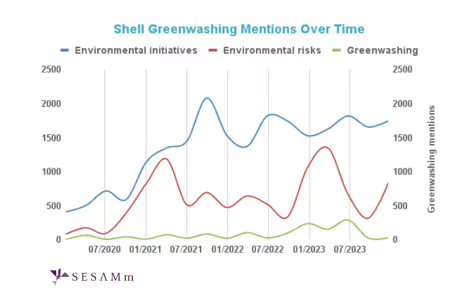
Figure 3: Shell greenwashing and ESG mentions over time.
Greenwashing Mentions
We can see an increase in greenwashing mentions in the first half of 2023. Around that period, Shell faced allegations and lawsuits concerning its environmental claims. The company was criticized for misleading U.S. authorities and investors about its energy transition efforts. Additionally, Shell faced public backlash for labeling fossil gas as 'renewable' while reporting record profits. A notable incident involved a shareholder suing Shell's executives over climate risks.
ESG Risks
Shell has faced several ESG-related risks, including legal challenges and pollution issues. In 2021, the company was sued by New York City over climate change-related advertising and filed an arbitration claim against Nigeria concerning a spill dispute. In March 2023, Shell faced another oil spill, this time in another region in Nigeria, Rivers State, and also saw institutional investors backing a lawsuit against its board over climate risks. The mid-2023 period saw Shell agreeing to pay $10 million for air pollution violations at a Pennsylvania petrochemical plant. Despite its net-zero pledge, the company announced plans to increase fossil fuel production.
ESG Initiatives
Despite its challenges, Shell has also engaged in various sustainability initiatives. In late 2021, the company announced plans to purchase power from the world's largest offshore wind farm. Mid-2022 saw a leadership change with the company's CEO stepping down as Shell aimed to align with its climate goals. The company also planned to deploy 10,000 EV chargers across India as part of its global strategy. In mid-2023, Shell committed to investing $10–15 billion in developing low-carbon energy solutions. Although the company abandoned its lower oil production target, it maintained its commitment to reducing emissions.
Shell's journey underscores the challenges of aligning environmental claims with real actions, emphasizing the importance of transparency and genuine sustainability efforts.
ENI's Greenwashing Mentions, ESG Risks, and Initiatives
ENI, an Italian multinational oil and gas company, has faced scrutiny for such practices. The company has experienced fluctuations in greenwashing mentions and has been involved in a number of ESG-related risks.
Figure 4: ENI greenwashing and ESG mentions over time.
Greenwashing Mentions
ENI's greenwashing mentions are fairly low. However, the company has been featured in discussions about greenwashing, especially with recent developments. In early 2022, the company faced criticism for inconsistencies in emissions data and greenwashing activities, as highlighted by the Sereno Regis Study Center. Greenpeace also criticized ENI for using the Sanremo Music Festival as a platform for greenwashing. In May 2023, ENI faced a lawsuit for allegedly lobbying and greenwashing to promote fossil fuels despite being aware of their environmental risks. Greenpeace sued the company, accusing it of knowingly contributing to climate change.
ESG Risks
Over the past 4 years, the oil giant's ESG risks have been few but not inexistent. ENI has encountered several risks, including legal challenges and pollution issues. In 2022, ENI's environmental strategy was deemed a failure, and concerns arose about a pipeline spill into the East Irish Sea. The company also faced legal actions in 2021, including an appeal against a court ruling in an illegal waste case and warnings from the Legality Network to reduce greenhouse gas emissions or face prosecution.
The company faced a lawsuit in early 2023 for allegedly having prior knowledge of the climate crisis. In another incident, a report found that ENI and Shell were responsible for significant pollution in Bayelsa, requiring a $12 billion cleanup.
Shell and ENI both face the challenge of balancing economic interests with environmental responsibility. Despite allegations of greenwashing and environmental risks, both companies have taken steps towards sustainability, such as investing in low-carbon solutions and renewable energy projects. Their experiences highlight the importance of transparency, genuine commitment to environmental responsibility, and the role of public scrutiny in holding companies accountable.
Greenwashing and ESG Investing
In sum, certain companies advertise their sustainability and green initiatives, while in reality, they are making false claims and practicing greenwashing, as evidenced by our analysis using SESAMm's AI and ESG reports. We use AI through TextReveal to generate alternative data for use cases, such as ESG and SDG, sentiment, private equity due diligence, corporate studies, and more. Our technologies can reliably ensure the credibility of ecological initiatives and serve global investment firms, corporations, and investors, such as private equity firms, hedge funds, and other asset management firms, to enhance their investment strategies.
Conclusion
In conclusion, the issue of greenwashing represents a substantial obstacle in the journey towards genuine environmental sustainability, misleading consumers and investors and diluting the efforts of genuine sustainable enterprises. Nevertheless, the emergence of advanced technologies such as Artificial Intelligence (AI) and Natural Language Processing (NLP) indicated a new era of accountability. Innovators like SESAMm are at the forefront, deploying these technologies to effectively unravel and counteract greenwashing practices. This empowers investors, asset, and portfolio managers to discern and align their resources with legitimately sustainable entities. The call to action is clear: a collective demand for transparency and responsibility is crucial.
Reach out to SESAMm
TextReveal’s web data analysis of over five million public and private companies is essential for keeping tabs on ESG investment risks. To learn more about how you can analyze web data or to request a demo, reach out to one of our representatives.
Stay ahead with the latest in ESG and AI intelligence
Join our mailing list to receive new reports, event invites, and updates from SESAMm directly to your inbox.









.png)