
The ESG Scorecard: A Deep Dive into Infrastructure Projects: Mines
September 4, 2025
•
5 mins read
Mining projects around the world often promise development and economic growth, yet their legacies reveal a far more complicated story. Sites like Cerrejón in Colombia, Córrego do Feijão and Samarco in Brazil show how environmental, social, and human rights risks can ripple through communities for decades. Rivers are poisoned, soils contaminated, and ecosystems devastated, while thousands of residents face health crises, displacement, and loss of livelihoods. Legal actions, class lawsuits, and ongoing remediation efforts illustrate that the consequences of these operations do not end when production stops. Communities continue to grapple with the aftermath, from toxic waste and tailings spills to the psychological scars of displacement and conflict.
What are the most pressing ESG challenges currently facing the mining sector? Read on to find out.
Córrego do Feijão Mine: ESG Challenges and Ongoing Controversies
The Córrego do Feijão Mine is facing serious ESG controversies following a dam collapse that resulted in 270 fatalities and contamination of the Paraopeba River. Indigenous villagers still lack safe land and access to clean water and food. The operating company, Vale, is dealing with ongoing legal challenges, including fines and criminal charges for negligence and bribery. Environmental and social impacts persist, with continued monitoring of water quality and safety risks from existing dams. Governance issues remain significant, highlighted by employee arrests and scrutiny over manipulated audits, prompting calls from local and international NGOs for improved remediation efforts and oversight of the mine’s operations.
Cerrejon Mine: Human Rights, Health, and Environmental Impacts
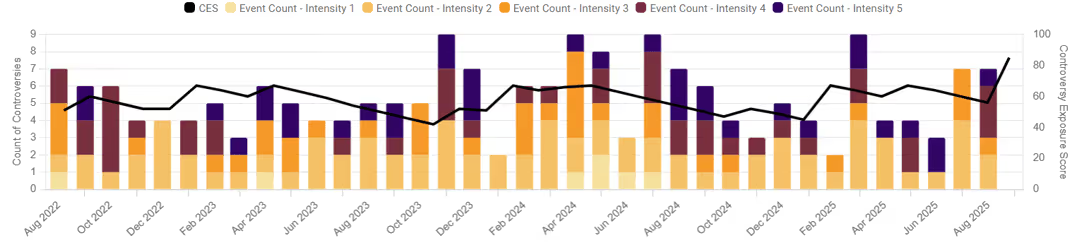
Cerrejón Mine faces significant ESG issues, particularly in environmental and social areas. Its expansion has displaced over 20,000 indigenous people, especially from the Wayúu community, leading to severe health problems and the deaths of 5,000 children. Environmental concerns include the diversion of the Bruno Stream, excessive water use during droughts, and significant air and water pollution. Labor unrest persists, with over 4,600 unionized workers striking over job cuts and unsafe conditions. The mine continues to face international criticism for violating local community rights and harming regional ecosystems.
Samarco Mine: Escalating ESG Challenges and Corporate Accountability
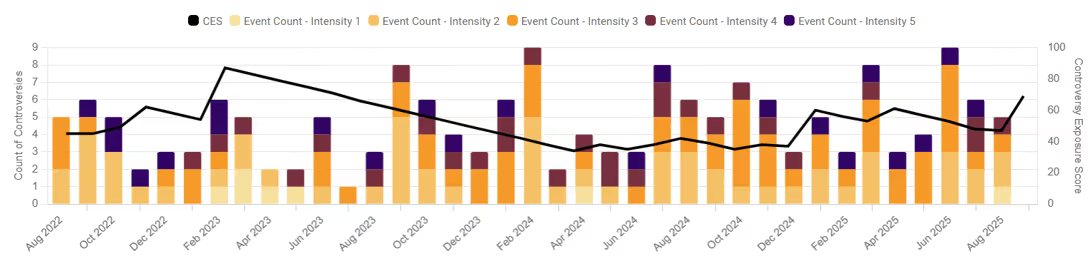
Samarco Mine faces intense ESG scrutiny nearly a decade after the 2015 Fundão dam collapse, with over 700,000 claimants in a $44 billion lawsuit for contaminated water and pollution. The operator risks bankruptcy due to environmental liabilities and failed debt restructuring, exacerbating financial instability. Ongoing issues include heavy metal contamination in wildlife and dust pollution exceeding health standards, prompting NGOs to demand the operator's removal from the UN Global Compact. Governance concerns have risen with employee arrests linked to safety protocol violations and falsified audits, raising questions about corporate accountability.
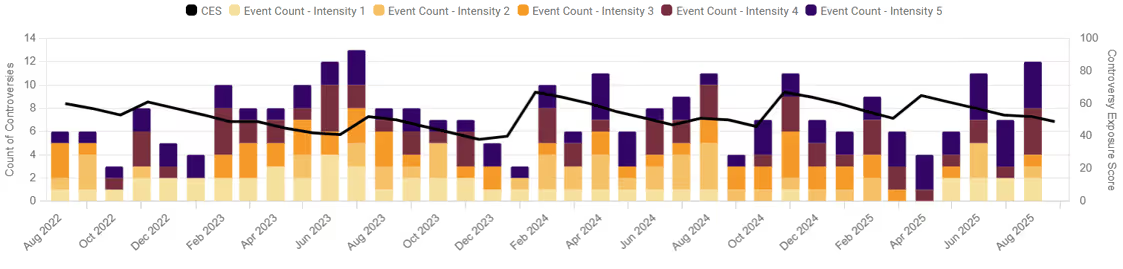
The ongoing ESG challenges in the mining sector highlight significant environmental, social, and governance failures that profoundly impact affected communities. The cases of Córrego do Feijão, Cerrejón, and Samarco reveal the dire consequences of prioritizing profit over sustainability. Mining companies must embrace accountability, transparency, and community engagement to rebuild trust and ensure a positive impact.
Reach out to SESAMm
TextReveal’s web data analysis of over five million public and private companies is essential for keeping tabs on ESG investment risks. To learn more about how you can analyze web data or to request a demo, reach out to one of our representatives.

In this final part of our series on AI in finance, we look at how new technological advancements will change the finance world. Over the next ten years, using data and AI for financial decisions will become common practice.
What is Generative AI and Why It Matters in Finance
New AI technologies, such as GPT-3.5 and GPT-4, are becoming part of everyday business tools. Although we're just scratching the surface of what they can do, these technologies will soon help us with tasks like writing emails, creating presentations, and making financial reports.
Take ESG (Environmental, Social, and Governance) indicators, for example. Right now, analysts often manually collect this data from financial reports. But soon, advanced AI models will handle this work, leading to more interactive and intelligent business tools.
What's Next for AI Technology
The following versions of these AI models will be even better than the ones we have today. Given that current models perform some tasks better than humans, it's exciting to think about their future capabilities. We expect these new models to excel in many different tasks. In the future, we'll see machines handle most tasks, which could be good for the world if we use this technology wisely in our everyday work.
How Generative AI Will Change Finance
Just like the internet and smartphones did, generative AI will change how businesses operate. Companies that adapt will do well, while others might struggle. One significant change will be in jobs, especially for analysts. As data becomes easier to collect and understand, analysts will shift to roles where they guide and interact with AI-based business systems.
How SESAMm Uses Generative AI
At SESAMm, AI is already making our work more efficient. It's changing both our internal processes and the features we offer our clients. For example, we use advanced AI models to automate data annotation for ESG and SDG (Sustainable Development Goals) alerts. This has saved our analysts 30% of their time. We're also creating a client-friendly interactive tool that will be a part of our dashboard. Our aim is to start with a demo and then fully automate the extraction and summary of key ESG and SDG events.
SESAMm’s Future with AI
In the long term, AI will play a big role in improving our services. We plan to use AI to automatically create reports, including detailed ESG or competitive analyses for private equity firms. AI is central to our innovation plans. We see it as a way to speed up our growth and establish SESAMm as a key player in the industry.
Our Long-term Objectives with AI
Our main goal is to make it easy for users to find accurate and timely data and ESG insights. The power of AI comes from its ability to quickly sort through a lot of information and pull out what’s important.
Another key aim is to help direct investments toward truly beneficial companies by improving our ESG measurement capabilities.
Staying Competitive in an AI World
To stay ahead, we are committed to raising internal awareness about AI and encouraging its active use across all teams. We also understand that a culture of innovation and transparency is crucial for success, particularly in ESG matters.
Final Thoughts
AI will change the way we work, but it's not just a tool—it's a vital part of our business strategy. It will help us improve our processes, services, and client relationships. Ultimately, AI is about much more than efficiency. It’s about unlocking new opportunities, empowering our team, and driving sector-wide innovation.
In case you missed it, please check out the previous parts of the series:
TextReveal's web data analysis of over five million public and private companies is essential for keeping tabs on ESG investment risks. To learn more about how you can analyze web data or request a demo, contact one of our representatives.
SESAMm Welcomes Industry Expert Stéphane Besson to Its Board of Directors
SESAMm is thrilled to welcome Stéphane Besson as the newest member of its board of directors. Stéphane is a seasoned expert in the finance industry with a rich background that includes BNPP and McKinsey. He has a notable track record, most prominently as the CEO of Coalition Greenwich for more than ten years. Under Stephane’s leadership, Coalition Greenwich, part of S&P, flourished to become the leader in providing strategic insights and analytics to the financial sector across Banks and Asset Managers.
“We are absolutely delighted to have Stéphane join our team. His remarkable journey in scaling Coalition Greenwich and advisory roles in several companies make him an ideal addition to SESAMm. His insights and strategic acumen will be incredibly valuable as we continue to expand our reach, especially in the European market where we have established a strong presence, and as we aim to increase our footprint in the US market,” commented Sylvain Forté, SESAMm’s CEO & Co-founder.
In his new role at SESAMm, Stéphane will not only be a board member but also an active strategic advisor. He currently also holds positions on Accelex and Acin boards and serves as chairman at Validis. His extensive experience guiding Coalition Greenwich's growth and advising various firms aligns perfectly with SESAMm’s mission. SESAMm, having recently secured $37MM in funding, is at a pivotal growth phase. The company specializes in leveraging AI to detect ESG controversies in public and private companies,
“I am very excited to join SESAMm. The quality of the team and their vision to bring more transparency to the ESG space convinced me immediately. I am looking forward to helping them deliver on their vision for their clients and the industry more broadly.” said Stéphane.
Stéphane's addition to the board is a testament to SESAMm's commitment to excellence and growth in AI-powered ESG insights. His strategic insights will contribute significantly to guiding SESAMm's growth in the global market.
The European Union stands at the forefront of global efforts to promote environmental, social, and governance (ESG) accountability. As the world becomes increasingly ESG-aware, the EU has developed a comprehensive regulatory framework designed to ensure transparency and accountability across all sectors.
These regulations represent the EU's commitment to sustainable development and responsible business practices. However, the regulatory landscape is evolving, with the February 2025 EU Omnibus Proposal introducing potential modifications aimed at reducing the regulatory burden on businesses. However, these proposals come at the risk of substantially undercutting the impact of the regulations.
This article recaps the current ESG regulatory framework in the EU, explores the changes proposed by the Omnibus, analyzes the potential impacts of these modifications, and discusses how financial institutions can navigate this evolving landscape while maintaining compliance.
The ESG Regulatory Landscape in the EU
The EU is advancing sustainability through a framework of regulations that enhance corporate accountability and reporting on ESG impacts. These measures aim to promote genuine sustainable practices and address international trade and emissions challenges. Though comprehensive, these regulations are also, at times, confusing in the way they overlap and impact each other. To get started, let’s examine the EU Taxonomy, SFDR, and CSRD—a triad of interconnected regulations designed to streamline and strengthen sustainable investing practices.
EU Taxonomy
The EU Taxonomy provides a classification system for environmentally sustainable economic activities, offering clear criteria to determine whether an economic activity can be considered "green."
Key Aspects of the EU Taxonomy
Defines criteria for environmentally sustainable economic activities
Requires companies subject to CSRD to report on Taxonomy alignment
The Taxonomy helps channel investment toward genuinely sustainable projects and businesses by creating a common language for sustainable activities.
Status
The EU Taxonomy has been operational since January 2022 with phased implementation. As of March 2025, companies subject to CSRD must disclose their taxonomy alignment percentages.
Sustainable Finance Disclosure Regulation (SFDR)
The SFDR focuses specifically on the financial sector, requiring financial market participants to disclose how they integrate ESG risks into their investment decisions and the sustainability impact of their financial products.
Key Aspects of SFDR
Requires disclosure of ESG risks in investment processes
Classifies financial products based on their sustainability characteristics
Aligns with EU Taxonomy criteria for sustainable investments
Aims to prevent greenwashing in financial products
The SFDR plays a crucial role in bringing transparency to the rapidly growing sustainable investment market.
Status
Fully implemented since March 2021, with enhanced Level 2 requirements since January 2023. All EU financial market participants must classify products under Articles 6, 8, or 9. Current market data shows that 28% of EU funds are compliant with Article 8 and 5% with Article 9, with a significant trend of reclassification from Article 9 to 8 due to stricter interpretations.
The CSRD stands as a cornerstone of the EU's ESG regulatory framework, requiring companies to report comprehensively on their environmental, social, and governance impacts. This directive mandates alignment with the EU Taxonomy, ensuring standardized reporting of sustainability metrics.
Key Aspects of CSRD
Requires detailed reporting on ESG impacts
Aligns with EU Taxonomy criteria for sustainability
Currently applies to companies with 250+ employees
Enhances corporate transparency on sustainability issues
The CSRD represents a significant step forward in standardizing sustainability reporting across the EU, providing investors, consumers, and regulators with comparable information on corporate sustainability performance.
Status
The CSRD, adopted in November 2022, replaces the Non-Financial Reporting Directive (NFRD). The transition to CSRD reporting was originally slated to begin in 2025 and would expand the number of companies subject to reporting requirements to 49,000 (vs 11,700 under NFRD). However, as we’ll see later, the Omnibus may push back the timing of CSRD.
Outside of the EU Taxonomy, SFDR, and CSRD, the Omnibus Proposal highlights two other key ESG regulations: CSDDD and CBAM. These regulations relate to corporate accountability for supply chains and to limiting carbon leakage.
Corporate Sustainability Due Diligence Directive (CSDDD)
The CSDDD focuses on corporate accountability throughout global supply chains, requiring companies to identify, prevent, and mitigate human rights and environmental risks associated with their operations.
Key Aspects of CSDDD
Requires companies to identify and mitigate human rights and environmental risks
Applies to full supply chains, ensuring comprehensive oversight
Applies to EU companies with 1,000+ employees and €450 million+ global turnover and non-EU companies with over €450 million EU turnover
Mandates regular monitoring and reporting on due diligence efforts
Strengthens corporate accountability for sustainability across operations
This directive acknowledges that a company's sustainability impact extends beyond its direct operations, encompassing its entire value chain.
Status
CSDDD was adopted in April 2024. Its phased implementation is slated to start in June 2026 and be completed by June 2028. The timing and scope of CSDDD is subject to change following the Omnibus Proposal.
Carbon Border Adjustment Mechanism (CBAM)
The CBAM is an innovative approach to preventing carbon leakage. It levies a carbon tax on imports to ensure that the EU's ambitious climate policies do not simply shift carbon-intensive production outside its borders.
Key Aspects of CBAM
Imposes a carbon tax on imported goods
Requires importers to report emissions data
Ensures payment for embedded carbon costs in imported products
Aims to prevent carbon leakage to regions with weaker climate policies
This mechanism aims to create a level playing field for EU producers subject to carbon pricing while encouraging global partners to implement similar carbon pricing mechanisms.
Status
The transitional phase for CBAM began in October 2023, with full implementation scheduled for January 2026. It currently covers cement, iron and steel, aluminum, fertilizers, electricity, and hydrogen. The certificate requirements will phase in gradually from 30% in 2026 to 100% by 2034. It’s expected to apply to 1.8 million EU importers and generate €5-14 billion in annual revenue when fully implemented.
The February 2025 EU Omnibus Proposal
Purpose and Goals
The EU Omnibus Proposal represents a significant recalibration of the EU's regulatory approach, seeking to balance sustainability ambitions with business competitiveness concerns.
The primary objectives of the Omnibus focus on alleviating regulatory burdens faced by businesses, simplifying compliance requirements, and streamlining reporting obligations. These efforts aim to enhance business competitiveness while addressing regulatory complexity concerns. By minimizing these challenges, the goal is to create a more favorable environment for businesses to thrive. However, this push for simplification could come at the expense of transparency and accountability, especially in sectors where regulation plays a protective role.
Impact Analysis: How the Omnibus Changes ESG Compliance
Below, we’ll take a closer look at each regulation and the changes proposed by the Omnibus Proposal.
EU Taxonomy Modifications and Implications
The Omnibus Proposal suggests a Level 2 modification to the application of the EU Taxonomy, reducing the number of companies required to report taxonomy alignment.
Key Changes:
Taxonomy alignment reporting is limited to companies subject to CSDDD
Voluntary reporting option for companies not required to comply
Possible Implications:
Reduced availability of standardized sustainability data
Increased difficulty in verifying "green" business claims
Higher risk of greenwashing in financial markets
Less reliable information for sustainable investors
These modifications would potentially undermine the Taxonomy's role in creating a common language for sustainable activities.
CSRD Modifications and Implications
The Omnibus Proposal significantly narrows the scope of the CSRD, reducing the number of companies required to report on ESG impacts.
Key Changes:
Threshold increase from 250+ to 1,000+ employees
Optional reporting for SMEs
A two-year delay in reporting obligations for some companies
Possible Implications:
80% reduction in companies required to report
Decreased transparency in corporate sustainability performance
Fewer sustainability data available to investors and regulators
Potential challenges in tracking sustainability progress
These modifications would substantially reduce the regulatory burden on smaller companies but raise concerns about the availability of comprehensive sustainability data.
CSDDD Modifications and Implications
The Omnibus includes significant modifications to CSDDD, with a narrowed scope and reduced monitoring requirements.
Key Changes:
Due diligence is limited to direct suppliers with over 500 employees, not full supply chains
Monitoring frequency reduced from annual to every 5 years
Delayed enforcement for one year for the first batch (Companies with 1.5 billion in turnover and 5000 employees)
Possible Implications:
Weakened corporate accountability for supply chain sustainability
Increased risk of undetected human rights and environmental violations
Reduced monitoring of global supply chain impacts
Extended timeline before full implementation
These changes would significantly reduce companies' compliance burdens but come at the risk of removing the essence of the directive, which is eliminating child labor, forced labor, etc.
SFDR Modifications and Implications
While not directly modified, changes to other regulations, particularly the EU Taxonomy, indirectly affect the SFDR.
Indirect Impacts:
Reduced availability of reliable ESG data
Challenges in differentiating truly sustainable investments
Potential increase in greenwashing risk
These indirect effects could undermine the SFDR's effectiveness in bringing transparency to sustainable investment products.
CBAM Modifications and Implications
The Omnibus Proposal simplifies CBAM compliance, particularly for smaller importers.
Key Changes:
Small importers (under 50 metric tons/year) are exempted
Reduced reporting burden for over 182,000 businesses
Possible Implications:
Simplified compliance for small businesses
Potential loophole risk if companies split shipments to stay under the threshold
Maintained coverage of 99% of emissions despite exemptions
These modifications would maintain the CBAM's effectiveness while reducing the administrative burden on smaller importers.
The Debate: Perspectives on the Omnibus Proposal
Arguments in Favor
Proponents of the Omnibus Proposal emphasize its benefits for business competitiveness and regulatory efficiency. They highlight the reduced administrative burden, especially for small and medium-sized enterprises (SMEs), which often struggle with complex regulations. Additionally, the changes aim to simplify compliance requirements, making it easier for businesses to adhere to regulations. By aligning with global standards, the proposal helps maintain the EU's economic competitiveness while promoting a more efficient allocation of resources across industries. Together, these factors create a more streamlined and supportive environment for businesses to thrive.
As BusinessEurope Director General Markus J. Beyrer stated: "Doing better with fewer and clearer norms is what European companies of all sizes are asking for. By reducing unnecessary reporting and regulatory burdens, the first Omnibus will allow companies to contribute more effectively to the EU's sustainability objectives while also preserving the EU economy's competitiveness."
European Commission President Ursula von der Leyen also expressed support for the proposal, stating: "EU companies will benefit from streamlined rules. This will make life easier for our businesses while ensuring we stay firmly on course toward our decarbonization goals."
Criticisms and Concerns
Critics raise significant concerns about the potential undermining of the EU's sustainability ambitions. They argue that the Omnibus Proposal may lead to unintended consequences, including reduced transparency in corporate sustainability performance, weakened supply chain accountability, and regulatory uncertainty during transition periods. Additionally, it could undermine sustainability objectives and increase the risk of greenwashing. As Mariana Ferreira from WWF European Policy Office commented:
"The Commission's sudden urge to destroy laws that are crucial for the achievement of the EU Green Deal is a perilous approach that is forcing Europe into a time of regulatory uncertainty. Under the guise of 'simplification,' the Commission put forward a proposal that will hinder economic and business success."
"The Omnibus proposal erodes EU's corporate accountability commitments and slashes human rights and environmental protections."
While the European Parliament debates the Omnibus Proposal, the fact remains that even if the regulations are delayed or loosened, the need for risk management remains unchanged. Investors require transparency, and companies must manage supplier risk effectively.
Navigating ESG Risks with SESAMm
SESAMm’s cutting-edge AI solutions empower investors, financial institutions, and corporations to navigate the complexities of ESG compliance with confidence. Leveraging an industry-leading data lake and state-of-the-art AI, SESAMm uncovers hidden risks in supply chains and target companies, providing real-time insights that drive proactive decision-making. By transforming regulatory challenges into opportunities for responsible and sustainable growth, SESAMm helps businesses stay ahead of evolving ESG requirements while mitigating risk and enhancing transparency.
SESAMm’s AI Technology Reveals ESG Insights
Discover unparalleled insights into ESG controversies, risks, and opportunities across industries. Learn more about how SESAMm can help you analyze millions of private and public companies using AI-powered text analysis tools.
Stay ahead with the latest in ESG and AI intelligence
Join our mailing list to receive new reports, event invites, and updates from SESAMm directly to your inbox.