The ESG Scorecard: A Deep Dive into Educational Technology
May 8, 2025
•
5 mins read
The educational technology (EdTech) sector, including companies like Udemy, Coursera, and Byju's, has grown rapidly but faces major social and governance challenges. Key issues include costly legal battles over privacy violations and deceptive practices, which raise investor concerns. Financial instability is also prevalent, with layoffs and bankruptcies highlighting doubts about workforce rights and sustainable business models. While some companies manage ESG issues better, operational inefficiencies remain a concern for long-term stability. What are the most pressing ESG challenges currently facing the EdTech sector? Read to find out.
BYJU’S: Treading Turbulent Waters Amidst Financial and Regulatory Challenges
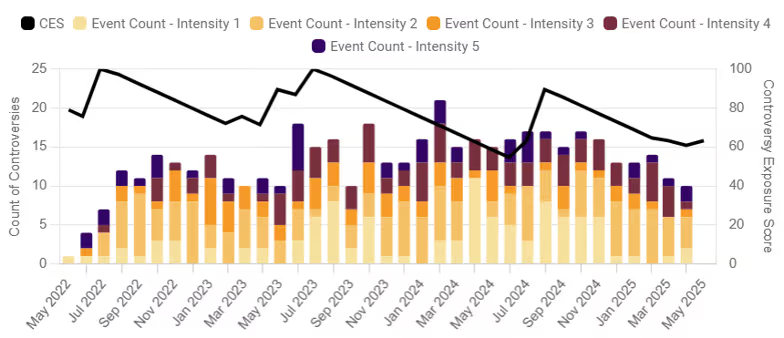
Byju’s, an EdTech startup in India, has faced significant challenges since 2022. The company has dealt with controversies, including data breaches, financial mismanagement, and regulatory investigations. Key issues include the shutdown of its Kerala office, mass layoffs, allegations of Goods and Services Tax evasion, and defaults on loan payments. In 2023 and 2024, Byju's continued to struggle with layoffs, money laundering investigations, and the resignation of executives. As of 2024, the company is at risk of insolvency, with ongoing bankruptcy proceedings and regulatory action against its leadership, highlighting its financial instability after years of rapid growth.
Udemy: Battling Legal and Ethical Challenges in the E-Learning Landscape
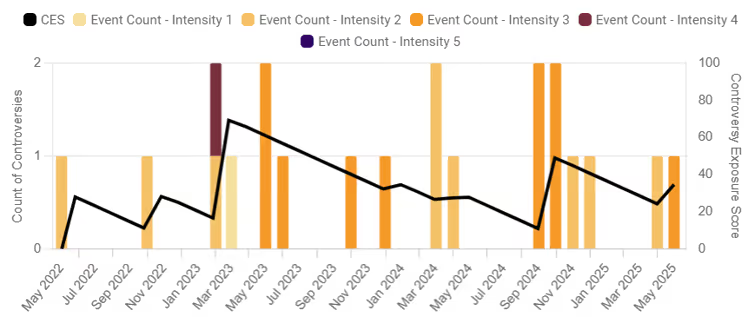
Udemy, a leading e-learning platform, has encountered increasing legal, financial, and operational challenges. These include a settlement over deceptive pricing practices, antitrust issues leading to a board member's resignation, and multiple lawsuits related to Facebook data sharing and video privacy violations. The company has also restructured its workforce to streamline operations and faced concerns over its generative AI policy regarding consent and transparency among instructors. These controversies highlight the complexities faced by EdTech companies in navigating legal and ethical challenges.
Coursera: Navigating Challenges in Security, Ethics, and Workforce Dynamics
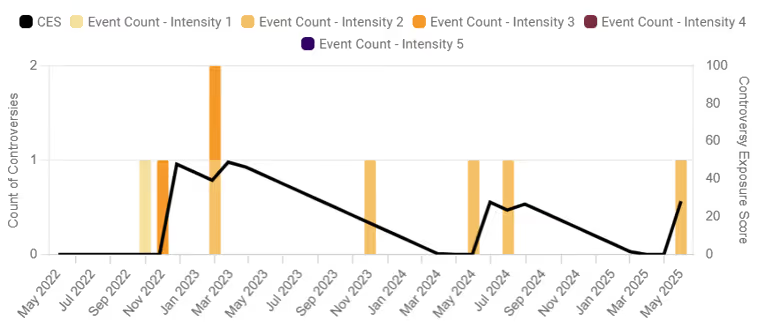
Coursera, another widely used online learning platform, has faced relatively few controversies as reflected by its Controversy Exposure Score. However, a few noteworthy challenges include security vulnerabilities, AI use, an investigation into misleading financial statements, and workforce reductions due to declining growth. The company is dealing with a class action lawsuit over subscription renewals and a data privacy lawsuit for sharing customer viewing history with Meta. Coursera also faces controversies related to AI, in this case on AI-powered tools for grading, providing feedback, and course-building, promising greater efficiency but raising questions about transparency and ethics. Finally, as part of restructuring, Coursera plans to cut its global workforce.
Each of these companies illustrates the growing ESG challenges in the EdTech sector. From maintaining data privacy and ethical AI use to ensuring sound governance, financial sustainability, and fair treatment of employees and customers, Udemy, Coursera, and BYJU’S all face heightened scrutiny. Recent controversies and operational troubles highlight the need for robust risk management as education technology firms mature on the global stage. The ESG risks – whether legal, social, or governance-related – not only threaten their reputations but also have material impacts on their long-term viability. By addressing these issues transparently and proactively, EdTech companies can work toward a more sustainable and responsible growth trajectory in the years ahead.
Reach out to SESAMm
TextReveal’s web data analysis of over five million public and private companies is essential for keeping tabs on ESG investment risks. To learn more about how you can analyze web data or to request a demo, reach out to one of our representatives.
Globally, ethics and sustainability are important, but the retail industry faces intense scrutiny over supply chain integrity. This spotlight shines on SHEIN and TEMU, two giants in the fast fashion and e-commerce sectors, known for their vast reach yet marred by controversies around labor practices and environmental impacts. This article explores their supply chain strategies, examining how current and emerging legislation, like the CSDDD initiative, aims to tackle the ethical dilemmas plaguing global retail. Through a comparison of SHEIN and TEMU, we assess the effectiveness of regulatory frameworks in addressing these critical issues. By analyzing their ESG controversies and comparing their responses, we assess how well current and future legislation, particularly the CSDDD initiative, addresses ethical issues in global supply chains.
Specialized Retail: The Case of SHEIN and TEMU
SHEIN and TEMU are compelling use cases due to their past controversies and the focus on their supply chain practices. Both companies have come under scrutiny for their labor practices, environmental impacts, and ethical issues, making them ideal subjects for analysis. By studying their supply chain challenges, we aim to assess the effectiveness of current legislation and predict the potential impact of future regulatory frameworks, particularly in the context of the CSDDD initiative.
While both companies operate with a similar business model, SHEIN is an established player entangled in numerous supply chain controversies. On the other hand, TEMU, a newcomer since 2022, faces similar issues. Comparing them helps us evaluate the effectiveness of existing supply chain legislation and determine whether increased regulatory scrutiny has improved compliance or merely raised awareness of these controversies within the industry.
Note:
Size bias mitigation:
We normalized the data for both companies to ensure an equal basis of comparison, accommodating the difference in operational history—SHEIN since 2008 and TEMU since 2022— to eliminate discrepancies in web attention.
Risk analysis:
It’s worth noting that the figures presented here specifically relate to supply chain risks, as that is the primary focus of our analysis.
Examining Supply Chain Controversies
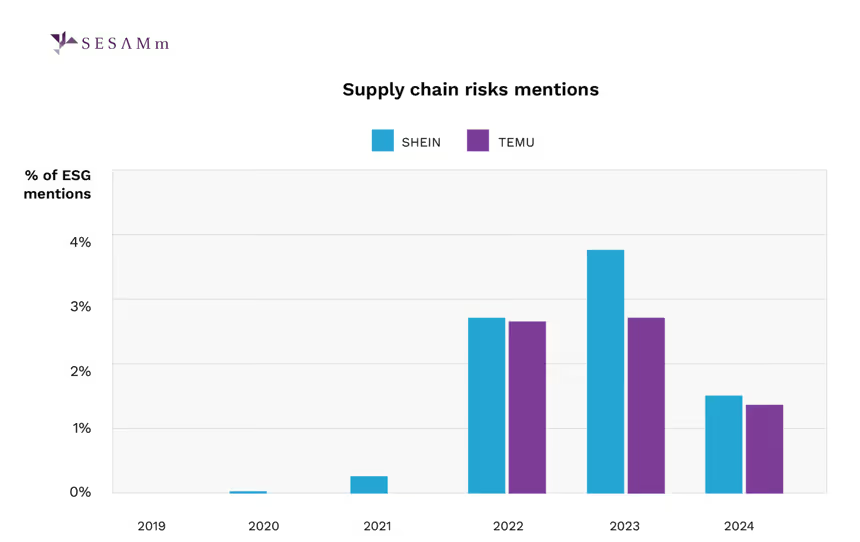
We analyzed ESG risks in the supply chains of SHEIN and TEMU over the past four years, adjusting data volumes for comparative analysis. SHEIN's supply chain risks have significantly increased since 2021, peaking in 2022 and continuing to rise in 2023, reflecting a growing online focus on its issues. Meanwhile, TEMU, despite only being established in 2022, has quickly come under intense scrutiny. The company faces frequent criticism for its supply chain practices, including condemnations for inaction and ongoing human rights violations.
Examining Social Sub-risks
In our analysis of social risks within the supply chains of TEMU and SHEIN, we discovered that fundamental human rights and labor rights are the most and second most prevalent issues, respectively. Notably, despite TEMU's more recent establishment compared to SHEIN, its supply chain has a relatively higher proportion of human rights controversies.
Both companies have faced serious allegations related to their supply chain practices. TEMU and SHEIN are scrutinized for using Chinese cotton potentially linked to slave labor, with insufficient efforts to mitigate forced labor risks. Allegations include child slavery, privacy issues related to sharing user data, and environmental neglect, including the use of carcinogens in products. Despite their efforts to boost their public image through aggressive marketing and influencer engagements, both companies have been criticized for their approach to environmental responsibility and labor practices.
Political calls for investigations into the use of Uyghur slave labor in both companies underscore their ethical challenges. Neither company has shown rigorous compliance with anti-forced labor laws, lacking stringent programs to audit supplier compliance. This highlights significant gaps in their corporate responsibility efforts.
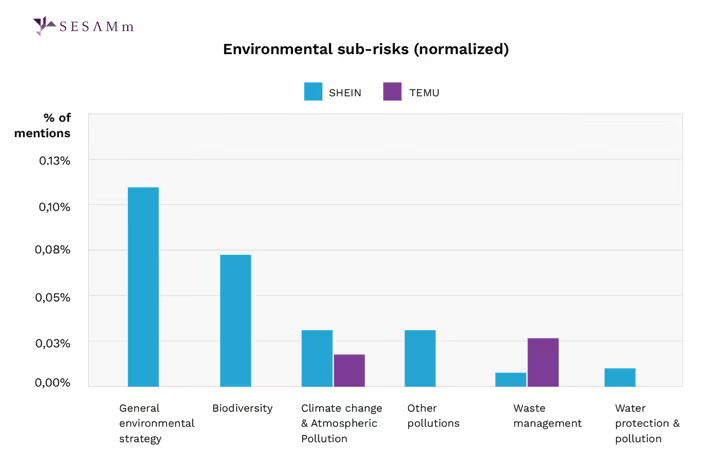
It's evident that social risks, particularly human rights breaches and labor rights controversies, have received significantly more attention than environmental risks. Despite the severity of environmental events, they represent a lower percentage in comparison. This highlights the prioritization of addressing social issues within these companies' operations.
SHEIN experiences extensive scrutiny, leading to a wealth of data on its practices. Conversely, TEMU, despite facing environmental controversies, has been less transparent about its environmental footprint, with Greenpeace reports highlighting this lack of clarity. This disparity underscores that SHEIN’s environmental impacts are more thoroughly documented than TEMU’s.
These environmental and health issues gained attention during SHEIN’s attempts to launch IPOs in the US and UK, spotlighting the company's ethical and environmental practices. Despite SHEIN's pledges to donate towards solving textile waste problems, critics label these actions as greenwashing, calling for significant alterations to its business model to address the underlying issues effectively.
Supply Chain Dynamics: SHEIN vs TEMU
While TEMU doesn't have its own brand like SHEIN, it operates under a comparable business model. It acts as an intermediary, managing shipments for products it doesn't manufacture. Despite their distinct approaches, both companies frequently engage in disputes, drawing attention to their supply chains. Additionally, policymakers often group them with similar firms, subjecting their fast fashion practices to heightened scrutiny.
These events highlight the growing scrutiny surrounding the supply chain practices of both SHEIN and TEMU. Senator Rubio's call for an investigation into allegations of Uyghur slave labor usage by both companies, additionally, mentions of Congressional attention has also focused on these companies, with reports exposing violations of U.S. tariff laws and evasion of human rights reviews on imports, shedding light on systemic issues within their operations.
Increasing Sustainability Awareness
We studied the mentions of both ESG initiatives associated with the brands and detected that over the analyzed time frame, SHEIN has been associated with significantly more initiatives than TEMU.
We analyzed the sustainability initiatives of these companies, finding that SHEIN's efforts outpace TEMU's significantly.
SHEIN focused on circular economy practices, exemplified by partnerships like that with Queen of Raw to reuse excess industry inventory and launches such as EvoluSHEIN and SHEIN Exchange, also boosting Product safety mentions, which promote recycled materials and resale of used products, respectively.
Throughout our analysis period, we noted that 2022 was a turning point for SHEIN's sustainability efforts, sparked by several mentions of breaches related to the Modern Slavery Act and child labor allegations in the previous year, which subsequently increased the company’s sustainability-related mentions. By 2023, as SHEIN prepared for potential IPOs in the US and UK and with the release of a controversial documentary, the company faced heightened scrutiny, with more allegations surfacing in its supply chain concerning various acts and legislations, such as the Modern Slavery Act, Uyghur Forced Labor Prevention Act, and others. Despite these challenges, mentions of SHEIN’s ESG initiatives also rose, although they remained less prominent than risk-related mentions due to controversies typically gaining more attention online. However, from 2024 to the present, we have observed more initiatives than risks, suggesting that, despite some acts and legislations being non-binding or not directly applicable to SHEIN, the potential reputational impacts drive the company toward positive change.
It's worth noting that we've observed discussions linking SHEIN with the recent EU Corporate Sustainability Due Diligence Directive, also referred to as CSDDD or CS3D. These discussions underscore the view that governments should refrain from incentivizing fast fashion companies like SHEIN. As the CSDDD is expected to bring about significant changes, forcing businesses to identify, prevent, or mitigate adverse impacts of their operations on human rights and the environment. Notably broader in scope compared to previous legislation, this directive will apply to all EU companies surpassing a certain revenue threshold. Consequently, fast-fashion retailers like SHEIN will face increased requirements to take action and ensure compliance.
The absence of enforceable regulations allows companies like TEMU to continue operating, but SHEIN's actions, particularly as it moves towards an IPO, raise questions about whether its efforts to improve practices are driven by the scrutiny associated with preparing for a public offering or by a sincere commitment to compliance with laws and regulations.
To conclude, our analysis underscores the dynamic landscape of supply chain regulations, ESG risks, and sustainability initiatives within the specialized retail sector, particularly in the fast-fashion industry. A focus on SHEIN and TEMU reveals a rise in both ESG initiatives and identified breaches. SHEIN's proactive initiatives suggest a response to regulatory pressures. Additionally, our findings suggest that even without binding legal requirements, companies may still choose to comply to enhance their reputation or respond to heightened scrutiny.
Reach out to SESAMm
TextReveal’s web data analysis of over five million public and private companies is essential for keeping tabs on ESG investment risks. To learn more about how you can analyze web data or to request a demo, reach out to one of our representatives.
Discussions around nuclear weapons and defense have recently highlighted how differently investors interpret weapons exclusions. In particular, Russia’s invasion of Ukraine has brought security considerations back into focus across Europe and prompted some investors to revisit long-standing exclusion policies.
At the same time, regulatory frameworks such as the Sustainable Finance Disclosure Regulation (SFDR) encourage investors to screen portfolios for controversial activities and disclose how those risks are managed. However, these frameworks do not impose a single global definition of weapons exposure. As a result, policies can vary widely between institutions.
Controversial Weapons
What Do We Mean by Controversial Weapons?
In responsible investment policies, the term “controversial weapons” has a relatively clear meaning. It refers to weapons that are prohibited or heavily restricted under international conventions because of their indiscriminate or humanitarian impacts. Typical examples include:
cluster munitions
anti-personnel landmines
chemical weapons
biological weapons
nuclear warheads
Because these weapons are banned or widely condemned under international treaties, investors usually apply strict zero-tolerance exclusions. Any company involved in producing these weapons, or supplying critical components for them, is typically excluded from ESG-focused portfolios.
What Counts as Weapons Exposure?
The broader category of weapons exposure is more complex and is where investor interpretations often begin to diverge. Recent discussions across Europe’s sustainable finance community have focused on whether defense companies should remain excluded from ESG portfolios, particularly in light of renewed security concerns following Russia’s invasion of Ukraine.
Many exclusion frameworks distinguish between controversial weapons and other forms of military-related activity. Companies may be involved in conventional weapons manufacturing, such as firearms, missiles, bombs, or military electronics. Others produce defense systems and equipment, including radar, communications technology, or aircraft components. Civilian firearms are also frequently treated as a separate category within exclusion policies.
In these cases, investors often rely on revenue thresholds rather than absolute bans. A company may be excluded if more than five to ten percent of its revenue comes from weapons manufacturing, while smaller or indirect exposure may still be permitted depending on the investor’s mandate.
A key challenge in these screenings is that a company’s weapons exposure is not always obvious from its core business description. A firm may supply components, software, or materials used in weapons systems or operate as part of a broader defense supply chain. This is particularly difficult to identify in private markets, where companies are not required to disclose detailed segment revenues or defense-related contracts.
As a result, defining and detecting weapons exposure requires clear policy definitions and structured screening logic. What counts as weapons involvement, and where the exclusion threshold lies, ultimately depends on each investor’s mandate and risk tolerance.
What's Different Now?
These questions are no longer abstract. Since Russia's invasion of Ukraine, major asset managers have visibly shifted their positions. Allianz Global Investors, for instance, updated its Article 8 fund policies in 2025 to allow defense companies. Global Trading UBS and Franklin Templeton made similar moves, each removing revenue-based weapons thresholds that had been standard practice for years. At the regulatory level, Hortense Bioy, Head of Sustainable Investing Research at Morningstar Sustainalytics, noted that "since the start of the war in Ukraine in 2022, it has become increasingly clear that geopolitics plays a more significant role in shaping the boundaries of sustainable investing than ethics." What these shifts share is a common thread: the thresholds and definitions that once felt settled are now being redrawn, which is precisely why screening frameworks need to be flexible enough to reflect each investor's current policy, whatever that may be.
Customizable Screening
Because exclusion policies are defined at different levels, it’s rarely as simple as establishing a generic exclusion list. Limited partners often impose their own restrictions or revenue thresholds, which general partners must apply alongside the fund’s internal ESG policy and regulatory restraints. In some cases, LP requirements may further restrict or override the fund’s baseline approach.
As a result, acceptable levels of exposure to activities such as conventional weapons can vary significantly across portfolios.
Screening frameworks, therefore, need to adapt to the investor’s policy rather than forcing the policy to adapt to the tool.
In this case, SESAMm’s AI-generated exclusion screening report can be customized to match each investor’s requirements. Threshold-based classifications help identify different levels of involvement, allowing investors to distinguish between companies with no exposure, limited exposure, or significant involvement in controversial activities. Each classification is supported by underlying evidence and source documentation, allowing analysts to verify the reasoning behind the flag.
This approach makes it possible to apply a consistent methodology across both public and private companies while remaining aligned with the investor’s specific exclusion framework.
Discussions around defense and responsible investment will continue to evolve as geopolitical and regulatory contexts shift. Recent debates around nuclear deterrence and defense participation illustrate how differently investors can interpret weapons exclusions, even when they operate under the same regulatory frameworks.
For investors, the challenge is therefore not only defining exclusion policies but ensuring that those policies can be applied consistently and transparently across portfolios. As definitions of weapons exposure vary, and as supply chains and private market structures add further complexity, screening frameworks must be capable of translating policy into clear, operational rules.
The aerospace and defense industry frequently faces ESG controversies, as these companies contend with high-exposure incidents that draw significant public and regulatory attention. In our recent webinar and ebook, we examined how AI-driven ESG evaluations enable early risk detection in these industries. Now, we want to explore what SESAMm's new Controversy Exposure Score (CES) can tell us about these same companies, including Boeing, SpaceX, Blue Origin, Raytheon, Lockheed Martin, and Airbus.
The aerospace and defense industry’s controversies mainly revolve around safety, labor issues, and regulatory concerns, which cause the CES scores to fluctuate considerably over time, influenced by both the volume and intensity of the events.
Boeing Analysis
Boeing has been consistently at the forefront of ESG controversies, experiencing fluctuating intensities that directly impact its CES score. These fluctuations are often tied to specific high-profile events. The company's high-intensity controversies, particularly related to deadly crashes and fraud allegations over safety concerns, have driven notable spikes in its CES score during the past few years.
Significant crash incidents and safety issues have recurred throughout the years. This has resulted in increased FAA scrutiny of Boeing in early 2021 following Boeing 787 inspections, followed by continuous inspections into the 2018 — 2019 crash scandals, which are reflected in the two CES spikes during 2021. In 2022, the CES score rose again as the company was sentenced to pay $2.5 billion for criminal charges and $200 million in settlements for SEC charges for misleading investors, both over the 737 Max scandal. In 2023, Boeing was ordered to appear in court for criminal settlements, an event classified as a high-intensity controversy, paired with significant media exposure reflected in the number of articles shared. This led to a surge in the CES spike despite the lower overall number of events during that period. In 2024, the U.S. urged Boeing to plead guilty to fraud charges related to the fatal crashes, further intensified by a whistleblower's release of additional safety concerns, resulting in further CES spikes. The most recent surge in the CES was triggered by a widespread employee strike over a contract offer, representing yet another setback for Boeing, whose reputation and finances have already been strained by manufacturing issues and federal investigations this year. Ultimately, both high-volume and high-intensity events related to Boeing’s controversies have contributed to the high CES score reflecting the company’s risks.
SpaceX Analysis
While SpaceX initially had relatively low controversy volumes and intensities in 2020, its CES score has steadily increased as well, aligning with the growth in controversies.
Notable peaks occurred in 2021, linked to controversies such as hiring discrimination concerns, an FAA investigation into test launches, and approval withholding for the Starship launch tower. Mid–2022 saw additional challenges, including CEO sexual harassment charges. Into 2023 and 2024, SpaceX’s scrutiny increased due to workplace environment-related lawsuits over hiring policy against refugees and sexual harassment and discrimination against women. Despite these events, SpaceX's controversies are less intense than Boeing's, so SpaceX has relatively lower CES scores.
Blue Origin Analysis
Blue Origin’s controversies have shown an increase over time. This surge was attributed to its conflict with NASA and SpaceX over the “Moon-landing” project. In 2022, Blue Origin faced FAA scrutiny over a flight anomaly and a workplace discrimination lawsuit. In 2023, further setbacks came from an espionage case, an engine explosion, and lawsuits involving discriminatory practices. The company experienced another wave of controversies in 2024, driven by an FAA investigation into parachute deployment failures and fresh allegations of workplace discrimination. Although Blue Origin’s controversies are relatively low in volume, occasional spikes have caused notable increases in its CES score.
Raytheon Analysis
Raytheon's CES score has remained moderate, with periodic surges between 2020 and 2021. These spikes were triggered by ESG risk events such as investor class action, violations of domestic preference laws, and the company’s involvement in Yemen's civil war. In 2022, the company faced another surge of controversies driven by an antitrust action lawsuit and further protests related to the situation in Yemen. In 2023, the CES score rose again amid backlash against the war in Gaza, the ongoing 2021 investors class action, environmental lawsuit, and FAA safety concerns for the company’s subsidiaries Pratt & Whitney, which also faced penalties for violating antiboycott regulations. Despite the diversity of ESG controversies, Raytheon’s overall CES score remains moderate compared to Boeing, thanks to the lower intensity of events it has encountered.
Lockheed Martin Analysis
Lockheed Martin's CES score has been relatively low and stable over time, with some fluctuations and few spikes. Mid–2021, the company had to pay a $10.28 million settlement for overcharging allegations; another notable surge occurred in 2022, triggered by FTC antitrust concerns over its Aerojet deal and an investor class action. The company’s involvement in war crimes in Yemen and Palestine during 2023 and 2024 has further fueled its controversies exposure hence the CES spikes. Though low in volume, Lockheed Martin’s controversies were marked by high-intensity events and media exposure, which contributed to significant spikes in its CES score.
Airbus Analysis
Airbus controversies events are relatively stable, with a slight decline overall and few spikes over time, as reflected in their CES score.
In early 2020, Airbus faced fraud and non-compliance allegations, along with a securities class action claim. By mid–2020, the company became embroiled in a bribery scandal. Toward the end of 2020 and into 2021, the long-standing Boeing-Airbus subsidy dispute resurfaced. In 2022, the bribery case remained unresolved, leading to Airbus agreeing to a $4 billion fine while also facing a $339 million class action lawsuit. The bribery allegations were still unfolding in 2023, accompanied by corruption claims in 2024. Compared to Boeing, Airbus has experienced fewer controversies in terms of volume and less severe high–intensity events. As a result, its CES score has remained relatively stable over time, with only minor fluctuations, primarily driven by legal investigations.
Conclusion
In the aerospace and defense industry, ESG controversies continue to shape the reputational and operational risks of leading companies. Boeing, SpaceX, Blue Origin, Raytheon, Lockheed Martin, and Airbus each face unique challenges that are reflected in their CES scores. While Boeing and Airbus have seen higher volumes and intensities of events, others like SpaceX and Blue Origin have witnessed moderate to low exposure but still face periodic scrutiny due to high–impact incidents. As these companies navigate evolving regulatory landscapes, labor concerns, and public perception, their CES scores will remain a critical indicator of their ESG performance. Download the ebook “The Boeing Scandal: Can AI Predict Controversies Before Traditional Tools?” to learn more about the Boeing scandal.
Reach out to SESAMm
TextReveal’s web data analysis of over five million public and private companies is essential for keeping tabs on ESG investment risks. To learn more about how you can analyze web data or to request a demo, reach out to one of our representatives.
Stay ahead with the latest in ESG and AI intelligence
Join our mailing list to receive new reports, event invites, and updates from SESAMm directly to your inbox.



.avif)
.avif)
.avif)
.avif)


-converti-depuis-png.avif)



.png)