The ESG Scorecard: A Deep Dive into The U.S Private Equity Landscape
December 3, 2025
•
5 mins read
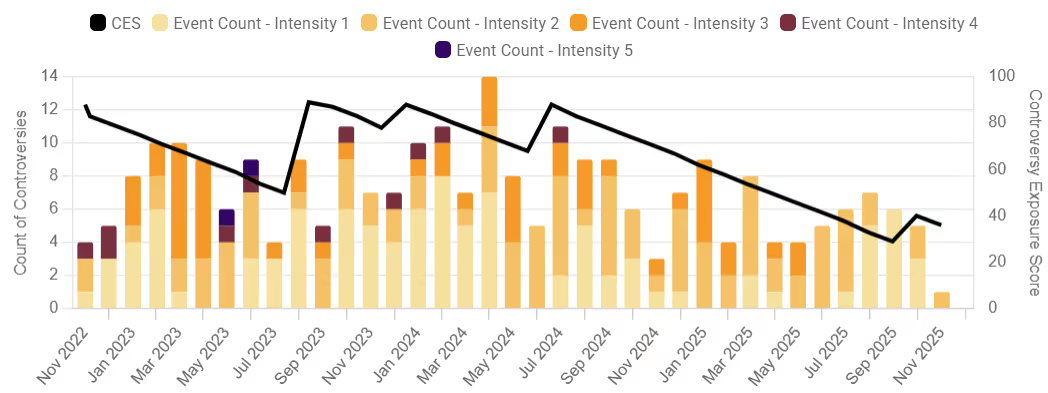
The ESG landscape for U.S. private equity firms is increasingly defined by systemic governance pressure and rising social and environmental scrutiny. Governance issues at firms such as Blackstone, KKR, Thoma Bravo, TPG, and Francisco Partners primarily focus on deal processes, disclosure practices, and investor protection. These concerns encompass settlements related to pension mismanagement, actions taken by the Department of Justice regarding pre-merger filings, as well as lawsuits and shareholder investigations examining the fairness of take-private transactions and stock buybacks. On the social side, exposure is driven largely by portfolio companies and political positioning. Housing and tenant-rights disputes sit alongside allegations of labor abuses, child labor, and unsafe conditions. Environmental concerns are increasingly prominent, with major companies facing criticism for their exposure to fossil fuels, their impact on climate change, and associated lobbying efforts.
What are the most pressing ESG challenges currently facing the U.S. private equity firms? Read on to find out.
Blackstone: Governance Pressure, Social Backlash, and Climate Criticism
Blackstone is facing a wide range of ESG controversies. Governance challenges include a $227.5 million settlement related to Kentucky pension mismanagement, a $590 million lawsuit involving SPAC Recovery Co. that alleges a fraudulent scheme, and SEC fines tied to off-channel communications failures. On the social front, the firm has drawn criticism for political spending that heavily favors right-leaning candidates, child-labor incidents, and recurring safety violations at portfolio companies. Housing-related concerns also persist, with tenant protests over rent and eviction practices and university movements calling for divestment from Blackstone-linked real estate funds. Environmentally, Blackstone continues to be targeted by climate activists for its fossil fuel exposure and its perceived contribution to escalating climate risks.
TextReveal’s web data analysis of over five million public and private companies is essential for keeping tabs on ESG investment risks. To learn more about how you can analyze web data or to request a demo, reach out to one of our representatives.
As 2025 kicks off, we stopped to take a look at the significant environmental, social, and governance (ESG) controversies of 2024, as we do every year. In this article, we dive into the three public companies with the most controversies for each pillar: environmental, social, and governance, analyzing the companies and the wider impact of the controversies themselves. Join us as we analyze these key moments that have not only influenced public opinion but also shaped the future of responsible business practices.
ESG Risks: Focus 2024
Starting with environmental risks, biodiversity and ecosystems, climate change, waste management, and atmospheric pollution emerged as the most scrutinized sub-risks in 2024. These issues were primarily tied to greenwashing, such as the Mercer Super case and energy companies' expansions at the expense of climate change.
Meanwhile, for social controversies, working conditions and fundamental human rights took center stage. Notably, some companies were linked to forced labor, while coffee supply chains were linked to child labor. Boycotts over the war on Gaza have also been a major highlight of 2024.
Environmental Controversies: Top 3 Public Companies
Shell
In 2024, Shell faced a host of environmental controversies, particularly through its Nigerian subsidiary, Nigeria Delta, which was implicated in serious water pollution due to oil spills. The company dealt with several other notable controversies, including a €15 million compensation related to the spills, a New York City lawsuit over climate change, and a landmark emissions ruling from a Dutch court. Additionally, the company faced condemnation from U.S. lawmakers for alleged greenwashing practices, a carbon credit scandal, and a water contamination lawsuit resolved with a $230 million settlement.
ExxonMobil
2024 was a challenging year for ExxonMobil. First, its Hammerhead project was hit by an FDA-required Environmental Impact Assessment to evaluate the potential ecological risks. Then, conflicts with Venezuela arose over environmental concerns, followed by several U.S. lawsuits. California, Kansas, and Puerto Rico all sued the company for issues ranging from global plastic pollution and greenwashing to trade law violations. Additionally, ExxonMobil was targeted in a climate lawsuit and faced ongoing fallout from the 1989 oil spill. Protests from groups like CalPERS and student activists highlighted dissatisfaction with ExxonMobil’s environmental practices, emphasizing the company's broad regulatory and public relations challenges.
TotalEnergies
Coming in at number three, TotalEnergies dealt with several environmental controversies, notbably protests related to its East African crude oil pipeline project in Tanzania and Uganda. The company has also been accused of greenwashing and misleading sustainability claims while struggling with oil leaks at its Donges refinery and Egina field. On top of these environmental controversies, TotalEngeries faced key governance and social controversies, including a $48 million fine by the U.S. Commodity Futures Trading Commission (CFTC) for attempting to manipulate the European gasoline market in March 2018. There are also ongoing investigations into an attack in Mozambique.
Social Controversies: Top 3 Public Companies
Boeing
In 2024, Boeing faced significant challenges due to safety concerns and production controversies, which have fueled employee unrest and public skepticism. Recent incidents, including a missing door plug attachment on a Boeing 737 Max and investigations into quality control lapses at Boeing and its supplier Spirit AeroSystems, have eroded trust among small businesses reliant on the manufacturer. Whistleblower testimonies and increasing scrutiny from Congress and the FAA highlight systemic safety failures. These developments suggest a difficult path ahead for Boeing as it works to regain credibility amid ongoing struggles.
Pfizer
In 2024, Pfizer faced scrutiny after EU documents revealed over 4.9 million adverse events and 3,280 deaths linked to its COVID-19 vaccine, especially among women and individuals aged 31-50. Critics allege Pfizer continued distribution despite knowing the risks, questioning the EMA's approval. Additionally, DNA contaminants, including carcinogenic SV40 sequences, have been reported in the vaccines. A whistleblower disclosed that Pfizer employees were offered a "separate" COVID vaccine, raising concerns about access inequality. Kansas has filed a lawsuit accusing Pfizer of misleading the public about vaccine safety; meanwhile, the company faces fines in the UK for excessive pricing of an anti-epileptic drug.
Meta
In 2024, Meta faced intense scrutiny and legal challenges due to multiple controversies, including a significant data breach, allegations of failing to protect children, and privacy concerns. The company settled a $1.4 billion lawsuit related to facial recognition practices and was fined $220 million by Nigeria for violating data laws. Additional lawsuits from school districts and the Consumer Protection Association highlighted issues related to social media addiction and mental health impacts on teenagers.
Governance Controversies: Top 3 Public Companies
Alphabet
2024 was a legally challenging year for Alphabet, facing numerous antitrust issues globally. For instance, Allegro sued Alphabet for $568 million over anti-competitive practices, and the U.S. Justice Department accused Google of monopolies in the search engine and Android app markets. It has also faced an antitrust ruling, which it plans to appeal. In Europe, Google was scrutinized under the Digital Markets Act and fined 71 million euros in Turkey for anti-competitive behavior. Additionally, France imposed a $271 million fine on Google for using news content without publisher consent, and India began investigating Google's gaming app policies. These incidents highlight Alphabet’s ongoing regulatory battles across multiple continents.
In conclusion, the controversies surrounding environmental, social, and governance issues in 2024 have underscored the urgent need for accountability and transparency within corporations. As these companies grapple with significant backlash and legal challenges, it is clear that stakeholder expectations are evolving. The demand for responsible practices is louder than ever, and the consequences of neglecting these issues can be severe, impacting not just public perception but also financial stability and sustainability.
SESAMm’s AI Technology Reveals ESG Insights
Discover unparalleled insights into ESG controversies, risks, and opportunities across industries. Learn more about how SESAMm can help you analyze millions of private and public companies using AI-powered text analysis tools.
BNP Paribas has released its 2025 ESG Global Survey, revealing how institutional investors are adapting their sustainability strategies in the face of shifting market dynamics, rising regulatory scrutiny, and increased public skepticism. The report surveyed 420 asset owners, asset managers, and private capital firms across 29 countries, representing a combined $33.8 trillion in assets under management, and paints a complex but ultimately optimistic picture of ESG’s evolution.
Resilient Commitment Amid a Changing Landscape
Despite growing political backlash and accusations of greenwashing in various markets, investor commitment to ESG remains strong. A large majority, 87%, said their ESG or sustainability objectives have remained stable, and fewer than 3% expect to scale back their commitments. Furthermore, 84% anticipate that their organizations will continue to progress on sustainability goals through 2030.
However, this confidence is paired with a new sense of caution. Forty-one percent of respondents reported a more restrained approach to publicly promoting their ESG activities. This shift reflects broader concerns about reputational risk and regulatory ambiguity, particularly in markets where ESG has become politicized. Still, the underlying momentum toward long-term ESG integration appears undeterred.
From Broad ESG to Thematic and Impact Strategies
The report also signals a shift from general ESG investing toward more targeted strategies, especially thematic investing. Eighty-five percent of participants now apply sustainability criteria to investment decisions, and 59% actively pursue thematic strategies such as climate resilience or social equity. Top investment priorities over the next two years include increasing allocations to the energy transition, divesting from carbon-intensive assets, and using active ownership to push portfolio companies toward improved ESG outcomes. This thematic focus suggests a maturation of ESG strategies, with more precise goals and performance expectations.
Emergence of ESG “Pacesetters”
A standout insight from the survey is the rise of “pacesetters,” the 19% of respondents that have achieved the highest levels of ESG integration. These advanced investors have already embedded ESG factors across portfolios, including metrics related to social impact, biodiversity, and “The Just Transition Mechanism”. Nearly all pacesetters are actively decarbonizing their portfolios and report alignment with broader societal and environmental goals.
This group is not only more sophisticated in managing ESG risk but also more likely to view ESG as a long-term value driver. Their practices highlight what comprehensive ESG adoption can look like when paired with sufficient resources, internal alignment, and robust data.
Private Capital’s Expanding ESG Role
Private capital managers are also emerging as key ESG players. More than half are using active ownership strategies, while 76% emphasize social impact, and 63% are engaged in just transition initiatives. These firms see ESG as an opportunity to generate alpha, align with stakeholder expectations, and lead in sustainability-driven innovation.
The Critical Role of Data and Partnerships
Finally, the survey underscores the growing importance of ESG data and trusted partners. Nearly half of all respondents expect to increase budgets for ESG data acquisition and analysis. When selecting financial partners, ESG reputation and expertise are increasingly decisive factors.
Overall, the 2025 survey shows that institutional investors remain deeply committed to ESG, but are evolving in how they execute and communicate these strategies. The future of ESG appears less about bold declarations and more about targeted, data-driven action.
SESAMm’s AI Technology Reveals ESG Insights
Discover unparalleled insights into ESG controversies, risks, and opportunities across industries. Learn more about how SESAMm can help you analyze millions of private and public companies using AI-powered text analysis tools.
Paris, France, April 11, 2024 - Expanding its ESG controversy coverage and off-the-shelf solutions, Manaos, a subsidiary of BNP Paribas and a modular investment service platform, has entered into a strategic partnership with SESAMm, a leading authority in ESG controversy data powered by advanced Generative AI. This collaboration marks a milestone in providing comprehensive, AI-powered ESG controversies insights directly to financial institutions and corporate clients.
Through this partnership, Manaos will integrate SESAMm's cutting-edge ESG controversies data into its platform, offering a dedicated dashboard and controversies reports for institutional investors and asset management companies and adding private equity firms to its offering. This integration expands Manaos' coverage of controversies, not just for listed assets but also for private assets, tapping into the world’s largest set of events captured on controversies in over 5 million private and public companies, in addition to providing access to the most granular ESG controversy dataset in the world.
Sylvain Forté, CEO & Co-founder of SESAMm, highlighted the importance of the partnership, stating, "At SESAMm, we're committed to delivering transparent and comprehensive ESG controversy data, providing essential insights for our financial and corporate clients. By partnering with Manaos, we are not only expanding our reach but also empowering financial institutions to seamlessly integrate ESG considerations into their investment strategies."
This strategic partnership between Manaos and SESAMm signifies a forward leap in integrating ESG considerations into investment strategies, offering unprecedented access to sophisticated ESG controversy insights for the financial industry.
Benoit Guibourg, Head of Product of Manaos, added: "We're thrilled to partner with SESAMm, a renowned expert in ESG controversy analysis leveraging the power of AI. Thanks to this collaboration, Manaos aims to provide an extensive offer on ESG controversies and leverage the platform to incorporate comprehensive ESG reputational insights in custom or ready-to-use dashboards and reports. SESAMm's expertise extends our ability to guide clients through the complexities of ESG considerations, marking a significant milestone in our mission towards sustainable investing. Furthermore, we are eager to work with SESAMm to unlock the power of their extensive coverage of the private world and provide ready-to-use solutions for our clients."
SESAMm is a global leader in ESG controversy data, using advanced Generative AI. It automates monitoring and due diligence on public and private assets. SESAMm provides coverage for more than 5 million companies in multiple languages. SESAMm works with top international firms such as Carlyle, Warburg, Natixis, RBI, Fitch, and Oddo.
About Manaos:
Manaos, a technology subsidiary of BNP Paribas, powers an all-in-one platform that connects the traditional information systems of institutional investors and asset management companies with carefully selected rating agencies and fintechs to manage all their investment services seamlessly. In practice, the Manaos platform enables investors to collect their fund compositions from their asset managers, while standardising portfolio data and allowing for asset-level portfolio look-through. From there, Manaos empowers asset managers and asset owners to test and measure their ESG investments performance by connecting their portfolio data to a range of over 20 best-of-breed ESG data providers (including MSCI, S&P Sustainable 1, Morningstar Sustainalytics, Moody’s and ISS ESG). Once enriched with third-party data, Manaos offers flexible, multimodal portfolio data extraction along with seamless data visualisation and dashboards features. Finally, Manaos reporting solutions help investors with the production of EETs (European ESG Template), SFDR PAI Statements, TCFD, LEC Art.29, Taxonomy and SDR regulatory reports, client ESG reports and more. For more information, visit www.manaos.com
Stay ahead with the latest in ESG and AI intelligence
Join our mailing list to receive new reports, event invites, and updates from SESAMm directly to your inbox.





.avif)


.png)