Webinar: Mastering Climate Risk in Private Markets
•
5 mins read
Climate risk on a private infrastructure asset can look completely different depending on where you look. Some assets carry obvious physical exposure but never hit the news until it’s too late. Others appear operationally resilient but generate a constant stream of controversies, fines, and local opposition. Most teams see only one side of the risk at a time.
In this recording, SESAMm CEO Sylvain Forté and Scientific Climate Ratings Sales Director Mariya Peykova put two real infrastructure assets under every angle that matters in private markets: physical, transition, controversy, regulatory.
Watch it to explore:
Reading the same infrastructure asset from multiple angles, not just one
From deal screening to reporting: at every stage of the asset investment lifecycle
Spotting hidden climate exposure before it shapes a deal or surfaces in an LP conversation
Luxury brand Loro Piana, owned by LVMH, has been placed under a one-year judicial administration by an Italian court after a labor exploitation investigation uncovered serious abuses within its supply chain. According to Reuters, workers at a subcontracted factory were paid as little as €4 per hour and subjected to 90-hour workweeks, often living inside the premises. One worker was reportedly attacked after requesting unpaid wages, requiring 45 days of medical treatment. The case highlights the growing scrutiny of labor conditions in Italy’s fashion manufacturing sector, especially among high-end labels. Loro Piana is now the fifth luxury brand, joining Dior, Armani, Valentino, and Alviero Martini, under court supervision due to supplier-related violations.
A Complicated Web of Subcontracting
What sets this case apart is the complexity of the supply chain. Loro Piana did not contract directly with the workshop where the violations occurred. Instead, it worked through two front companies, both of which lacked actual manufacturing capacity. These intermediaries then subcontracted the work to a network of unregistered or poorly monitored producers. All the firms involved in this chain have been swept up in the investigation.
This multi-tier outsourcing structure made it difficult to detect violations and raises questions about accountability. The Milan court noted that Loro Piana "culpably failed" to supervise its partners, prioritizing cost and output over due diligence.
Why It Matters
Luxury brands trade on trust and exclusivity. Consumers expect not just quality, but integrity, especially regarding sourcing. When serious labor violations are revealed, the reputational risks extend far beyond one product or supplier. They affect brand credibility, investor confidence, and long-term consumer loyalty.
This incident also reinforces a trend: regulators are increasingly willing to intervene when voluntary monitoring fails. Judicial administration isn’t just symbolic; it’s a legally binding oversight mechanism aimed at forcing systemic change.
The Path Forward
For fashion brands, this is a clear signal that supply chain governance must go deeper. That includes mapping indirect suppliers, improving transparency around subcontracting, and enforcing ethical standards at every level. Simply trusting the next link in the chain is no longer enough.
In a sector built on craftsmanship and heritage, safeguarding those values behind the scenes is just as important as what ends up on the runway.
SESAMm’s AI Technology Reveals ESG Insights
Discover unparalleled insights into ESG controversies, risks, and opportunities across industries. Learn more about how SESAMm can help you analyze millions of private and public companies using AI-powered text analysis tools.
Allianz Commercial oversees underwriting for a highly diversified global client base, including a vast ecosystem of large and medium-sized enterprises and infrastructure projects.
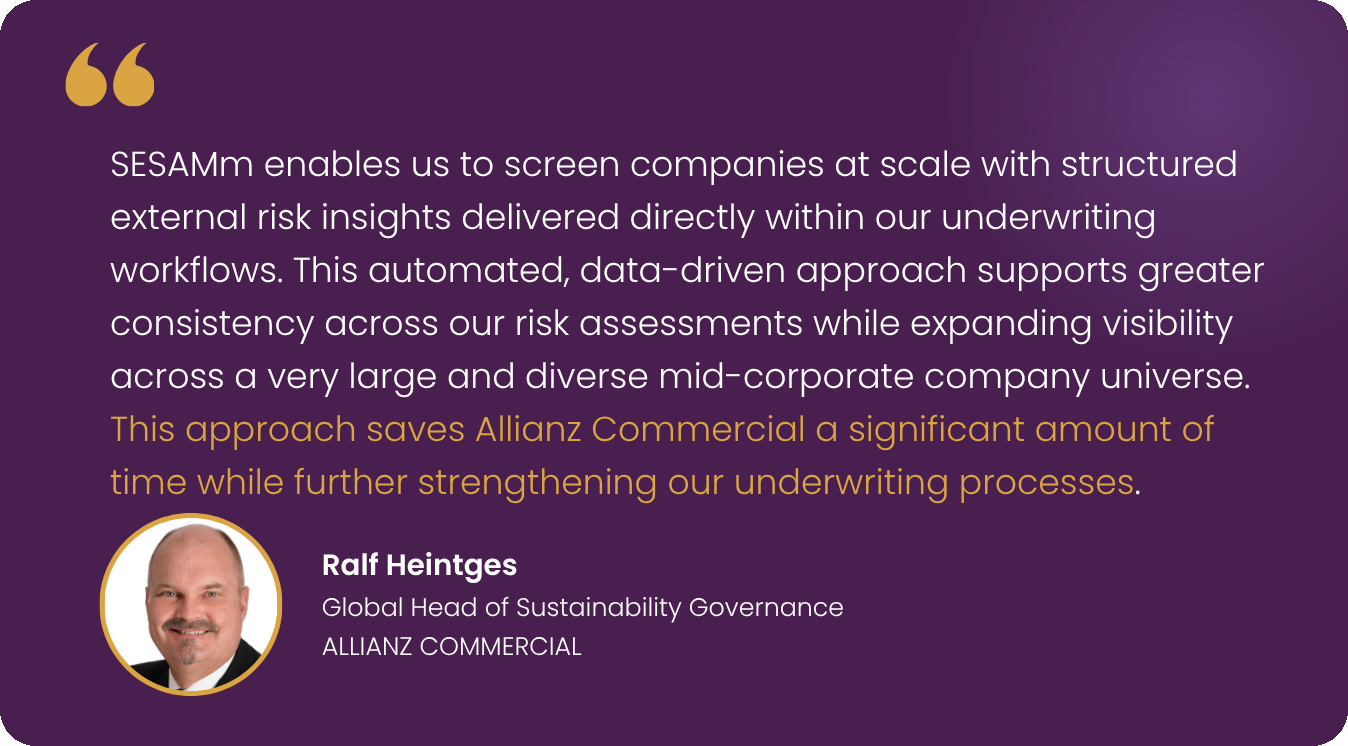
To enhance visibility into underwriting risks at scale, Allianz Commercial partnered with SESAMm to implement an automated sustainability and reputational risk due diligence capability directly integrated into underwriting workflows. SESAMm now automates the assessment of hundreds of thousands of companies each year, delivering structured insights on sustainability and reputational risk in seconds via a real-time API-driven workflow.
This deployment functions as a fully integrated component of daily underwriting activities across global teams, supporting high-volume decision-making processes without adding operational burden.
Key Benefits at a Glance
Efficiency: Transformed a manual, multi-step process into a fully automated, real-time underwriting check delivered in seconds.
Going Beyond Data: Automatically completes the sustainability and reputational due diligence questionnaire rather than simply delivering raw risk event data, saving time and enabling faster referral decisions.
Dedicated Corporate and Infrastructure Projects Coverage: Comprehensive global coverage across corporate coverage and infrastructure projects.
Tailored Approach: Risk logic configured to Allianz Commercial’s underwriting policies and decision frameworks, delivering assessments tailored to its specific requirements rather than requiring adaptation to an off-the-shelf product.
The Objective: Consistent Risk Visibility at Scale
Underwriting teams had sustainability and reputational risk data for large listed companies from an existing data provider, but required broader coverage across SMEs and privately held companies. To fill this gap, underwriting teams relied on a combination of internal processes and external research to identify potential risks. As volumes increased, ensuring consistent and timely access to sustainability impacts became a key challenge, particularly during onboarding and renewal cycles.
As part of this process, SESAMm delivered significant additional value by providing direct answers to each sustainability and reputation due diligence questionnaire question in a systematic way, enabling Allianz Commercial to fully automate the process, which was not feasible with other solutions.
Allianz Commercial aimed to:
Provide underwriters with immediate access to structured risk data.
Align with internal sustainability and reputational risk guidelines.
Support efficient onboarding and renewal workflows at high volumes.
Allianz Commercial needed a solution that could deliver real-time, standardized, and scalable risk insights directly within underwriters’ workflows.
The Solution: SESAMm’s Enterprise Underwriting Automation
SESAMm partnered with Allianz Commercial to deploy a fully integrated risk intelligence layer embedded within its proprietary underwriting environment. Underwriters now access SESAMm insights directly within their existing interface.
When underwriters enter a company identifier, the system uses Dun & Bradstreet’s D‑U‑N‑S® Number to anchor the search in a globally recognized, trusted, and data‑rich company record. With that foundation, the SESAMm API can instantly retrieve and deliver a structured sustainability and reputational risk assessment, supporting both precise entity matching and scalable discovery across millions of companies.
The SESAMm API evaluates external data over a multi-year period and automatically answers predefined due diligence questions across sustainability and reputational risk categories. Each response includes:
Clear yes/no determinations
Supporting justification and context
Supporting evidence, compliant with Allianz Commercial audit track requirements
The output is aligned with internal reputational risk and sustainability guidelines and supports transparent, auditable underwriting decisions without adding operational complexity.
Results & Impact
Since deployment, SESAMm has enabled Allianz Commercial to evaluate corporate coverage and infrastructure projects underwriting with consistent, real-time external risk intelligence. A process that previously required multiple research and validation steps can now be completed in under a minute through automated API-driven checks embedded directly within underwriting workflows.
The solution supports the assessment of hundreds of thousands of companies annually for Allianz Commercial and provides underwriters with documented sustainability and reputational risk insights at the point of decision. With expanded visibility across privately held and smaller companies globally, Allianz Commercial benefits from a far more consistent risk coverage while maintaining the speed and reliability required for high-volume onboarding and renewal processes across global operations.
As sustainability expectations rise, so does scrutiny. This ebook explores how industries are performing against the UNGC’s Ten Principles—and where risks are being overlooked. Backed by SESAMm’s AI-powered UNGC violations screening, it offers a data-backed view into ESG alignment and accountability.
What You'll Learn:
Commitment doesn’t always mean compliance: Public alignment with the UNGC is there, but our data reveals persistent ESG risks that often go unaddressed.
Certain sectors face heightened exposure: The technology, finance, and automotive industries consistently rank among those most frequently linked to potential breaches.
The enforcement gap is widening: A clear disconnect exists between alleged violations and actual accountability, emphasizing the need for real-time monitoring and stronger ESG oversight.
Stay ahead with the latest in ESG and AI intelligence
Join our mailing list to receive new reports, event invites, and updates from SESAMm directly to your inbox.

-converti-depuis-png.avif)


.jpg)


.png)