Built for Transparency: SESAMm and the EU ESG Rating Regulation
07/02/2026
•
5 mins read
On 2 July 2026, the EU ESG Rating Regulation, Regulation (EU) 2024/3005, entered into application. For the first time, providers of ESG ratings in the European Union operate under formal supervision, with common expectations for transparency, governance and independence. We see this as a turning point for the industry, and a welcome one.
SESAMm welcomes the Regulation because its objectives have been ours for a long time. On the day it entered into application, we notified ESMA of our intention to continue operating in the Union and to seek authorization as an ESG rating provider. This article explains how we have prepared, how we take part in the wider regulatory environment, and where we are in the process.
A Regulation We Have Been Preparing For
The Regulation did not take us by surprise. We have been preparing for it for more than two years, following each step of its development and taking part in the workshops ESMA has held for the industry along the way.
That preparation runs deeper than paperwork. Long before the Regulation existed, SESAMm was built on a simple conviction: an ESG signal should be traceable to its source and explainable in its method. We monitor ESG controversies in real time across millions of public and private companies, and the discipline required to do that at scale, and to stand behind every score, is exactly the discipline a regime built on transparency now asks of every provider.
An Active Voice in the Ecosystem
We have not watched this Regulation from the sidelines. SESAMm is a member of EASRA, the European association of ESG rating providers, where our CEO, Sylvain Forté, serves as Vice-Chair. He also sits on the Sustainable Finance Commission of the AMF, the French financial markets authority.
We have engaged directly with ESMA as part of our preparation for the Regulation. A good regulation is built through dialogue between supervisors and practitioners, and we have been a constructive part of that conversation, contributing the perspective of a technology-led provider working at global scale.
Transparency and Independence, Built In
The heart of the Regulation is transparency, and that is where our longest-standing investment sits.
Our full rating methodology is now public and free to access at sesamm.com/methodology, with disclosures provided at the level of our rating product. It sets out what our Controversy Exposure Score measures, the data behind it, how severity is assessed, where AI does the work, and where our analysts validate it.
That combination is deliberate. AI gives us the scale to read millions of documents a day. Our analysts give the system its rigor, defining the methodology, running quality assurance and validating the data every day. Changes to the methodology are backtested against an extensive historical database of controversy events before they ever reach a client.
Independence is part of the same design. Our scoring logic is applied by rule, consistently across every entity, and is not adjusted for any individual company. That is a structural choice, and it is one of the reasons the market can read a SESAMm score as an opinion formed by method rather than by negotiation.
Where We Are in the Process
Under the Regulation's transitional arrangements, providers that notify ESMA of their intention to seek authorization may continue to operate while their application is assessed. Having given that notification on 2 July 2026, SESAMm will file its full application within the window the Regulation sets, and our service continues without interruption.
We want to be precise about status. Authorization is a process, and it is underway. We are not describing a completed outcome, and we will inform our clients and partners as the process reaches its conclusion. What we can say today is that we have done the work to approach it from a position of readiness rather than from a standing start.
What This Means for Our Clients
For the institutions that rely on our data, the direction of travel is clear and positive. The Regulation raises the bar for the whole market on transparency, governance and independence, and it turns those qualities into something a provider must show rather than simply assert.
Those are the principles SESAMm has been building on for years. We are glad the market is moving toward a standard we have long believed in, and we intend to keep playing our part in getting it there.
To read our full methodology, visit sesamm.com/methodology. To discuss what the Regulation means for your ESG data, get in touch with our team.
Nous sommes fiers d’annoncer que SESAMm figure une nouvelle fois dans le Palmarès FinTech 100 France, qui distingue chaque année les 100 meilleures entreprises fintech du pays selon des critères tels que l’innovation, la croissance, la pertinence des solutions proposées et l’impact environnemental et social. Cette reconnaissance met en lumière les fintechs qui façonnent l’avenir du secteur financier.
Depuis 2022, notre progression dans ce classement prestigieux témoigne de notre engagement constant pour l’excellence et l’innovation : nous avons débuté en 63ᵉ position en 2022, grimpé à la 36ᵉ en 2023, puis à la 34ᵉ place en 2024 où nous étions également reconnus parmi les entreprises les plus actives sur les enjeux environnementaux, sociaux et de gouvernance (ESG). En 2025, nous avons franchi un nouveau cap en atteignant la 19ᵉ place, en hausse de 15 rangs par rapport à l’an dernier, et en nous hissant à la 1ʳᵉ place dans la catégorie Environnement, Impact et ESG.
Cette reconnaissance reflète le dynamisme de nos équipes et la pertinence de nos innovations pour accompagner les acteurs financiers dans l’analyse et la gestion des risques ESG. Nos dernières avancées, telles que nos AI ESG Assessment Reports et notre fonctionnalité de détection en temps réel des violations du United Nations Global Compact (UNGC), illustrent notre volonté de fournir des solutions toujours plus performantes et fiables à nos clients.
Merci à nos équipes, nos clients et nos partenaires pour leur confiance et leur soutien indéfectible !
SESAMm’s AI Technology Reveals ESG Insights
Discover unparalleled insights into ESG controversies, risks, and opportunities across industries. Learn more about how SESAMm can help you analyze millions of private and public companies using AI-powered text analysis tools.
Wildfires used to be a summer story. For most of the last decade, they arrived with the Northern Hemisphere dry season, dominated a few weeks of headlines, and receded once the rains came. That is no longer a safe assumption. Los Angeles burned in January 2025, a month that has historically been the quietest of the year for wildfire news anywhere in the world. Canada lost more forest in 2023 than in any year in its recorded history. Greece, Spain, and Portugal now post record-breaking fires in years that are not supposed to be their worst.
Given how much the pattern itself seems to be changing, we wanted to look past the headlines and into the data: how has coverage of wildfires actually moved over the past seven years, what does the aftermath of these fires look like once the smoke clears, and which countries, and companies, keep reappearing in the story. The analysis below sets out what the data shows, and, where it helps to understand it, what was actually happening on the ground at the time.
Executive summary
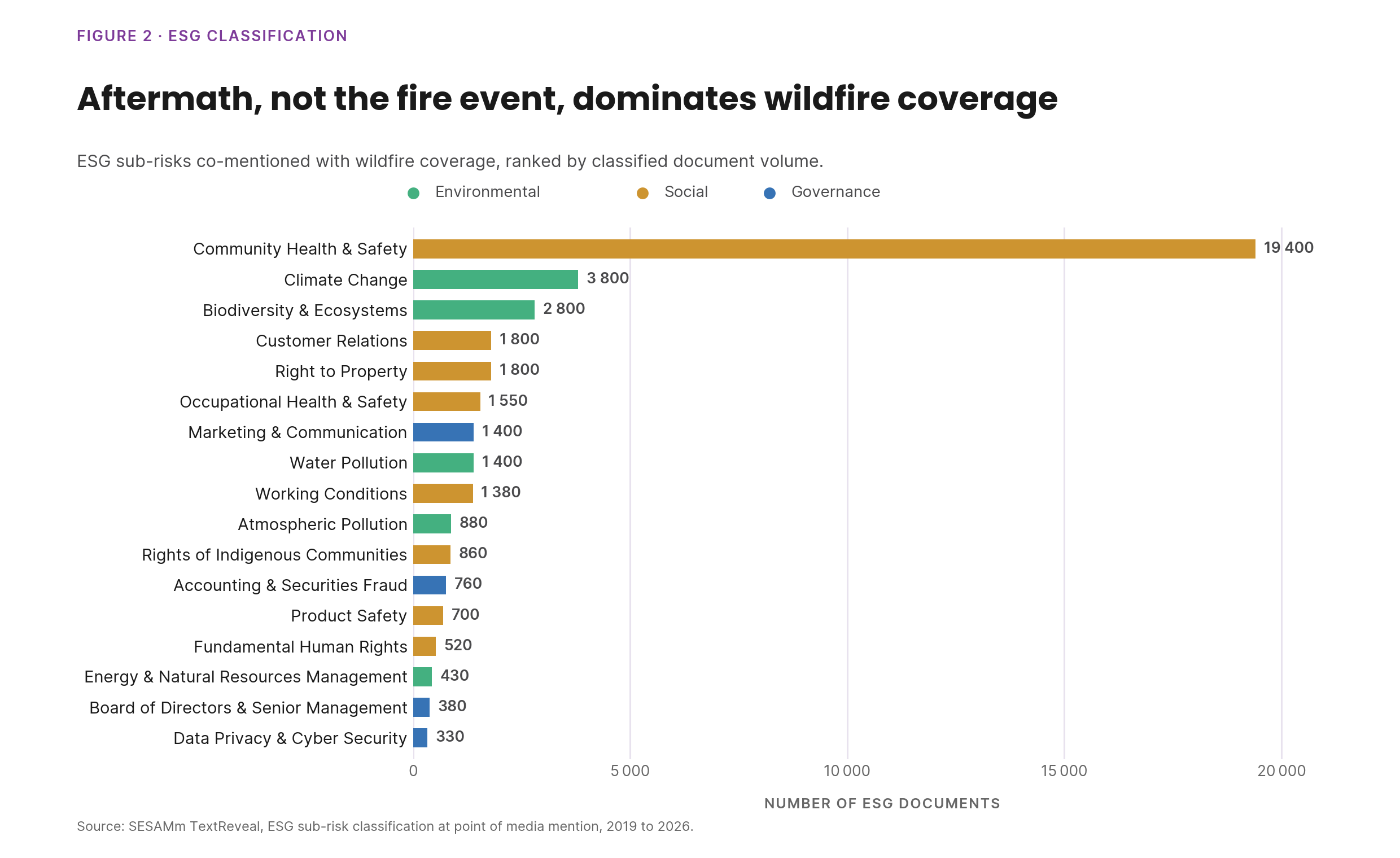
This analysis reviews global wildfire mentions between 2019 and 2026 across three lenses: quarterly mention volume, ESG sub-risk classification, and country-level geographic distribution, cross-referenced against documented public reporting. Three findings stand out: (1) wildfire coverage has shifted from a seasonal pattern to a sustained, year-round baseline since 2023; (2) coverage volume tracks proximity to population centers and identifiable liable parties more closely than it tracks the physical scale of the fire itself; and (3) the dominant subject matter in wildfire-related ESG coverage is the aftermath (casualties, contaminated water and air, insurance exposure, litigation) rather than the fire event in isolation.
1. Mention volume over time: a seasonal story becomes a year-round one
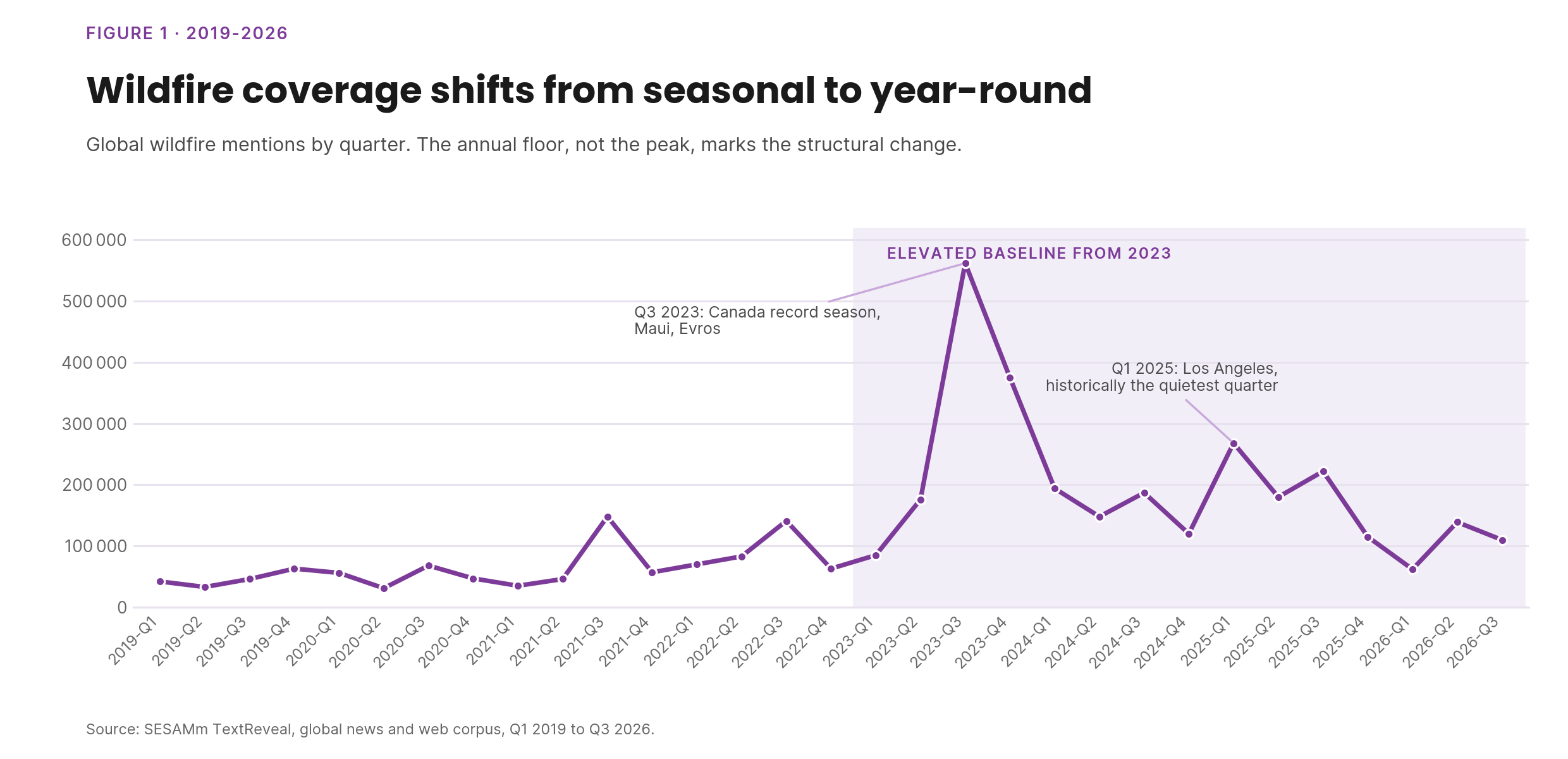
For most of the period, the data follows a predictable four-quarter cycle: Q1 is the annual low, Q2 shows a moderate rise, Q3 spikes with the Northern Hemisphere dry season, and Q4 falls back. That cycle breaks in two places, and both breaks mark a structural change rather than a one-off event.
Q4 2023 does not return to baseline after the Q3 peak: coverage stays elevated into the final quarter for the first time in the dataset.
Q1 2025, historically the lowest-volume quarter of the year, reaches roughly 270,000 mentions, more than several previous Q3 peaks.
The floor is the more telling number. In the quarters before 2023, non-peak volume rarely exceeded 80,000 mentions. From 2023 onward, even the quietest quarters do not fall below roughly 110,000–190,000. Wildfires have moved from a seasonal hazard to a year-round subject of coverage.
It's worth noting what does not explain this shift: acreage burned. 2020 through 2022, the years directly before this data climbs, include some of the largest fires by area in modern US and European history, yet register comparatively modest mention volume, partly because those years overlapped with the COVID-19 pandemic, which absorbed a large share of global news capacity.
The years that do dominate the chart, 2023 and 2025, are not necessarily the years with the most land burned; they are the years fire reached population centers and produced an identifiable party to blame. The Lahaina, Marshall, and Los Angeles fires are all comparatively small by area next to the 2020 US West Coast season or Canada's 2023 season, but generated substantially more coverage because of death toll, structures destroyed, and utility liability. Acreage, in short, is a weak predictor of coverage; proximity and blame are strong ones.
What was happening on the ground behind each peak
Each Q3 peak in the dataset lines up with a specific, documented cluster of events:
Q3 2022: fires threaten the Yosemite region and Sequoia groves in California; Spain and Portugal report wildfires during a European heat wave; a federal review attributes a New Mexico wildfire to a botched prescribed burn.
Q3–Q4 2024: a wildfire cuts power to Labrador; another burns near Suncor's Firebag oil-sands site in Alberta; Jasper, Alberta is significantly damaged; Greek investigators attribute the country's worst fire of the year to a faulty power cable.
Q1 2025 (the anomaly): a 14-fire outbreak tears through Los Angeles and San Diego County over January 7–31 on Santa Ana winds; the Palisades and Eaton fires alone destroy more than 18,000 structures and kill at least 31 people, with over 200,000 evacuated. Property-value loss is estimated at roughly $31 billion by CoStar, with total economic loss estimated between $250–275 billion by AccuWeather. Days later, the European Forest Fire Information System reports more than 100,000 hectares burned across the EU by the end of March, three months ahead of the typical season.
Across every year in the dataset, the same mechanism converts a fire into a sustained story: ignition (lightning, arson, or utility equipment failure) combines with drought and wind to produce the initial event, but litigation and identified liability sustain the coverage long after the fire is contained. PG&E, Southern California Edison, PacifiCorp, and Hawaiian Electric recur as named defendants across separate fires and separate years.
Wildfire-related controversies were classified into ESG sub-risk categories at the point of media mention. The ranking below runs from highest to lowest mention volume, with a documented, sourced example behind each category.
Climate Change: wildfires are framed as both symptom and accelerant. Canada's 2023 season burned at roughly seven times the historical average; researchers found climate change had tripled the underlying fire risk in the country's boreal forest, and the season released an estimated 1.5 billion metric tons of CO2, comparable to a decade of Canada's typical wildfire emissions.
Customer Relations: reflects the California property-insurance crisis: State Farm nonrenewed roughly 72,000 California policies in the two years before the January 2025 fires, then faced a state investigation into claims handling, including denial of hygienic smoke-damage testing, after the fires it did cover. A $1 billion FAIR Plan assessment was subsequently levied on insurers operating in California.
Right to Property: tied to the scale of destroyed real estate, an estimated $31 billion in property value destroyed in the January 2025 Los Angeles fires, and to litigation over responsibility for that loss, including Los Angeles County's lawsuit against Southern California Edison and Edison's countersuit against the county.
Marketing & Communication: covers corporate communications during active disasters, including relief pledges, the Recording Academy and MusiCares pledged $1 million to Los Angeles wildfire relief in January 2025, and utility crisis messaging, which came under renewed scrutiny after Edison International executive pay continued to rise during the period the company faced Eaton Fire liability claims.
Working Conditions: wildland and municipal firefighting workforce strain during extended, overlapping fire seasons across multiple continents.
Atmospheric Pollution: principally the June 2023 Canadian smoke event: New York City's air quality index peaked at 465, with a 24-hour PM2.5 average nearly three times the US regulatory standard, and follow-on research linked the event to a 44–82% increase in asthma-related emergency-department visits in the city.
Accounting & Securities Fraud: the Edison International shareholder class action filed after the Eaton Fire, alleging the company misrepresented the readiness of its power-shutoff program; Edison's share price fell approximately 34% following the fire, and the suit names CEO Pedro Pizarro and CFO Maria Rigatti as defendants.
The remaining categories (Product Safety, Fundamental Human Rights, Energy & Natural Resources Management, Board of Directors & Senior Management, and Data Privacy & Cyber Security) account for smaller shares of classified documents and were not tied to a comparably documented recurring event pattern in this dataset.
3. Geographic distribution of coverage
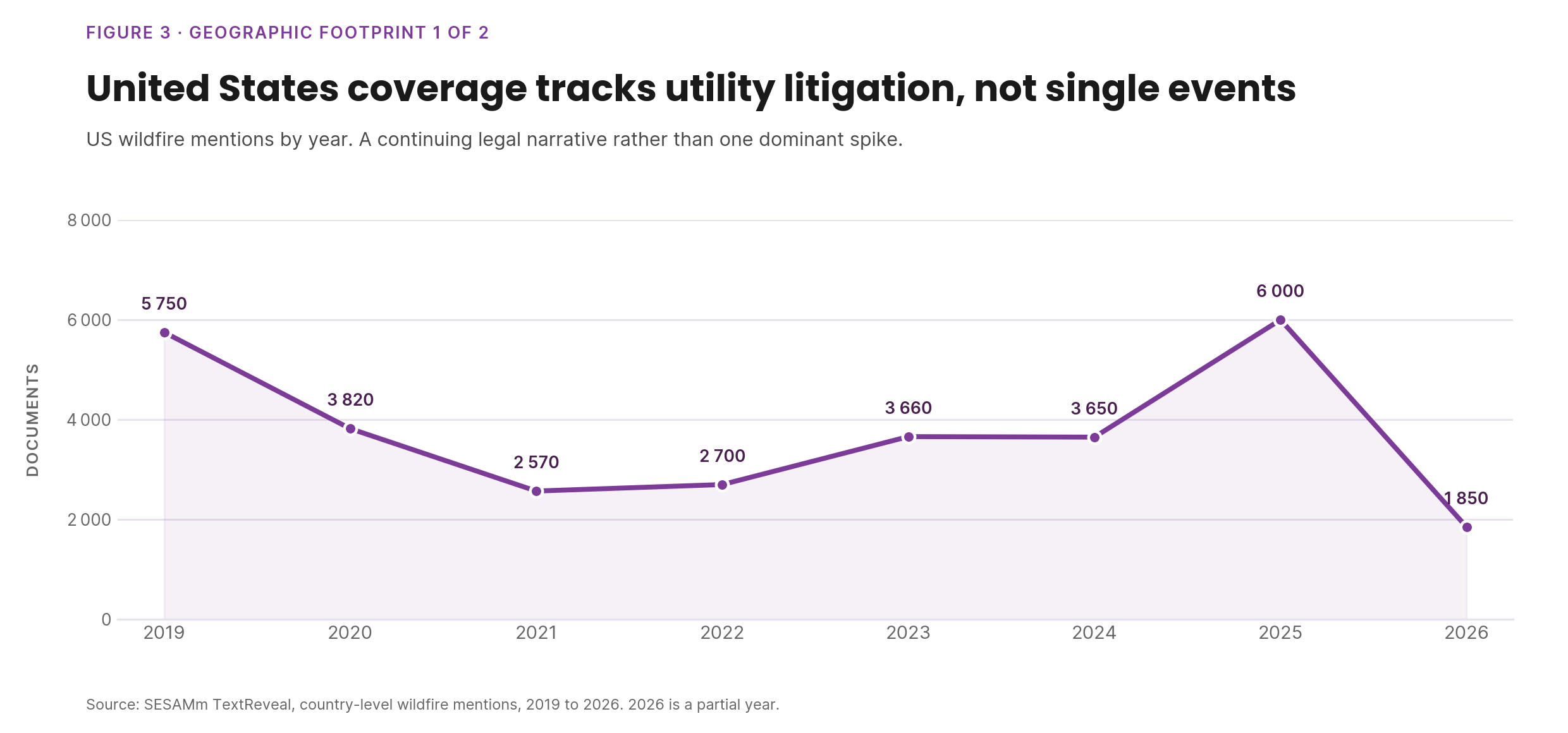
The United States accounts for the largest share of country-level mentions throughout the period, without a single dominant spike: volume rises through 2023–2025, peaks around 2025, then falls sharply into 2026. That shape fits a continuing sequence of named utility liability cases (PG&E, Southern California Edison, PacifiCorp) more than it fits a single event.
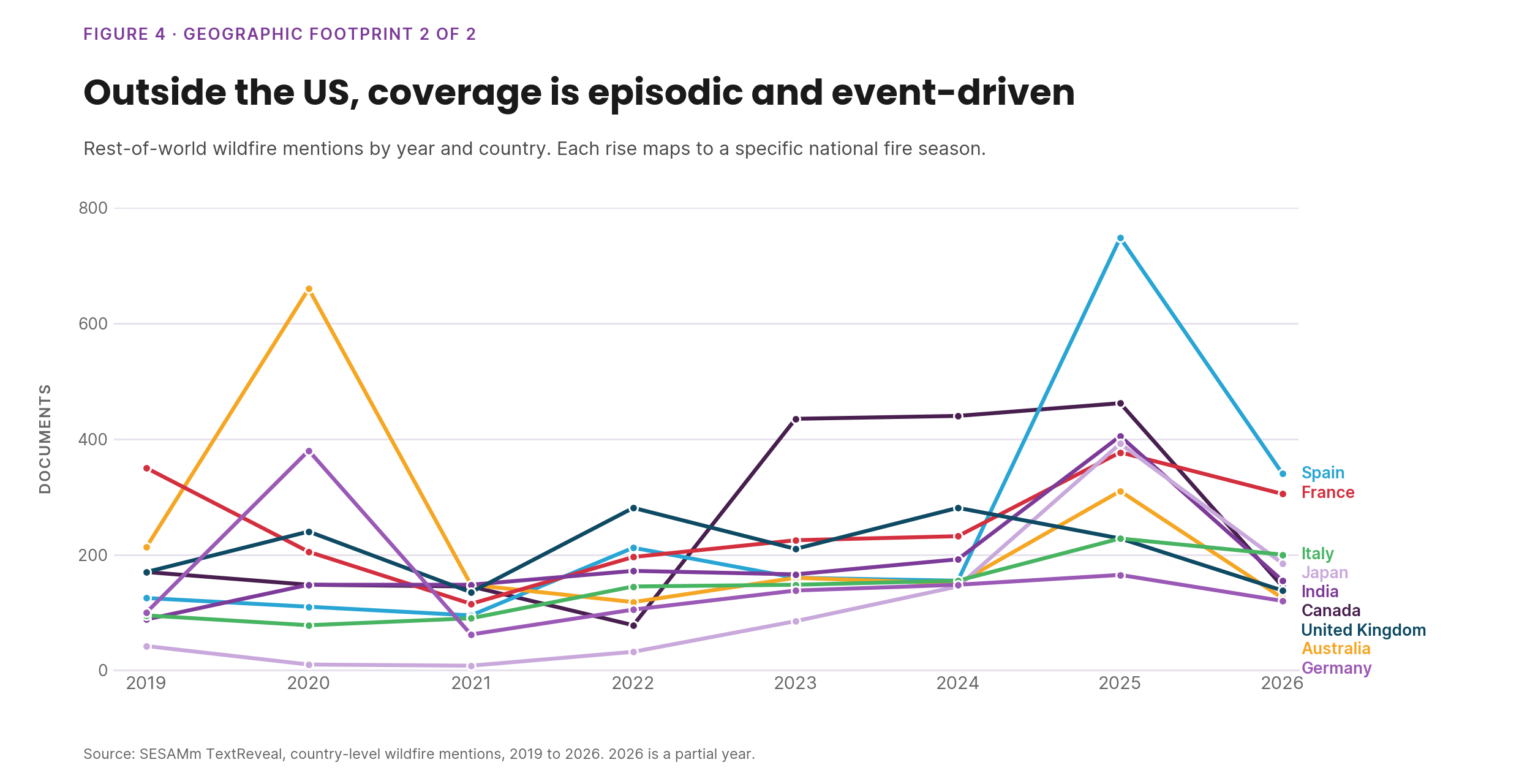
Outside the US, coverage is more episodic, clustering around identifiable national events rather than building a sustained baseline:
Australia peaks sharply around 2019–2020, matching Black Summer (24 million hectares burned, 33 deaths, an estimated three billion animals affected), then recedes.
Canada rises from 2022 and peaks around 2025, matching the record 2023 season (roughly 15–18 million hectares, eight firefighter deaths, up to 232,000 evacuated) and the continuation of large fires in 2024, including Jasper.
Greece shows a sustained late-period rise, matching the 2023 Rhodes evacuation and the Evros fire, followed by continued fire activity in 2024, including the faulty-power-cable fire investigators called the country's worst of the year.
Spain shows its highest point at the end of the series, consistent with the unusually early 2025 season (100,000+ hectares burned across the EU by end of March) and recurring summer wildfire and heat-wave coverage in 2022.
France, Germany, India, Italy, Japan, and the United Kingdom register comparatively low, stable volumes throughout, with modest increases around 2024–2025 in line with the broader post-2023 elevated baseline rather than country-specific events.
Read together, US coverage behaves like an ongoing institutional and legal narrative anchored by utility litigation, while rest-of-world coverage behaves like a series of discrete, event-driven spikes tied to specific fire seasons.
Conclusion
Across mention volume, ESG classification, and geography, the evidence points to a consistent mechanism. Coverage volume is driven primarily by three factors: proximity of the fire to population centers, the presence of an identifiable liable party, typically a utility, and how much a competing global news cycle is absorbing attention capacity at the same time. The physical scale of a fire is, on its own, a comparatively weak predictor of how much coverage it receives. On that basis, the next spike in wildfire coverage is more likely to come from an urban-interface fire with a clear liability story than from the largest fire by area.
Join SESAMm for breakfast in Midtown during Climate Week NYC on September 23rd from 8:30 am - 10:30 am. We'll give a short, informal walkthrough of what's new on the platform and what's coming next, then open it up for coffee and conversation with the SESAMm team and other users in ESG, risk, and compliance.
This is a small gathering for SESAMm clients and prospects. Space is limited - looking forward to seeing you there!
Stay ahead with the latest in ESG and AI intelligence
Join our mailing list to receive new reports, event invites, and updates from SESAMm directly to your inbox.




.jpg)


.png)