The ESG Scorecard: A Deep Dive into The Insurance Sector
October 29, 2025
•
5 mins read
The insurance sector continues to face mounting ESG scrutiny amid rising climate losses, digital vulnerabilities, and complex regulatory environments. Over the past three years, leading firms such as UnitedHealth Group, Prudential Financial, and AIG have faced increasing challenges related to governance oversight, social accountability, and environmental exposure. Climate-related issues have driven significant financial impacts, while increased regulatory intervention, particularly in healthcare and claims management, has underscored the cost of weak internal controls. Data breaches, legal disputes, and reputational controversies have further intensified the spotlight on insurers’ operational resilience and ethical standards. Collectively, these developments illustrate how ESG risks in the insurance industry are shifting from mere concerns to central strategic priorities.
What are the most pressing ESG challenges currently facing the insurance sector? Read on to find out.
UnitedHealth Group (UNH): Governance and Regulatory Scrutiny
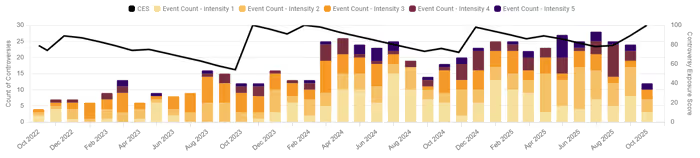
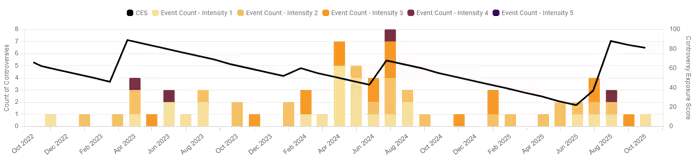
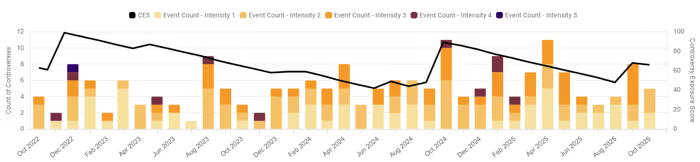
UnitedHealth’s ESG risks have intensified amid ongoing investigations and governance controversies. Its $3.3 billion acquisition of Amedisys has led to an antitrust lawsuit, while its Medicare Advantage business is under investigation for federal fraud. Social controversies include reports that UnitedHealth used algorithms to shorten patient rehabilitation care and paid nursing home bonuses to limit hospital transfers, prompting inquiries from U.S. senators. With its stock declining nearly 30% amid these challenges, the insurer’s case highlights the growing regulatory and ethical scrutiny of healthcare-linked financial services.
Prudential Financial Inc.: Compliance, Cybersecurity, and Consumer Protection Risks
Prudential’s ESG controversies over the past three years reflect systemic issues in data governance, workforce management, and regulatory oversight. The company announced layoffs in different regions, as well as a data breach affecting over 25 million individuals, for which a $4.75 million settlement is available to cover claims. Additionally, the U.S. Department of Labor found that Prudential had illegally denied over 200 life insurance claims, which has impacted investor confidence. These events highlight the company's vulnerabilities in compliance, cybersecurity, and consumer protection.
American International Group (AIG): Climate Risks and Reputational Challenges
Over the past three years, AIG has faced increased ESG scrutiny regarding climate risks and fossil fuel underwriting, reporting a 39% decline in profit and over $600 million in losses from Hurricane Ian. Activists pressure AIG to withdraw coverage for the East African Crude Oil Pipeline due to environmental concerns. On the social side, AIG has been struggling with reputational fallout from protests marking the 15th anniversary of its bailout and allegations of sexual assault involving a senior executive. On governance, AIG has been dealing with legal battles ranging from disputes over firearm-related claims and post-M&A settlements to trade secret litigation, underscoring persistent operational and compliance risks across its global portfolio.
The recent controversies across major insurers reinforce a broader trend: the convergence of financial performance, regulatory compliance, and ESG integrity. For AIG, physical climate risk and fossil fuel exposure remain defining challenges; for Prudential, consumer data protection and fair claims practices are under scrutiny; and for UnitedHealth, governance lapses tied to healthcare operations threaten long-term trust. As the sector evolves under increasing public and regulatory pressure, insurers that strengthen transparency, ethical oversight, and risk governance will be best positioned to sustain credibility and competitiveness in an ESG-driven market.
Reach out to SESAMm
TextReveal’s web data analysis of over five million public and private companies is essential for keeping tabs on ESG investment risks. To learn more about how you can analyze web data or to request a demo, reach out to one of our representatives.
After months of hard work from our team, we closed on a €35 million Series B2 funding round led by Elaia and Opera Tech Ventures (BNPP), which followed a €7.5M B1 round led by New Alpha and Carlyle in January 2021. That means we can now pursue the next phase of SESAMm’s growth.
We want to accomplish many things with this investment, and I’m incredibly grateful to all of our investors, partners, and clients who helped us during this process. But before I talk about them and SESAMm’s future, I can’t help but think about how the company started.
Academic beginnings
It’s still hard to believe that SESAMm sprouted from an idea, an academic project, and three college students. I still remember Pierre Rinaldi asking me to develop the first algorithms that used social media to analyze financial markets while in school. Pierre worked at a bank trading desk while finishing his studies and doing a research internship at a behavioral finance lab, where the idea came up for the project. I studied engineering and was passionate about AI already, so I started coding, and the first project was born.
Eventually, this project outgrew my capabilities. The volume of data involved needed hardcore algorithms to process them, the kind of algorithms Florian Aubry could build. Florian was the best developer in my engineering school, and lucky for us, he was also my friend.
From left to right: COO Pierre Rinaldi, CEO Sylvain Forté, and CTO Florian Aubry.
Before long, we started renting servers, optimizing code, and building signals based chiefly on Twitter data, reproducing research papers that also used text data to generate sentiment indicators for financial markets. You could say that this project had become more than academic at this point. But it really only became a company once we won our first startup award.
The award that sparked the launch of a company
We participated in a competition organized by local incubator SEMIA with support from Société Générale as a way to gain credibility for the project, and would you know, we won. The award was monetary, and we could receive it on one condition: that we launch an actual company.
You probably already know that starting a business is a big decision, at least it was for Pierre, Florian, and me. After all, we were still in school, trying to finish our degrees and looking to start new careers. Our choices could be life-altering. Pierre, for instance, planned to take a full-time job at the bank he was working at.
In the end, we chose SESAMm. Pierre didn’t take the job at the bank. I did my end-of-study internship at SESAMm, which allowed me to focus on the company 100% while finishing my degree. And Florian dedicated all his time and energy to the startup, too. In other words, we were all in, and our school project had officially become a business.
Pressure to build
Setting up a company was relatively easy. Building a business, as it turns out, is way harder. How would we take SESAMm’s product and put it to work? Pierre’s contacts, that’s how.
One by one, Pierre called on everyone he knew from school that worked in trading, offering them a chance to be the first to test the latest AI innovation: using social media for financial analysis. Back then, Pierre had more of a sales role. He’s now COO and head of HR, in case you were wondering.
Our first client was a trader from London. He put $50,000 into a strategy based on SESAMm’s signals. With our signals, the trader grew his portfolio with such performance that he began to raise capital, including for a hedge fund. Ultimately, he was trading $50 million from the strategy. It was the kind of success and track record we needed in the finance industry to take SESAMm to the next level.
Compelled to move…literally
Having demonstrated success, an investment firm, a venture firm called Fonds Venture Numérique Lorrain, reached out to us with interest in investing in SESAMm’s first round of funding. But they had two conditions:
SESAMm must move to Metz, a startup-friendly hub in the Lorraine region in France.
SESAMm must seek additional funding from other investors.
At the time, SESAMm was based in Strasbourg because that’s where Florian and I studied. And for all intents and purposes, we hadn’t planned on moving.
Also, aside from Pierre reaching out to school acquaintances to try our solution, we had never pitched anyone to fund our company before. Pierre, Florian, and I faced a serious choice and challenge.
What did we do, and how did we fare?
We reached out to business angels and pitched numerous times while continuing to work on the product and starting to plan the first recruitments. We learned a lot during this initial period about how to structure a company and present it to investors. At the time, startups were less common in the region and using online content from YC and other accelerators was invaluable for us.
SESAMm’s headquarters is now in Metz, and we currently have offices in Paris, London, Tunis, New York, and Tokyo. We’ve also diversified our technology and clientele, particularly in ESG and corporate spaces. In other words, we faced the challenge, moved our headquarters, and grew and evolved a lot!
Our first sign, our first footprint, our first home office in Metz.
Series B2 funding round challenges
That brings us to the recent past. We’ve grown our company so much that it was time for another funding round, and the timing wasn’t the best. Our teamwork and ability to communicate effectively across regions and cultures were vital in tackling this latest fundraising round. We decided to run the entire process in-house as it was important to us to not only demonstrate our ability to do so but also to build our own VC relationships.
Moreover, we’ve had a unique previous fundraising experience. Having been funded by FinTech venture capital firm NewAlpha Asset Management and a large private equity firm like Carlyle Group Inc. in earlier rounds helped us improve our processes and standardize our communications. We felt ready for this challenge.
Frankly speaking, though, between the COVID-19 pandemic and the Russia-Ukraine war, startup funding had become a much bigger challenge. Things weren’t popping like they were a couple of years ago, so we needed to be cautious and conservative yet bold and compelling. Regardless, we dug deep and stuck with the plan, with a focus on our numbers and our vision.
To achieve our goal, we created an internal team, onboarded two advisors, and created a scalable process. The internal team included SESAMm’s C-suite: CEO (Sylvain Forté), COO (Pierre Rinaldi), CTO (Florian Aubry), CFO (Marie-Charlotte Deucher), CMO (Jorge Alvarez), and CDO (Eric Sionnet). Our advisors provided guidance around strategy, gave feedback, and supplied operational help when needed. And from our pitch deck variations to our storage and sharing policies, we established a fine-tuned communication and project management process to keep us on task and on time. It was a good process, and it really helped us manage things efficiently while maintaining control over day-to-day operations. I can’t say it enough: process is always the key.
Fundraising wasn’t easy, but the process was worthwhile. And all this to say that I couldn’t be happier to announce that SESAMm has wrapped up its Series B2 funding round. With this money, we plan to further expand into the U.S. and Asian markets and continue SESAMm’s exponential growth. We’ll also seek key talent to sustain this growth and support the development of our AI technology.
Pleased, grateful, and excited for what comes next
Today, SESAMm is a healthy and fast-growing company. And as COO, CTO, and CEO, respectively, Pierre, Florian, and I are now more than a scrappy group of students. We’re a crew with the support of many contributors, consisting of more than 100 employees across many offices and cultures. It’s because of the teamwork and collaboration that SESAMm is where it is today. And I’m immensely grateful for all our team’s effort and the tremendous support we get from clients, investors, and advisors every day.
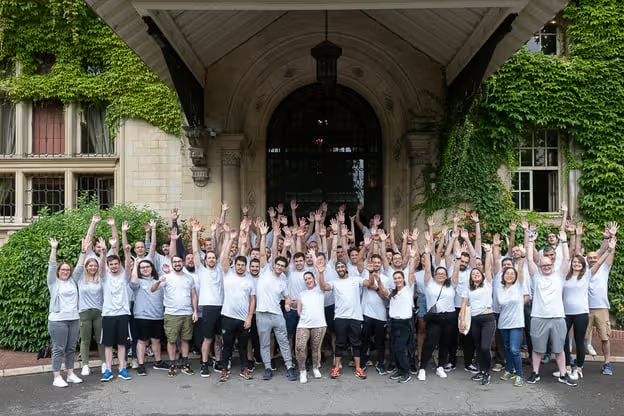
Paris, France, September 2022: Many of the 100+ SESAMmers gathered for a company retreat.
Thank you for being a part of our journey, and see you at SESAMm’s next milestone. Cheers!
SESAMm recently announced its successful Series B2 fundraising round. The news was covered by TechCrunch, a popular technology news website known for its comprehensive coverage of the latest developments in the tech industry.
SESAMm, a French startup that helps financial firms and corporates adhere to their ESG goals by using natural language processing (NLP) to generate insights from digital content, has raised €35 million ($37 million) in a round of funding to expand internationally.
Despite a growing backlash against ESG efforts from some politicians and vocal executives, companies are still cognizant of the reputational and commercial risks of ignoring their environmental, social, and corporate governance (ESG) responsibilities — this applies both to their internal practices and those of third-parties they do business with.
With that in mind, SESAMm enables businesses to track textual data from across the web — including news portals, NGO reports, and social networks — and convert this into actionable insights.
SESAMm has amassed a fairly impressive roster of clients from across the financial realm specifically, including U.S. investment giant Carlyle Group, French corporate and investment bank Natixis, Japanese multinational insurance holding company Tokio Marine, and U.K.-based asset management firm Unigestion.
Companies can access SESAMm’s flagship product, TextReveal, via several conduits, including an API that brings SESAMm’s NLP engine into their own systems. But on top of that, SESAMm also offers a web-based dashboard where companies can access data analysis, visualizations, and push notifications for various due diligence, compliance, and ESG scenarios.
For example, a company that wants to keep tabs on its supply chain partners can use SESAMm to track anything related to those partners that hits the public domain, such as emerging fraud litigation or other lawsuits. This allows them to proactively respond the instant they receive an alert via SESAMm — these ESG alerts, which SESAMm launched a few months back, can be delivered by email or system integrations, for example a customer relationship management (CRM) application.
Elsewhere, private equity firms can use SESAMm for due diligence on potential acquisition or investment targets. Indeed, SESAMm boasts a “20 billion article data lake” which it applies its NLP algorithms to to identify mentions on any type of company, with the data sliced, diced, and categorized into user-friendly dashboards.
“Private equity firms usually engage with consulting firms to perform due diligence on target companies,” SESAMm co-founder and CEO Sylvain Forté explained to TechCrunch. “The cost of doing this is very high, and the result is suboptimal as the amount of data on the web is enormous for individuals to go through it. Therefore frequently, the results are not comprehensive enough, leading to inaccuracies.”
However, the SESAMm platform can be configured for any number of use-cases, such as “share of voice” competitor analysis, or any other theme that might be relevant to a company.
“With the current attention on ESG in the industry, many of our use-cases are focused on that — however, we provide insights into several types of information,” Forté said. “This includes sentiment on brands, thematic stock baskets and indices, company leadership reputation, and web insights on macro-economic indicators such as inflation, among others.”
According to Forté, SESAMm pre-trains large language models, similar to that of ChatGPT, the generative AI poster child of the moment — on all the data it hoovers up, and fine-tunes the algorithms on its own datasets, which are annotated across the 100-plus languages it supports.
“SESAMm integrates a variety of data — over 20 billion articles in 100 languages with 14 years of history,” Forté said. “Data sources include highly-vetted news organizations, expert blogs, and social media. SESAMm also manages licenses for proprietary data sources from premium news channels.”
“Raising a significant amount during challenging market conditions highlights the relevancy of SESAMms focus on two key trends — AI and sustainability,” Forté said. “In turn, these tools enable organizations to make better decisions and fill the data gaps, particularly in ESG, on both public and private companies.”
The aerospace and defense industry is essential to global technology and transportation, playing a crucial role in maintaining international security and connectivity. However, this sector faces intense scrutiny due to its significant impact on ESG factors. Amidst challenges like safety lapses and whistleblower revelations, stakeholders are increasingly relying on advanced AI technologies to gain insights into potential controversies. Such technologies have enabled a deeper understanding of the complex ESG issues that permeate the industry, revealing not only the specific challenges faced by companies like Boeing but also providing a broader view of the sector's commitment to corporate responsibility and sustainability.
This article explores the aerospace industry and its ESG challenges, backed up by a case study of industry giant Boeing. It also explains how we used SESAMm’s AI-powered tools to detect these controversies beforehand.
Aerospace and Defense Market Mentions
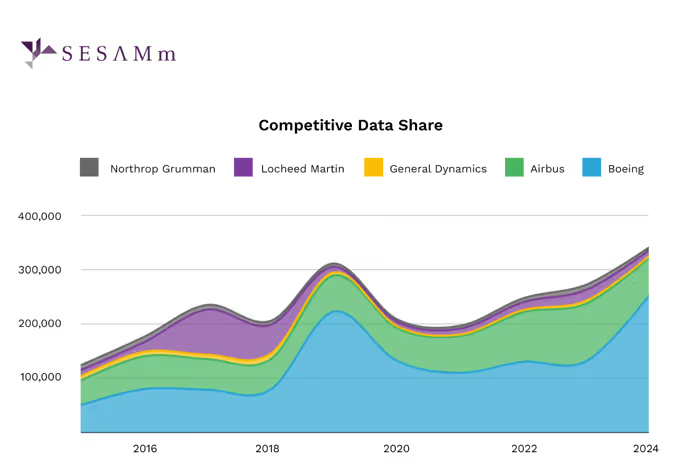
The top market players in the aerospace and defense industry command 8.3% of the overall market's online mentions. This sector is increasingly scrutinized for its ESG practices amidst technological advancements and global policy shifts.
Media Sentiment in the Aerospace Industry
In this study, we ran our AI tools through our data lake to extract the major market players: Northrop Grumman, Lockheed Martin, General Dynamics, Airbus, and Boeing, with the time frame starting from 2015 to date. The data reveals a notable peak in online mentions of the market trend, mainly following Boeing’s plane crash controversies. Post-2018, we noticed a general upward trend for Airbus and Boeing, indicating their increasing dominance or recovery in the market. This trend demonstrates the shifting landscape of the aerospace industry, where competition is intense, and the share of mentions can reflect broader market movements and company-specific developments.
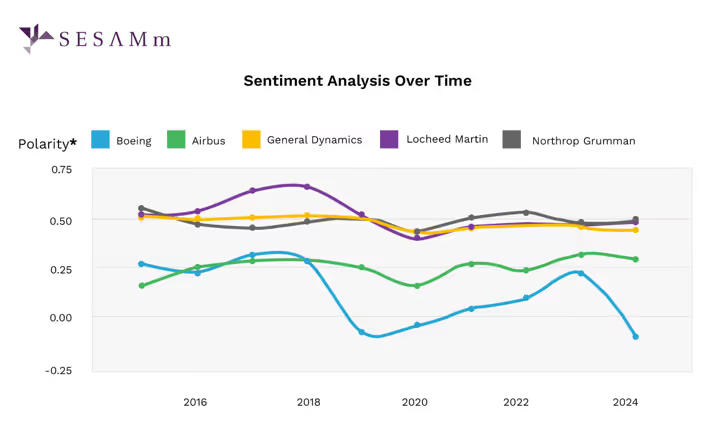
(*): Polarity or sentiment polarity represents a company's aggregate of positive and negative sentiment (opinions, reviews), ranging from -1 to 1. A zero score means that there is as much positive as negative sentiment. High e-reputation brands can have polarity scores of more than 0.5.
The sentiment across the aerospace market reflects the industry’s highs and lows. On one hand, there are moments of significant achievements like new contracts and technological breakthroughs that drive companies like Lockheed Martin to positive media highlights. Between 2016 and 2018, Lockheed Martin experienced a surge in positive mentions due to key contract wins and proactive company initiatives, which have contributed to maintaining its reputation and market value.
Conversely, the industry faces intense scrutiny over various controversies, notably those surrounding Boeing. The company, a dominant figure in the market, has been at the center of numerous negative headlines, giving it the lowest sentiment polarity among its peers. Issues range from serious safety lapses, such as the tragic 737 MAX crashes throughout the years, to ongoing legal challenges and whistleblower claims that overshadow its governance practices. These incidents have not only affected Boeing’s sentiment negatively but have also influenced the overall perception of the aerospace and defense sector, highlighting the industry's susceptibility to reputational risks.
Macro Themes
The aerospace sector, while essential for global connectivity, has not been without its controversies, especially concerning safety and compliance issues. Among the major players, Boeing's significant share of media mentions is primarily driven by a series of high-profile accidents, including the 737 MAX crashes in 2019, killing all passengers and another serious incident in South China in 2022. These accidents triggered a cascade of lawsuits and fines, severely impacting Boeing’s public perception and operational standing. The aftermath of these incidents also precipitated broader discussions around leadership changes, management practices, safety protocols, and accountability measures within the company.
Similarly, Airbus has faced its own challenges, with notable accidents in 2015 in France and 2016 in the Mediterranean Sea, followed by another in 2020, resulting in 97 fatalities. These incidents underline the persistent safety risks inherent in aerospace operations and the critical need for stringent oversight. Accusations of ethical and legal violations also loom large across the industry. Boeing, for example, has been embroiled in numerous investigations and lawsuits related to various accusations. Meanwhile, other industry giants like Northrop Grumman and Lockheed Martin have faced legal actions over environmental and contracting practices, such as Northrop’s involvement in residential chemical contamination and Lockheed’s settlement over accusations of overcharging the Navy. General Dynamics has also encountered legal scrutiny over employment practices and allegations of human rights and privacy violations.
These controversies highlight a complex landscape of operational, legal, and ethical challenges in the aerospace industry. Each incident not only affects the involved company but also catalyzes shifts in regulatory practices and leadership strategies, underscoring the need for robust governance and proactive risk management to uphold safety and integrity in aerospace operations.
ESG Analysis
The influence of ESG factors on public perception and internal company policies within the aerospace industry is profound. Governance issues, in particular, continue to be a critical focus as aerospace companies confront challenges related to compliance, ethical practices, and transparency. Social factors are also prominent, with labor practices and safety standards critically influencing operational and strategic decision-making. Environmental considerations are escalating in importance as the industry progresses towards more sustainable practices, driven by increasing concerns over climate change and environmental sustainability.
Northrop Grumman illustrates an aspect of ESG concerns with specific environmental risks linked to its operations. Accusations have surfaced against Northrop Grumman for its role in environmental degradation, such as pollution from manufacturing plants and involvement in contamination incidents at residential sites. These issues not only affect the company’s environmental track record but also impact its social standing and governance integrity. The company also displays some governance risks related to its total mentions volume driven by accusations of fueling false ‘Revenge Porn’ allegations against CIA whistleblower John Kiriakou as well as legal investigations driven by Northrop Grumman investors over its claims to recover their losses and class action lawsuits over claims of a breach of fiduciary duty.
The aerospace sector’s engagement with these ESG factors indicates a shift towards addressing the critical issues facing the industry. Boeing ranks first in terms of risks, with social risks having the highest share, followed by Airbus, with risks coming from social issues such as customer relations, fundamental human rights, and governance risks mainly related to its fraud, bribery, and corruption charges. This shift is not just about mitigating risks but also about harnessing opportunities to enhance corporate responsibility and ensure long-term sustainability.
Deep Dive into Boeing: ESG Risks and Public Perception
The aerospace industry has faced increasing scrutiny over its ESG practices. Among the key players, the American aerospace company Boeing has been prominently featured in media discussions, not only due to its market distinction but also because of its ESG challenges that have sparked significant controversy.
Boeing Word Cloud
This word cloud visually represents the main online topics surrounding Boeing, particularly focusing on the issues and controversies related to the 737 Max aircraft. Key terms like "737 Max," "Boeing," "safety," "death," and "FAA" are prominently displayed, indicating these as central themes in the discussion. The size of each word in the cloud signifies its frequency and importance in related discussions, with larger words being more prevalent. This visualization encapsulates a range of associated topics such as "lawsuit," "Senate hearing," and "missed inspections," highlighting the broad spectrum of regulatory, safety, and ethical issues that have dominated public and media discourse regarding Boeing.
Boeing ESG Analysis
According to TextReveal’s findings, since 2019, Boeing's ESG risks have intensified, particularly in social and governance, leading to a substantial impact on its public image and stock performance. The company's struggles with governance issues are well-documented, encompassing major safety lapses that resulted in the tragic crashes of the 737 MAX aircraft in the span of six months in Indonesia and Ethiopia. These events have not only led to a loss of life but also raised serious questions about the company's commitment to safety protocols and ethical standards.
Social risks at Boeing are also prominent, with multiple incidents involving customer relations and human capital management. Notably, the company has faced significant scrutiny regarding its response to the 737 MAX crashes, highlighting deficiencies in transparency and accountability in dealing with the fallout. The handling of these incidents resulted in widespread public distrust, significantly damaging Boeing's relationships with airlines, regulatory bodies, and the flying public. Issues such as delays in disclosing software malfunctions and the initial reluctance to ground the fleet have led to accusations of prioritizing profit over passenger safety. Furthermore, Boeing's labor practices have also come under fire. There have been multiple instances of tension with labor unions over contract negotiations, job cuts, and factory conditions, which exacerbate the social risks by affecting employee morale and productivity. These labor disputes and the perceived erosion of safety standards contribute to a challenging environment, complicating Boeing's efforts to rebuild trust and ensure operational stability.
Early Signs: Whistleblowers
We used TextReveal's analytics capabilities to track the prevalence of whistleblower mentions within the aerospace industry, with data pointing back as far as 2019. This tool has effectively highlighted ongoing concerns and patterns related to corporate governance and safety issues.
Boeing has also been facing whistleblower retaliation. High-profile cases involving whistleblowers like John Barnett, who was found dead under mysterious circumstances, and Sam Salehpour, who reported safety shortcuts and received physical threats, illustrate the perilous environment for those who challenge the status quo. These whistleblowers' stories, while distressing, shed light on a culture that may prioritize expediency over thoroughness and safety.
One of the most significant cases involved John Barnett, a former quality manager at Boeing, who raised alarms about critical safety lapses in the production of the 787 Dreamliner. Barnett claimed that faulty parts were knowingly installed on planes, potentially endangering passengers. His revelations were met with hostility and retaliation, resulting in his tragic and suspicious death, which was officially ruled as a suicide. This case has fueled widespread media coverage and public outcry, questioning the integrity of Boeing’s internal safety practices and the treatment of employees who report such critical issues.
Another well-known whistleblower, Ed Pierson, reported concerns about the 737 MAX's manufacturing process, specifically pointing to the rushed production schedules that he believed compromised safety. His testimony before congressional hearings helped to expose a "profit over safety" mentality that appeared to saturate Boeing’s management practices. Pierson’s allegations were particularly damaging as they were directly linked to the two fatal crashes of the 737 MAX, which tragically resulted in 346 deaths.
Sam Salehpour, a Boeing engineer, also came forward with allegations of manufacturing shortcuts that compromised the structural integrity and safety of Boeing aircraft. Like others, Salehpour faced significant backlash from superiors and was reportedly blackballed within the industry for his outspokenness, highlighting the severe personal and professional risks faced by whistleblowers within the air travel giant.
The cumulative effect of these whistleblower cases has led to significant scrutiny from regulatory bodies, the media, and the public. The Federal Aviation Administration (FAA) has stepped up its oversight of Boeing, leading to fines, increased regulations, and a temporary grounding of the 737 MAX fleet. These incidents have sparked broader discussions about the need for systemic reforms within the aerospace industry to ensure that safety and ethical standards are not only upheld but prioritized over financial incentives.
How does SESAMm Detect ESG
Navigating the vast amounts of data available is a significant challenge when conducting this type of analysis. At SESAMm, our experts begin with a comprehensive sentiment analysis of the industry and its key players. By examining trends, particularly spikes in data volume or shifts in sentiment—both positive and negative—they can pinpoint the issues and controversies driving these changes. Following this, our team conducts a thematic deep dive into the topics most relevant to the industry, providing a nuanced understanding of the issues that are particularly sensitive for stakeholders. With these insights in hand, our team then moves to company-specific analyses and benchmarking to assess how individual companies perform relative to their peers.
SESAMm's TextReveal® platform plays a significant role in identifying and understanding the complex web of controversies within industries such as aerospace. Through its algorithms, the platform sifts through vast amounts of data from diverse sources like news outlets, social media, and corporate disclosures to detect subtle cues and patterns that might indicate emerging ESG controversies. This robust data collection and analysis enable SESAMm to pinpoint issues related to whistleblower activities, safety violations, and governance lapses well before they gain widespread attention. By integrating this intelligence, SESAMm facilitates a deeper understanding of the underlying factors contributing to these controversies, aiding stakeholders in navigating the intricate dynamics of corporate accountability and regulatory compliance.
SESAMm's TextReveal® platform provides a comprehensive suite of ESG analytics tools that leverage extensive data collection from news outlets, social media, corporate disclosures, and NGO reports, ensuring thorough coverage of emerging and underreported ESG issues. Utilizing advanced artificial intelligence, the platform analyzes sentiments and contextual nuances within this data to identify positive and negative ESG indicators, helps stakeholders measure public sentiment before issues escalate, and makes accurate business decisions. Additionally, its capability to identify and map relationships between entities such as companies, individuals, and products to various ESG issues is crucial for assessing how internal dynamics influence a company’s overall ESG profile.
TextReveal® also employs predictive analytics to foresee potentil ESG controversies, enabling proactive risk management and strategic planning. Moreover, it offers detailed ESG reporting and scoring, providing quantifiable insights into a company’s ESG performance, which is invaluable for investors and analysts. Lastly, the platform’s analysis of the influence of key individuals on ESG practices offers deeper insights into leadership effectiveness and ethical compliance, making SESAMm's tools essential for integrating ESG considerations into comprehensive corporate strategy and maintaining competitive advantage in a socially conscious market environment.
Conclusion
Navigating the complexities of ESG risk management requires a shift from traditional methods to more advanced, AI-driven approaches. AI's ability to analyze vast amounts of unstructured data enables early detection of hidden risks, as demonstrated in our case study on Boeing. Using AI, we identified emerging controversies around Boeing's safety practices, quality control, and governance issues before they escalated, showcasing the technology's potential for proactive risk management.
Incorporating AI into ESG assessments allows private equity firms and other stakeholders to move beyond reactive strategies. By detecting potential risks early, firms can safeguard their investments, protect their reputations, and align with a growing emphasis on responsible investing. Embracing AI-driven tools is not just about keeping pace with market demands—it's about ensuring a more secure, transparent, and sustainable approach to investment in an ESG-focused world.
Reach out to SESAMm
TextReveal’s web data analysis of over five million public and private companies is essential for keeping tabs on ESG investment risks. To learn more about how you can analyze web data or to request a demo, reach out to one of our representatives.
Stay ahead with the latest in ESG and AI intelligence
Join our mailing list to receive new reports, event invites, and updates from SESAMm directly to your inbox.

.jpg)



-01066.avif)



.avif)
.avif)


.png)