UK to Regulate ESG Ratings Providers: Why It Matters
November 4, 2025
•
5 mins read
In a landmark move for sustainable finance, the UK government has announced plans to regulate ESG (Environmental, Social, and Governance) ratings providers. The Financial Conduct Authority (FCA) will soon be tasked with overseeing these firms, marking a major shift from the current hands-off approach. This development comes amid growing concerns about the inconsistency, opacity, and influence of ESG ratings on investment decisions.
Why Regulate ESG Ratings Providers?
The regulatory gap in ESG ratings is clear when compared to traditional credit ratings. Credit rating agencies (like S&P, Moody’s, and Fitch) operate under strict regulatory oversight and well-defined methodologies, which is one reason their assessments tend to be closely aligned. In fact, one study found the top credit agencies’ ratings are 99% correlated, whereas ESG ratings from different providers showed only about 60% correlation. In practice, that means two ESG raters might disagree as wildly as “AAA” vs “BBB” for the same firm in the same period. By contrast, it’s rare to see such divergence in credit ratings because that industry has long been supervised and standardized.
Absent regulation, ESG ratings have been opaque and inconsistent. Regulators and market watchdogs have likened the ESG ratings arena to a “Wild West” in need of a sheriff. An environment “unregulated and opaque” where even companies with poor environmental track records can sometimes score surprisingly well. The lack of transparency in how ratings are determined makes it hard for investors to trust what an ESG score truly reflects. This opacity not only fuels skepticism but also raises the risk of greenwashing, where unsustainable companies might hide behind inflated ESG scores.
New oversight aims to bring transparency, consistency, and trust to ESG ratings. Authorities around the world are now stepping in. For instance, the UK government has introduced legislation to bring ESG rating providers under the Financial Conduct Authority’s remit. Similarly, European regulators (ESMA in the EU) and others in Japan and India are moving toward tighter standards. The consensus is that ESG ratings need basic guardrails, much like credit ratings, to ensure they are rigorous, reliable, and free of conflicts of interest. As one analysis noted, if a credit rating agency were to suddenly downgrade scores at the scale we’ve seen with ESG re-ratings, regulators would have intervened immediately. Treating ESG ratings “similarly” to credit ratings in terms of oversight is increasingly seen as necessary to prevent nasty surprises (read: unexpected discrepancies) and to maintain market stability.
Regulation can address several issues: it can mandate clearer methodological transparency, require disclosure of rating drivers, and enforce governance standards (for example, to manage conflicts of interest if a rater also offers paid consulting). All of these steps would help investors and companies finally peek behind an ESG rating. In other words, examine the underlying factors, rather than taking scores at face value. Ultimately, effective regulation should turn ESG ratings from a black box into a more consistent, credible tool for decision-making.
What the UK Plans to Do
Under the new legislation, any ESG ratings provider serving UK clients will be required to obtain authorization from the FCA. These firms will need to disclose their methodologies, manage conflicts of interest, and maintain proper governance controls. The regulation is designed to align with international recommendations, such as those from IOSCO, and mirrors similar efforts already underway in the EU.
The goal is to bring greater transparency, comparability, and accountability to a market expected to grow significantly in the years ahead. The FCA plans to consult on specific rules later this year, with implementation expected to phase in over time.
Why This Matters
Bringing ESG ratings under regulatory oversight could be a turning point for sustainable investing. With consistent standards and greater clarity on how scores are determined, investors can better understand the rationale behind ratings and compare them more effectively. It could also reduce the risk of greenwashing by forcing providers to show their work.
Of course, some concerns remain. Smaller ESG ratings firms may struggle with the cost of compliance. Others worry that regulation could stifle innovation or lead to market consolidation. But broadly, the move has been welcomed by investors and industry groups as a necessary step toward improving trust in ESG data.
As global regulators push for greater alignment, the UK's framework could help shape a more transparent and robust ESG ratings ecosystem - one that better serves both capital markets and long-term sustainability goals.
SESAMm’s AI Technology Reveals ESG Insights
Discover unparalleled insights into ESG controversies, risks, and opportunities across industries. Learn more about how SESAMm can help you analyze millions of private and public companies using AI-powered text analysis tools.
Wildfires used to be a summer story. For most of the last decade, they arrived with the Northern Hemisphere dry season, dominated a few weeks of headlines, and receded once the rains came. That is no longer a safe assumption. Los Angeles burned in January 2025, a month that has historically been the quietest of the year for wildfire news anywhere in the world. Canada lost more forest in 2023 than in any year in its recorded history. Greece, Spain, and Portugal now post record-breaking fires in years that are not supposed to be their worst.
Given how much the pattern itself seems to be changing, we wanted to look past the headlines and into the data: how has coverage of wildfires actually moved over the past seven years, what does the aftermath of these fires look like once the smoke clears, and which countries, and companies, keep reappearing in the story. The analysis below sets out what the data shows, and, where it helps to understand it, what was actually happening on the ground at the time.
Executive summary
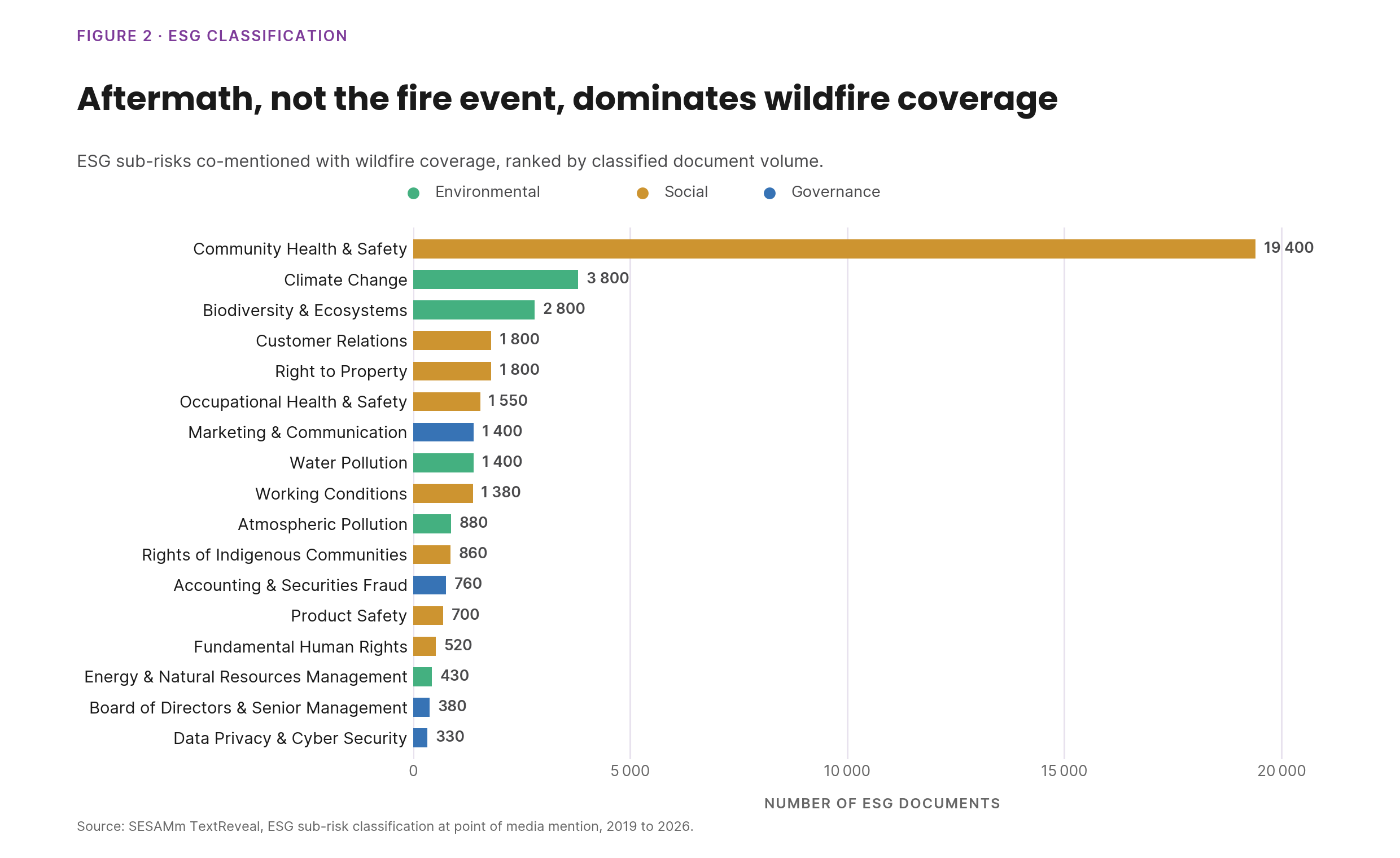
This analysis reviews global wildfire mentions between 2019 and 2026 across three lenses: quarterly mention volume, ESG sub-risk classification, and country-level geographic distribution, cross-referenced against documented public reporting. Three findings stand out: (1) wildfire coverage has shifted from a seasonal pattern to a sustained, year-round baseline since 2023; (2) coverage volume tracks proximity to population centers and identifiable liable parties more closely than it tracks the physical scale of the fire itself; and (3) the dominant subject matter in wildfire-related ESG coverage is the aftermath (casualties, contaminated water and air, insurance exposure, litigation) rather than the fire event in isolation.
1. Mention volume over time: a seasonal story becomes a year-round one
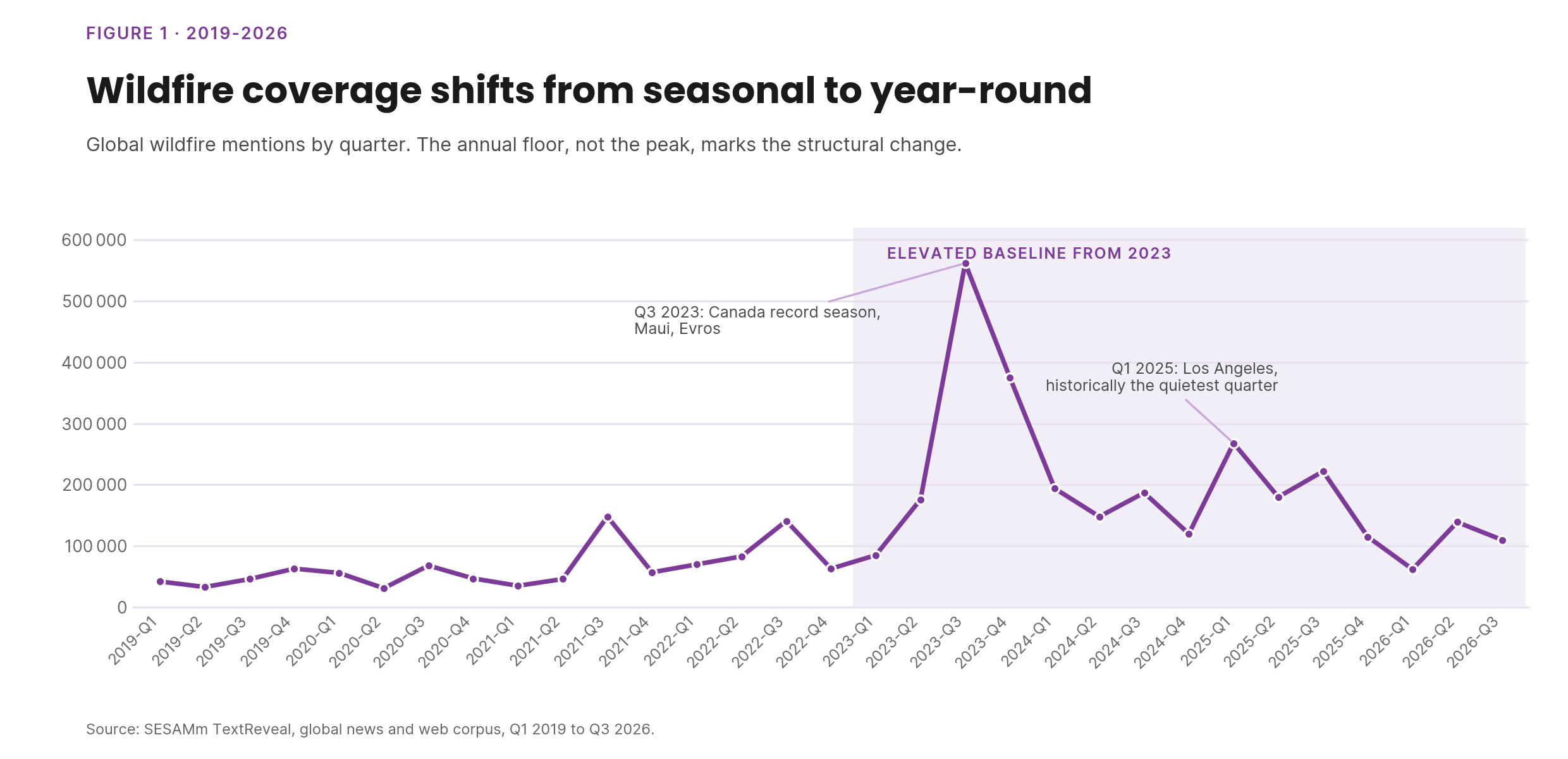
For most of the period, the data follows a predictable four-quarter cycle: Q1 is the annual low, Q2 shows a moderate rise, Q3 spikes with the Northern Hemisphere dry season, and Q4 falls back. That cycle breaks in two places, and both breaks mark a structural change rather than a one-off event.
Q4 2023 does not return to baseline after the Q3 peak: coverage stays elevated into the final quarter for the first time in the dataset.
Q1 2025, historically the lowest-volume quarter of the year, reaches roughly 270,000 mentions, more than several previous Q3 peaks.
The floor is the more telling number. In the quarters before 2023, non-peak volume rarely exceeded 80,000 mentions. From 2023 onward, even the quietest quarters do not fall below roughly 110,000–190,000. Wildfires have moved from a seasonal hazard to a year-round subject of coverage.
It's worth noting what does not explain this shift: acreage burned. 2020 through 2022, the years directly before this data climbs, include some of the largest fires by area in modern US and European history, yet register comparatively modest mention volume, partly because those years overlapped with the COVID-19 pandemic, which absorbed a large share of global news capacity.
The years that do dominate the chart, 2023 and 2025, are not necessarily the years with the most land burned; they are the years fire reached population centers and produced an identifiable party to blame. The Lahaina, Marshall, and Los Angeles fires are all comparatively small by area next to the 2020 US West Coast season or Canada's 2023 season, but generated substantially more coverage because of death toll, structures destroyed, and utility liability. Acreage, in short, is a weak predictor of coverage; proximity and blame are strong ones.
What was happening on the ground behind each peak
Each Q3 peak in the dataset lines up with a specific, documented cluster of events:
Q3 2022: fires threaten the Yosemite region and Sequoia groves in California; Spain and Portugal report wildfires during a European heat wave; a federal review attributes a New Mexico wildfire to a botched prescribed burn.
Q3–Q4 2024: a wildfire cuts power to Labrador; another burns near Suncor's Firebag oil-sands site in Alberta; Jasper, Alberta is significantly damaged; Greek investigators attribute the country's worst fire of the year to a faulty power cable.
Q1 2025 (the anomaly): a 14-fire outbreak tears through Los Angeles and San Diego County over January 7–31 on Santa Ana winds; the Palisades and Eaton fires alone destroy more than 18,000 structures and kill at least 31 people, with over 200,000 evacuated. Property-value loss is estimated at roughly $31 billion by CoStar, with total economic loss estimated between $250–275 billion by AccuWeather. Days later, the European Forest Fire Information System reports more than 100,000 hectares burned across the EU by the end of March, three months ahead of the typical season.
Across every year in the dataset, the same mechanism converts a fire into a sustained story: ignition (lightning, arson, or utility equipment failure) combines with drought and wind to produce the initial event, but litigation and identified liability sustain the coverage long after the fire is contained. PG&E, Southern California Edison, PacifiCorp, and Hawaiian Electric recur as named defendants across separate fires and separate years.
Wildfire-related controversies were classified into ESG sub-risk categories at the point of media mention. The ranking below runs from highest to lowest mention volume, with a documented, sourced example behind each category.
Climate Change: wildfires are framed as both symptom and accelerant. Canada's 2023 season burned at roughly seven times the historical average; researchers found climate change had tripled the underlying fire risk in the country's boreal forest, and the season released an estimated 1.5 billion metric tons of CO2, comparable to a decade of Canada's typical wildfire emissions.
Customer Relations: reflects the California property-insurance crisis: State Farm nonrenewed roughly 72,000 California policies in the two years before the January 2025 fires, then faced a state investigation into claims handling, including denial of hygienic smoke-damage testing, after the fires it did cover. A $1 billion FAIR Plan assessment was subsequently levied on insurers operating in California.
Right to Property: tied to the scale of destroyed real estate, an estimated $31 billion in property value destroyed in the January 2025 Los Angeles fires, and to litigation over responsibility for that loss, including Los Angeles County's lawsuit against Southern California Edison and Edison's countersuit against the county.
Marketing & Communication: covers corporate communications during active disasters, including relief pledges, the Recording Academy and MusiCares pledged $1 million to Los Angeles wildfire relief in January 2025, and utility crisis messaging, which came under renewed scrutiny after Edison International executive pay continued to rise during the period the company faced Eaton Fire liability claims.
Working Conditions: wildland and municipal firefighting workforce strain during extended, overlapping fire seasons across multiple continents.
Atmospheric Pollution: principally the June 2023 Canadian smoke event: New York City's air quality index peaked at 465, with a 24-hour PM2.5 average nearly three times the US regulatory standard, and follow-on research linked the event to a 44–82% increase in asthma-related emergency-department visits in the city.
Accounting & Securities Fraud: the Edison International shareholder class action filed after the Eaton Fire, alleging the company misrepresented the readiness of its power-shutoff program; Edison's share price fell approximately 34% following the fire, and the suit names CEO Pedro Pizarro and CFO Maria Rigatti as defendants.
The remaining categories (Product Safety, Fundamental Human Rights, Energy & Natural Resources Management, Board of Directors & Senior Management, and Data Privacy & Cyber Security) account for smaller shares of classified documents and were not tied to a comparably documented recurring event pattern in this dataset.
3. Geographic distribution of coverage
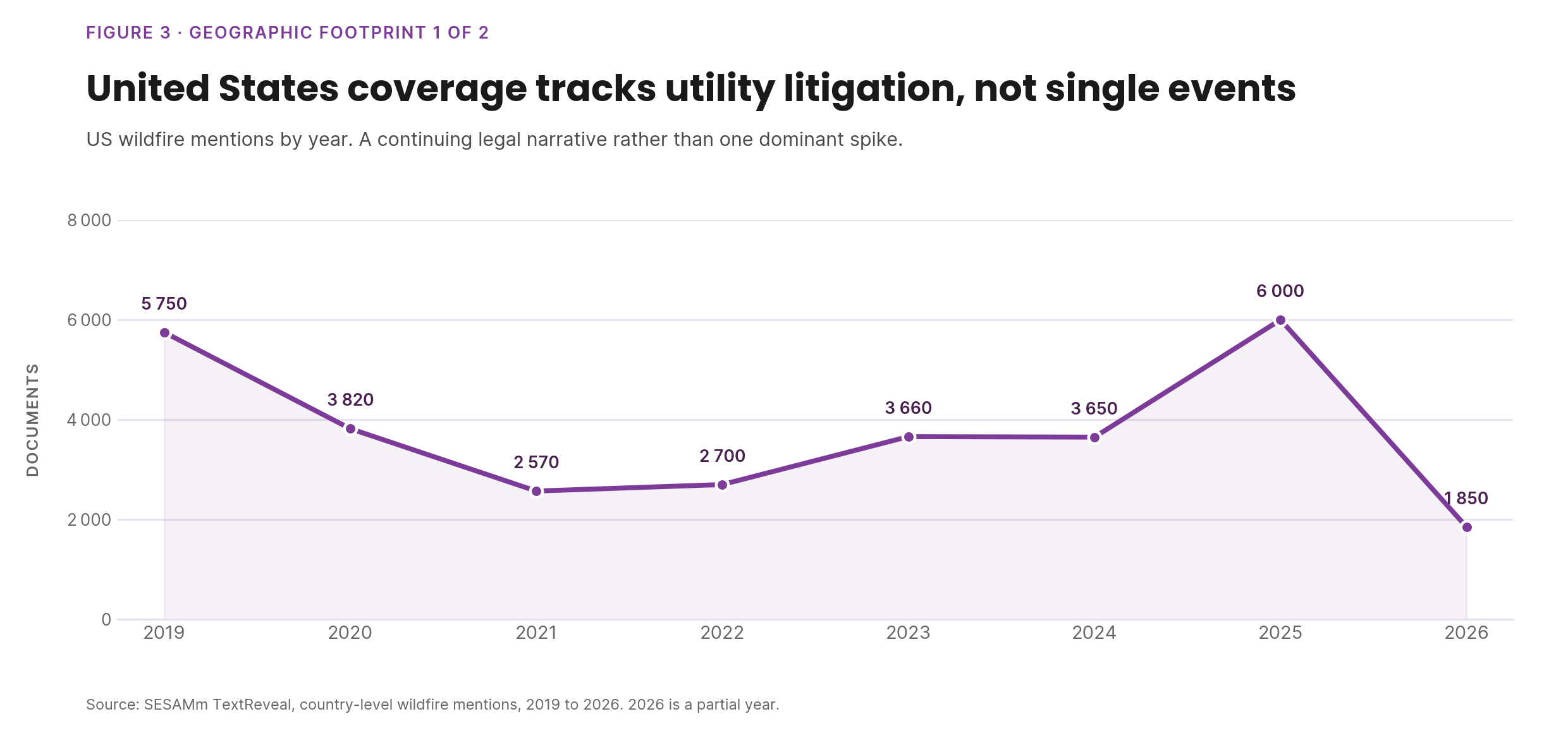
The United States accounts for the largest share of country-level mentions throughout the period, without a single dominant spike: volume rises through 2023–2025, peaks around 2025, then falls sharply into 2026. That shape fits a continuing sequence of named utility liability cases (PG&E, Southern California Edison, PacifiCorp) more than it fits a single event.
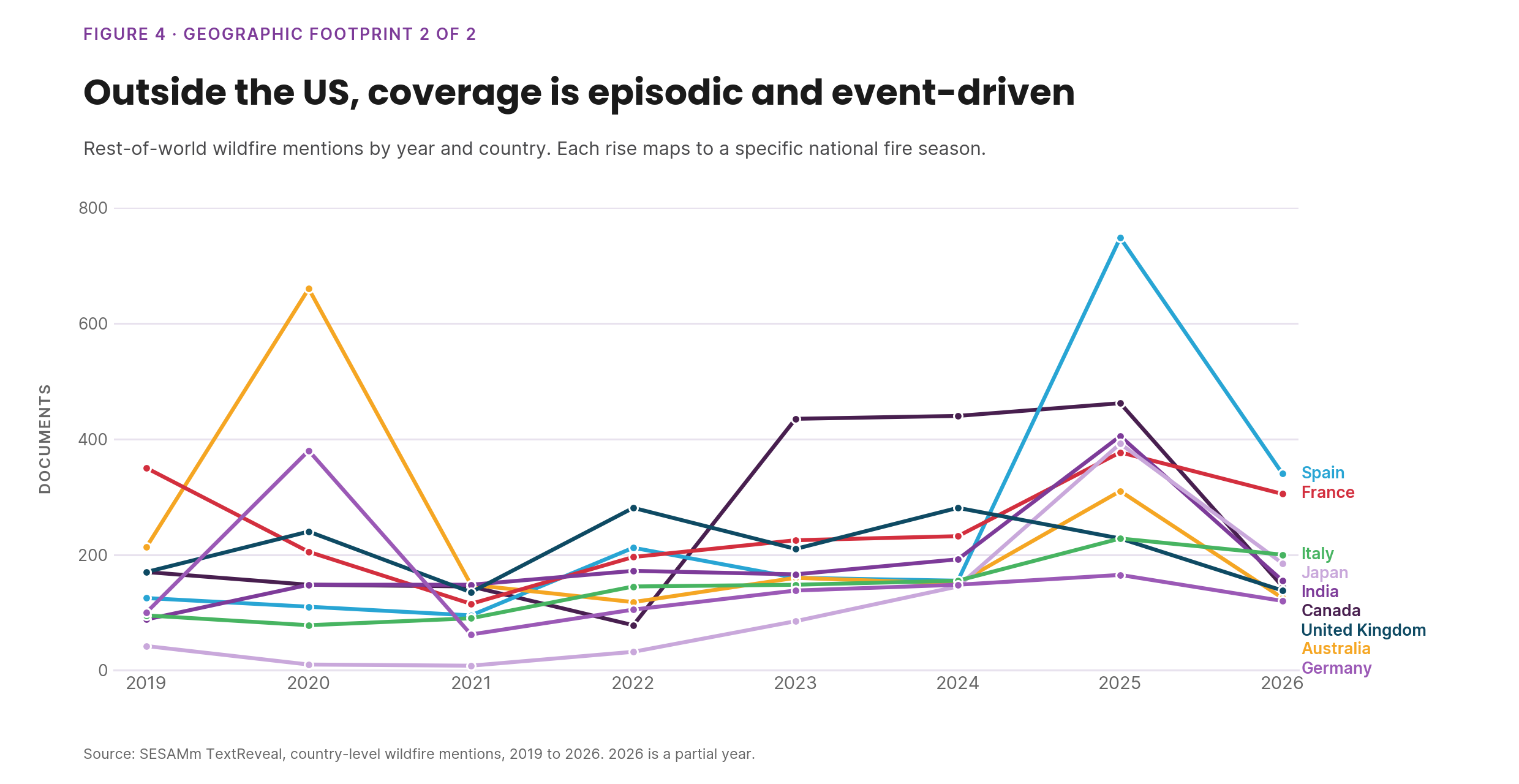
Outside the US, coverage is more episodic, clustering around identifiable national events rather than building a sustained baseline:
Australia peaks sharply around 2019–2020, matching Black Summer (24 million hectares burned, 33 deaths, an estimated three billion animals affected), then recedes.
Canada rises from 2022 and peaks around 2025, matching the record 2023 season (roughly 15–18 million hectares, eight firefighter deaths, up to 232,000 evacuated) and the continuation of large fires in 2024, including Jasper.
Greece shows a sustained late-period rise, matching the 2023 Rhodes evacuation and the Evros fire, followed by continued fire activity in 2024, including the faulty-power-cable fire investigators called the country's worst of the year.
Spain shows its highest point at the end of the series, consistent with the unusually early 2025 season (100,000+ hectares burned across the EU by end of March) and recurring summer wildfire and heat-wave coverage in 2022.
France, Germany, India, Italy, Japan, and the United Kingdom register comparatively low, stable volumes throughout, with modest increases around 2024–2025 in line with the broader post-2023 elevated baseline rather than country-specific events.
Read together, US coverage behaves like an ongoing institutional and legal narrative anchored by utility litigation, while rest-of-world coverage behaves like a series of discrete, event-driven spikes tied to specific fire seasons.
Conclusion
Across mention volume, ESG classification, and geography, the evidence points to a consistent mechanism. Coverage volume is driven primarily by three factors: proximity of the fire to population centers, the presence of an identifiable liable party, typically a utility, and how much a competing global news cycle is absorbing attention capacity at the same time. The physical scale of a fire is, on its own, a comparatively weak predictor of how much coverage it receives. On that basis, the next spike in wildfire coverage is more likely to come from an urban-interface fire with a clear liability story than from the largest fire by area.
Recently, SESAMm sat down with ClimateAction to discuss the evoloving ESG regularlatory landscape and its impact on businesses and investors alike. Below we’ve gathered key takeawyas from that discussion.
Addressing ESG Challenges
Organizations are facing the challenge of managing a broad range of ESG-related risks while adapting to new legal requirements. These include tracking greenhouse gas emissions, monitoring labor practices, and ensuring board diversity, all while meeting the expectations of multiple stakeholders, including shareholders, employees, governments, and communities.
Frameworks like the Organisation for Economic Co-operation and Development (OECD) guidelines, the UN Global Compact, and the International Labour Organization conventions provide a foundation for best practices in these areas. However, implementing these standards effectively requires companies to go beyond compliance and actively engage with stakeholder feedback.
The Role of ESG Data and Stakeholder Insights
Companies and investors are increasingly shifting to robust data sources to craft effective ESG strategies. ESG data collection now includes not only internal metrics, such as workplace safety statistics and environmental performance indicators but also external stakeholder perspectives. These insights, drawn from media coverage, social media sentiment, and reports from non-governmental organizations, provide a more comprehensive understanding of a company's impact and reputation. For investors, this information is necessary for assessing risks and opportunities in their portfolios. By integrating external feedback into their analyses, investors can better align their strategies with regulatory demands and societal expectations.
Leveraging Advanced Technologies in ESG Monitoring
Artificial intelligence (AI) and natural language processing (NLP) technologies have emerged as effective tools for ESG monitoring and reporting. These technologies can analyze vast amounts of data from diverse sources, including news articles, social media posts, and corporate reports, to identify potential ESG controversies and risks.
The benefits of AI-driven ESG analysis are particularly evident in sectors with limited traditional data, such as private equity. By expanding coverage to include smaller or less transparent companies, AI enables investors to gain deeper insights into their portfolios.
Furthermore, advances in AI, particularly large language models, have enhanced the ability to detect and analyze a wider range of events that might impact a company's ESG performance. This capability helps address one of the primary limitations of ESG reporting—reliance on self-reported data, which may not fully capture a company's real-world impact.
Preparing for the Future
As ESG regulations become more stringent and stakeholder expectations rise, businesses and investors must adopt proactive strategies. By leveraging advanced technologies and comprehensive data sources, they can better manage ESG risks and align with regulatory requirements. This approach not only ensures compliance but also enhances reputation and long-term sustainability, positioning organizations to thrive in an increasingly ESG-focused world.
The integration of stakeholder feedback into ESG assessments represents a significant shift in how organizations view their responsibilities. By combining traditional metrics with innovative technologies, companies, and investors can build strategies that reflect both regulatory priorities and societal values. This holistic approach is essential for navigating the complex and rapidly changing ESG landscape.
TextReveal’s web data analysis of over five million public and private companies is essential for keeping tabs on ESG investment risks. To learn more about how you can analyze web data or to request a demo, reach out to one of our representatives.
The biotech industry faces significant ESG risks, particularly in governance. Social and operational risks are less common but still material.
Across the sector, companies like Cassava Sciences, BrainStorm Cell Therapeutics, and Anavex Life Sciences frequently face governance controversies, including shareholder and class action litigation, security fraud, SEC investigations, and more. While social risks are generally secondary, they are notable in areas such as workforce reductions, layoffs following acquisitions, and labor disputes, with patient-safety considerations emerging in therapies with adverse effects.
What are the most pressing ESG challenges currently facing the biotech sector? Read on to find out.
Cassava Sciences: Governance and Transparency Concerns
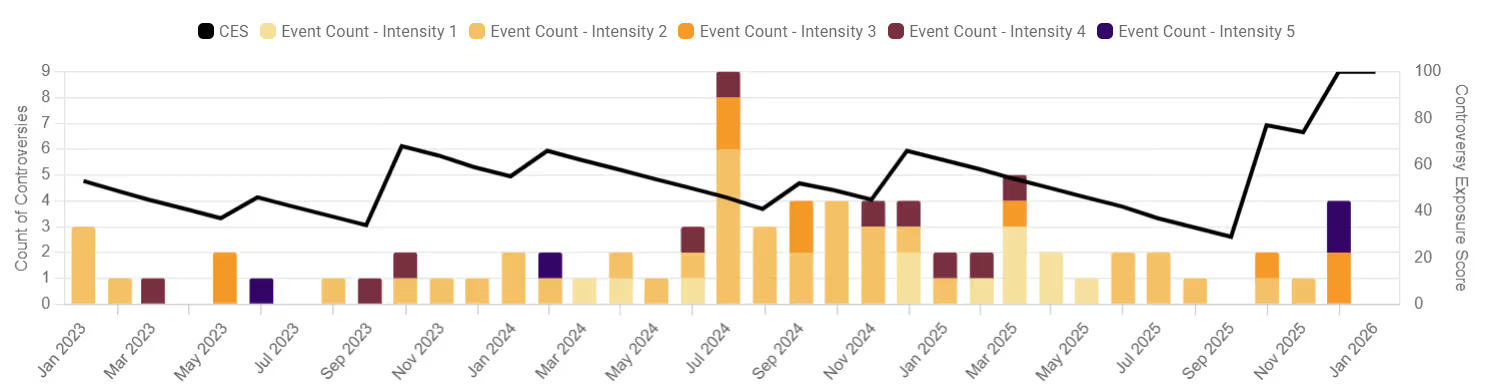
Cassava Sciences has a high Controversy Exposure Score, the result of its involvement in several severe ESG controversies. The company has faced class action and shareholder litigation, resulting in settlements of $31M and $40M over allegedly misleading statements related to its Alzheimer’s drug, Simufilam. Governance concerns are further amplified by allegations of manipulating trial data and scientific misconduct, which have attracted both SEC investigations and reports of criminal probes. Additional legal controversies include malicious prosecution and defamation lawsuits filed in response to alleged “short and distort” campaigns. On the social side, Cassava has faced a 33% reduction in its workforce, reflecting operational restructuring.
Anavex Life Sciences: Lawsuits and Regulatory Scrutiny
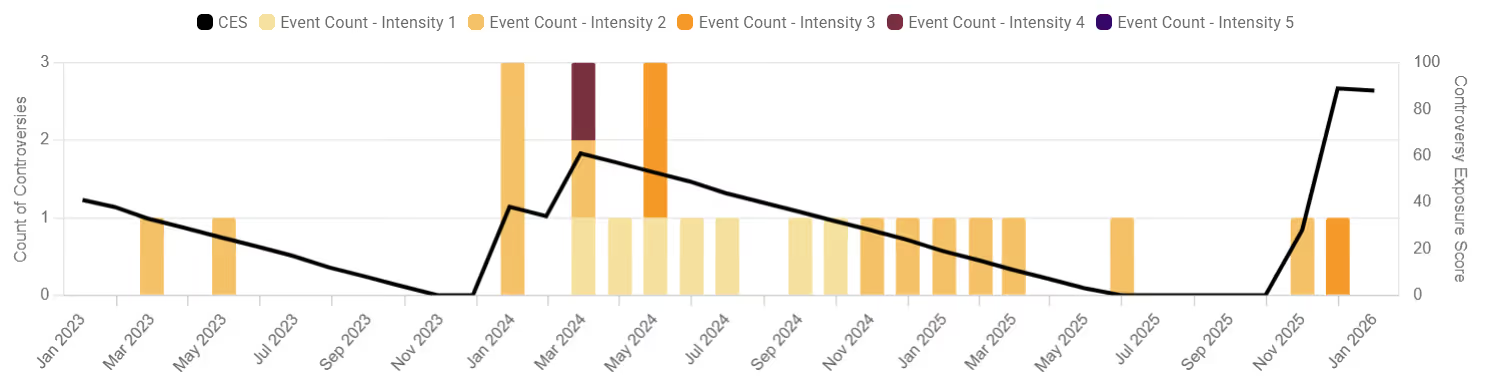
Anavex Life Sciences faces notable governance risks, primarily stemming from shareholder litigation and concerns regarding the integrity of its clinical trials. Multiple class action lawsuits allege misrepresentation and deceptive practices, particularly in reporting outcomes for Rett syndrome and Alzheimer’s disease trials. Governance concerns are compounded by data inconsistencies, changes in trial evaluation criteria, and regulatory scrutiny, including the EU’s rejection of its Alzheimer’s drug.
BrainStorm Cell Therapeutics: Fraud and Credibility Allegations
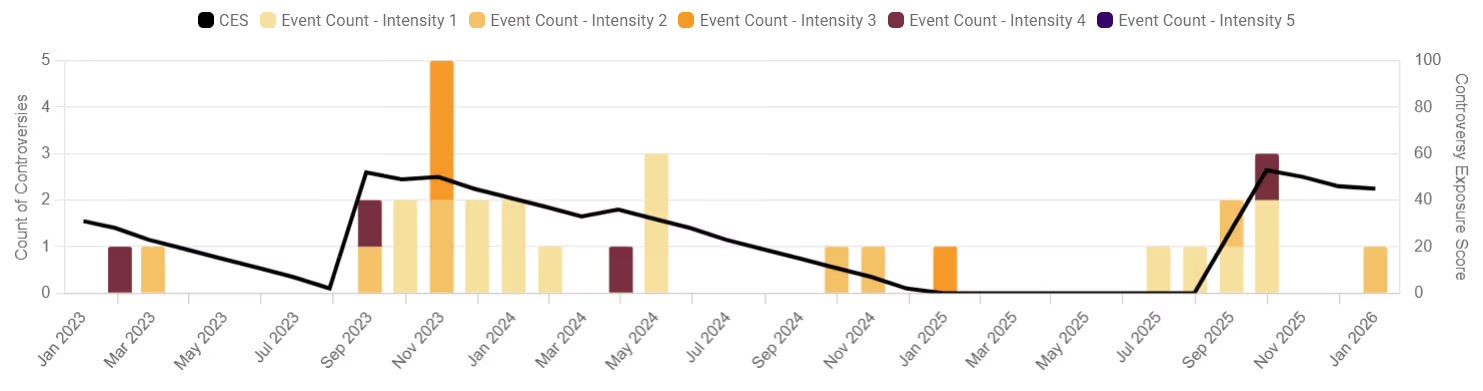
BrainStorm Cell Therapeutics exhibits a concentrated governance risk profile, with issues spanning several aspects. Class action lawsuits and securities fraud claims allege investor harm from misstatements, while the company faces lawsuits for overstating FDA feedback and misrepresenting the efficacy of its ALS therapy, NurOwn. These allegations are reinforced by FDA panel and reviewer concerns, raising questions about its scientific credibility. BrainStorm is also facing delisting from Nasdaq and a breach of contract lawsuit. On the social front, the company’s ESG exposure stems from plant shutdowns, workforce restructuring, and job cuts, raising labor practice concerns.
The biotech industry’s ESG profile is increasingly shaped by governance-related controversies, particularly around transparency, litigation, and regulatory scrutiny. Companies like Cassava Sciences exemplify how unresolved allegations, ranging from trial data manipulation to securities fraud, can significantly shake stakeholder trust and financial stability. While social and operational risks appear less frequently, workforce reductions, safety concerns, and labor disputes highlight broader vulnerabilities tied to the sector’s rapid pace and scientific complexity. As the industry continues to innovate, managing these ESG risks will be crucial not only for compliance but also for long-term credibility and sustainable growth.
Reach out to SESAMm
TextReveal’s web data analysis of over five million public and private companies is essential for keeping tabs on ESG investment risks. To learn more about how you can analyze web data or to request a demo, reach out to one of our representatives.
Stay ahead with the latest in ESG and AI intelligence
Join our mailing list to receive new reports, event invites, and updates from SESAMm directly to your inbox.