Webinar Replay: Addressing Core Challenges in ESG Data Management
February 25, 2025
•
5 mins read
In our recent webinar with WeeFin, "Addressing Core Challenges in ESG Data Management," CEOs Sylvain Forté and Gregoire Hug discussed both the fast-evolving ESG landscape and how managing complex data is more critical than ever.
Watch this webinar to learn how to:
Manage the lack of standardization and the inconsistency in ESG data.
Address data quality issues and missing data.
Implement a dedicated ESG data management system to balance flexibility and standardization for meaningful reports.
Fill out the form to access the webinar replay now!
Webinar Replay: Addressing Core Challenges in ESG Data Management
Greenwashing is evolving—and so are the tools to uncover it.
In our most recent webinar, "How to Spot Greenwashing vs Real Sustainability Using AI," SESAMm CEO Sylvain Forté and Fingreen AI CEO Louis Frank sat down and unpacked the complexities of ESG credibility in today’s climate-conscious market. From emerging patterns in greenwashing to the rise of corporate silence—greenhushing—they explored what the latest data tells us and how AI is changing the game.
What you'll learn:
Breaking Down ESG Buzzwords: An Introduction to Greenwashing, Greenhushing, and Greenwishing, showing how their mentions have surged in recent years—across sectors and regions.
The Data Doesn’t Lie: While oil and gas and industrials are frequent offenders, every industry faces reputational risks—case in point: the controversies surrounding firms like DWS and BNY Mellon.
Traceability & Transparency: How open methodologies can help verify commitments like Net Zero and SDG alignment.
Fill out the form to access the webinar replay now!
Geopolitical events can quickly create ripple effects across global trade routes, supply chains, and corporate operations. For investors, commercial banks, insurers, and other organizations, identifying which portfolio companies or counterparties are exposed to these developments is a real challenge, especially when monitoring large universes of public and private companies.
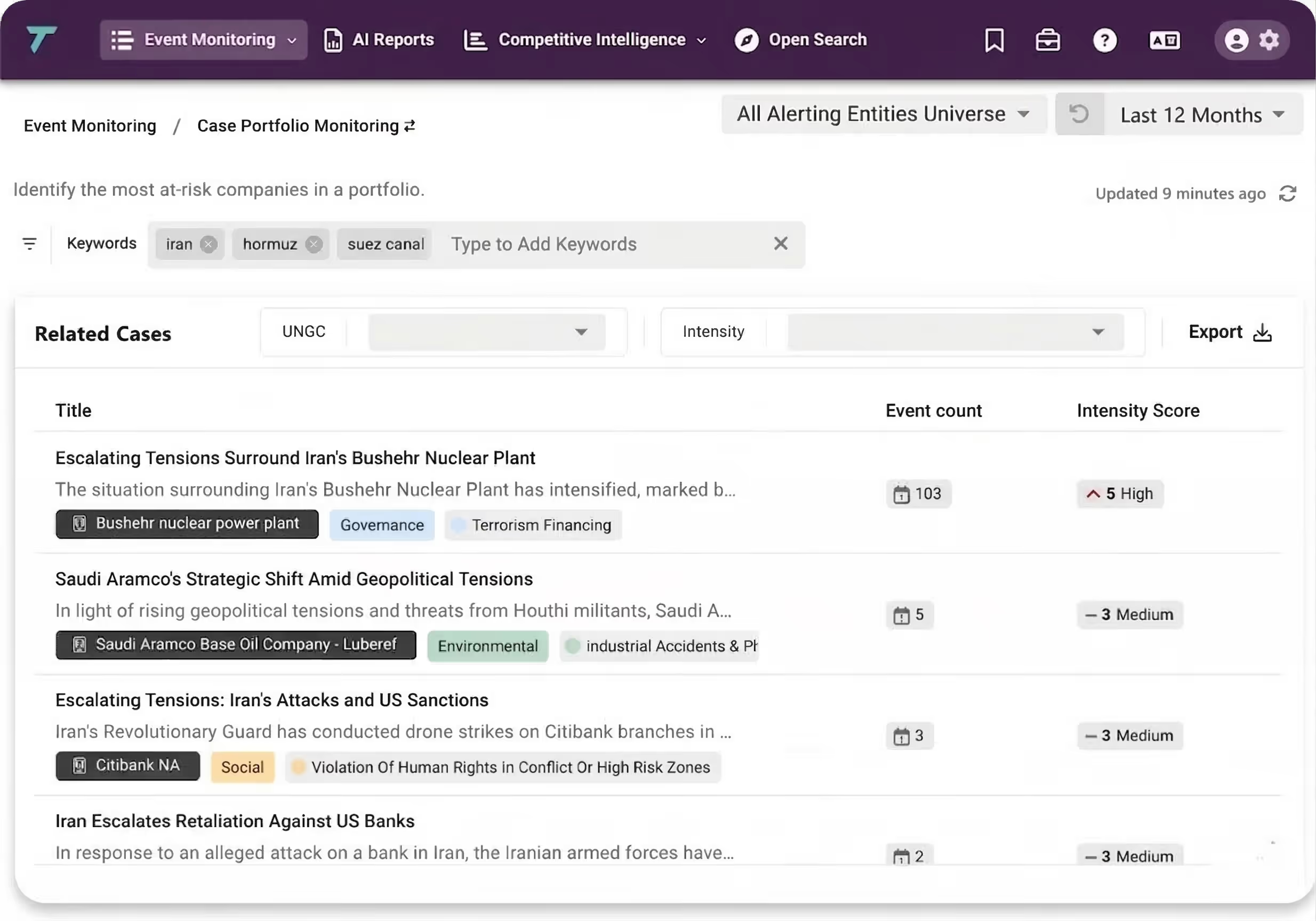
SESAMm's thematic keyword search enables analysts to quickly discover controversies related to specific topics or emerging events across thousands of companies. This functionality allows them to filter results by theme without having to manually review large volumes of news and event data.
This functionality is particularly valuable when monitoring rapidly evolving geopolitical situations. To assess exposure related to the current conflict involving Iran, for example, users can run a thematic search across a broad company universe using keywords such as: Iran, Hormuz, and Suez Canal.
These keywords capture references to critical geopolitical locations and maritime chokepoints that may affect global shipping routes, energy markets, cybersecurity risks, and broader operational disruptions. Keywords can be tailored to any geopolitical scenario. Users can start broad and refine as the situation develops, or combine location-based terms with event-specific language to narrow results to the most relevant controversies.
When applied across a large company universe, the dashboard surfaces a range of related controversies ranked by severity. From high-intensity cases like escalating tensions around Iran's Bushehr Nuclear Plant, to medium-intensity signals such as retaliatory actions targeting US banks, offering clear visibility into which companies may face the highest risks.
Zooming In on Company-Level Exposure: The Example of Amazon
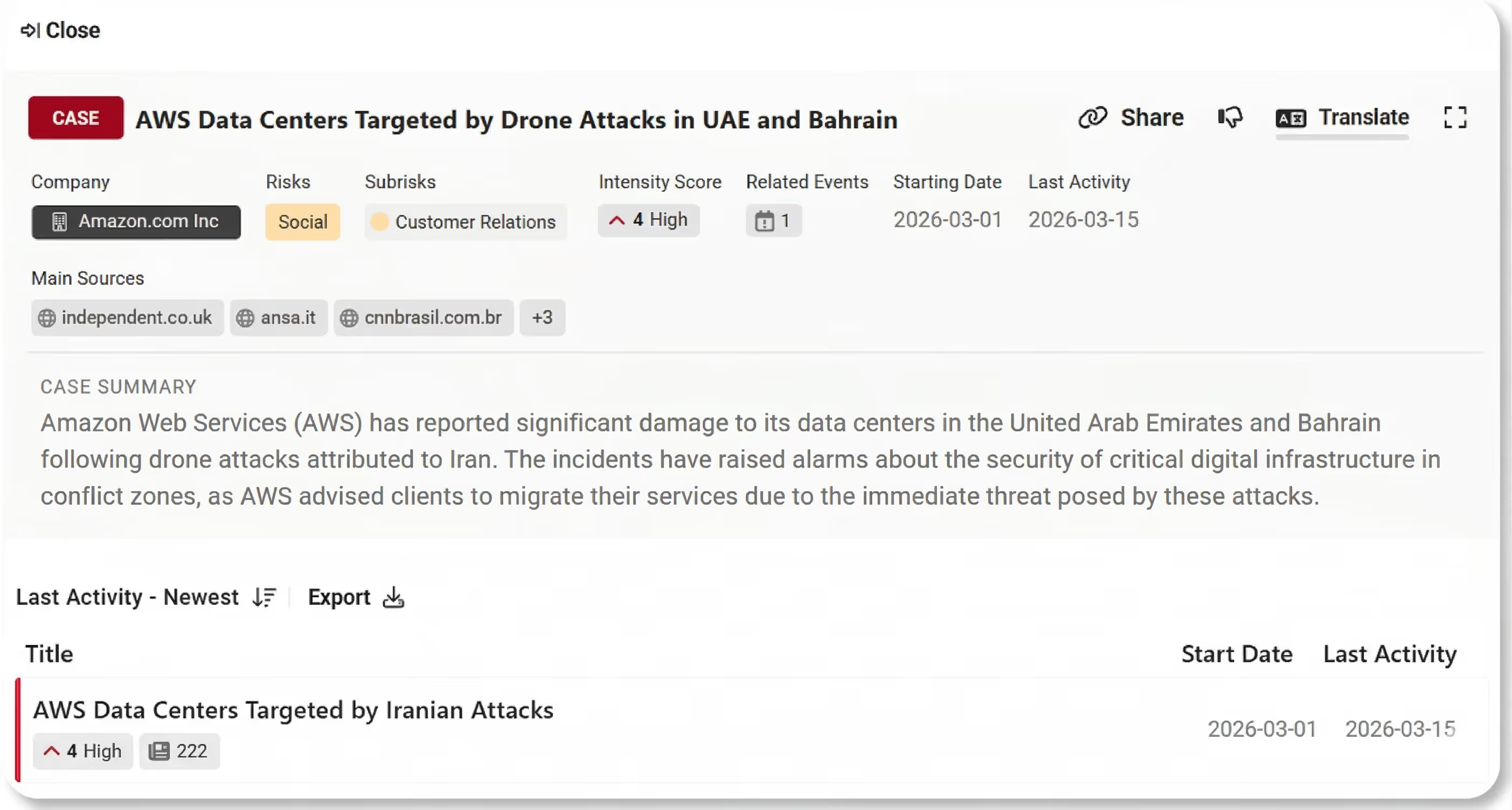
Alternatively, analysts can also use the same keyword approach to filter controversies associated with a specific company. This helps determine whether a particular portfolio holding, borrower, or insured entity may be affected by the same geopolitical developments.
Applying this search to Amazon, for instance, surfaces a high-intensity case titled "AWS Data Centers Targeted by Drone Attacks in UAE and Bahrain." The case, rated 4/5 in severity and drawing on over 200 related news events, describes significant damage to AWS infrastructure in the UAE and Bahrain following attacks attributed to Iran, prompting AWS to advise clients to migrate services.
This kind of signal carries real weight for financial institutions. For investors, it highlights operational and geopolitical risks affecting a major technology provider. For banks and insurers, it may point to infrastructure vulnerabilities, operational disruption risks, or broader geopolitical tensions affecting clients' critical systems.
From Geopolitical Events to Portfolio Risk Signals
Geopolitical events rarely affect just one company. For financial institutions monitoring thousands of entities, they create complex, evolving risk exposures across entire portfolios, lending books, and insurance coverage.
Thematic keyword searches help bridge this gap, connecting macro-level developments to company-level controversies quickly and systematically. By combining automated controversy detection with flexible search capabilities, analysts can rapidly identify relevant signals, investigate affected companies, and prioritize follow-up work.
In practice, this means moving faster from emerging geopolitical events to actionable risk insights. Whether the trigger is a conflict in the Middle East, sanctions on a major economy, or rising tensions around a critical shipping lane, the same approach applies, giving investors, banks, and insurers a systematic way to stay ahead of geopolitical risk across their entire portfolio.
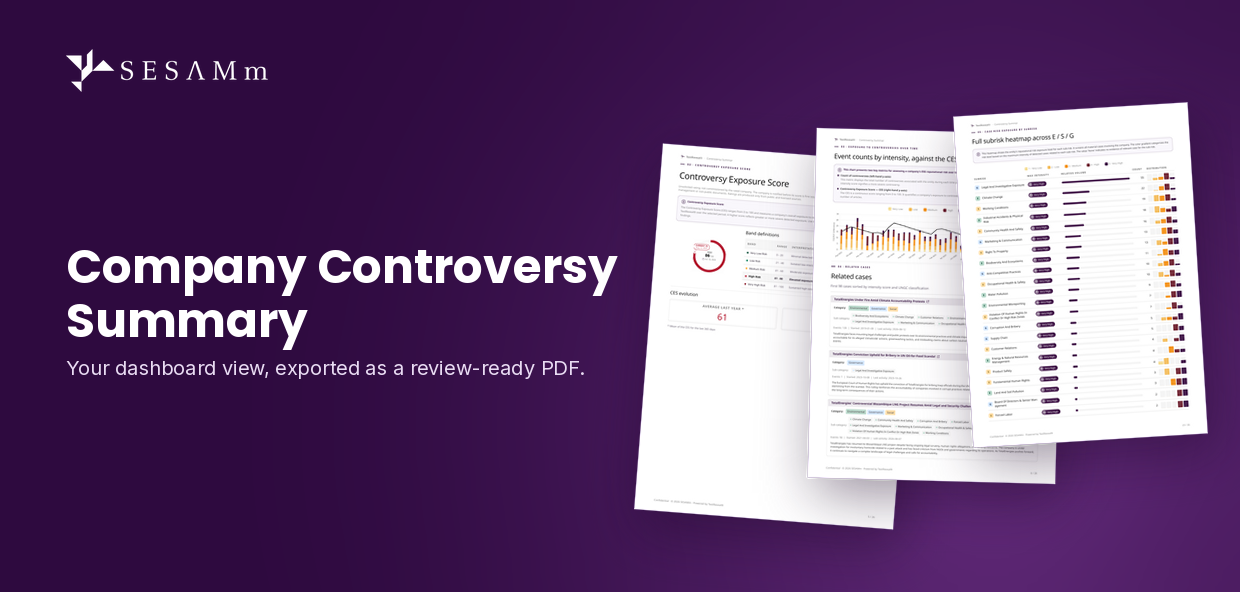
We are happy to announce the Company Controversy Summary, a new entity-level export that turns a TextReveal® dashboard view into a presentation-ready PDF in a single click, without screenshots or manual reformatting.
The report is built for the internal reviews you already run, from quarterly risk committee packs to compliance files and deal team memos. Each section explains what the scores mean and how the analysis was conducted, so the export can be filed or presented as it comes.
From Dashboard to Document in One Click
The report covers six sections: an executive summary, the Controversy Exposure Score (CES), how that score has evolved over time, monthly exposure charts by intensity, a case list with UNGC classification, and a methodology appendix. Because every case traces back to the underlying SESAMm sources, a reviewer can verify any finding without coming back to you.
Monitoring has been real-time for several years, while reporting has not, which leaves analysts screening a company in minutes and then rebuilding the same findings by hand for whoever signs off, a step this export removes.
Scoped to the Review at Hand
Setting the time range and the filters before exporting means the report reflects the review it was produced for, whether that is a deal period, a compliance window, or a monitoring cycle. Those filters are then printed on every page, so anyone reading the document later can see what was screened.
A deal team working on a target, for example, sets the diligence window, applies sector-relevant filters, and exports a report covering only that period.
Key Benefits of the Company Controversy Summary
A file, not a screen: The report leaves the dashboard as a document you can attach or present, generated from the view you are already working in.
Six sections in one document: Everything a reviewer needs, in the order they read it, with nothing summarized away.
Scope a reader can see: The window and the filters behind the report travel with it, so no one has to ask what the analysis included.
Stay ahead with the latest in ESG and AI intelligence
Join our mailing list to receive new reports, event invites, and updates from SESAMm directly to your inbox.