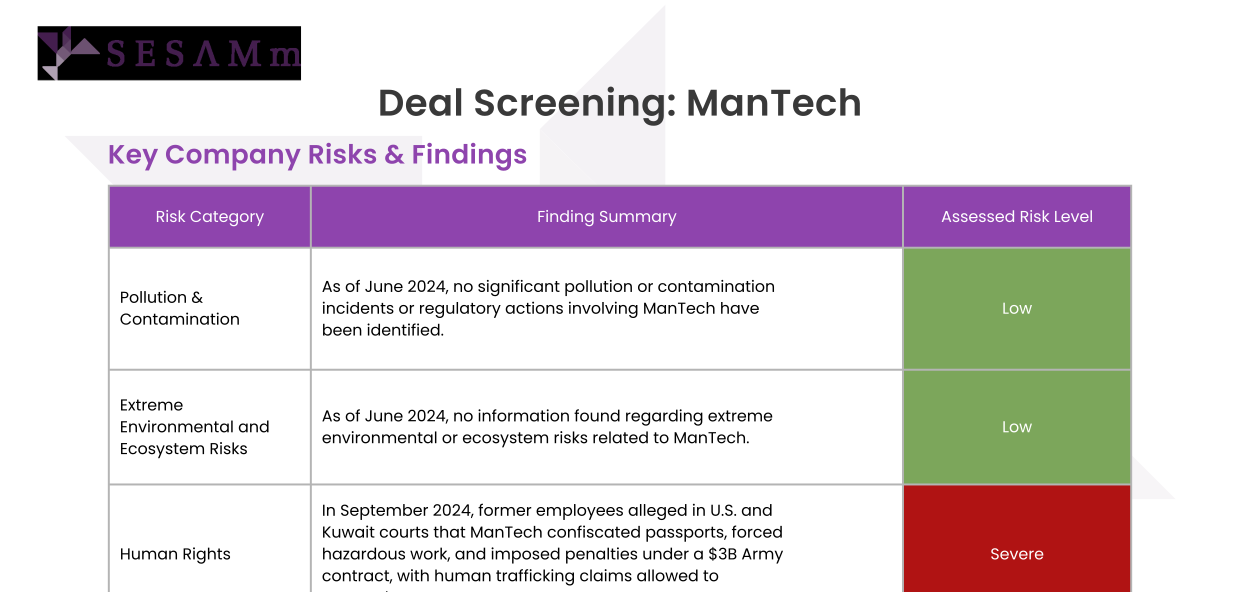

This is from SESAMm’s Deal Screening AI report. These reports are usually used by private equity deal teams and M&A teams to conduct pre-commercial due diligence on any company or project in minutes, and they contain insights and risks on the target company as well as a full competitive and market analysis.
ManTech International Corporation is a U.S.-based defense contractor specializing in cybersecurity, data analytics, and systems engineering solutions for national security and government agencies. Founded in 1968 and headquartered in Herndon, Virginia, the company operates globally. It primarily serves U.S. defense, intelligence, and homeland security clients, delivering technology services that support mission-critical operations such as cybersecurity protection, artificial intelligence and analytics, and intelligence, surveillance, and reconnaissance capabilities.
The broader defense and intelligence services market in which ManTech operates is expanding rapidly due to rising global defense spending, geopolitical tensions, and increasing demand for advanced digital and cyber capabilities. Within this context, ManTech has recently secured several growth signals, including a $200 million cybersecurity contract with the National Oceanic and Atmospheric Administration, partnerships to deploy secure AI technologies, and major analytics and systems contracts with the U.S. Army, reflecting continued demand for its technical expertise.
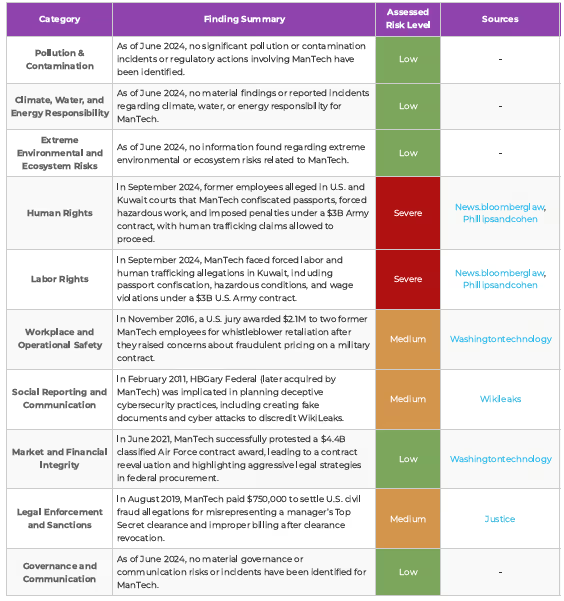
The report identifies several legal and reputational risks that could be relevant in a due diligence context. The most significant relate to labor and human rights issues, including allegations by former employees that the company confiscated passports and imposed hazardous working conditions under a U.S. Army contract in Kuwait, with a U.S. court allowing human-trafficking claims to proceed. Other previous issues include whistleblower retaliation claims linked to military contract billing practices and a civil fraud settlement involving misrepresentation of security clearance status. Environmental risks appear limited, with no major pollution or climate-related incidents identified.
In the competitive landscape, ManTech operates alongside firms such as Booz Allen Hamilton, Leidos, CACI International, SAIC, and General Dynamics Information Technology. While not the largest player in the sector, it is regarded as a capable provider of secure IT and cybersecurity solutions for classified government missions. Overall, the report concludes that ManTech benefits from strong demand for defense technology and cyber capabilities but faces reputational exposure primarily tied to labor practices and contract-related compliance risks.
Reach out to SESAMm
SESAMm’s AI Deal Screening Reports analyze web data across over five million public and private companies to help investors quickly identify legal, ESG, and reputational risks during due diligence. To learn more about how you can generate these reports or to request a demo, reach out to one of our representatives.

With sustainability being imperative, it's essential to examine how public and private companies align with the Sustainable Development Goals (SDGs). This article, leveraging insights from SESAMm's TextReveal, dives into the behaviors of both sectors across industries, exploring their impact on achieving a sustainable future. Join us as we unravel the complexities of corporate contributions to the SDGs, highlighting key differences and challenges public and private entities face in their journey toward sustainability.
What are the 17 Sustainable Development Goals?
The 17 UN SDG objectives, introduced in 2015 with the target of achievement by 2030, are geared towards building a sustainable society. Initially designed for governments, certain companies can contribute significantly to these goals through their products or conduct. However, our focus here will center on identifying behaviors that counter these 17 objectives.
The analysis of Sustainable Development Goal (SDG) adverse behaviors, as identified by SESAMm's TextReveal, offers a comprehensive comparison between public and private companies within various industries. The focus is to discern disparities in SDG behaviors within the same sector and pinpoint the predominant SDG goal breaches in these industries.
Excluding Goal 2 ("End hunger") due to its alignment with state-related initiatives, the analysis concentrates on corporate-impactful goals.
Public and private sectors face challenges in meeting SDGs, particularly Goals 1 ("End poverty") and 16 ("Peace & justice and strong institutions"), with issues in labor rights and governance. However, public companies are more aligned with Goal 8 ("Decent work and economic growth") across industries, facing a range of controversies from biodiversity to management issues. In contrast, private companies focus on Goal 11 ("Sustainable cities"), dealing with climate change and customer relations risks.
Goal 16 ("Peace & justice and strong institutions") is significant in both sectors but particularly in the Financials and Information Technology for public companies and in Financials, Fossil Fuels, and Health Care for private companies. This goal involves human rights, labor rights, human capital, and governance-related controversies.
These findings highlight the profound impact of SDG-related risks on economic growth and stability across various sectors. Industries like Information Technology, Industrials, and Consumer Discretionary exhibit heightened susceptibility to SDG adverse behaviors, underscoring the necessity for vigilant risk management to ensure economic prosperity and security.
Industrial UNGC Use Case
What is the UN Global Compact?
The United Nations Global Compact (UNGC), established in 2000, outlines ten principles across four main pillars: human rights, labor standards, and anti-corruption. These principles are critical in guiding companies toward ethical and responsible behaviors.
Figure 1: UNGC for public companies.
Figure 2: UNGC for private companies.
The analysis reveals distinct patterns in breaches of UNGC principles. Private companies in the industrials and fossil fuel sectors show a notable correlation with anti-corruption breaches, emphasizing the importance of due diligence in these areas. In the fossil fuel industry, public companies primarily breach environmental principles, while private companies show more breaches related to anti-corruption along with environmental concerns.
Private industrial companies also display a significant number of anti-corruption breaches involving various legal challenges. In the consumer staples sector, public companies primarily face human rights breaches, including forced labor and privacy violations. The private consumer discretionary sector also shows a high number of human rights breaches, particularly related to privacy and diversity and inclusion.
Overall, public companies across various sectors tend to have more frequent or severe UNGC breaches compared to private companies. This highlights the different challenges faced by public and private entities in adhering to the UNGC principles.
Conclusion
Significant variations in sustainability strategies emerge when looking at public and private companies through their SDG performances. Public companies prioritize economic growth and grapple with environmental and governance concerns, while private companies focus on creating sustainable cities, addressing climate change, and fulfilling social responsibilities. Both sectors encounter obstacles in eradicating poverty and ensuring justice, highlighting their crucial roles in promoting global sustainability objectives. This analysis underscores the essential proactive approach needed from both public and private entities to tackle sustainability challenges effectively.
Download the full report to discover how different sectors navigate regulatory pressures and sustainability challenges with real-world examples to guide your strategy.
Reach out to SESAMm
TextReveal’s web data analysis of over five million public and private companies is essential for keeping tabs on ESG investment risks. To learn more about how you can analyze web data or to request a demo, reach out to one of our representatives.
One of the biggest challenges in risk monitoring is sifting through mountains of irrelevant data. Whether you're using search engines, financial news platforms, or even specialized in-house analytics, you end up with too much noise. Scrolling through to page 12 of Google is not only time-consuming, but leaves you with the nagging feeling that you could still be missing something.
Artificial Intelligence (AI) is a hot topic, with new breakthroughs and possible applications popping up every day. The question is no longer simply “can AI help me with that?” but rather “how can I use AI to help with that?” For Environmental, Social, and Governance (ESG) controversy and risk monitoring, AI is used to sift through enormous data sets at unparalleled speeds, bringing critical insights to the forefront faster and more efficiently than humanly possible.
When there are hundreds of companies to monitor, for example in a large investment portfolio or a group of suppliers, the advantages of AI are obvious. But what about smaller portfolios? How do you know it’s time to start using AI? Based on our experience working with private equity firms, asset managers and commercial banks, we’ve pulled together five signs that it’s time to consider AI.
1. Overwhelmed by Data: There's Too Much Noise
An AI-powered tool filters out the noise, even in situations where seemingly only humans would be able to do it, giving you the peace of mind that there’s no controversy lurking in the dark corners of the web. All of the key information is gathered in one place, ready for you to evaluate and decide the best course of action.
2. Difficulty Finding Critical Information: The Black Hole of Private Companies
On the flip side - sometimes instead of finding too much data, you can’t find any data at all. For private companies, information can be scarce, especially for smaller companies based overseas, where the only news coverage is local and in the local language. In this case, ESG ratings agencies often aren’t able to fill the gap either. There are millions of firms worldwide and less than 50,000 of them are covered by rating agencies (source).
AI, on the other hand, enables systematic coverage and statistically relevant results without human intervention, analyzing millions of websites and providing coverage on millions of public & private companies. If you are struggling to find information on a company, AI might be the answer.
3. Can't Accurately Analyze an Event: The Context is Missing
Beyond the actual controversy or event itself, understanding the context and history around it is essential for risk assessment. Is this a one-off concern or part of a recurring pattern? To get the full picture, you need to take a closer look not only at the company in question, but the key players, i.e. key executives, and the industry as a whole to understand if this is within the norms.
AI has an important role to play here also. By simply expanding the search, AI can provide you with a full picture of the controversy, including a quick summary and a benchmark against competitors in just a matter of minutes.
4. Missed Critical Window for Action: The Cost of Inefficiency
Markets can change quickly - and it’s only getting worse as information is spreading faster and more widely. The more time it takes you to gather and analyze information, the less time you have to react. This can be a challenge whether you are monitoring 30 companies or 100’s. If you find yourself trapped in a cycle of reacting to news rather than acting proactively, AI can help. Because AI scans and analyzes information in seconds, the alerts to potential controversies are in near real-time, allowing you as much time as possible to take action.
5. Missing ESG Expertise: The Knowledge Gap
To top it all off, ESG is complex and constantly evolving. Understanding what data is relevant and how to evaluate it requires real expertise. ESG rating agencies provide some guidance, but they typically leverage self-reported data - which is naturally biased. Take greenwashing for example where a company misleads its stakeholders, investors, and consumers about its environmental practices by communicating positive environmental performance contrary to its actual, less positive execution. It’s difficult to identify greenwashing using self-reported data.
Because AI relies on external stakeholders, such as online forums or news sources, it offers an unbiased take on a company’s ESG performance. Additionally, by choosing an AI with ESG expertise built-in, you benefit from an expert analysis without increasing the burden on your team.
As the speed and amount of information available continues to grow, AI offers a scalable way to monitor your partners, suppliers and portfolio. To learn more and find out if AI is a good fit for your company, contact our experts at SESAMm.
U.S. banks have dramatically increased fossil fuel financing in a notable contradiction with the narrative established after COP26. According to the 2025 Banking on Climate Chaos report, compiled by the Rainforest Action Network and its partners, global banks significantly scaled up their support for the fossil fuel industry in 2024, with a staggering $162 billion increase, pushing total financing to $869 billion.
U.S. institutions are at the forefront of this backslide. JPMorgan Chase, Bank of America, Citigroup, and Wells Fargo accounted for one-third of global fossil fuel financing, approximately $289 billion. JPMorgan alone provided $53.5 billion, a 35% rise in funding that placed it at the top of the global list. Bank of America and Citi each contributed over $44 billion, while Barclays led among European banks, increasing its lending by 55% ($35.4 billion).
Why the Sudden Surge?
This resurgence coincides with the political shift in the U.S. following the Trump administration’s departure from the Paris Agreement and weakened climate policies. In parallel, several major banks have exited the Net-Zero Banking Alliance, prompting environmental groups to accuse them of “walking away from climate commitments.”
What This Means for Climate Risk
The spike in fossil fuel financing carries profound implications. First, it increases banks’ exposure to climate liability risk. A Financial Times analysis cites growing concerns that banks may face litigation due to their financing practices in relation to climate change. Second, funneling money back into carbon-intensive sectors undermines global efforts to limit warming to 1.5 °C; long-term goals rest on systemic transitions away from fossil fuels.
Public Relations vs. Funding Reality
Banks have defended their actions by emphasizing fossil fuels and clean energy investments. JPMorgan, for instance, claims it invested $1.29 in green energy for every dollar in fossil fuel financing. Nevertheless, critics argue that green financing claims ring hollow when fossil fuel funding is simultaneously ramping up.
Rebuilding Credibility in Sustainable Finance
The disconnect between words and actions is a challenge for the financial sector. With growing scrutiny on climate claims, stakeholders demand greater transparency and accountability. Greenwashing has evolved from a reputational issue to a regulatory one, impacting trust and market access. Banks that emphasize climate commitments while increasing fossil fuel investments risk losing credibility. To maintain stakeholder confidence, a genuine transition to clean energy financing is crucial. Trust now hinges on consistent actions rather than just marketing promises, allowing us to build a sustainable future together.
SESAMm’s AI Technology Reveals ESG Insights
Discover unparalleled insights into ESG controversies, risks, and opportunities across industries. Learn more about how SESAMm can help you analyze millions of private and public companies using AI-powered text analysis tools.
Stay ahead with the latest in ESG and AI intelligence
Join our mailing list to receive new reports, event invites, and updates from SESAMm directly to your inbox.