We have exciting news to share! Real Deals has recognized SESAMm for Best ESG Tech for TextReveal® ESG Alerts at the Real Deals ESG Awards 2022! These awards focus on: 1. a mixture of demonstrable customer and revenue growth; 2. detailed overviews of how new initiatives, products, or services have aided the business and helped their clients
ESG monitoring is becoming increasingly critical as legislation and stakeholders focus on sustainability, positive impact initiatives, and CSR. Early detection of controversies and positive impact events for private and public companies is possible through natural language processing (NLP)-powered technologies. SESAMm's ESG and SDG Alerts use AI to give firms the ability to monitor millions of public and private companies worldwide, providing more objective indicators.
A big thanks to SESAMm's investors, partners, and clients
We thank our clients, investors, and partners for your support and patronage. Thank you for being such a big part of SESAMm; you're why we do what we do, and many of you have been involved since day one. And your generous and encouraging attitude has helped get us here today.
Of course, we're honored to earn the ESG Tech award at Real Deals ESG Awards 2022. We're also excited for our clients and partners. And while we have more work to do and clients to serve, we think the future looks bright for us, our partners, and our clients.
About SESAMm and TextReveal
SESAMm is a leading NLP technology company serving global investment firms, corporations, and investors, such as private equity firms, hedge funds, and other asset management firms. Through TextReveal, we give you NLP capabilities to generate your own alternative data for use cases, such as ESG and SDG, sentiment, private equity due diligence, corporation studies, and more. And with access to SESAMm’s massive data lake, made up of 20 billion articles and messages and growing, you can make better investment decisions.
Reach out to SESAMm
For a personal demonstration of our award-winning platform, reach out to a representative
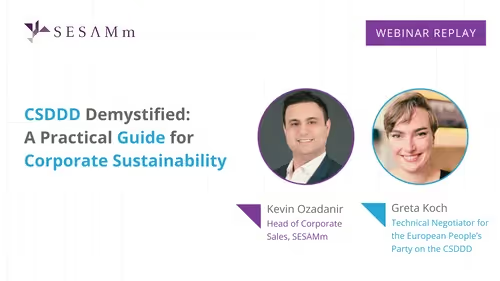
Watch the replay of our webinar, "CSDDD Demystified: A Practical Guide for Corporate Sustainability," to gain the actionable insights your business needs to navigate the complexities of the Corporate Sustainability Due Diligence Directive (CSDDD).
In this session, Kevin Ozadanir, Head of Corporate Sales at SESAMm, and Greta Koch, Technical Negotiator for the European People’s Party on the CSDDD, break down the directive's objectives and provide practical guidance for companies tackling compliance challenges. This is your opportunity to:
Understand the CSDDD's objectives and its role in strengthening the EU's sustainability agenda.
Learn how the directive compares to other regulations, such as the German Supply Chain Act, and what sets it apart.
Prepare for compliance by exploring strategies to integrate sustainable systems and address diverse regulatory expectations across the EU.
Get a blueprint for effective risk analysis and supply chain management tailored to companies operating across multiple jurisdictions.
Stay ahead of political developments, including the potential repeal of Germany's Supply Chain Act and what it means for global sustainability.
The webinar wraps up with a deep dive into integrating CSDDD with other frameworks, such as the EU Taxonomy and CSRD, and provides a clear roadmap for aligning your operations with evolving corporate sustainability standards.
Don't miss this chance to equip your team with the knowledge to tackle regulatory challenges with confidence. Fill out the form to access the webinar replay now!
Screen smarter. Act faster. Flag hidden risks at scale.
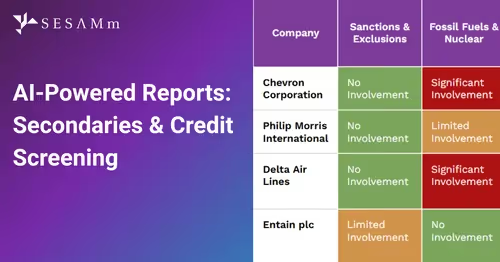
Speed and accuracy are critical in due diligence, especially when screening for reputational or compliance risks across large portfolios. That’s why we built SESAMm’s Secondaries & Credit Screening report: a faster, smarter way to assess exposure to restricted and controversial business activities.
How it works
Designed for investors, compliance teams, and financial institutions, this report uses SESAMm’s generative AI and large language models (LLMs) to analyze millions of documents and flag companies involved in sensitive sectors.
With just a list of company names, it highlights potential involvement in:
Fossil Fuels & Nuclear
Weapons & Military Equipment
Predatory Lending
Gambling & Betting
Adult & Violent Content
Severe Human Rights & Labor Violations
Tobacco, Alcohol & Recreational Drugs
Each result includes linked sources and a clear explanation, providing not just a flag but the context behind it.
Fast, Transparent, Scalable
Whether you're conducting secondary deal due diligence, reviewing a loanbook, or aligning portfolios with exclusion lists, this new report offers:
Scalable, fast batch screening: Upload a list of companies and get standardized, structured results in minutes.
Transparency: Each flag is backed by a justification and includes access to cited sources.
Faster decisions: Get standardized Excel outputs in minutes.
Deeper insight: Uncover risks that go beyond traditional industry classifications.
A New Standard for Risk Screening
Already in use by leading financial firms, the Secondaries & Credit Screening report brings clarity to complex decisions, helping teams flag risks earlier, faster, and more confidently.
Ready to Get Started?
Reach out to see a sample report or request a custom screening of your own list. With SESAMm’s Secondaries & Credit Screening, your next due diligence process just got faster and smarter.
The chemicals industry, often perceived as the backbone of modern economies, is undergoing a notable shift. With the world's focus now fixed on environmental, social, and governance (ESG) initiatives, this sector finds itself at the crossroads of risk and opportunity. In this “ESG Data Trends,” we dive deeper into the chemicals’ market ESG performance, studying the example of Ineos.
The chemicals industry: riding the ESG wave
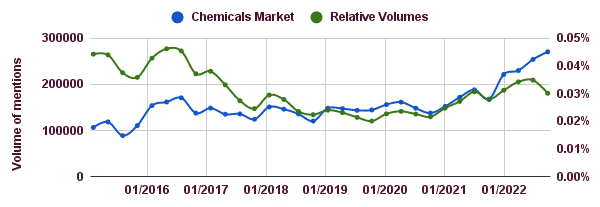
Post-2020, the chemical market has seen an increase in web mentions. Several factors—from gas shortages rattling this energy-intensive market to escalating environmental concerns—have ushered in a new era of sustainability discussions. But which chemicals are stealing the limelight? Chlorine, Ammonia, and Base Chemicals like Ethylene and Propylene account for over half of the chemical web mentions. And it's not just about their volume. The narrative is changing too. The industry is leaning towards eco-conscious production, championing innovations like recycled propylene, Renewable-Benzene, and Green ammonia.
Figure 1: Chemical market volume of mentions.
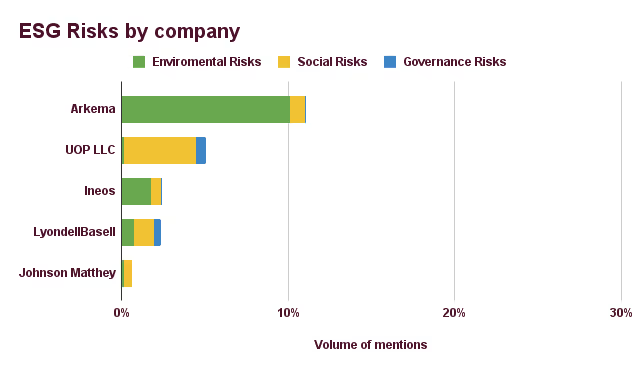
What's interesting about this is the emphasis on ESG initiatives over ESG risks. It's a clear signal that the industry is taking action toward sustainability and is making tangible strides. When looking at the industry’s ESG risks mentions, we found that Arkema has the highest percentage of ESG Risks driven mainly by environmental incidents and impact on biodiversity due to a chemical plant explosion in 2017, followed by UOP LLC, which displays the highest proportion of Social related risks as a consequence of layoffs.
Figure 2: ESG risks by company.
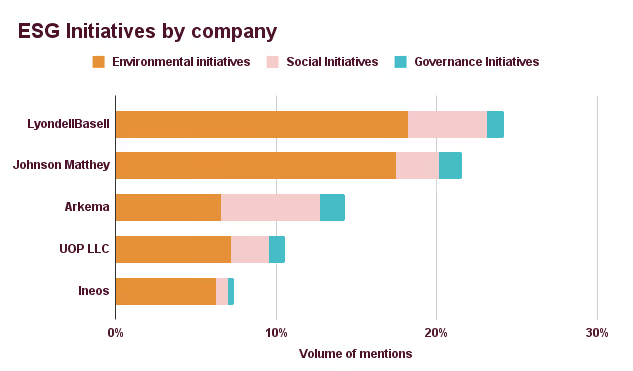
Conversely, across the industry, the volume of ESG initiatives indicates a significant commitment to sustainable related practices. Environmental-related practices are the most mentioned initiatives in the chemicals industry; precisely, two pillars stand out in ESG initiatives: climate change reduction and circular economy strategies. LyondellBasell displays the highest percentage of ESG initiatives mentions due to its climate change reduction and circular economy strategies, where the company is working towards greenhouse gas reductions and advancing plastic waste recycling. Despite having the highest environmental risk mentions, Arkema has the highest social-related initiatives with corporate social responsibility.
Figure 3: ESG initiatives by company.
Case study: Ineos
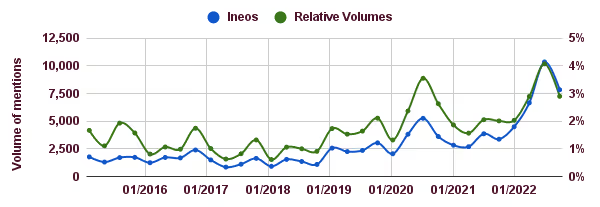
The TextReveal Dashboard detected another chemicals company with an increasing number of mentions, the British multinational Ineos. After the announcement of Ineos Grenadier's off-roader in 2020, the number of mentions more than doubled, increasing Ineos' overall volume. Later on, the company’s mentions have been relatively increasing after cooling down from the announcement, with a significant increase in 2022 following M&A and collaboration announcements, sustainability actions, and controversies around its CEO, Jim Ratcliffe.
Figure 4: Ineos volume of mentions and relative volumes.
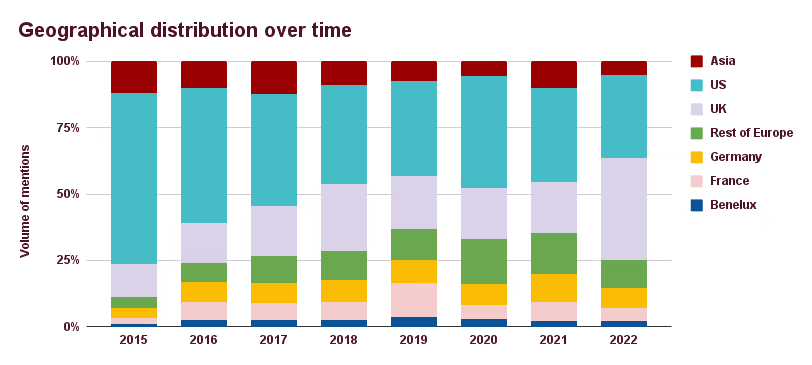
We also detected a geographical shift in mentions. Once dominant in the US, Ineos mentions dropped from 65% in 2015 to roughly 30% in 2022. Europe, on the other hand, has seen a spike from 25% to over 65%. Sentiment analysis offers another layer of insight.
Figure 5: Geographical distribution over time.
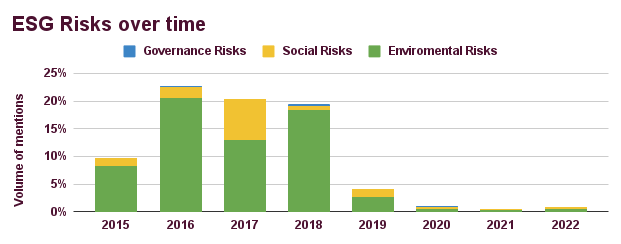
While the sentiment has largely remained steady, there have been dips, especially during periods associated with fracking controversies and environmental incidents, including a toxic chemical spill. Digging deeper into Ineos’ ESG risks, there has been a decrease over the recent years; nonetheless, before 2019, we captured a relatively higher number of risks, mainly environmental–related controversies, coming from mentions about overexploitation of resources, namely fracking. Social-related risks display a significant proportion of data driven by social dialogue controversies as we capture multiple mentions of protests, particularly in 2017.
Figure 6: Ineos ESG risks over time.
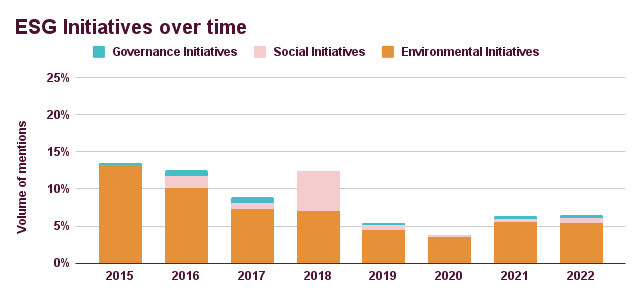
While Ineos ESG risks mentions represent 2.46% of its overall data share, its ESG initiatives mentions represent 5.91% of its web presence, signaling a more positive outlook for the firm, at least from a perception point of view. Furthermore, we detected that environmental–related initiatives are the main focus for Ineos, particularly climate change, while social initiatives arise, particularly in 2018, due to product safety mentions.
Figure 7: Ineos ESG initiatives over time.
Data sources
To produce this analysis, we combined natural language processing with billions of textual web data related to the chemicals market. Using NLP-powered models gives us an edge as we can extract ESG, SDG, and financial insights that aren’t necessarily obvious or easy to detect. These insights help investors make better investment decisions. SESAMm leverages artificial intelligence and machine learning technologies to help you decipher and understand timely sentiment, trends, and ESG metrics on a wide range of public and private companies.
Reach out to SESAMm
TextReveal's web data analysis of over five million public and private companies is essential for keeping tabs on ESG investment risks. To learn more about how you can analyze web data or request a demo, contact one of our representatives.
Stay ahead with the latest in ESG and AI intelligence
Join our mailing list to receive new reports, event invites, and updates from SESAMm directly to your inbox.







.png)