Ebook: The Boeing Scandal: Can AI Predict Controversies Before Traditional Tools?
September 26, 2024
•
5 mins read
Effectively managing environmental, social, and governance (ESG) risks is important, especially for private equity firms focusing on small or private companies. These firms often lack the detailed public data available for larger corporations, making it challenging to identify hidden ESG controversies that could impact investments. Traditional methods, heavily reliant on structured data and formal disclosures, often fall short when dealing with unstructured and fragmented information found in diverse sources like social media, local news, and niche industry reports. This is where Artificial Intelligence (AI) comes into play.
Our ebook, "The Boeing Scandal: Can AI Predict Controversies Before Traditional Tools?," explores the transformative role AI can play in enhancing ESG risk assessment processes. It explores the limitations of conventional methods and demonstrates how AI technologies, such as natural language processing (NLP) and machine learning, offer a more effective solution for identifying ESG risks. By analyzing vast amounts of unstructured data from various sources, AI gives firms access to the early detection of potential controversies, providing a more comprehensive and proactive approach to risk management.
A key highlight of the ebook is a detailed case study on Boeing, a major player in the aerospace industry. Through AI-driven analysis, we identified early signs of emerging controversies surrounding Boeing's safety practices and governance issues. The case study illustrates how AI can sift through complex data, uncover hidden patterns, and provide early warnings that allow stakeholders to act before these issues escalate into major crises.
The ebook outlines a step-by-step AI-driven process for ESG risk detection, from data collection and filtering to advanced sentiment analysis and actionable insights. This comprehensive guide empowers private equity firms to move beyond reactive strategies and adopt a proactive stance in ESG risk management.
Reach out to SESAMm
TextReveal’s web data analysis of over five million public and private companies is essential for keeping tabs on ESG investment risks. To learn more about how you can analyze web data or to request a demo, reach out to one of our representatives.
Welcome to the latest article in our ESG Data Trends series. Today, we're turning our attention to the growing bike industry, specifically spotlighting Italy's Pinarello. Our aim is to illustrate how health-conscious and ecological trends, increased by the pandemic, have steered the world towards bicycles for both commuting and exercise. Pinarello, as well as many of its competitors, are private companies, which poses a particular challenge to analyze them in depth as the amount of data available is particularly sparse and harder to find. However, with the help of AI tools, this task becomes not only possible but also highly automated.
Bike Industry Trends: A General Overview
Long–term Momentum: Online mentions related to the bicycle market have exhibited a consistent upward trend since 2015, peaking in the last three years in the wake of COVID-19.
Figure 1: Bike market volume of mentions over time.
Government Initiatives: Notably, a spike in government investment in cycling infrastructure has paralleled the pandemic-induced behavioral changes.
Figure 2: Bike commuting VS. government focus on cycling infrastructure over time.
Type-specific Popularity: Among the various segments, E-bikes dominate online mentions, followed by mountain bikes and road bikes.
Figure 3: Bike market breakdown by type over time.
Digital Ecosystem: The digital facet of the trend reveals that sports data apps, especially those focusing on performance tracking, have gained considerable traction.
Figure 4: Sports data apps and their use mentions over time.
E-bikes: Riding the High Wave
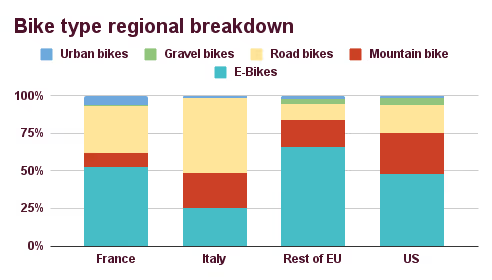
E-bikes have captivated attention across the board. They are now deemed a convenient solution to commuting, more so after the pandemic. Geographically, Europe outperforms the US in E-bike mentions, with France leading the charge on urban bikes. Italy, on the other hand, showcases a stronger inclination towards road bikes.
Figure 5: Bike type regional breakdown.
The Pandemic Effect on Road Bikes
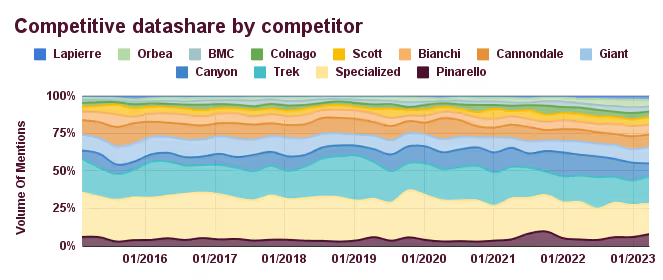
The road bike segment witnessed an unprecedented surge in mid-2020, corresponding with pandemic lockdowns. Major players like Specialized, Trek, and Canyon lead in online mentions, but Pinarello holds its ground with a stable and slightly growing competitive share.
Figure 6: Road bike market data share by competitor over time.
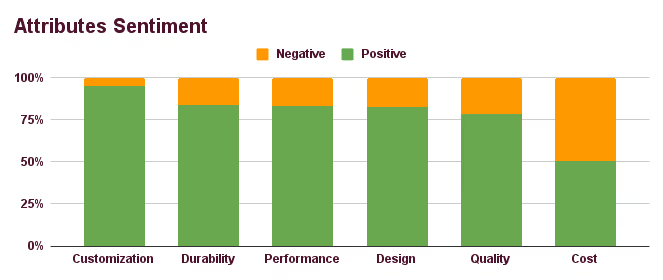
Consumer Preferences: Performance and quality emerge as the dominant positive attributes, whereas cost remains the primary consumer concern.
Attribute Sentiment: When analyzed based on sentiment, customization, and performance, score the highest, whereas cost ranks the lowest due to consumer complaints.
Figure 7: Road bike market attributes sentiment.
Case Study: Pinarello
Online Reputation Insights
The volume of online mentions for Pinarello has seen a steady climb, particularly after 2021. Quality and performance have risen as positive attributes, while cost remains a predominant negative sentiment, inflamed further by recent discussions about the brand's pricing strategy.
Figure 8: Pinarello attributes sentiment.
ESG Analysis of Pinarello and the Bike Industry
Low-risk ESG Profile: In general, the bike industry fares well in ESG evaluations. The risks usually center around social and governance aspects.
Social Risks: These primarily relate to product safety, with several recalls from various companies, including Specialized and Trek.
Governance Risks: Pinarello has faced patent infringement claims, while other brands like Giant have been accused of fraudulent behavior.
ESG Positive Impact Initiatives
The industry, by and large, is aligned with environmental sustainability goals. Trek stands out for its environmental initiatives and social opportunities, while Canyon demonstrates advances mainly in the environmental management of the supply chain.
As for Pinarello, the brand has undertaken ESG-positive initiatives, notably in environmental and social spheres. Product innovations like the Nytro E e-bike and high-performance 3D printed bikes signify their commitment to sustainable technology. Moreover, their partnerships and sponsorships aim to uplift local communities.
Navigating ESG Goals in the Bike Market
The bike market, led by brands like Pinarello, demonstrates significant strides in alignment with ESG goals. For private equity firms and asset managers, the value lies not just in financial returns but also in understanding ESG risks and opportunities that could influence long-term sustainability and risk mitigation.
How can SESAMm help you track ESG performance using AI?
We combined natural language processing with billions of textual web data related to the bike market to produce this analysis. Using NLP-powered models gives us an edge as we can extract ESG, SDG, and financial insights that aren’t necessarily obvious or easy to detect. These insights help investors make better investment decisions. SESAMm leverages AI and machine learning technologies to help you decipher and understand timely sentiment, trends, and ESG metrics on public and private companies to assist organizations in risk mitigation and profit generation strategies.
Reach out to SESAMm
TextReveal's web data analysis of over five million public and private companies is essential for keeping tabs on ESG investment risks. To learn more about how you can analyze web data or request a demo, contact one of our representatives.
The ESG landscape for U.S. private equity firms is increasingly defined by systemic governance pressure and rising social and environmental scrutiny. Governance issues at firms such as Blackstone, KKR, Thoma Bravo, TPG, and Francisco Partners primarily focus on deal processes, disclosure practices, and investor protection. These concerns encompass settlements related to pension mismanagement, actions taken by the Department of Justice regarding pre-merger filings, as well as lawsuits and shareholder investigations examining the fairness of take-private transactions and stock buybacks. On the social side, exposure is driven largely by portfolio companies and political positioning. Housing and tenant-rights disputes sit alongside allegations of labor abuses, child labor, and unsafe conditions. Environmental concerns are increasingly prominent, with major companies facing criticism for their exposure to fossil fuels, their impact on climate change, and associated lobbying efforts.
What are the most pressing ESG challenges currently facing the U.S. private equity firms? Read on to find out.
Blackstone: Governance Pressure, Social Backlash, and Climate Criticism
Blackstone is facing a wide range of ESG controversies. Governance challenges include a $227.5 million settlement related to Kentucky pension mismanagement, a $590 million lawsuit involving SPAC Recovery Co. that alleges a fraudulent scheme, and SEC fines tied to off-channel communications failures. On the social front, the firm has drawn criticism for political spending that heavily favors right-leaning candidates, child-labor incidents, and recurring safety violations at portfolio companies. Housing-related concerns also persist, with tenant protests over rent and eviction practices and university movements calling for divestment from Blackstone-linked real estate funds. Environmentally, Blackstone continues to be targeted by climate activists for its fossil fuel exposure and its perceived contribution to escalating climate risks.
TextReveal’s web data analysis of over five million public and private companies is essential for keeping tabs on ESG investment risks. To learn more about how you can analyze web data or to request a demo, reach out to one of our representatives.
Paris, France – 24 février 2026 – SESAMm, leader mondial des données de controverses ESG et réputationnelles, annonce le renouvellement de son partenariat avec le Crédit Mutuel Arkéa, initié en janvier 2023, pour le renforcement de l’évaluation et du suivi des risques ESG au sein de ses activités d’achats et d’investissement.
Depuis le début de cette collaboration, Crédit Mutuel Arkéa s’appuie sur la plateforme SESAMm pour analyser les risques environnementaux, sociaux et de gouvernance liés à ses fournisseurs, partenaires et participations. Grâce à des données de controverses ESG fondées sur l’intelligence artificielle, il est possible d’identifier notamment les manquements réglementaires, incidents environnementaux, risques sociaux, atteintes aux droits humains, cas de corruption et autres risques réputationnels.
Dans le cadre de ce partenariat renouvelé, SESAMm poursuit cet accompagnement, à la fois lors des appels d’offres et dans le suivi continu des tiers, ainsi que pour l’analyse des dossiers d’investissement et la surveillance quotidienne du portefeuille, complétées par des synthèses hebdomadaires des controverses ESG.
Ce renouvellement de confiance confirme la valeur ajoutée des analyses de SESAMm pour renforcer la cohérence, la réactivité et la robustesse des processus de due diligence et de gestion des risques ESG du Crédit Mutuel Arkéa.
Stay ahead with the latest in ESG and AI intelligence
Join our mailing list to receive new reports, event invites, and updates from SESAMm directly to your inbox.

-converted-from-svg.avif)










.png)